线性空间的立体化重塑与复合功能植入:该项目巧妙地将一个狭长、原为铁路支线的“剩余空间”转化为一个多层级的复合型社区公园。通过抬高首层(1.4米)和设置离地3.8米的高线步道,设计成功地在有限的宽度内实现了空间的三倍延展,极大地丰富了步行体验和功能复合度。这种立体化的空间策略,不仅成功地嵌入了文化休闲、艺术展示、运动娱乐等多种功能,也有效应对了基地受地铁及周边楼距限制的场地约束,展现了高超的场地适应性和空间魔术。
场地文脉的深刻挖掘与记忆的结构化表达:设计紧密围绕曹杨新村作为新中国第一个工人新村的历史文脉展开,尤其对场地原有的铁路用途进行了诗意的转译。通过连续设置的轻质拱棚结构,不仅呼应了“铁路月台”的场景记忆,还利用其重复的形态和变化的多彩(五种颜色)实现了对公园不同功能区(如分区定位)的有效导视和边界划分。这种将历史记忆转化为清晰、可感的设计语汇(拱棚的遮阳而非遮雨设计)的方式,体现了设计对场所精神的尊重与创新。
高强度的实施效率与社区尺度的细致回应:项目在不到一年的时间内完成了从概念到落成的全过程,体现了设计、协调和施工的高效整合能力。更值得称赞的是,设计高度重视与周边十一个社区及公共机构的边界对话与协商。通过提供多种墙体和门禁组合方案(实墙、通透钢构等),设计尊重了社区的个性化需求,实现了公园边界的“协商式”生成,最终形成了既能连接共享,又能尊重隐私和边界的有机界面,展现了以人为本的社区更新理念。
The gallery bridge and the entrance to the south basement © Zhu Runzi
廊桥与南段地下室入口 © 朱润资
Aerial view of the north entrance at Caoyang road © Zhu Runzi
北段曹杨路入口鸟瞰 © 朱润资
Overall Concept and Objectives: The site, nearly one kilometer long with a width ranging from 10 to 15 meters, was formerly a branch of the Zhenru Freight Railway, later converted into the Caoyang Railway Farmers Market. After the market closed in 2019, this space was replanned and constructed in less than a year into a brand-new, multi-layered, composite pedestrian experiential community park green space. Caoyang BaiXi Park integrates art into the life of the Caoyang community through the concept of the "3K" corridor, responding multi-dimensionally to the 2021 Shanghai Urban Space Art Season. By excavating the site's context and constructing spatial scenarios, the design reshapes the street green network, forming a north-south continuous pedestrian link akin to a "long vine bearing fruit," further expanding the organic renewal of the Caoyang community. As former railway land and subsequently a farmers market for over 20 years, this unique linear space is a typical leftover space in a megacity. Upon first seeing the site, we realized that even in a familiar city, there are unexpected, surprise-filled marginal spaces, and how to reuse such spaces is a necessary consideration as urbanization enters a stage of existing stock optimization.
整体概念与目标:
基地长近一公里,宽度介于10米至15米之间,前身为真如货运铁路支线,后改为曹杨铁路农贸综合市场,2019年市场关停后这个空间在不到一年的时间被重新规划建设为一个全新的、多层级、复合型步行体验式社区公园绿地。曹杨百禧公园以“3K”通廊为概念将艺术融入曹杨社区生活,以从多维度回应2021年上海城市空间艺术季。设计通过挖掘场地文脉、建构空间场景,得以重塑街道绿网、形成“长藤结瓜”般的南北贯穿的步行纽带,进一步拓展曹杨社区的有机更新。作为曾经的铁路用地和随后20多年农贸市场,这个特殊的线性空间属于超大城市里的典型剩余空间。当看到场地的一刹那,我们意识到在熟悉的城市中,仍有出乎意料的、蕴藏着惊喜的边角料空间,而如何再利用这类空间是城市化进程进入存量时代的必经思考。
Night view of the north entrance at Caoyang road © Zhu Runzi
北段曹杨路入口夜景 © 朱润资
Exploded axonometric drawing
爆炸轴测图
Background and Opportunity: As the first planned and constructed workers' new village after the founding of New China, the base area of Caoyang New Village represents the collective memory and historical process of an era. The market ran north-south along the abandoned railway, adjacent to the workers' community. To improve the living standards and spatial quality of the area, the district government and sub-district office defined the site's goal as an urban park to provide daily cultural and leisure activities for residents in the future. The initial version of the scheme was completed in just two days, and the plan was adjusted and finalized in less than two weeks. Subsequently, design adjustments and deepening proceeded simultaneously with coordinated construction excavation under the coordination of various departments. After the foundation was segmented and completed, prefabricated steel structures gradually entered the site. Within a period of less than one year, the project went from conceptual design to final completion and operation.
背景与机缘:
作为新中国成立后的第一个规划建设的工人新村,基地所处的曹杨新村代表了一个时代的集体记忆和历史进程。市场沿废弃铁路南北贯穿于紧邻的工人社区,区政府及其街道办为提升区域生活水平与空间品质,将该地目标定义为未来提供居民日常文化休闲活动的城市公园。项目伊始仅以两天完成首版方案,以不足两周时间调整、敲定方案。此后设计调整与深化协同施工开挖等工作在各个部门协调下同步推进,基础分段完工后预制钢构逐步进场,在不到一年的时间周期中从概念方案设计到最终落成投入使用。
North entrance Caoyang urban living room
北段入口曹杨客厅
Lanxi road overpass
兰溪路过街云桥
South circle corridor
南段环形廊桥
Design Strategy and Scenarios: The narrow site was given three times the spatial extension through three-dimensional design methods, becoming an extended boundary for leisure activities for different user groups from nearby residential areas, schools, and commercial offices at different times. Due to subway and surrounding building distance restrictions, the excavation depth of the semi-underground level was limited to 1 meter; the ground floor was raised by 1.4 meters, reserving some ground-level space as a community "storage container" to provide temporary functions such as art exhibitions, community events, and cultural and creative markets; on the other hand, to avoid disturbing the surrounding residential buildings with the public space, the elevated walkway running north-south was limited to a height of 3.8 meters above the ground.
设计策略与场景:
狭窄的场地通过立体的设计手段被赋予3倍的空间延展,成为附近住宅区、学校、商业办公等不同使用人群在不同时段下休闲活动的边界拓展。由于地铁以及周边楼距限制,半地下层的开挖限度被控制在1米;首层向上抬高1.4米,预留出部分底层空间作为社区“收纳器”提供如艺术展览、社区活动、文创集市等临时性功能;另一方面,为了不造成公共空间对周边小区居民楼的干扰,南北贯通的高线步道被限定在离地3.8米的高度。
Urban living room at Caoyang road © Zhu Runzi
北段入口曹杨客厅 © 朱润资
North playground and the Art wall © Zhu Runzi
北段篮球活动空间与艺术墙 © 朱润资
Open space of north semi-underground © Zhu Runzi
北段底层开敞空间 © 朱润资
The 880-meter-long landscape corridor is divided into north and south wings, aggregating 10 sets of scenarios to meet public services such as gathering, activity, entertainment, leisure, and sports. The elevated corridor extends from the core to the north and south, connecting community vitality and forming multi-dimensional three-dimensional spaces that are non-interfering yet intersecting and conversational. The northern entrance, serving as an urban living room facing Caoyang, incorporates the podiums of Lian Nong Building and Zhong Qiao Building on the left and right sides into the design update, creating a two-level entrance plaza integrating the ground and the sky bridge, which allows walking and long-distance viewing. The mid-section pedestrian overpass crossing the city road integrates the walking experience of the park on both sides of Lanxi Road, allowing street life, bustling traffic, and pedestrians to form part of the park's scenery. The southern end connects the straight sky bridges on the left and right with a circular corridor bridge. In front of and behind the bridge, a hackberry tree passes through the gap of the sky bridge; as they grow, their branches and leaves intertwine, allowing passersby to touch the foliage. We hope to increase greenery as much as possible, planting trees, grass, and flowers wherever possible, so that this entire space has greenery alongside the steel structure.
全长880米的景观长廊划分为南北两翼,聚合10组场景以满足聚集、活动、娱乐、休闲、运动等公共服务。立体长廊从核心向南北延展,串联社区活力,形成互不干扰又交错对话的多维立体空间。北端入口作为面向曹杨的城市客厅,将左右两侧的联农大厦、中桥大楼裙房纳入设计更新范围,使之围合地面与云桥形成高低两层的入口广场,可行进、可远眺。中段跨越城市道路的双流线过街天桥整合了兰溪路两侧公园的步行体验,使得街道上的生活、熙熙攘攘的车流与行人共同组成了公园场景的一部分。而南端以环形廊桥连接了左右的直线云桥,前后各有一颗朴树穿过云桥空隙,随着生长茎叶相互缠绕,行经其中可碰触枝叶。我们希望尽可能地增加一些绿化,见缝插针地去种一些树,一些草,一些花,让这个整个空间除了钢铁, 也有绿意。
Aerial view of the love bridge © Zhu Runzi
七夕廊桥鸟瞰 © 朱润资
Love bridge structure © Zhu Runzi
七夕廊桥结构 © 朱润资
ALYA's three relatively important linear public spaces—Aite Park along the Wusong River, the connection at Pudong Minsheng Wharf, and the connection along Yangpu Riverside—the latter two were exhibition venues for the 2017 and 2019 Shanghai Urban Space Art Season (SUSAS). The design of Caoyang BaiXi Park summarizes the experience of our previous projects, but it differs from the unique scenes along the river. Its environment is precisely a typical community site filled with human vitality yet easily overlooked—a non-typical leftover space. How to find new potential and energy in these leftover spaces is an important inspiration for our next phase of work and research.
ALYA的三个比较重要的线型的公共空间——吴淞江边上的爱特公园、浦东民生码头贯通、杨浦滨江贯通,后两个也分别是2017年和2019年上海城市空间艺术季SUSAS的展场。曹杨百禧公园的设计总结了我们过往几个项目的经验, 但它有别于一江一河的独特场景,它所处的环境恰恰是一个如此有烟火气,又如此容易被忽略的的典型社区场地中的非典型剩余空间。如何能够在这些剩余空间中找到新的潜力与能量,是我们下阶段工作与研究的重要启示。
Lanxi road overpass © Zhu Runzi
兰溪路跨街天桥 © 朱润资
Landscape space under the bridge of South part © Zhu Runzi
南段桥下景观空间 © 朱润资
Activity space under the Shatian Platform © Zhu Runzi
沙田月台下活动空间 © 朱润资
Color Selection: We spent a long time choosing the colors; it was not clear from the beginning. The main tone was naturally desired to be gentle and unobtrusive, but if it were just gray or silver, it wouldn't express the vitality of the community. We prototyped ten color matching schemes. Ultimately, we chose silver as the main tone for the steel structure of the sky bridge, with orange sprayed on the inner side, hoping to show vigor through color contrast. Spaces below the 1.4-meter mark had different considerations. The objective conditions of the semi-underground space are narrow and dim; how to harmonize the dark space with the bright space above ground? We chose a different color scheme from the sky bridge: the steel structure of the semi-basement ceiling is mainly silver-white, sprayed with yellow on the inner side. This silver-white is a pearl white with a larger proportion of silver powder, different from the gray above ground. We judged that the experiential quality of the semi-underground space is more important than color uniformity. This might be a decision most architects wouldn't make and a challenge not encountered in previous projects, breaking a bit of conventional thinking.
色彩选择:
我们花费了很长时间选择颜色,并非一开始就想清楚的。主基调上当然希望是一个比较温和、不突兀的颜色,但如果只是灰色或银色,则表达不出社区的活力。我们打样了十种颜色配比方案。最终选择了在云桥钢结构主体为银色的基调下,内侧喷涂橙色,希望通过颜色的对撞展现朝气。1.4米标高以下的空间则有不同考虑。半地下空间的客观条件是狭窄、暗淡的,如何让暗的空间与地面之上亮的空间相协调?我们选择了与云桥不同的色彩方案:半地下室顶板的钢构以银白色为主,内侧喷涂黄色。这种银白色是一种珍珠白,银粉比例较大,与地面以上的银灰色不同。我们判断半地下空间体验感的重要性高于颜色的统一性,这可能是大部分建筑师都不会做的决定,也是之前的项目没有遇到过的挑战、突破了一点常规的思维。
South semi-underground entrance and the BOTTLE space © Zhu Runzi
南段半地下室入口及宝特瓶 © 朱润资
The Arch Canopy—Memory of the Railway Platform: The design consciously created a series of continuous light-weight arch canopy structures in the park, covered with shading membranes. The choice of shading over rain protection was based on two points: first, in a linear open park, feeling nature is important; second, from a technical perspective, using a rainproof membrane would require bearing greater wind loads, making it impossible to highlight the tensile contrast between the lightness of the sky bridge and the heaviness of the canopy structurally. The formal significance of the arch canopy is to evoke memories of the railway—the scene of green trains slowly entering the platform. Platforms come in many forms, so we chose the simplest arch shape for different connections and also selected five different colors. Because the style is repetitive and the color changes, the arch canopy serves to divide the entire park—a blue one at one end, then a pink one further on—allowing people to simply locate themselves via color.
拱棚——铁路月台的记忆:
设计上有意识地在公园里创造了一系列连续的轻质拱棚架构,覆以遮阳膜。遮阳而非遮雨出于两点考虑:一是在线性的开放公园内重要的是感受自然;二是技术层面的考虑,一旦选用遮雨的膜,就需要承受更多风荷载,无法在建造层面上凸显云桥与拱棚的轻与重的张力对比。拱棚形式上的意义是勾起我们这种对铁路的记忆——曾经绿皮火车徐徐入月台的场景。月台有很多种形式,我们就选择一个最简单的拱形做不同的串联,也选择了五种不同颜色。因为样式是重复的、颜色是变化的,于是拱棚有了给整个公园分区的意义——在端头是一个蓝色,再往前有一个粉色——通过颜色可以简单地定位人的位置。
Stairs and Corridor Canopy
楼梯与廊道顶棚
Corridor on the outdoor stage © Zhu Runzi
心连心舞台拱廊 © 朱润资
End of the south part covered within the nature © Zhu Runzi
自然植物掩映下的南段尽端 © 朱润资
Walls as Boundaries and Connections—Dialogue with the Community and Public Institutions: Our design team engaged in serious dialogue, discussion, and consultation with the sub-district office and every community. There are eleven residential communities and several public institutions surrounding BaiXi Park. Establishing boundaries between the park and communities or institutions requires multi-party dialogue. Through communication, we learned about their needs, mutual difficulties, and limits, ultimately forming good connections. During the design process for the BaiXi Park enclosure, we generated no fewer than ten types of wall and gate combinations. These included solid walls with washed stone finishes, steel structure walls that allow visual exchange to varying degrees, and combinations of both. We hoped to respect the community's wishes with different types of walls and gates, jointly designing the connection and boundary between the park and the community through discussions and negotiations with residents. Some communities chose solid walls and no openings, while others chose transparent steel structure walls, hoping the park's greenery could also permeate into the community. Thus, as you walk along BaiXi Park, you can observe the changes in the enclosure.
作为边界与连接的围墙——与社区和公共机构对话:
我们的设计团队同街道办一起与每一个社区都有认真地对话、探讨、磋商。百禧公园周边共有十一个居民社区,还有若干个公共机构。建设公园与社区或机构的边界其实需要多方的对话,通过沟通得知对方的需求、彼此的困难与界限,最终形成良好的连接。在百禧公园围墙方案的设计过程中,我们产生了不下十种墙与门的组合类型。其中有水洗石饰面的实墙,有在不同程度上允许视线交流的钢构围墙,也有两者的结合。我们希望以不同类型的墙与门来尊重社区的意愿,通过与居民讨论、协商共同设计公园与社区的连接与边界。有的社区选择实墙、选择不开门,另一些选择通透的钢构围墙,希望公园的绿色也能渗透到社区里来。所以顺着百禧公园一路走过去能观察到围墙的变化。
Heart to Heart Stage
心连心舞台
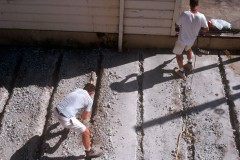
Construction process of the South Shatian Platform
南段沙田月台建造过程
Construction process of the North BOTTLE Space tri-linear connection
北段宝特瓶三线性连接建造过程
Construction process of the North Multifunction Playground
北段多功能活动场地建造过程