围合到无界:社区公园的全面开放与全时激活:项目核心在于将原本封闭管理的“田林中心绿地”彻底开放,打破了300米半径内近两万居民单一出入口的局限,实现了公园与社区的无缝连接。这一“破而后立”的策略不仅提升了公共服务效率,解决了东侧居民因距离远而无法进入的问题,更确立了公园全天候、无边界的社区生活枢纽定位。设计在尊重现有浓密乔木资源的基础上,关注全龄段、全时段的使用需求,旨在将更新后的公园塑造为具有在地性特征和完整空间结构的都市生境,是城市更新中从功能性修复到生活方式激活的重要范例。
以形构形:环形结构下的活力生态交织:针对场地“林多田少”的现状和居民对全龄活动空间的需求,设计巧妙地采用了“以形构形”策略,基于现有圆形和弧线型路网,构建了“圆形草坪+圆环形主路径+环形布局活动场地”的基础格局。这种策略在最大化保护珍贵大树林荫的前提下,高效地组织了公园空间。环形结构不仅顺应了场地肌理,更通过分层的设计——中心开敞草坪、核心“梦田廊”休憩综合体、以及外围环绕的慢跑道与健身活动区——有机地融合了休憩、运动、亲子等多元功能,形成了掩映于自然绿色中的活力景观,实现了生态保护与社区活力的有机统一。
环境再生产:系统化的雨水花园与生境营造:项目深度挖掘了公园的自然潜力,将保护现有林地资源提升为“环境再生产”的核心。通过将公园路沿设计为100%开放式,并结合地形梳理出下凹绿地系统,构建了分型的“雨水花园”系统,包括自然生境式、艺术地景式和水源地式。这种系统化的设计不仅强化了公园的碳汇功能,更通过植入观果、芳香、药用植物微生境,并利用回收材料制作“昆虫旅馆”、“本杰士堆”,将科普内涵和生态感知融入到日常游赏体验中,实现了从单一绿地到多功能、可感知的都市生态系统的升级。
1. Breaking Down and Building Up: A Boundaryless Park for All Weather
Tianlin Park, initially built in 1999 as the enclosed "Tianlin Central Green Space," saw that residents within a 300-meter radius (from Yishan Road in the north to Tianlin East Road in the south, Qinzhou Road in the east, and Liuzhou Road in the west) had only one small entrance in the southwest corner. This not only severed the park's connection with residents' lives and reduced the efficiency of public service but also caused residents on the east side to forgo recreational opportunities due to the long travel time. This made the renovation and renewal of Tianlin Central Green Space, by completely opening its perimeter walls towards a truly open and boundaryless community park, a vital necessity for green living.
田林公园始建于 1999 年,在更新前是封闭管理的“田林中心绿地”,绿地周边 300 米半径内(北至宜山路、南至田林东路、东至钦州路、西至柳州路)近 2 万居民仅能从西南角的一个较小的入口进入,这不仅使公园绿地与市民生活关系割裂、公共物品服务效率较低,更直接导致东侧居民因交通时距较远而放弃日常进入绿地的游憩机会。这使得将田林中心绿地围墙彻底打开,走向真正开放无界的社区公园的改造更新成为绿色生活的刚需。
© CreatAR Images
© CreatAR Images
For this crucial project concerning surrounding residents, VIA began research, planning, and design in the summer of 2021, finalizing a stable renewal design plan through review and community feedback hearings by the end of 2021. Building upon the removal of the east and west perimeter walls to integrate the park's greenery into the neighborhood fabric, enhance public accessibility, and achieve the goal of 24-hour opening, the plan further focuses on responding to the needs of users across all ages and times, protecting and utilizing existing mature trees and green resources, and accommodating community and resident culture. The aim is to create a renewed Tianlin Park that functions as an all-weather urban habitat with local characteristics and a complete spatial structure.
针对这一周边居民关心的重要项目,VIA 于 2021 年夏天开始着手研究、策划、设计,并于 2021 年底通过评审与社区居民意见听证会形成了稳定的更新设计方案。方案在去除东西两侧围墙将公园绿色融入街区、增强公共性、达成 24 小时开放目标的基础上,更关注全龄段与全时段的使用者需求的响应、现状乔木与绿色资源的保护与利用、社区与居民文化的承载,试图将更新后的田林公园营造为具有在地性特征与完整空间结构的全天候都市生境。
© CreatAR Images
© CreatAR Images
2. Shaping by Form: A Vital Habitat Constructed in a Ring
In terms of scale and location, Tianlin Park is defined as a "community park" [1]. Our site research summarized the existing spatial characteristics as having "many forests (dense mature trees) but no fields (diverse recreational activity areas)." Simultaneously, surrounding residents expressed strong demand for all-ages use, healthy activity spaces, and resting facilities within the park, while the dense mature trees, grown for over 20 years, severely restricted the expansion of recreational areas. To preserve the mature trees in their original positions as much as possible and protect the park's most important green ecological resources, we decided to organize and sort the overall park spatial structure based on the existing circular and arc-shaped road network, the existing site, and the under-canopy spaces that do not affect the growth of large trees. We adopted the design strategy of "shaping by form" [2] to create a fundamental spatial pattern in the core area: a "circular lawn + circular main path + ring-layout activity areas."
在规模和区位上,田林公园被定义为“社区公园”[1] ,而我们的现场调研则给出了有“‘林(浓密的现状大树)’无‘田(多样的游憩活动场所)’”的现状基础空间特征总结。同时,周边居民也对公园中的全龄使用、健康活动空间和休憩设施等内容提出的强烈的需求,而现场经 20 余年生长的浓密大树则极大地限制了游憩活动场地的拓展。为尽可能原位保留大树、保护公园中最重要的绿色生态资源,我们决定基于现状的圆形和弧线型路网、既有的场地、不影响乔木生长的林下空间来组织与梳理整体公园空间结构,采用“以形构形” [2] 的设计策略在公园核心区域形成了“圆形草坪+圆环形主路径+环形布局的活动场地”的基础空间格局。
© CreatAR Images
© CreatAR Images
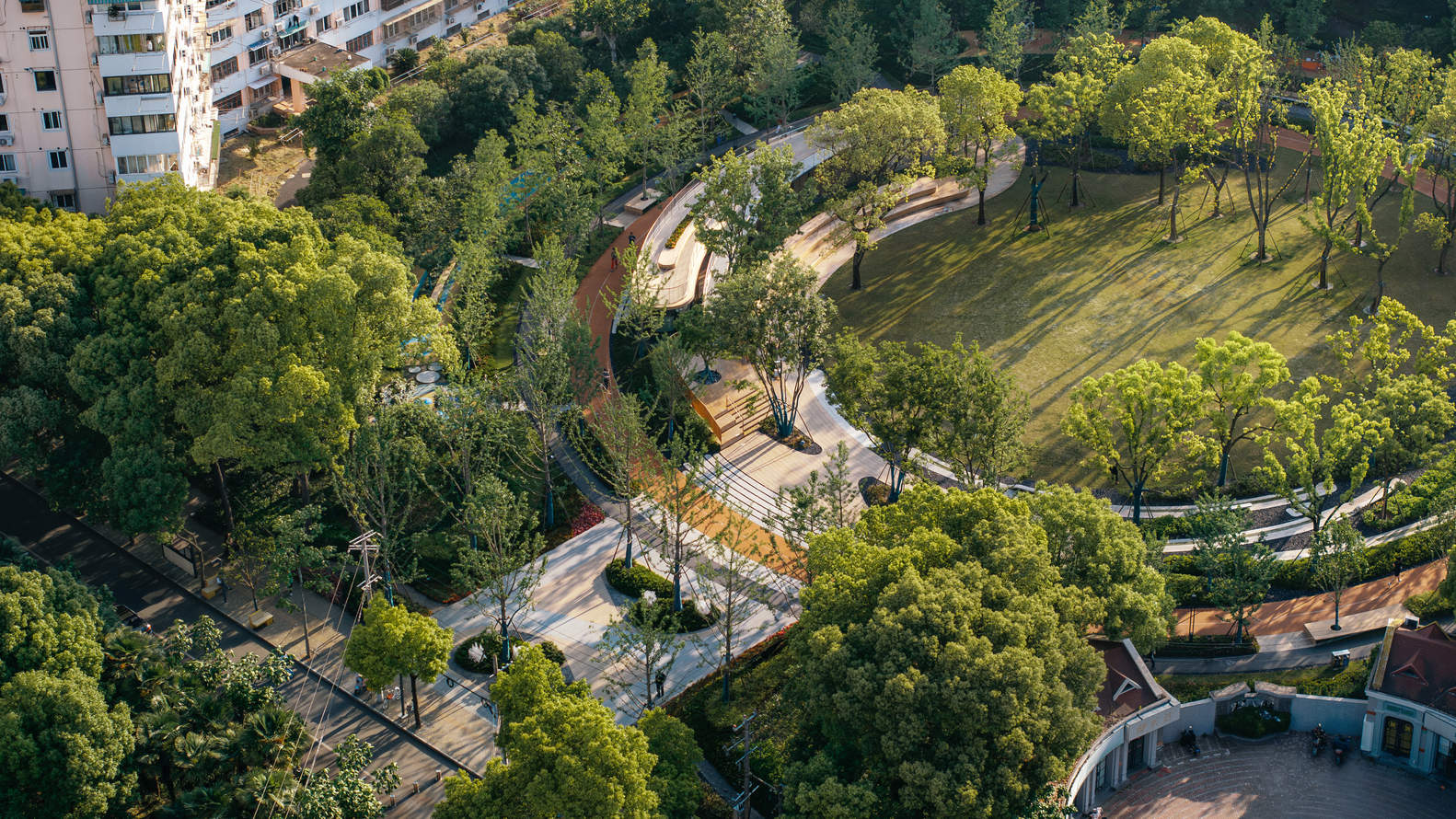
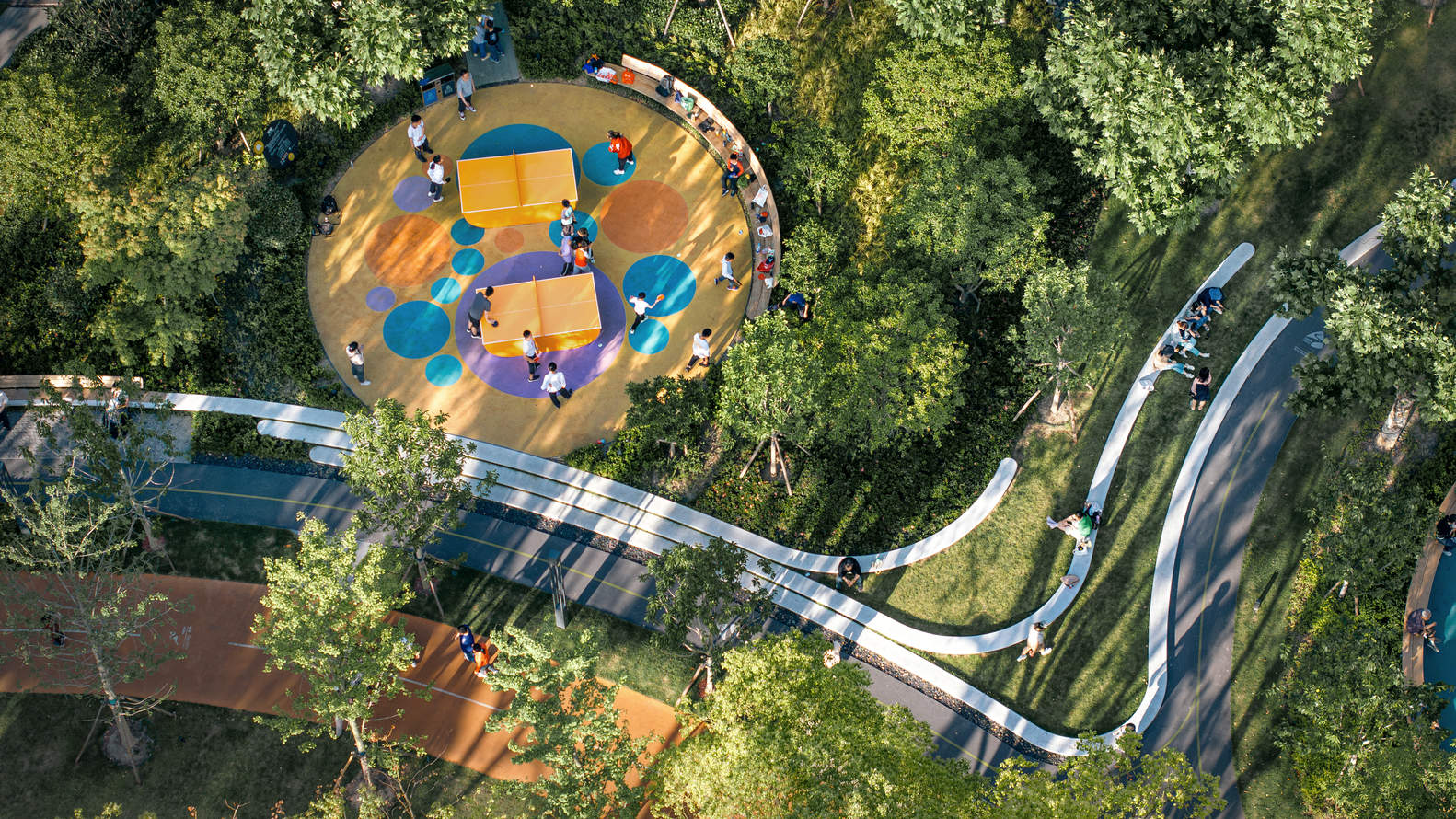
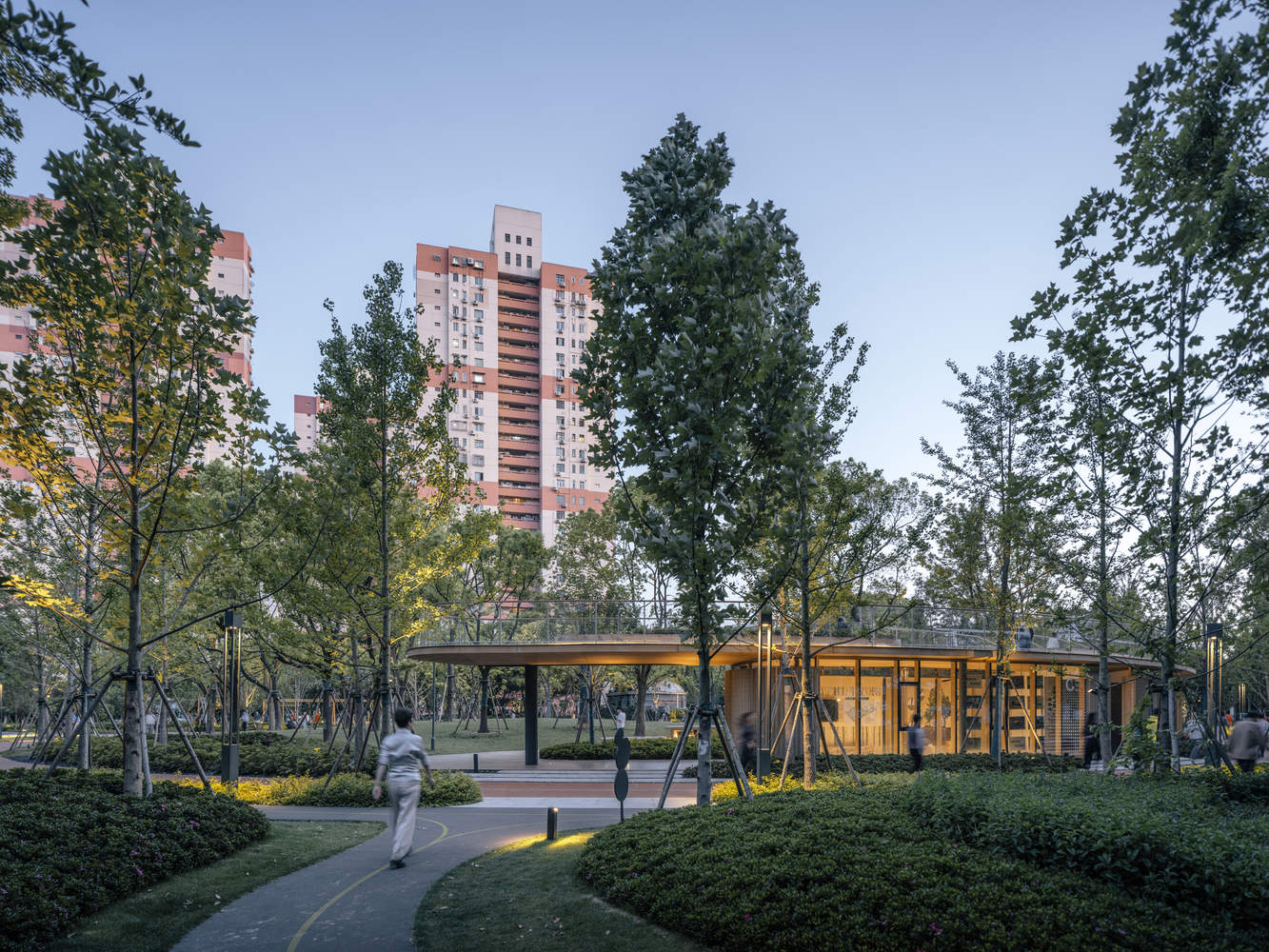
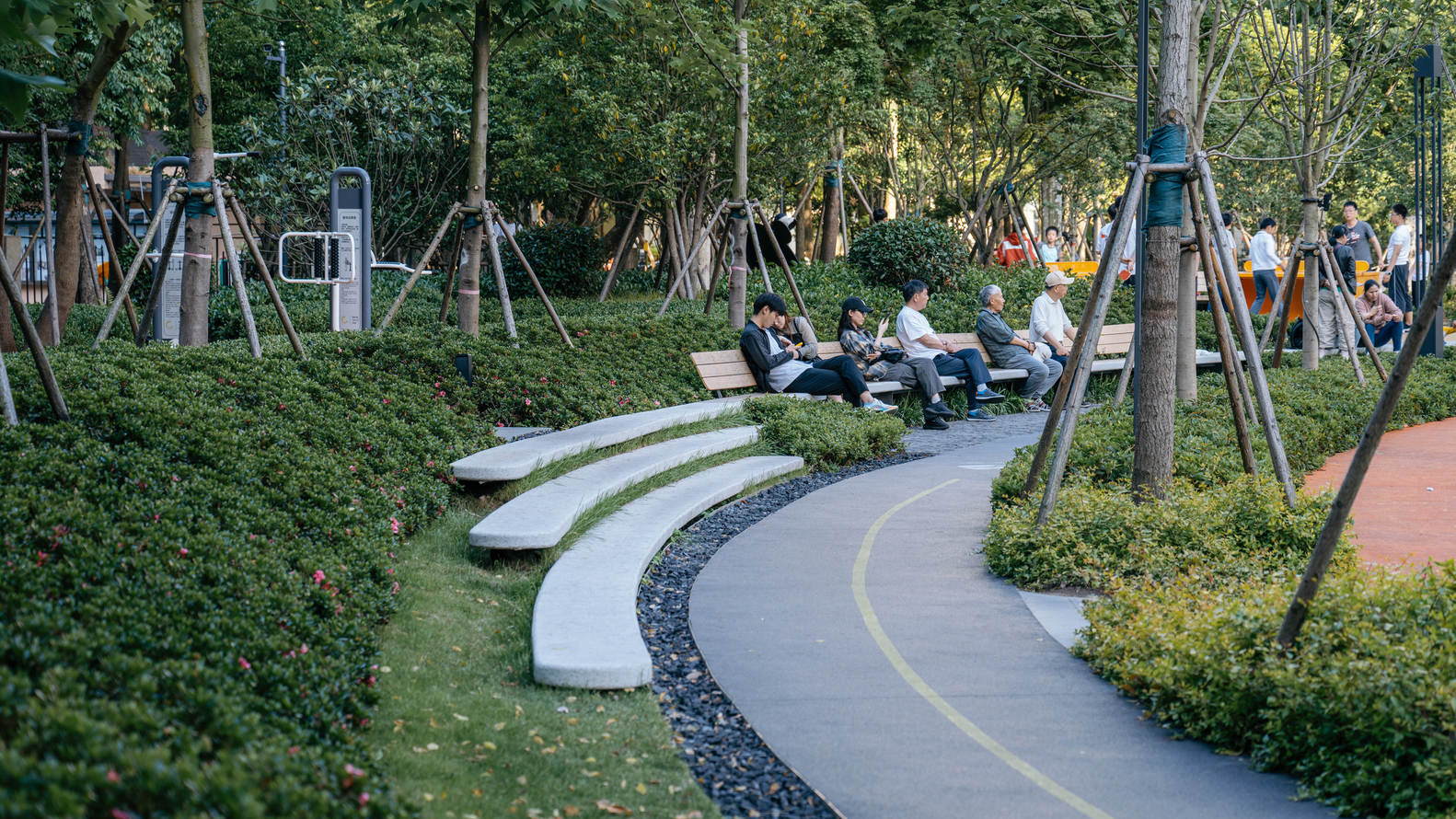
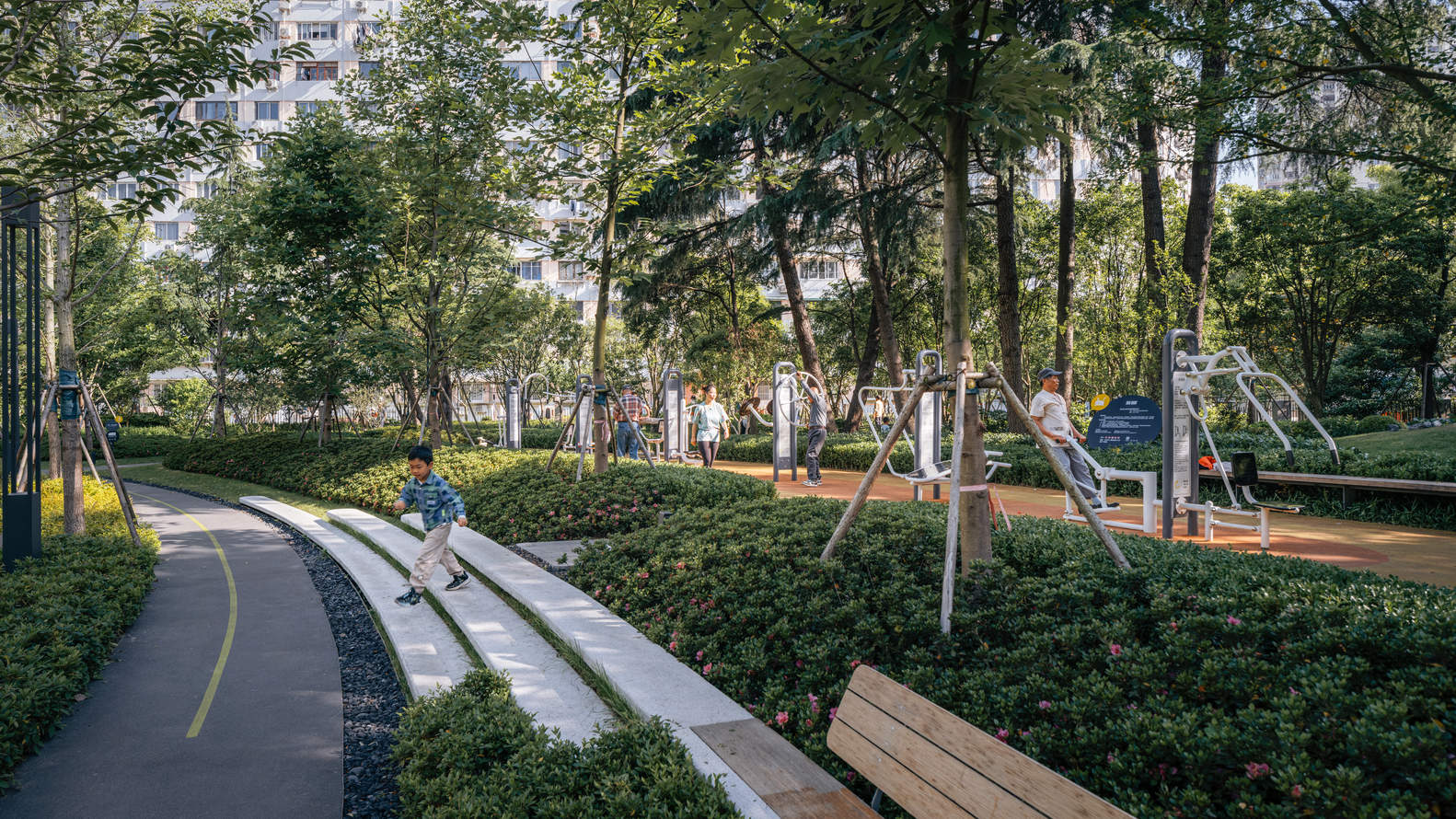
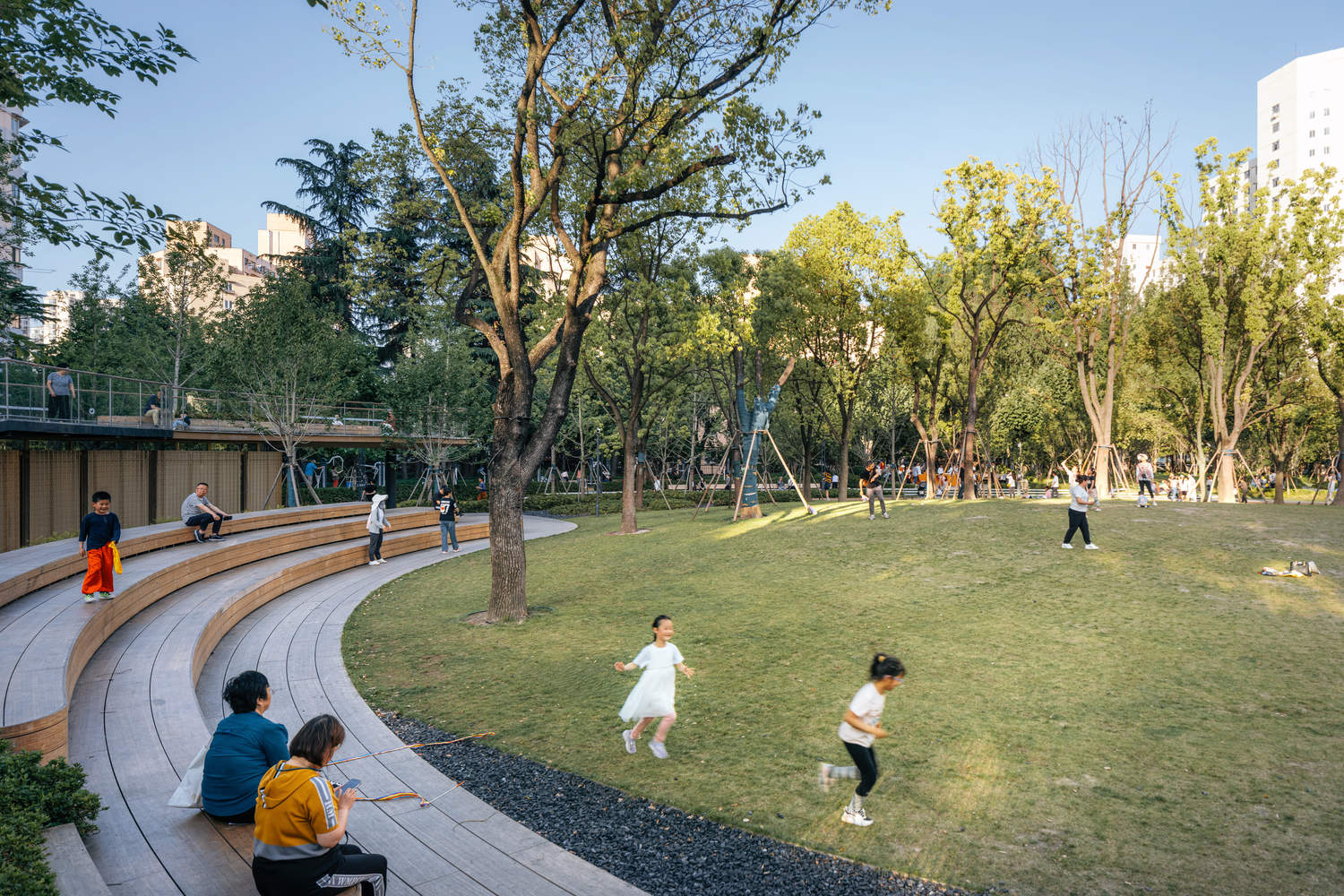
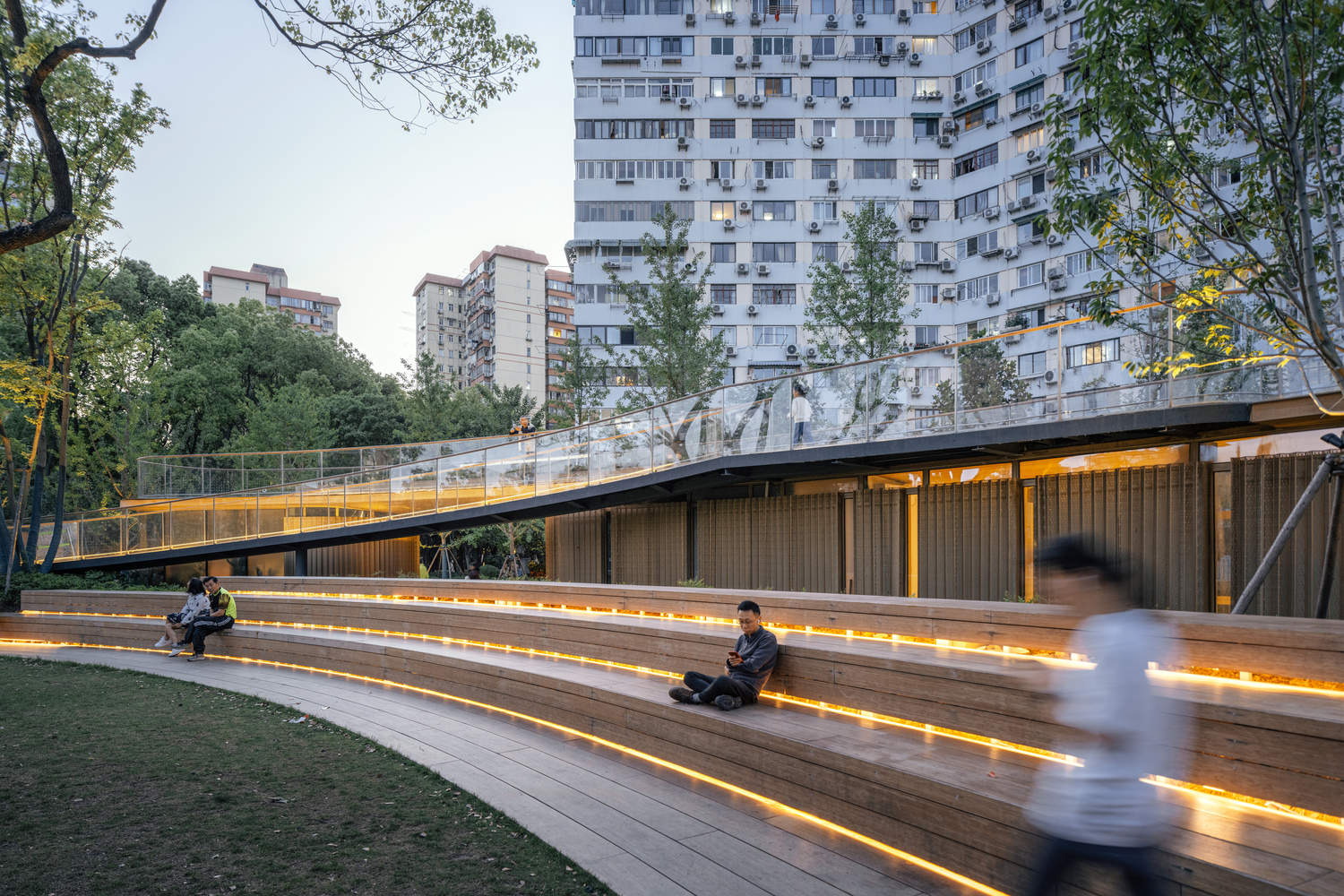
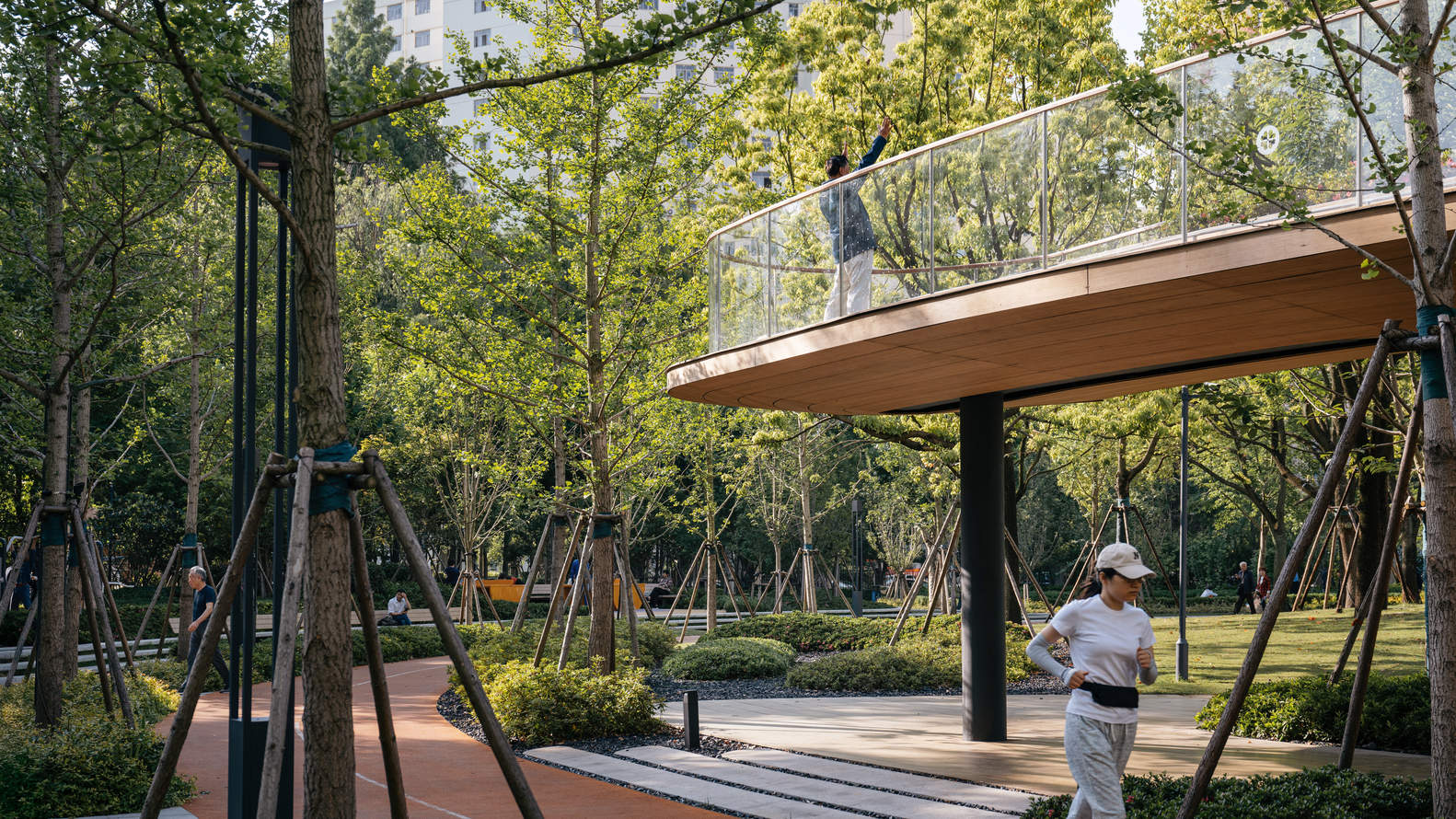
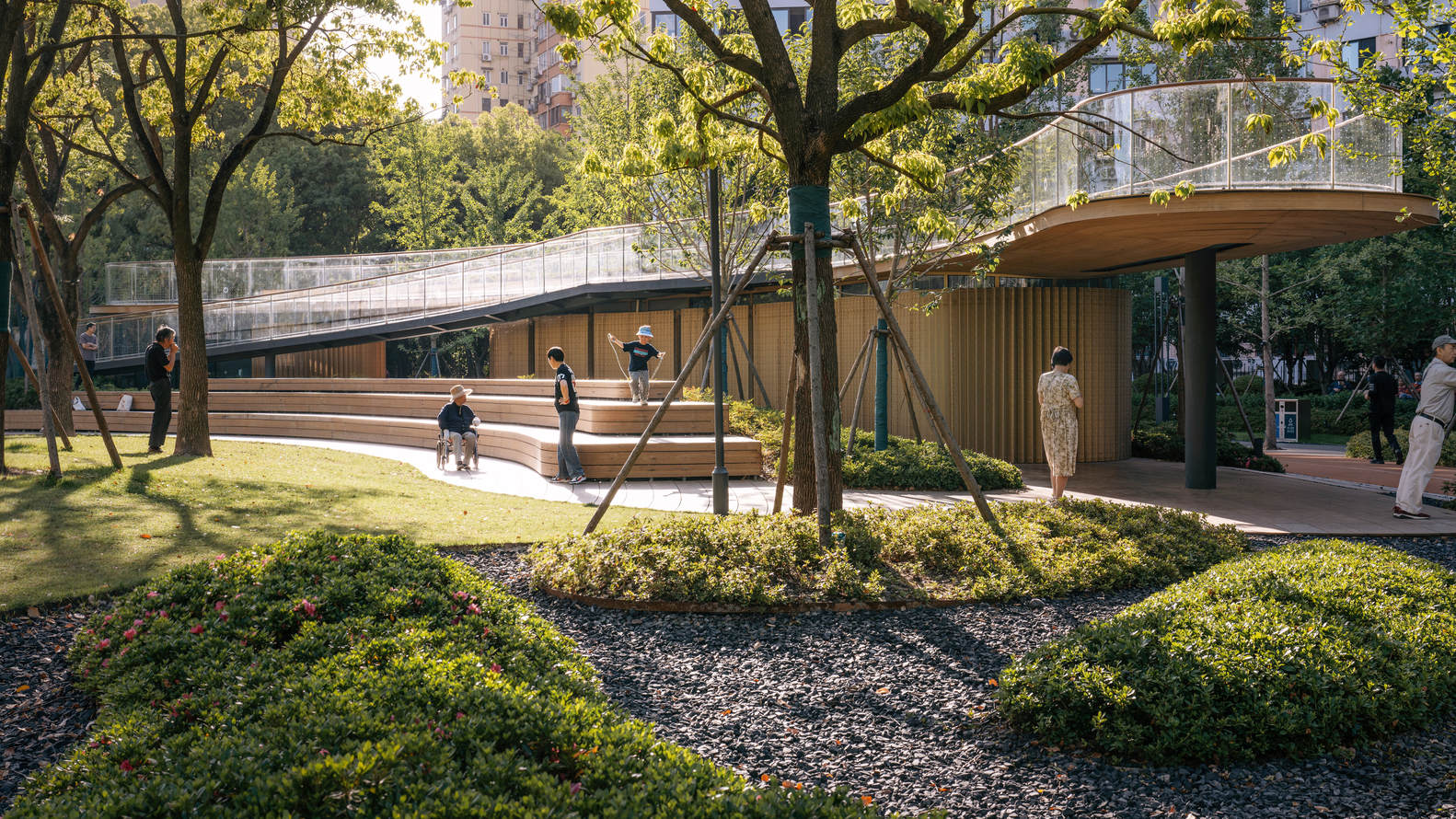
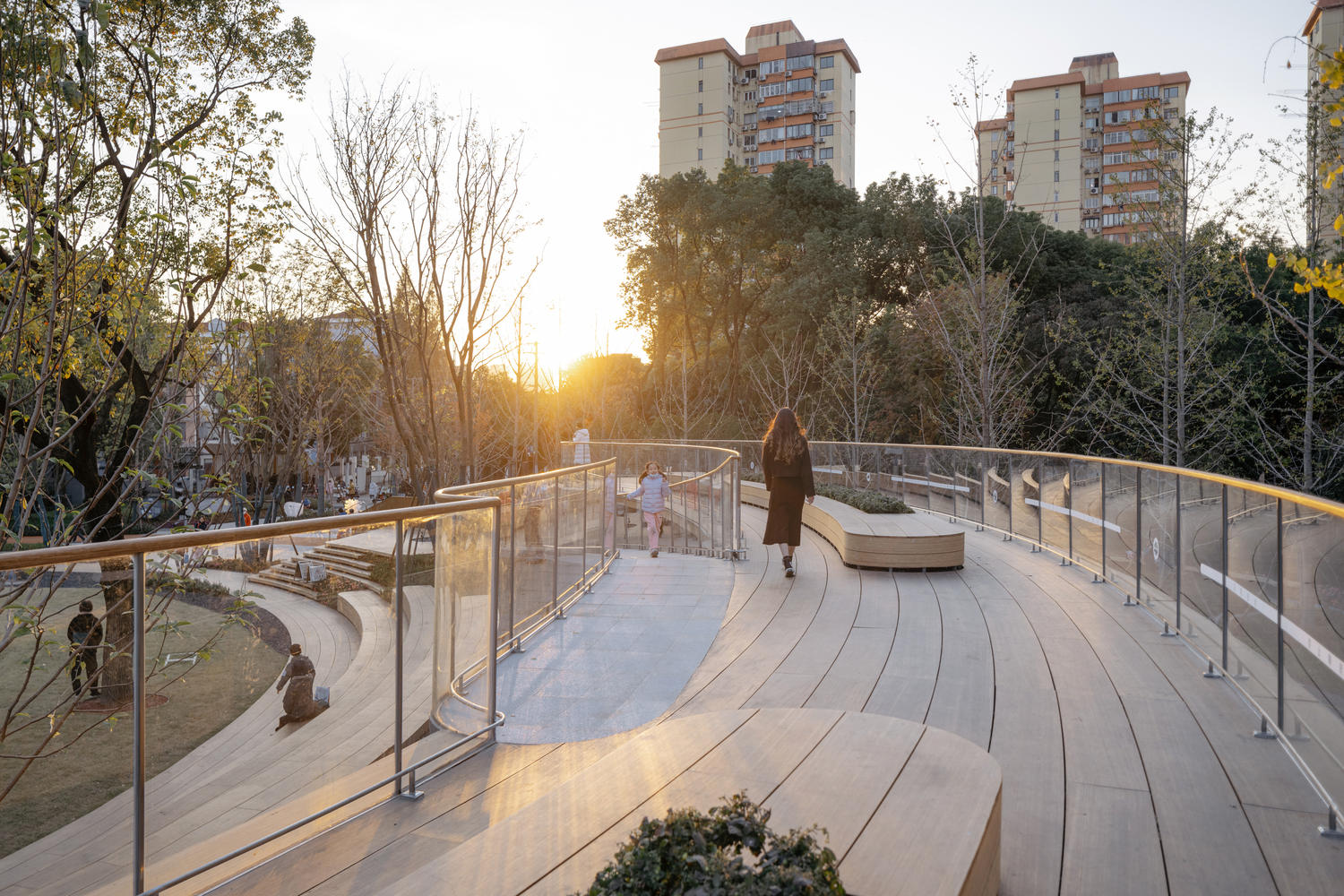
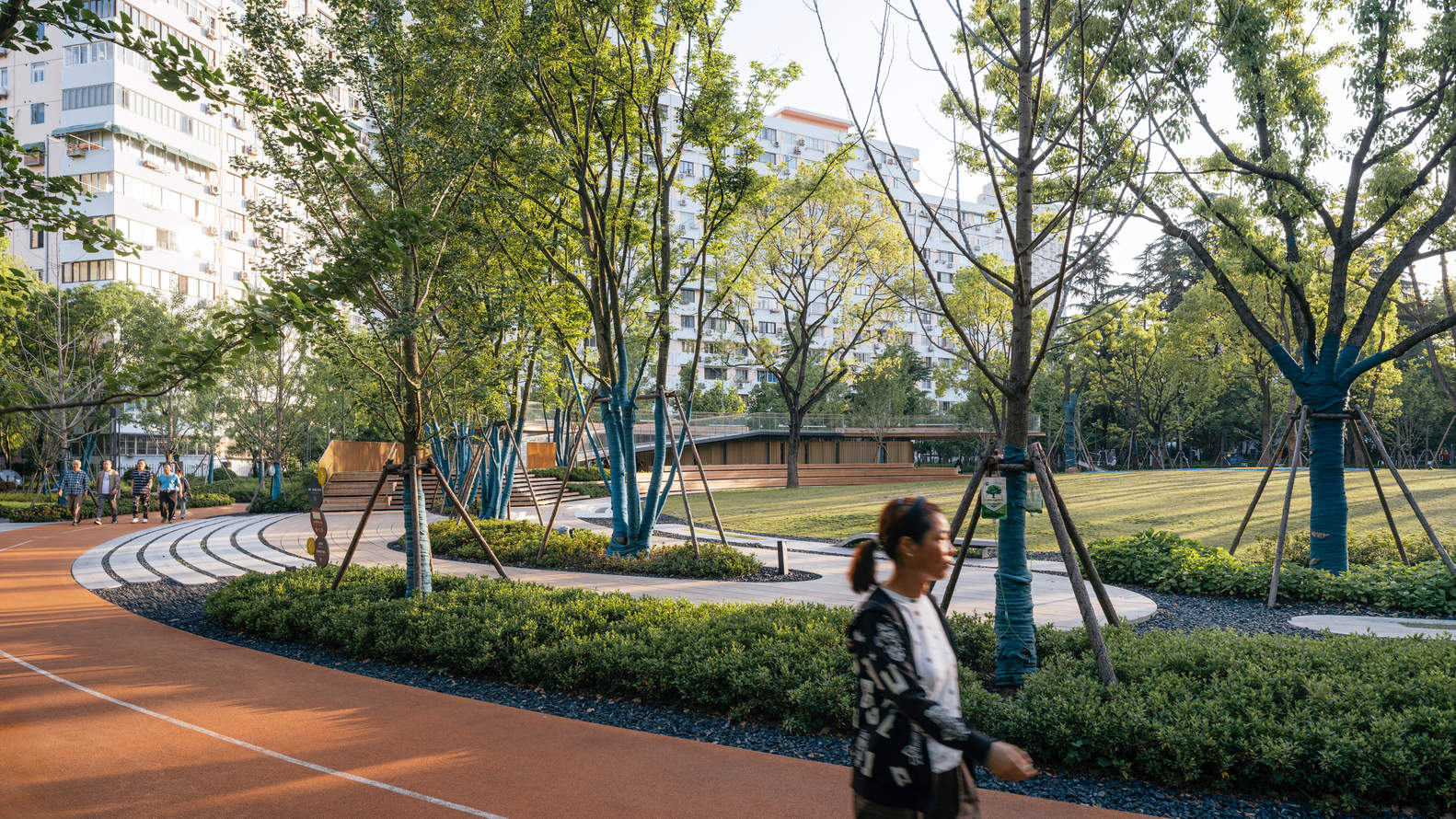
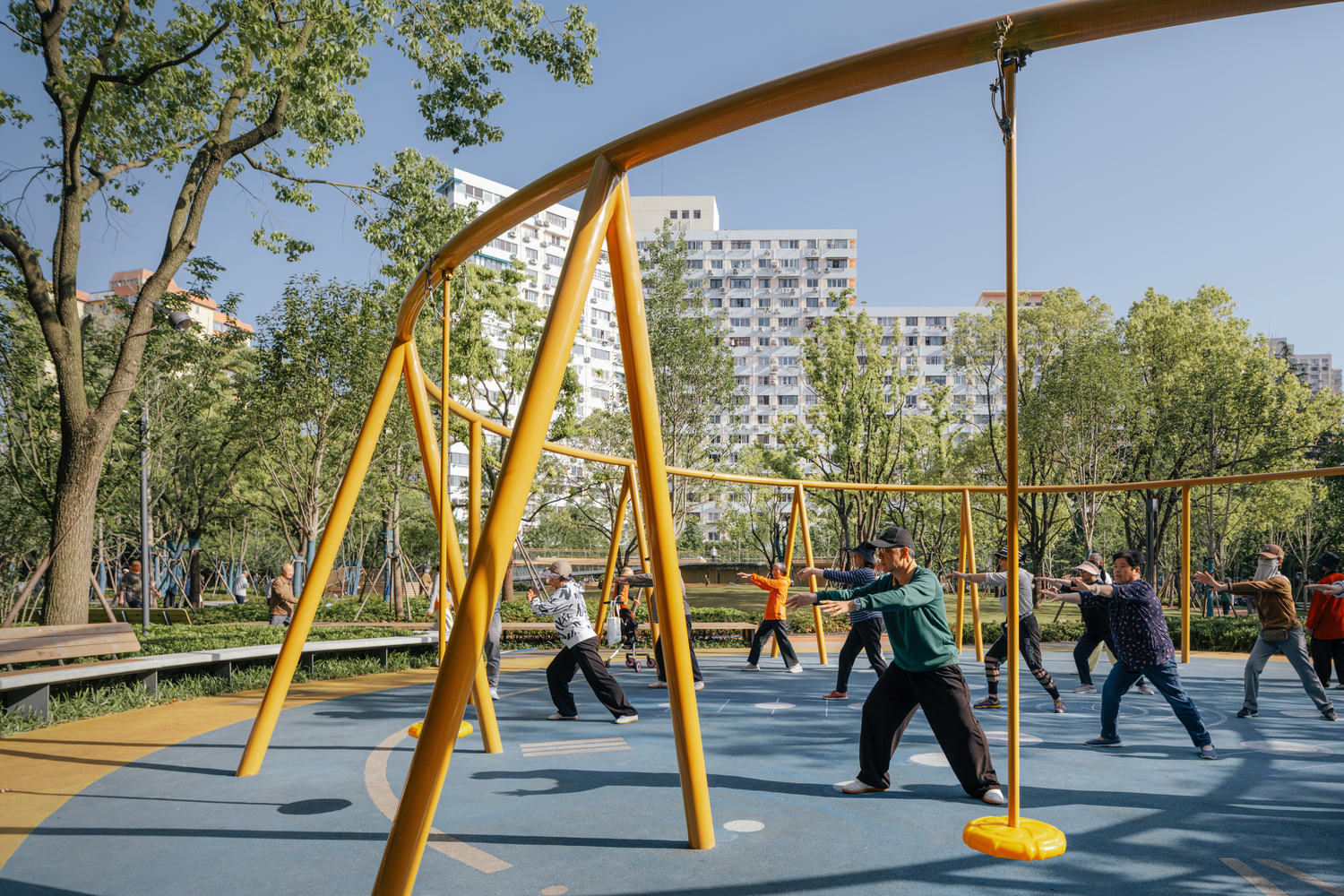
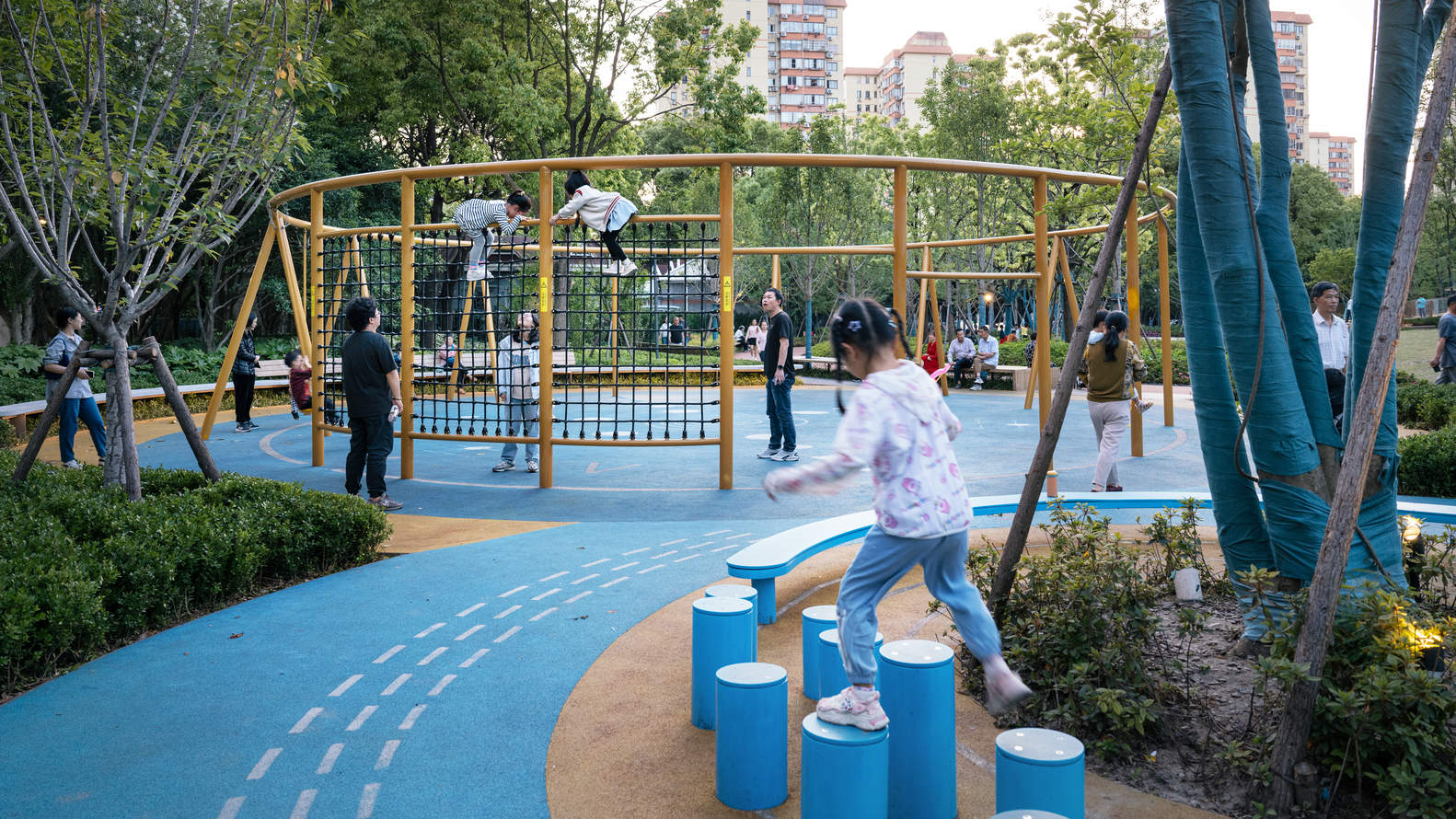
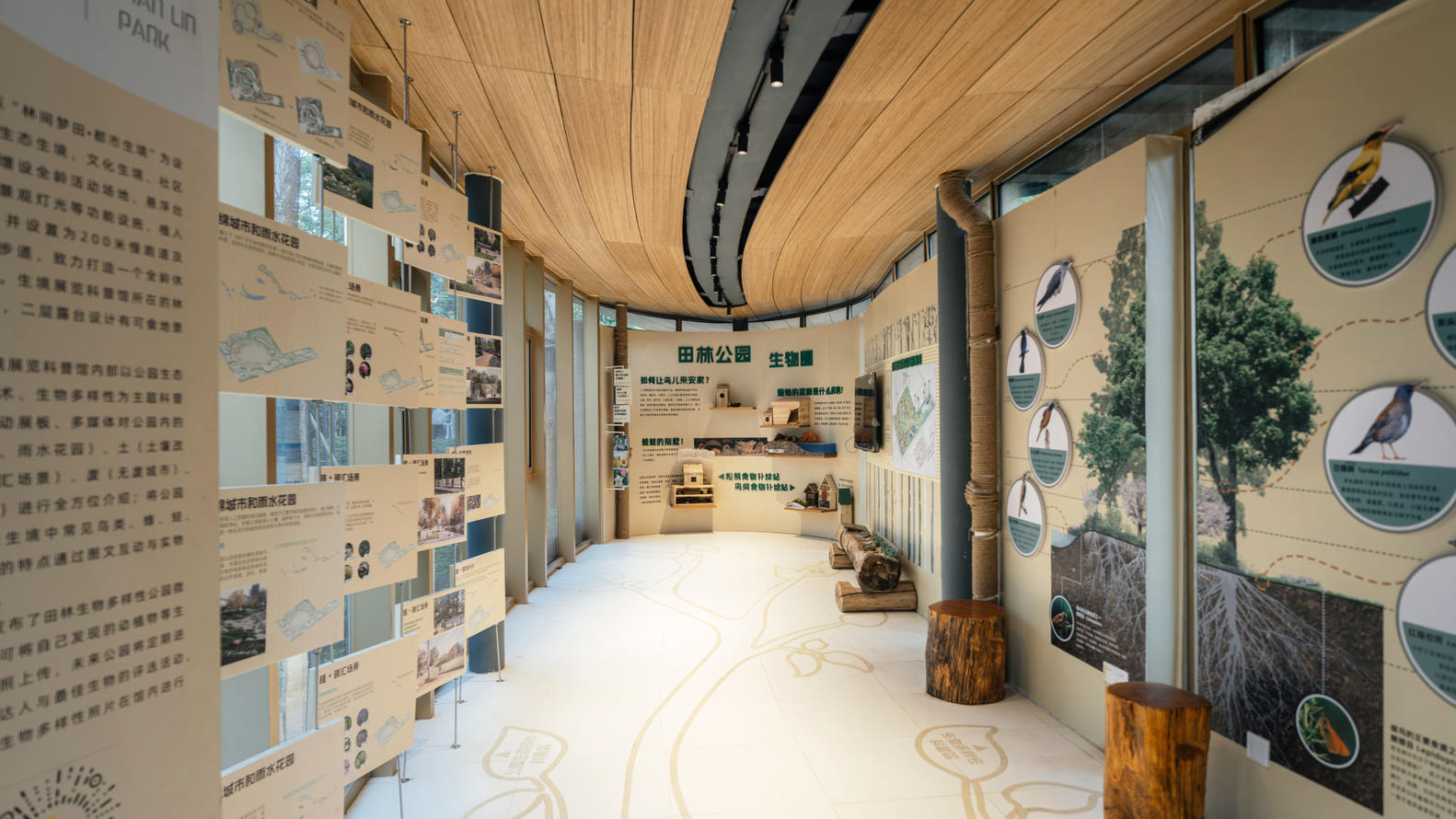
Firstly, based on the existing conditions, the central area of the park was designed as a circular grass slope accessible to users, providing a broad and open basic park experience for the high-density community. In the northern part of the lawn, which receives the best sunlight, we used the technique of "stretching the overall wooden platform space" to design the "Mengtian Corridor," which integrates diverse functions such as stepped seating, an aerial viewing platform, sheltered rest areas, a community gardening center, and an ecological science popularization hall, making it the most important comprehensive service facility for rest in Tianlin Park's main space. Concurrently, outside the lawn, we designed a main park path composed of a "3-meter wide circular jogging track + 1.5-meter wide circular green rest area + 1.5-meter wide circular walking path," establishing the basic spatial framework of Tianlin Park while accommodating diverse functions. Outside the main path, various fitness areas suitable for all ages, children's activity spaces, and parent-child game areas were organized, interspersed with broken circular layouts within the existing under-canopy spaces, resulting in a landscape feature of "vital spaces nestled in natural greenery," integrating the park's natural base with community vitality. The creation of a vital habitat based on the circular spatial construction is a significant element of Tianlin Park's spatial utilization; this is not only a creative continuation of user behavior patterns but also the source of Tianlin Park's unique spatial and visual characteristics.
首先,我们基于现状将公园中心区域设计为可供使用者进入的圆形大草坡,为高密度社区提供豁然开朗的公园基础体验。并在草坪北部日照最佳处,以“整体木平台空间拉伸”的手法设计了融合台阶看台、空中观景平台、廊下休憩空间、市民园艺中心、生境科普馆等多元功能的“梦田廊”,使之成为田林公园主体空间最重要的休憩服务综合设施。同时,在草坪外侧设计了由“ 3 米宽环型慢跑道 +1.5 宽环形绿化休憩空间 +1.5 宽环形漫步道”构成的主园路,在兼容多元功能的基础上奠定了田林公园的基础空间构架。并在主园路外侧组织适于全龄段使用的多种健身场地、儿童活动空间、亲子游戏场地,并以断续的环形布局方式植入现状林下空间,形成了“掩映于自然绿色中的活力空间”的景观特征,将公园自然基底与社区活力呈现融于一体。基于环形空间建构的活力生境营造是田林公园空间利用的重要内容,这不仅是延续使用者行为习惯的一次创作,也由此形成了属于田林公园的空间与视觉特征。
© CreatAR Images
© CreatAR Images
3. Environmental Reproduction: Expression and Perception of Natural Habitats
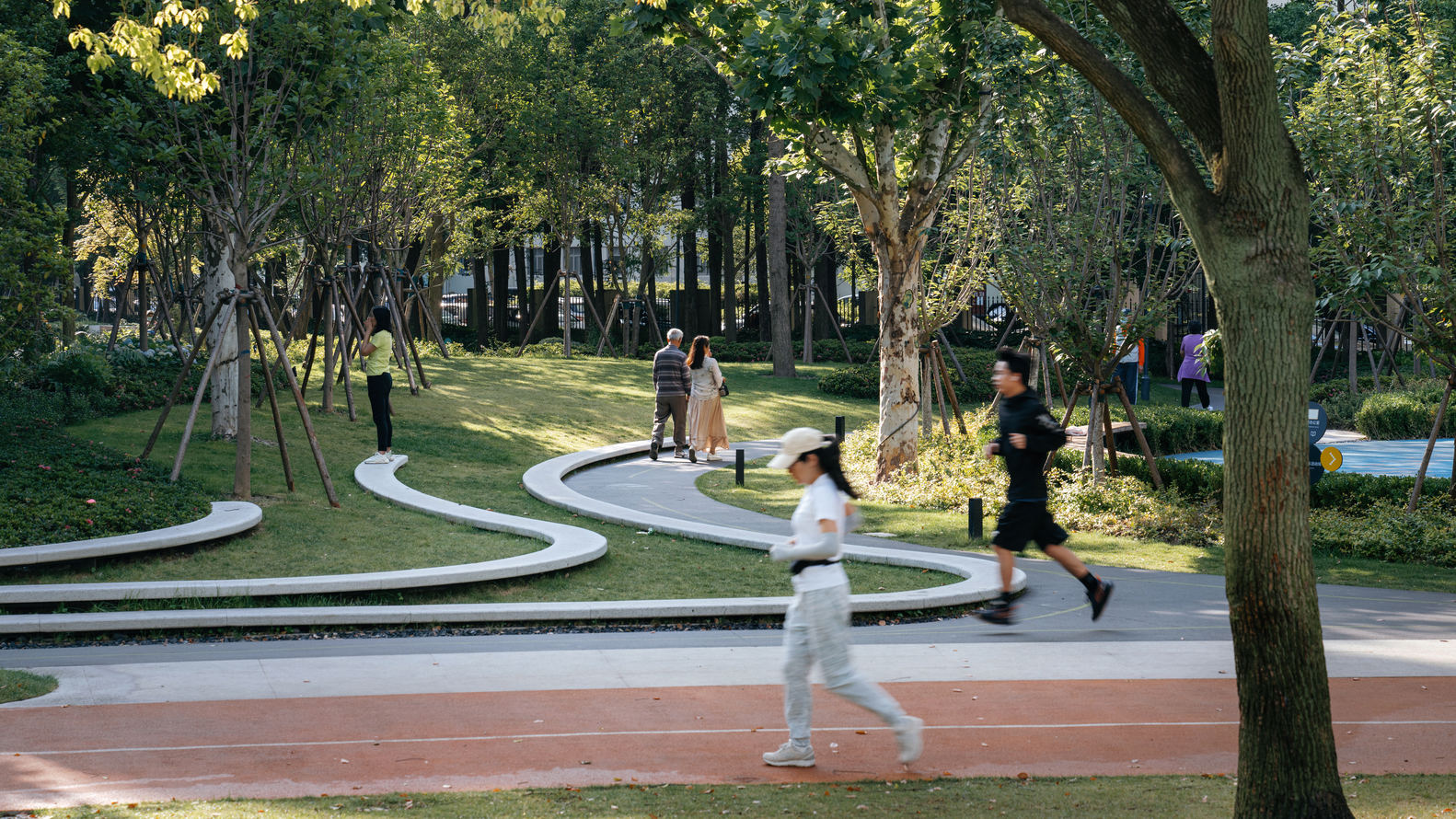
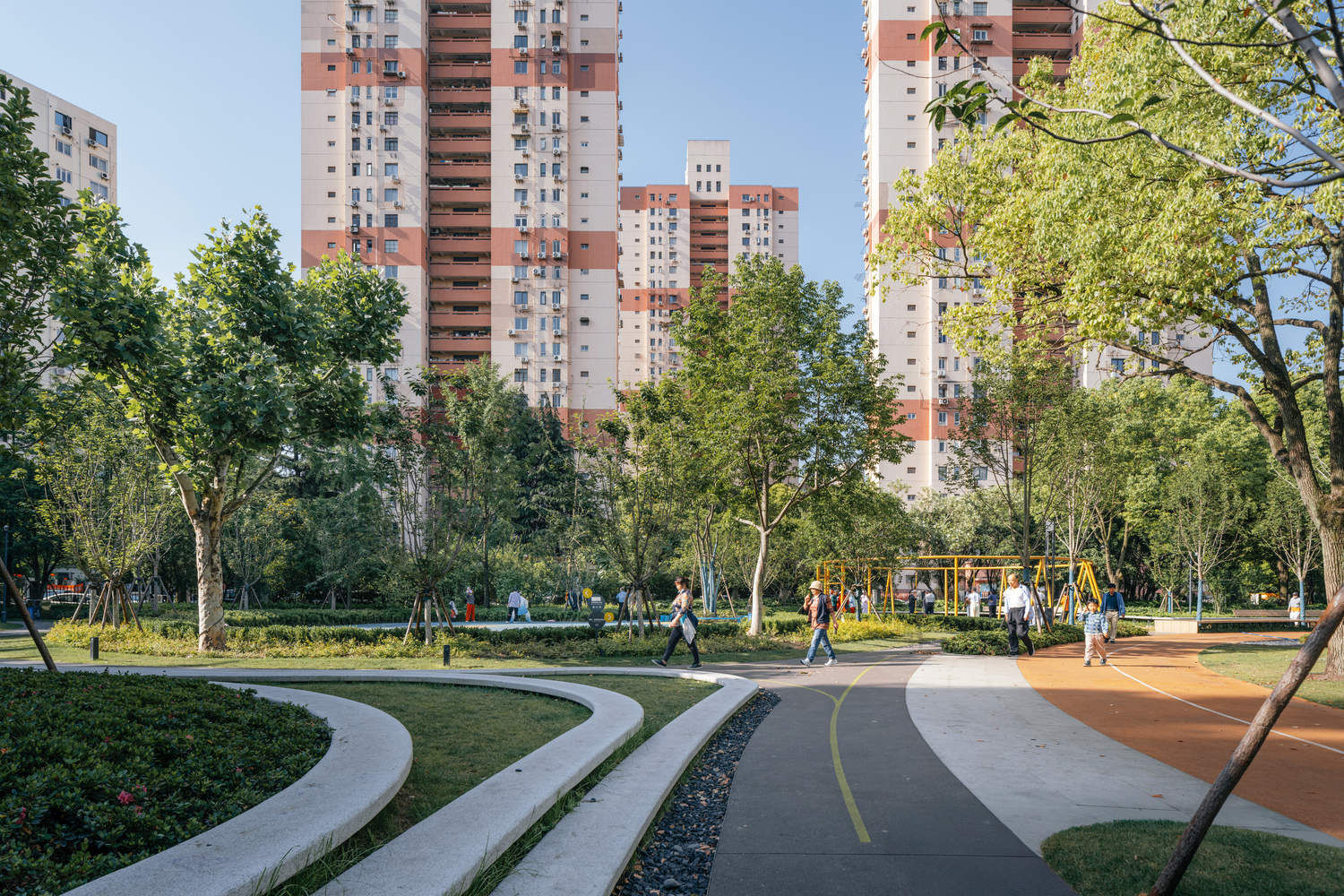
The existing dense canopy presented both a challenge and an opportunity: the renewal design needed to be based on the protection of mature trees and the strengthening of carbon sequestration functions, while also inspiring the creation and expression of a more complete habitat. In the under-canopy green spaces, besides using evergreen flowering shrubs that tolerate pruning to fix the understory structure, we mostly employed low-maintenance perennial ground covers and shade-tolerant herbaceous perennials to shape a basic planting atmosphere that is both simple and bright, yet rich in natural wildness. Simultaneously, we converted the park paths and site edges to 100% "open curbs" and utilized overall topographical reorganization to create sunken green spaces under the forest canopy, thus forming a "rain garden" system. This system was categorized based on different spatial functions: "natural habitat-style rain gardens," "artistic landscape-style rain gardens," and "water source-style rain gardens."
现状乔木蔚然成林,优越的自然绿化条件一方面提示更新设计需以大树保护、强化碳汇功能为基础,同时也激发了更完整的生境营造与表达。在林下绿色空间,除采用耐修剪的常绿开花灌木固定下木结构外,我们更多使用低维护的多年生地被与耐阴宿根花卉,以塑造既简洁明快又富于自然野趣的基础绿化氛围。同时,我们将公园园路与场地改造为 100% “开放式路沿”,并结合整体地形梳理出林下的下凹绿地空间系统,由此形成“雨水花园”系统。并结合不同空间功能,以“自然生境式雨水花园”、“艺术地景式雨水花园”、“水源地式雨水花园”的分型建构系统。
© CreatAR Images
© CreatAR Images
Along the natural habitat-style rain gardens, we introduced "fruiting habitat," "fragrance habitat," "medicinal plant habitat," and "rock habitat" into the under-canopy spaces. This enriches the experience and科普 (science popularization) content of strolling under the forest by forming different types of plant micro-habitats. Furthermore, by organizing the topography, we designed ecological landscape creation using recycled construction waste (bricks, stones, etc.) and plant trimmings, integrating "insect hotels" and "Hugelkultur mounds" into the landform. These elements are systematically arranged around the natural habitat-style and water source-style rain gardens, laying a foundation for more three-dimensional park micro-habitat creation. Unlike the natural habitat-style and artistic landscape-style rain gardens which primarily focus on infiltration, the water source-style rain gardens are sunken under-canopy spaces with temporary rainwater storage functions, providing water and food sources for birds alongside newly added fruit trees in adjacent areas. Through the protection of natural greenery and the construction of a more complete park habitat system, we aim to increase the ecological capacity of the entire neighborhood while transforming habitat perception and ecological science popularization into a more intuitive visitor experience through holistic green landscape creation.
在自然生境式雨水花园沿线,我们将“观果生境”、“芳香生境”、“药用植物生境”、“岩石生境”植入林下空间,在形成不同类型的植物微生境的基础上,丰富了林下漫步游赏的体验与科普内涵。同时,结合地形整理,设计利用现场回收建筑废料(砖、石等)与植物修剪产生的枝条进行生态型整体地景营造,将“昆虫旅馆”、“本杰士堆”结合在整地地景中,围绕自然生境式雨水花园与水源地式雨水花园做更完整的系统布局,为更立体的公园微生境营造打好基础。与自然生境式雨水花园、艺术地景式雨水花园以渗透为主不同,水源地式雨水花园是具有临时积蓄雨水功能的下凹式林下空间,与临近区域新增的果树一起为鸟类提供水源、食物源。尝试通过自然绿色的保护与更完整的公园生境系统建构,在提升整体街区生态环境容量的同时,以整体绿色地景营造的方式将生境感知与生态科普转化为更直观的使用者游观体验。
© CreatAR Images
© CreatAR Images
4. Embedding Tranquility: Functional Places for Cultural Habitat
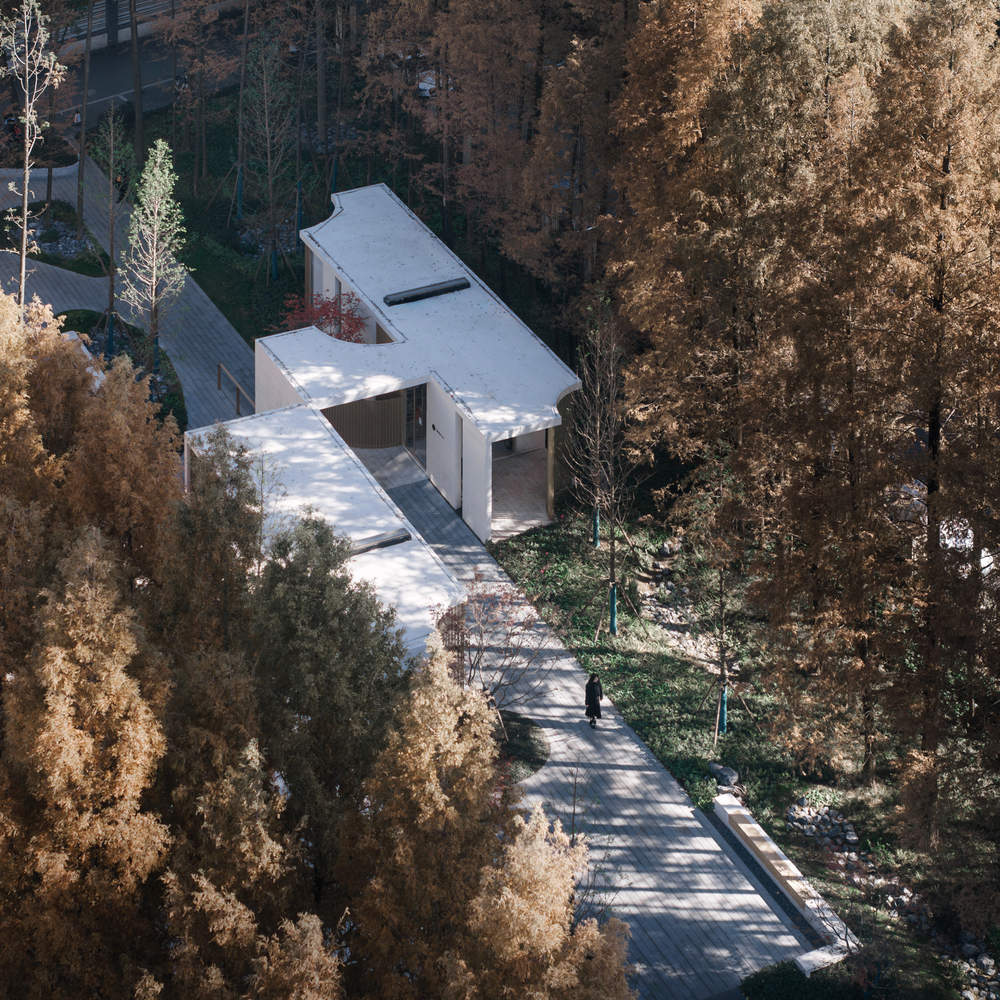
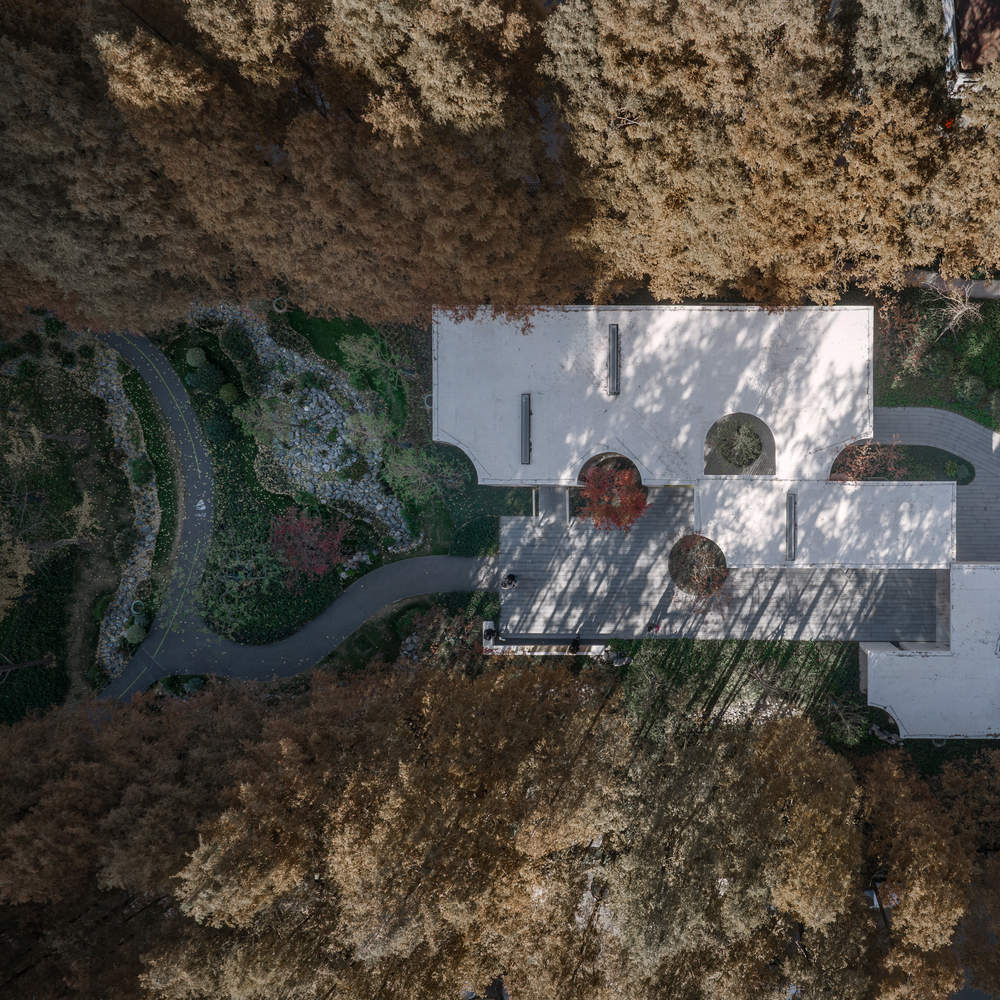
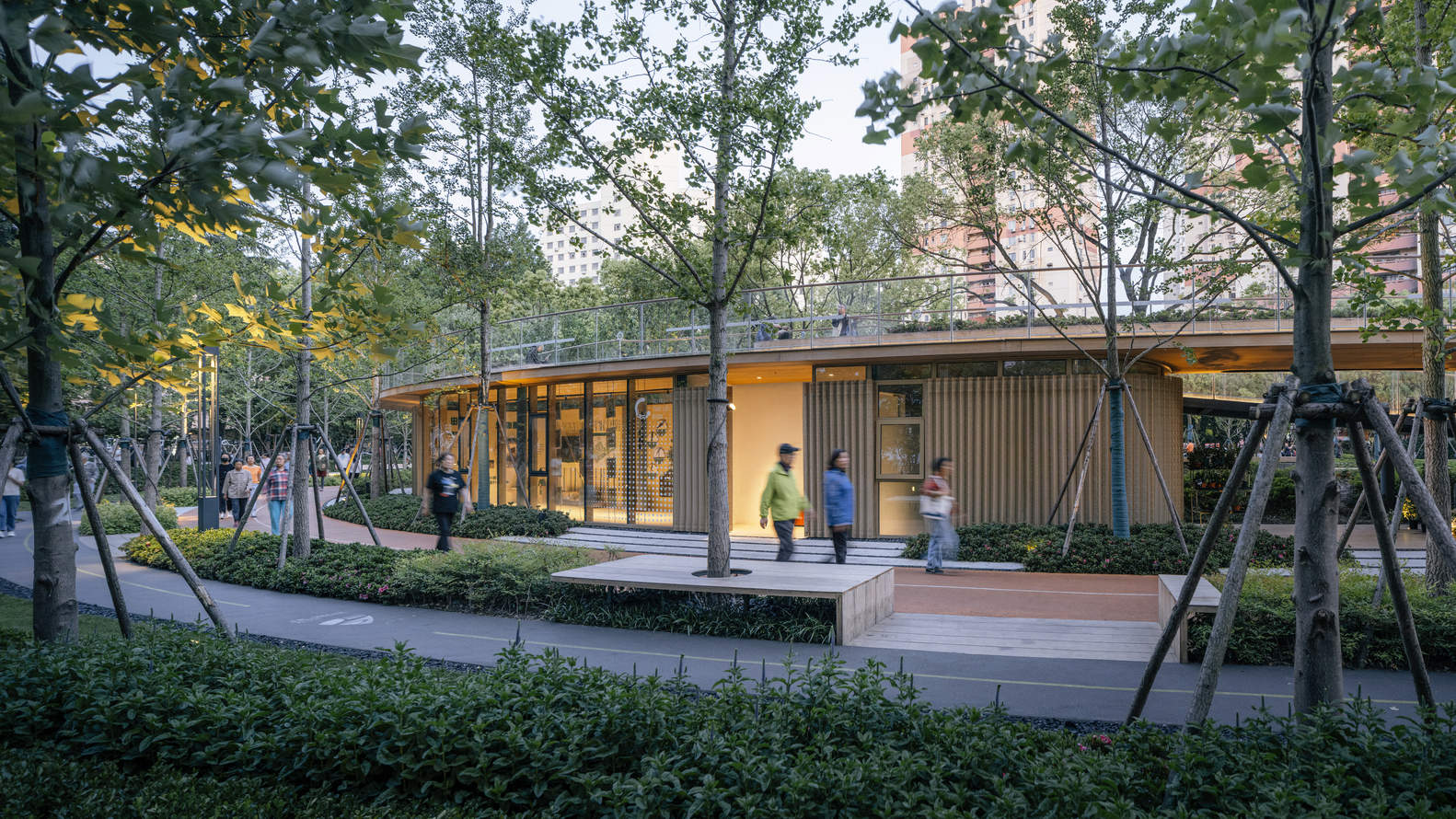
The site of Tianlin Park can be understood as being composed of one large and one small rectangle. The smaller eastern rectangular space is relatively independent spatially. Before the renovation, it was dominated by hard activity areas enclosed by Dawn Redwood (Metasequoia glyptostroboides) forests, posing potential safety concerns. The nursing home to the north of the site requires adjacent spaces to be relatively quiet, and the renovated park also needs some management and service facilities. Therefore, without damaging the Dawn Redwood forest, we decided to "embed" a Visitor Service Center ("Linyin Xuan" [3]), which includes park inquiry management and public restrooms, into the existing hardscape area to serve residents and visitors.
田林公园用地可以被理解为是由一大一小两个矩形构成,东侧面积较小的矩形空间在空间上相对独立,改造前是由水杉林围合下的存在安全隐患的硬质活动场地为主。场地北侧的敬老院要求相邻空间相对安静,同时公园更新后也需要一定的管理服务设施,因此我们决定在不破坏水杉林的前提下,利用现状硬质场地“嵌入”一处包含公园问询管理、公共卫生间等功能的游客服务中心(“林隐轩”[3] )为居民和游客提供服务。
© CreatAR Images
© CreatAR Images
Based on the analysis of spatial scale and adjacency, the design of Linyin Xuan and its surrounding landscape space differs from the large-scale circular construction technique of Tianlin Park’s main space. Instead, it adopts a small-scale "combination of void and solid" spatial module approach of "4m × 4m × 4m." This seeks maximum integration with the existing Dawn Redwood forest spatially, while also creating a quiet corner in the park through the concept of "hiding in the forest." The void-solid combination spatial module design allows Linyin Xuan to fulfill the function of a visitor service center while also accommodating the eastern entrance of the 24-hour open Tianlin Park. The flowing relationships of "curved vs. straight," "dynamic vs. static," and "hidden vs. revealed" present contemporary landscape architecture's spatial and cultural interest. Compared to the open, vibrant, and expansive ("Kuang") nature of the main landscape space of Tianlin Park, the area around Linyin Xuan is secluded ("Ao"), blending into the surrounding community environment and the existing Dawn Redwood forest, expressing the cultural habitat of the Tianlin area.
基于空间尺度与相邻关系的分析,林隐轩及周边景观空间的设计有别于田林公园主体空间的较大尺度环形建构手法,而是采用“ 4米 × 4米 × 4米”小尺度“虚实结合”空间模块组合的方式,在空间上寻求与现状水杉林高度融合的同时,也以“隐于林”的方式形成了公园中的静谧一角。虚实结合的空间模块设计在让林隐轩满足游客服务中心功能的基础上,也兼容了 24 小时开放的田林公园的东侧入口,以流动的“曲直”、“动静”、“藏露”关系呈现出当代造园的空间与文化意趣。与田林公园主体空间景观开敞、富于活力的“旷”相较,林隐轩周边则是融于周边社区环境与现状水杉林的“奥”、是属于田林地区的文化生境表达。
© CreatAR Images
© CreatAR Images
5. Forest Dream Field: The Broad Urban Habitat of Tianlin Park
"Forest Dream Field" is the design concept for the renewal of Tianlin Park, embodying VIA's initial intention to protect the existing shaded areas, optimize the utilization of under-canopy spaces, and enhance the natural state beneath the trees. Here, we pursue a broader definition of an urban habitat that matches the needs of a high-density built environment: ① The construction of a diverse activity site system that responds to the positioning as a community park and user needs represents the manifestation of Tianlin Park's "Vital Habitat"; ② Building upon the park's image of open green interfaces and sunny lawns, the "Natural Habitat" shaping, threaded by the diverse expression of rain gardens under the forest canopy, connects soil, vegetation, insects, small mammals, and birds, constituting a vital part of Tianlin Park's renewal. This is unfolded in conjunction with overall spatial organization through integrated user experience rather than traditional closed-off popular science methods; ③ The contemporary landscape architecture attempt in the eastern part of Tianlin Park, integrated with supporting service facilities, is a localized "Cultural Habitat" appropriately introduced here. How to inherit and embody the cultural interest of Chinese gardens in the development of contemporary park cities has always been an academic issue of particular concern to VIA.
“林间梦田”是田林公园改造更新的设计理念,体现了VIA保护现状林荫、优化林下场地利用方式、提升林下自然状态的设计初衷。在这里,我们追求匹配高密度建成环境需求的更广义的都市生境:① 响应社区公园定位与使用者需求的多元活动场地系统建构,是田林公园“活力生境”呈现;② 在公园开放绿色界面与阳光草坪的公园意象建立的基础上,以林下多元表达的雨水花园系统为线索展开的联系土壤、植被、昆虫、小型哺乳类动物、鸟类的“自然生境”塑造,是田林公园更新的重要内容,并以融入使用者体验的方式结合整体空间梳理展开而非封闭式的传统科普手段;③ 田林公园东部结合公园配套服务设施的当代造园尝试则是我们在这里恰当植入的具有在地性的“文化生境”,而如何在当代公园城市发展中传承与体现中国园林文化意趣也一直是VIA特别关注的学术议题。
© CreatAR Images
© CreatAR Images
Finally, it is worth mentioning that the "Forest Dream Field" lighting installation at the western open interface is not only an important entrance landscape marker for Tianlin Park but also a public art work jointly created by residents of the Tianlin Community Senior University under the proposal and organization of VIA, the owner, and the Tianlin Sub-district Office of Xuhui District [4]. This was an important participatory design practice that condensed local sentiment.
最后值得一提的是,西侧开放界面的“林间梦田”灯光装置不仅是田林公园重要入口景观标识,也是 VIA 提议发起、在业主与徐汇区田林街道办事处组织下,由田林社区老年大学居民学员共创的公共艺术作品[4] ,是一次重要的凝结在地情感的参与式设计实践。
© CreatAR Images
Notes:
[1] According to the "Classification Standard for Urban Green Space (CJJ/T85-2017)" released by the Ministry of Housing and Urban-Rural Development in 2017, a community park (G12) is defined as "a green space with basic recreational and service facilities, mainly serving residents within a certain residential area for nearby daily leisure activities."
[2] Shaping by form is a spatial sorting method summarized by VIA Landscape based on extensive renewal-type park and green space design practices in recent years. It is also a spatial utilization strategy and renewal design technique responding to the development goals of a "Park City" and the protection of green ecological resources.
[3] See the article titled "The Third Line: Linyin Xuan in Shanghai Tianlin Park Amidst the Dawn Redwood Forest," published in Time + Architecture, Issue 4, 2024; or see articles published by VIA Landscape on various professional media platforms under the titles "Linyin Xuan" or "Shanghai Tianlin Park Visitor Service Center."
[4] The "Forest Dream Field" lighting installation is designed as four sets of weathering steel calligraphy characters: "Lin" (Forest), "Jian" (Between), "Meng" (Dream), and "Tian" (Field), each composed of 7 pieces. After detailed node refinement by a professional manufacturer, they were implemented. Under the coordinated organization of the Xuhui District Greening Management Center and the Xuhui District Tianlin Sub-district Office, each character was calligraphed by multiple calligraphy enthusiasts from the Tianlin Community Senior University, and the best versions were selected by voting to serve as templates for the lighting installation's production and installation.