生态韧性与洪水共生的设计哲学:本项目最核心的亮点在于其对武江沿岸洪泛区的深刻理解和积极应对。设计师没有采取传统的硬化堤坝来隔离洪水,而是通过有限的岸线改造和抛石加固,成功保留了河漫滩的泄洪功能,构建了一个与洪水周期性变化的弹性公共空间。通过设立不同标高的耐冲刷栈道和园路系统,公园在不同水位下都能保持基本功能,这种“与洪水共生”的设计哲学,不仅增强了场地的自然适应性,更让使用者直观地感知到河流的生命节奏,实现了人造系统与自然动力的和谐共存。
“遗迹感”构筑与自然对话的场所营造:在场地的人造物设计上,设计团队展现了对在地文化和材料语汇的精妙提炼。入口建筑低调融入,而高架栈桥则以粗朴的石构语言,营造出一种仿佛早已与自然融为一体的“遗迹感”,模糊了人工与自然的边界。观景平台借鉴了当地吊脚楼的形态,使新构筑物在形式上与场地文脉产生联系。同时,通过仅挖掘浅坑作为雨洪滞留池,促进了半水生植物的生长,使人工干预降到最低,确保了构筑物成为引导人们探索和欣赏现有生态的媒介,而非干扰。
交通工具的在地化引导与社区活化:本项目在社区参与和功能植入上进行了极具创意的尝试,特别是对当地主要交通工具——摩托车的“接纳”。允许摩托车直接驶入特定区域的设计,巧妙地将享受自然的活动无缝嵌入到村民的日常出行和生活中,极大地激发了当地居民亲近自然的意愿。此外,利用废弃管桩改造的科普设施、可淹没的水榭作为皮划艇码头等多元复合功能,使得公园从单一景观空间转变为集休闲、教育、垂钓、水上运动于一体的社区活力中心,有效激活了这片被忽视的“野地”。
With an altitude difference of up to 4 meters between the flood level and the normal water level, frequent floods occur in Guitou Town during the abundant rainfall of spring and summer. High dikes were built along the river in the town center to resist floods, which protected the land but also severed the connection between people and water. The hardening of the riverbank further led to the loss of flood storage buffer zones and the narrowing of the river channel. Therefore, the core design challenge lies in: how to coexist with floods and create an elastic public space that can adapt to changes in flood levels, allowing the rhythm of nature to be perceived by people.
桂头镇地处武江沿岸,春夏季节雨量充沛,洪水频繁,洪泛水位与常水位之间的高差可达4米。镇中心区域沿江筑起高堤以抵御洪水,虽然保护了土地,却也切断了人与水的联系,河岸的硬化更是导致滞洪缓冲区丧失与河道缩窄。因此,设计的核心挑战在于:如何与洪水共生,创造一个能够适应洪水变化的弹性公共空间,让自然的节奏能够为人们所感知。
We first made limited modifications to the existing shoreline, retaining the flood discharge function of the floodplain and reinforcing it with rock placement to prevent soil and water erosion. At the same time, we fully considered the periodic changes in floods and established a recreational system adapted to different water levels, building boardwalks and park paths at different elevations using scour-resistant and easy-to-maintain materials. Even at the highest flood water level, the park can still provide services for people. The park acts like a ruler measuring nature; this elastic design not only enhances the site's adaptability but also allows people to more intuitively feel the dynamic changes of nature.
我们首先对现状岸线进行了有限改造,保留了河漫滩的泄洪功能,通过抛石加固防止水土流失。同时充分考虑洪水的周期性变化,设立适应不同水位的游憩系统,以耐冲刷、易维护的材料建造不同标高的栈道和园路。即使在洪水最高水位时,公园依然能够为人们提供服务。公园如同一把标尺丈量着自然,这种弹性设计不仅增强了场地的适应性,也让人们能够更直观地感受到自然的动态变化。
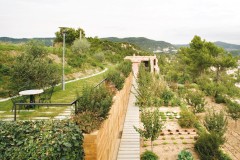
The entrance building and the small square face the road with a low posture, while facing nature with an open expanse. The elevated boardwalk is designed to allow people to use the park even during the flood season. The boardwalk extends towards the Wu River, offering tourists an open view, while the colonnade beneath the bridge provides shaded resting space from rain. The colonnade employs a rustic stone structure language, attempting to create a sense of "relic" coexisting with nature, as if these structures have long been integrated with nature. Three differently shaped viewing platforms extend from the boardwalk, inspired by the stilt houses built by local villagers. At night, the boardwalk transforms into a "Starlight Bridge," with luminous stones embedded on its surface echoing the stars in the night sky. In terms of overall form, we minimized engineering intervention, preserving the original topography, habitats, and native vegetation, only excavating three shallow pits in the center of the site as rainwater retention ponds. When the flood recedes or after rain, these shallow pits will form rain gardens, nurturing communities of semi-aquatic wild plants.
入口建筑和小广场以低矮的姿态面向公路,而以开阔面向自然。高架栈桥是为了让人们在洪泛季节依然能够使用公园。栈桥面向武江展开,为游客提供开阔的视野,桥下的柱廊则提供了遮荫避雨的休憩空间。柱廊采用粗朴的石构语言,试图营造一种与自然共生的“遗迹感”,仿佛这些构筑物早已与自然融为一体。栈桥上还延伸出三座形态各异的观景平台,灵感来自当地村民建造的吊脚楼。夜晚,栈桥化身为“星光桥”,桥面上镶嵌的发光石与夜空中的繁星交相辉映。整体形态上,我们尽量减少工程干预,保留原有的地形、生境和乡土植被,仅在场地中央挖掘三个浅坑作为雨洪滞留池。洪水退去或雨后,这些浅坑会形成雨水花园,孕育出半水生的野生植物群落。
All the design measures mentioned above aim to minimize the gap between man-made objects and nature, making the park a medium for dialogue between humans and nature.
上述设计手段均旨在让人造物与自然的罅隙更小一些,使公园成为人与自然对话的媒介。
The park allows motorcycles to enter, and visitors can drive their motorcycles directly to the end of the boardwalk to enjoy the scenery. Considering that motorcycles are the most important mode of transportation in the town, this design undoubtedly stimulates the villagers' interest in freely enjoying nature and plays a key guiding role, integrating the enjoyment of nature into daily life. The Wu River was already there, but these views might be entering the sight of the villagers for the first time.
公园允许摩托车进入,游客可以直接开着摩托车到栈桥的端头,欣赏风景。考虑到摩托车在镇上是最重要的交通工具,这个设计无疑激发了村民自由享受自然的兴致,起到了关键的引导作用,将享受自然融入了日常。武江原本就在那,但这些风景却可能是第一次落入村民的眼里。
The boardwalk, the circular park path, and the stepping stones among the vegetation are not only great places for jogging and walking but also provide excellent venues for birdwatching and insect observation. We also utilized discarded pipe piles to transform them into various forms of children's playground equipment and science popularization installations, providing an entertaining and educational nature classroom for teachers and students of the neighboring Guitou Primary School. The submersible concrete water pavilion has become a camping center and a kayak dock, while the rock embankment has become a popular spot for villagers and tourists to fish and collect snails.
栈桥、环形园路和植被间的汀步,不仅是慢跑散步的好去处,也为观鸟和观察昆虫提供了绝佳场所。我们还利用废弃的管桩,改造成多种形式的儿童游乐设施和科普装置,为邻近的桂头小学师生提供了寓教于乐的自然课堂。可淹没的混凝土水榭成为露营中心和皮划艇码头,而抛石驳岸则成为村民和游客垂钓、捞螺的热门地点。
Solar energy technology is used in the design of the park station and the boardwalk. The photovoltaic panels form a continuous roof, whose undulating shape echoes the rhythm of the Wu River waves. The angle of the photovoltaic panels is precisely calculated and adjusted to 17 degrees facing south to optimize solar energy reception efficiency throughout the year, providing clean energy for the park.
公园驿站和栈桥的设计中采用了太阳能技术。光伏板形成连续的屋面,其起伏的形态呼应着武江水波的韵律。光伏板的角度经过精确计算,调整为17度朝南,以实现全年太阳能接收效率最优化,为公园提供清洁能源。
The design of Guitou Town Wetland Park originates from a deep respect for nature. This floodplain wetland has always been like a hidden natural secret, never having the chance to become a place for people to explore the beauty of nature. Through this renovation, we attempt to integrate moderate artificial intervention while preserving the original ecological characteristics to create a public space that coexists harmoniously with nature. The park is not only a place to view scenery but also a place for people to rediscover and perceive changes in nature. Here, the boundaries between man-made objects and nature are blurred, and the relationship between humans and nature is redefined. We hope that through this park, more people can feel the poetry and beauty of nature, and the ecological civilization of Guitou Town can be continued and elevated.
桂头镇湿地公园的设计源于对自然的深切尊重。这片洪泛湿地一直以来都仿佛是被隐藏的自然秘境,未曾有机会成为一个让人们探索自然之美的场所。通过这次改造,我们试图在保留原有生态特点的基础上,融入适度的人工干预,创造一个与自然和谐共生的公共空间。公园不仅是一个观赏风景的地方,更是一个让人们重新发现自然、感知自然变化的场所。在这里,人造物与自然的界限被模糊,人与自然的关系被重新定义。我们希望通过这个公园,让更多人感受到自然的诗意与美,也让桂头镇的生态文明得以延续和升华。