对“茧房”的精妙构思与形式推演:该项目最核心的亮点在于对业主特定且“不可能”需求的精准回应——在既定户型限制下,通过对现有非功能性空间(如原衣帽间和走廊)的置换与重塑,创造出一个既独立又具有开放性的“茧房”空间。设计通过反复的方案推演和对外部条件的理性回应(如物业限制),最终将一个多边形结构演化为一个圆润、内聚的“茧”形体,实现了功能集成、视野收拢与私密性的完美平衡。这种从极端限制中推导出独特几何形态的过程,体现了建筑师高超的逻辑思维和对居住体验的深刻洞察力,使得“茧房”不仅是一个房间,更成为全屋的中心和制高点。
“房子里的小巷”所营造的叙事性流动体验:项目在空间流线上实现了大胆的创新,通过精心设计的“小巷”(连接茧房和主卧的狭长走廊)打破了传统住宅的单调性。这条长达6米的走廊,通过连续的转角、光线的明暗交替(从昏暗到尽端书架的聚焦光),以及空间尺度的变化(如入口处的拱形压低),将简单的“通行”行为转化为充满探索欲和节奏感的仪式。这种通过路径叙事激活日常体验的设计手法,成功地将原先被视为缺陷的狭小空间,转化为连接不同生活区域、激发使用者情感共鸣的独特“园林”体验。
将植物融入设计语言,实现“居室园林”的理想:本项目成功地将中国古典园林的“因借”思想融入现代住宅设计,以植物作为核心的“借景”媒介,实现了空间氛围的丰富化和人与自然的连接。通过在“茧房”的镜窗、壁龛、卡座旁等关键节点配置精心挑选的植物,创造出可观赏、可互动的“小品册页”效果。这种对“居室小园林”理念的实践,强调了空间应是个性化、生命力的载体,反对标准化和风格的盲目堆砌,最终促成了功能性与审美体验的统一,让居住空间成为个体精神的真实外化。
Without designing residential spaces, I initially thought that every household just went about their daily lives. I never imagined that people have so many peculiar ideas about life, and that residences hold so many possibilities. Individual worlds are so rich, and Chinese families are so diverse, yet they are obscured by the standardized brochures of real estate and the model rooms on Xiaohongshu. This commission was an almost "impossible task." The hostess stated firmly: "I want an independent room. Inside, there must be a large desk, my vanity, and a big wardrobe. I need to work quietly in there undisturbed, yet still be able to see outside." The apartment layout was fixed: a conventional three-bedroom, two-living room configuration, with a depth of over ten meters, the entrance in the middle, and a short corridor connecting the bedrooms and bathrooms, with functional rooms at the far ends. Besides the couple, the elderly relatives and the children in the family all needed independent bedrooms—where could a room for the hostess be created?
在没做居室设计的时候,以为家家户户只是过日子而已。从未想过人们对生活有那么多奇怪的想法,住宅又有这么多的可能性。个体世界如此丰富,中国家庭如此多样,却被千篇一律的房地产售楼书和小红书样板间遮蔽了。这次的委托,又是个近乎“不可能完成”的任务。女主人语气笃定地说:“我要一个独立房间。里面要有一张大书桌,有我的化妆台、大衣柜,我一个人在里面安静做事不被打扰,又能看到外面”。套型格局已定,常规的三室两厅,十几米的进深,入口在中部,短走廊连着卧室和卫生间,功能房间都在尽端。除了夫妻俩,家里的老人和小朋友都要独立卧室,从哪里变出一个女主人房间呢?
© 金秋野建筑工作室
© 金秋野建筑工作室
The Origin of the Cocoon:
Coincidentally, the original layout had a walk-in closet jammed between the living and dining rooms, with a door opening into the master bedroom. I don't know what the original designer was thinking; this closet was not only a dark room but also had sharp angles, making it quite obstructive. It was neither too close nor too far from the main entrance, turning into dead space. The owner despised it and was determined to remove it. I thought, why not expand it into the hostess's room, perfectly enclosing the view between the living and dining areas and framing the entrance hall. The owner also disliked the master bedroom and the children's room having doors facing each other, as well as the cramped L-shaped corridor leading to the master bedroom. She hoped to enter the master bedroom directly from the living room, so that the wall behind the sofa, having gained a door, would no longer be a closed wall but gain "depth." All these ideas were integrated into the concept of the "Cocoon."
茧房的由来
刚好原始户型在客餐厅之间塞了一个衣帽间,对主卧开门。也不知当初设计房子的人是怎么想的,这东西不仅是个黑房间,而且棱棱角角的,相当碍事,与正门之间的距离不远不近,成了垃圾空间。主人嫌它碍眼,必欲除之而后快。我想了下,不如干脆扩大成为女主人房,刚好在客餐厅间收拢视野,围出玄关。主人还说,不喜欢主卧和小朋友房间门对门,以及进入主卧的那条逼仄的L形走廊。她希望可以从客厅直接进主卧,这样沙发后那面墙因为有了一扇门,就不再是一道封闭的墙,而有了“深度”。这些想法,都被整合到“茧房”的构思中。
The first version of the "Cocoon" had nothing to do with a "cocoon." It merely utilized the original walk-in closet and short corridor to form a polygonal room, adjacent to the children's room exterior wall on the north and facing the living room with a large window on the south. Inside, the hostess's desk was directly opposite the window, with the children's piano placed under the windowsill, raising the internal floor height by 30cm. It bordered the master bedroom on the east, with the door opening at the southeast corner, requiring a bend inside to allow space for the bathroom passage. On the west side, to frame the entrance hall, gather the surrounding views, and embed the entrance cabinet, a complex折线 (creased line/polyline) was formed. Continuing this action, the dining area range was naturally delineated on the north side, allowing 60cm for the children's room entrance. Influenced by this initial Cocoon version, one edge of the living room, dining room, master bedroom, and children's room became a折线. The interior of the Cocoon was divided into two zones—a work area and a dressing area. This plan formed a triangular portal at the junction of the living room, hostess's room, and master bedroom. I repeatedly envisioned its shape and the interesting movement experience until the day the plan was submitted to the property management, only to receive a negative reply: "No, you cannot open a door on this wall." The owner was furious; property management had given verbal consent for minor adjustments earlier. After arguing the merits, they finally conceded defeat. I found the intricately shaped hostess's room in the initial draft hard to give up; it grew into that form as a necessity under various constraints—logical yet subtle, very much like "classical gardening." It seemed the space had been compressed to its maximum, leaving no room for maneuver. The owner said: "Mr. Jin, it's up to you! But since that's the case, I have a new requirement: whatever the new plan looks like, I hope I don't see a sharp corner when I enter; it should be a bit more rounded, haha..." and then left for the Chinese New Year. During the festival, the weather was fair, and Beijing suddenly became quiet. I looked at the drawings and thought, if the bedroom opened to the north, the hostess's room would have to move south, which would not only compress the living room space but also reintroduce the L-shaped corridor I had tried so hard to avoid, and it would be even longer than before. Was there any other way? No. So, I stopped overthinking and decided to optimize as much as possible. One aspect was the hostess's room: it needed to shrink, minimized while satisfying the requirements, to avoid encroaching too much on the living room space; the other was the corridor to the master bedroom, which must not be unpleasant.
其实第一版的“茧房”跟“茧”一点关系都没有,它只是借用了原来的衣帽间和短走廊形成的多边形房间,北边与儿童房的外墙相邻,南边对着客厅做成一扇大窗,里面正对女主人的书桌,窗台下放小朋友的钢琴,内部地坪因此抬高 30cm。东侧与主卧相邻,门开在东南角,进去之后折一下让出卫生间过道。西侧为了围出玄关、收拢两侧视野,并嵌入玄关柜,形成了复杂的折线,延续这个动作,在北侧顺势划出餐厅范围,并让出 60cm 给小朋友房间做出入口。受这个初版茧房影响,客厅、餐厅、主卧和儿童房都有一条边变成折线,茧房内也分为两个区域——工作区和梳妆区。这个方案在客厅、女主人房、主卧结合处形成一个三角形的传送门,我反复设想它的形状和有趣的行走体验,直到方案提交给物业的那一天,得到否定的回复:不行,这道墙上不能开门。业主很恼火,物业早前口头承诺这里可以局部调整。据理力争一番,最终败下阵来。初稿中这个形状复杂的女主人房,对我来说颇难舍弃,它之所以长成这样,是种种条件制约下的必然结果,有逻辑又难揣摩,很“园林”。似乎空间已经被压缩到极致,无计可施了。业主说:“金老师,就看你的了!不过既然如此,我还有个新要求:新版方案,无论长啥样,希望进门不要看到墙角,最好圆润一点,哈哈”……说完就过春节去了。节日期间一派风和日丽,北京城一下子安静下来。我对着图纸想,如果卧室朝北开口,女主人房必须南移,不仅压缩客厅空间,原来极力避免的L形走廊就又出现了,而且比原来还长。还有别的办法吗?没有。那就不做他想,尽量优化。一个是女主人房,它要缩小,满足要求的基础上最小化,避免侵占太多客厅空间;一个是通往主卧的走廊,它必须不讨人嫌。
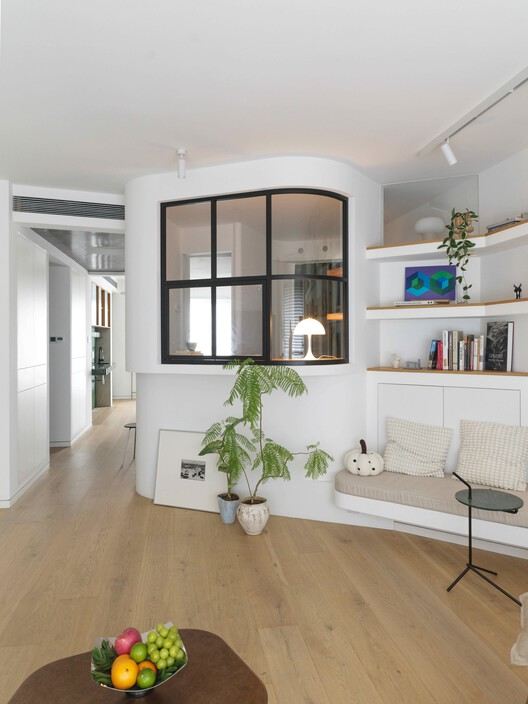
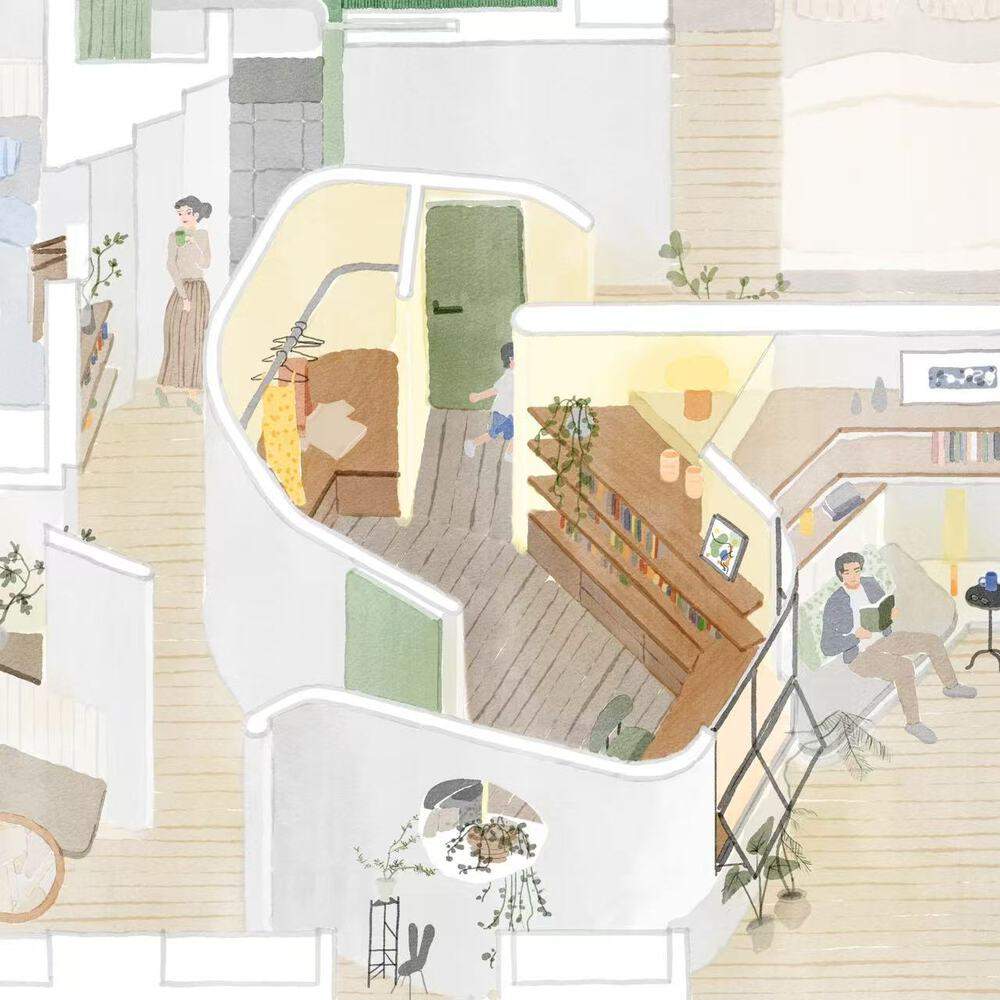
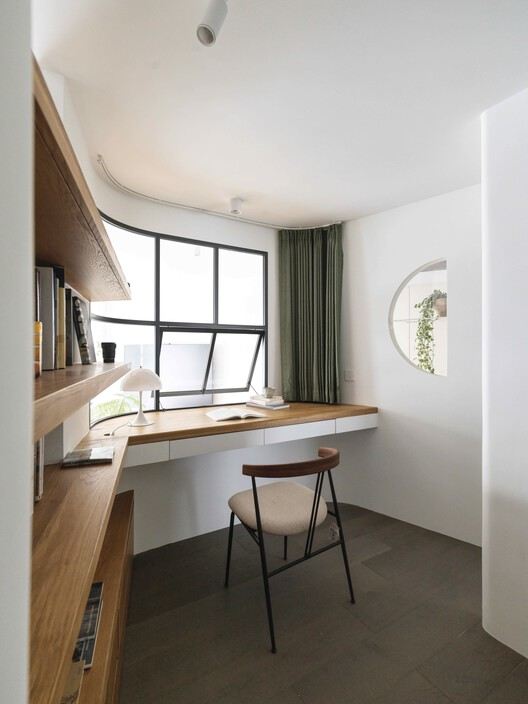
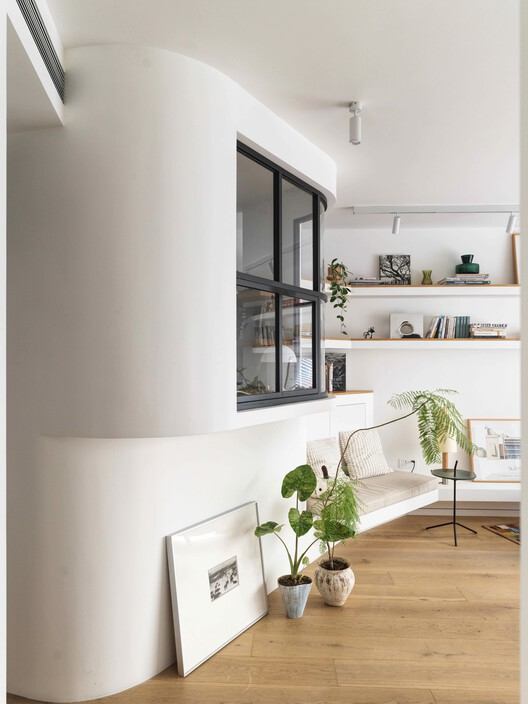
Thus, the hostess's room shifted south, becoming full and rounded, no longer the strange shape from before, finally becoming a true "Cocoon." Being rounded doesn't mean arcs or ellipses, but rather subtle chamfered corners with folded lines, making construction alignment easier. Shifting the upper and lower halves slightly created two entrances: one facing the dining room and the other leading to the master bedroom, allowing direct entry without going through the outer corridor. The master bedroom entrance is particularly narrow, just wide enough for one person, with the side wall of the wardrobe acting as a "screen wall" (Yingbi). The desk still overlooks the living room, the east wall features a full-height bookshelf, and a circular porthole is opened on the west wall, obscured by plants, allowing the hostess to see people coming and going without being easily seen. Although small, the Cocoon is fully equipped, occupying a central position like a communicating vessel, and simultaneously serving as the vantage point for the entire family. To gain better lighting, a large window was opened facing the living room, somewhat like an exterior window that can swivel open upwards. Sitting here is comfortable, intimate, and truly possesses the imposing air of overlooking the whole house. The host felt a bit embarrassed to state his needs: "A small wardrobe in my bedroom; a coffee bar in the dining room." That's all.
于是女主人房南移,变得饱满圆润,不再是之前奇奇怪怪的样子,终于成了一个“茧”。说圆润,也并不是圆弧或椭圆,而是折线小圆角,方便施工定位。上下两半错动一下,出现两个入口,一个面对餐厅,一个通往主卧,这样就可以不经由外走廊而直接进入房间。主卧入口特别狭小,刚够一人通行,衣帽柜的侧墙充当了“影壁”;书桌依然俯瞰客厅,东墙上是通高的书架,西墙上开了一个圆形的洞窗,用植物加以遮掩,这样女主人可以看到外面进出的人,却不容易被看到。茧房虽小但五脏俱全,占据了中央位置,像个连通器,同时也是全家的制高点,为了获得更好的采光,朝客厅开了大窗,有点像个室外窗,可以上旋打开。坐在这里,很舒服,很局气,真有俯瞰全屋的气概。男主人有点不好意思地说:我的需求是——卧室里的小衣柜;餐厅里的咖啡台。就这些。
The above is the origin of the Cocoon.
以上就是茧房的由来。
© 金秋野建筑工作室
插画
© 金秋野建筑工作室
The Alley Inside the House:
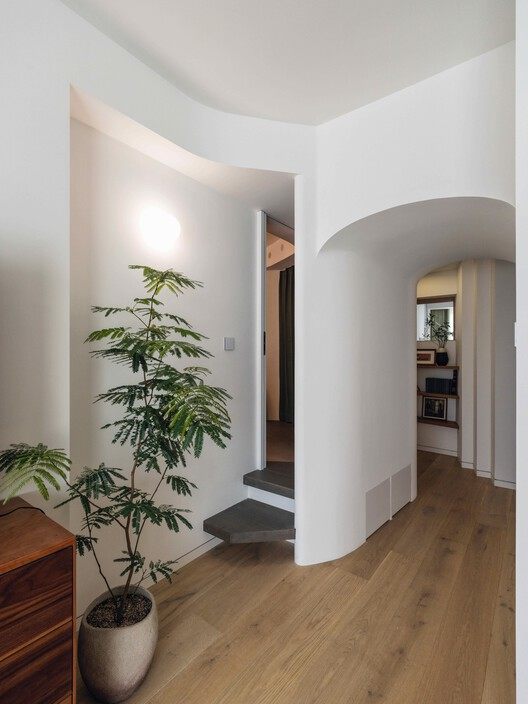
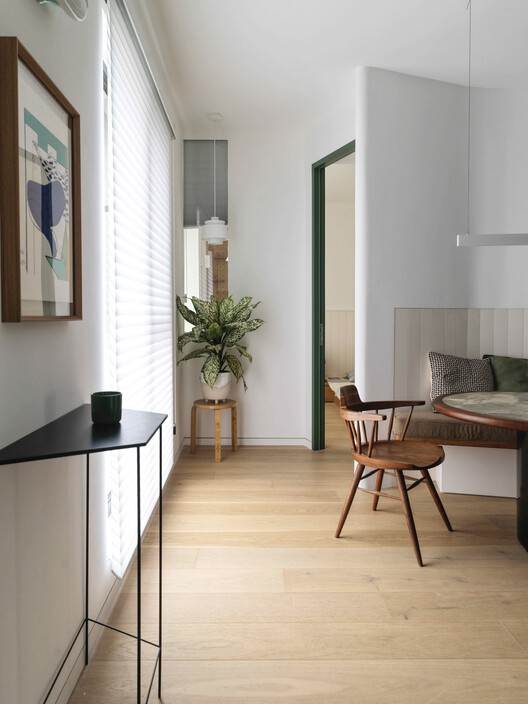
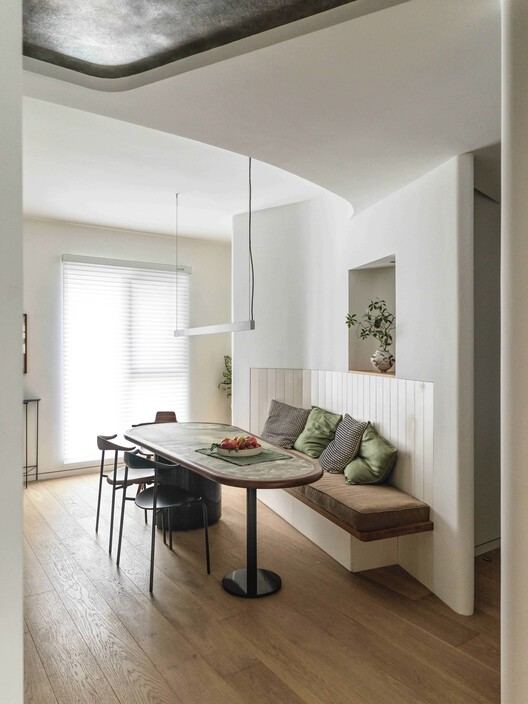
The width of the Cocoon was determined by two conditions: the position of the northernmost point of the living room's east wall and the required passage width around it. It is these extreme dimensions that shaped the small corridor leading from the entrance hall and dining room to the master bedroom. From start to finish, one has to make a U-turn of more than 180 degrees, which is unusual in residential buildings. As mentioned before, the owner disliked the typical L-shaped dark corridor in standard layouts. Since this contradiction could not be resolved, I decided to do the opposite: extend its length and polish its form to artificially create a sense of rhythm, turning "passage" into an interesting affair. The exterior wall of the Cocoon facing the main entrance was slightly skewed northwestward to create an entry enclosure. From here eastward, one enters the first segment of the small corridor. On one side is the raised entrance of the Cocoon, and on the other is the double-folded back wall of the dining booth. This double fold in the wall also helps form a cohesive space for the dining area, precisely leaving a triangular volume on the south side, which was skillfully made into a double-sided connecting niche, facing the dining room from the front and opening to the small corridor from the side. As one moves, they can glimpse the dining room through the beautifully posed plants in the niche. By this point, the light has become very dim. Dimness is usually negative, but in this curved corridor, it aptly awakens the anticipation of exploration, leading to the bright bookshelf at the end through the opened master bedroom door. The bookshelf is illuminated by light from two directions: one from the master bedroom light filtering through the archway, and the other from the clerestory window of the children's room above. Both are indirect lighting, which appears perfectly soft when viewed from the dark area. The lighting here involves a recessed dome in the ceiling that emits a faint glow.
房子里的小巷
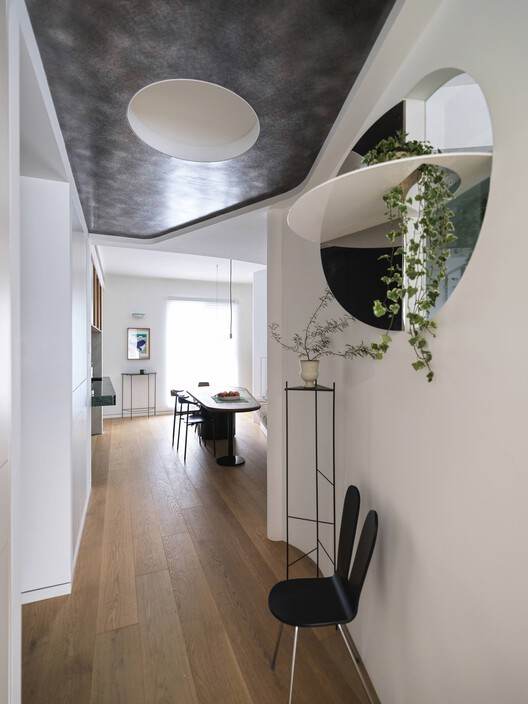
茧房的宽度是由两个条件决定:客厅东墙北侧顶点的位置,和周围通行的宽度。正是这些极限尺寸,塑造了从玄关和餐厅通往主卧的小走廊的形式。从起点到终点,要绕一个回头弯,超过180度,这在住宅中是不寻常的。之前说过,主人不喜欢普通户型中的L形黑走廊。既然无法解决这个矛盾,就反其道而行之,继续延伸它的长度、打磨它的造型,人为制造节奏感,让“通行”成为一件有趣的事。茧房面向主入口一侧的外墙朝西北撇了一下,是为了营造入口围合,从这里向东,就进入小走廊的第一个段落。一侧是茧房抬高的入口,一侧是餐厅卡座双折的背墙。这道墙的双折,也是为了餐厅形成内聚的空间形式,恰好在南侧留出了一个三角形体量,顺势做成双向连通的壁龛,正面朝着餐厅,侧面向小走廊打开。人在行进的时候,可以透过壁龛中的姿态美妙的植物瞥见餐厅。到这里,光线已经很暗了。昏暗本来是消极的,但在这道弯曲的走廊中,却恰好唤醒了探索的预期,通过打开的主卧室门,看到端头明亮的书架。书架被两个方向的光线照亮:一是从拱门里透进来的主卧的光,二是上方儿童房高窗的光。两边都是间接采光,从暗处看去,恰到好处的柔和。这里的照明是在吊顶上挖了一个穹,它发出的光也是淡淡的。
The bedroom door is positioned considering the rhythm of movement. Upon entering, one encounters the second segment of the small corridor, turning 90 degrees to face the bedroom. This dark green door is fitted with a hemispherical high window, which protects privacy while allowing light from above to diffuse to both sides, offering a breath of fresh air. The northeast corner wall is folded three times, echoing the turning path; toilets and suspended cabinets are actually recessed behind it. Turning the corner leads to the final segment of the small corridor, where a deep arch compresses the space, yet makes the view extend further.
卧室门选在这个位置,也是考虑到行进节奏,进了门就是小走廊的第二段,转90度弯后面对卧室。这道墨绿色的门上装了一个半球体高窗,既保护了隐私,也让高处的光弥漫到两边,透一口气。东北角墙体折了三下,呼应拐弯的走势,其实背后嵌着马桶和吊柜。转过弯来进入小走廊的最后一段,这里做了一个有深度的拱,压低了空间,也让视野更远。
Looking back upon entering the bedroom, the archway leading to the small corridor and the narrow entrance of the Cocoon facing the bedroom are tightly adjacent, resembling two mysterious caves leading to the unknown. When moving out from the bedroom, one can more directly see the children's room clerestory and the dual-aspect windows of the dining room. To ensure privacy, the clerestory has internal folding wooden panels, and the soundproof glass forms a transparent box housing the window sashes. This 6-meter-long small corridor brings considerable pleasure to moving between rooms, something completely unimaginable before. Thanks to the property management, I was forced to change the plan into a better form. The hostess's room is now detached from the surrounding walls, not only becoming a true "Cocoon" but also allowing users to feel its roundness and softness from all directions. The alternating experience of light and shadow has become a beneficial adjustment to the monotonous daily routine. Life gains a little scenery because of this "alley inside the house."
进入卧室回过头看,通往小走廊的拱门和茧房朝向卧室的狭窄入口紧紧挨在一起,像两个神秘的洞穴,通往未知的所在。从卧室往外走的途中可以更直接的看到儿童房高窗和餐厅双侧窗,为了保证私密,高窗内置了折叠木隔板,隔音玻璃形成一个透明盒子,收纳了窗扇。6 米长的小走廊,给房间中的通行带来了颇多乐趣,这是之前无论如何也想不到的。多亏物业,逼我把方案改成更好的样子。女主人房现在从四周墙体中剥离出来,不仅成了一个真正的“茧”,也方便使用者从各个方向去感受它的圆润与温柔。明暗交替的行走体验,成了乏味日常的有益调剂。因为这条“房子里的小巷”,生活多了点小小风景。
© 金秋野建筑工作室
© 金秋野建筑工作室
© 金秋野建筑工作室
A Touch of Greenery, A Few Skylights:
Usage requirements drive spatial division; spatial division creates confinement; confinement necessitates appropriate ventilation to extend sightlines. Besides the hemispherical window on the corridor door, the glass box window in the children's room, and the double-sided window in the dining room backdrop wall mentioned earlier, the most peculiar feature is the flower stand mirror window of the Cocoon facing the entrance.
一点绿意,几处轩窗
使用需求驱动空间划分,空间划分造成限定,限定带来围合感,这时候需要适当透口气,让视线延伸出去。除了刚才提到的走廊门半球窗、儿童房玻璃盒子窗和餐厅背景墙双向窗,最特别的要数茧房面向入口处的花架镜窗。
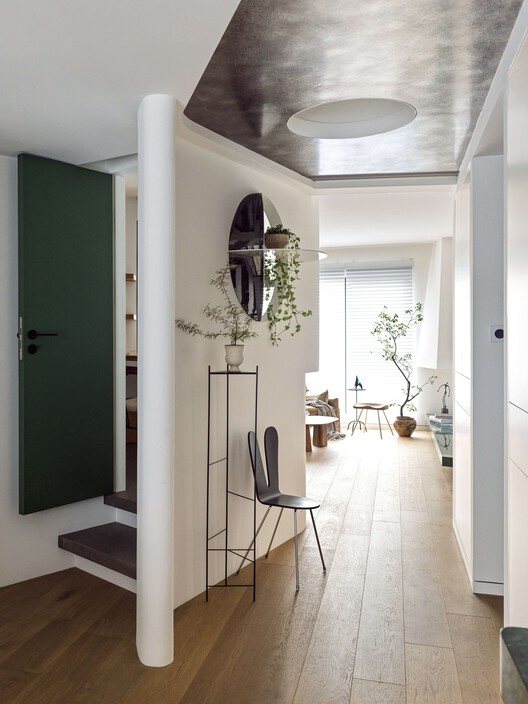
It is actually a spatial installation, half open with embedded glass, and half composed of mirrored stainless steel and white-painted stainless steel arranged in an alternating pattern—a "mirror window." Two vertical stainless steel semicircular shelves are arranged at an acute angle to avoid directly facing the entrance. A vigorous Japanese Snowbell is placed on the horizontal shelf, its branches draping down from the reserved fan-shaped opening. The mirror window reflects the surrounding scenery, the circular window reveals the warm light of the Cocoon, and the plant leaves overlap in the mirror, creating a dazzling, ever-changing miniature album page when viewed in motion. Below, on a triangular-section high-legged flower stand, sits a Mimosa pudica with widely spread branches, gazing across at the mirror window, together forming a scenic focal point opposite the entrance.
它其实是一个空间装置,一半漏空镶嵌玻璃,一半是镜面不锈钢和白色喷涂不锈钢交叉组成的“镜窗”,其中竖向不锈钢半圆托板有两片,呈锐角布置,避免正对入口。横板上放一盆蓬勃的日本雪莹,枝条从预留的扇形洞口悬垂下来。镜窗反射周围景物,圆窗透出茧房暖光,植物的叶子在镜中交叠,运动中看,成了一幅变幻迷离的小品册页。下面的三角形截面高脚花架上是一盆枝条舒张的密叶合欢,与镜窗顾盼相对,共同成为入口对景。
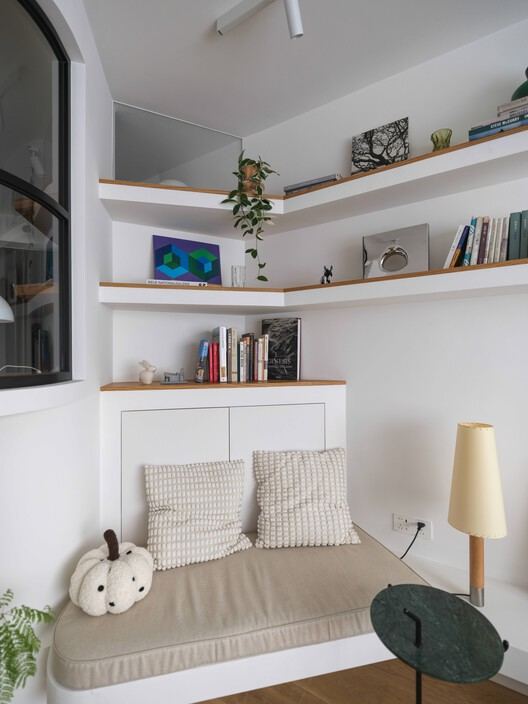
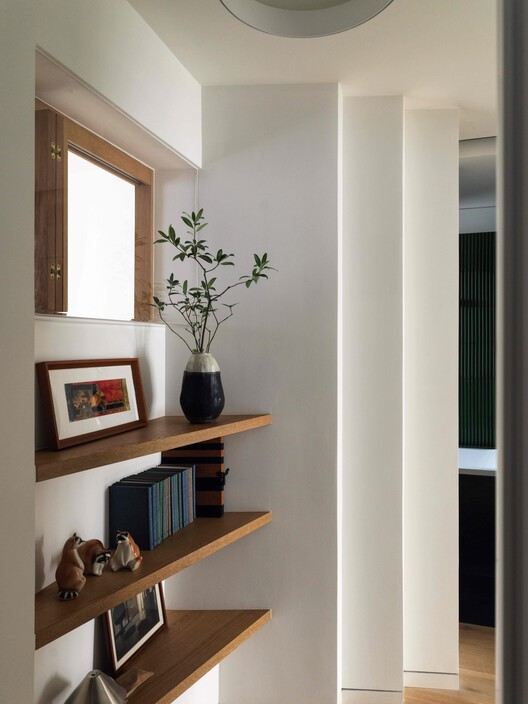
The dining table is custom-made. The backrest of the double-folded booth seating uses wall panels with vertical lines, which, along with the green semicircular glazed tiles of the adjacent sideboard, evoke a sense of family gathering. A beautifully posed Coral Beads plant is placed in the double-sided window, its branches spreading to fill the width of the niche and then extending a branch out to the small corridor through the side opening. To make this "residential miniature garden" more lively, we carefully selected plants for every corner. In the southwest corner of the living room, facing the entrance hall, is a large Coral Beads plant with lush foliage. Behind the sofa are Philodendron Florida Ghost and Velvet Leaf Alocasia. The piano beneath the Cocoon was canceled by the owner and replaced with a Jacaranda tree, paired with Monstera deliciosa 'Macetta'. A variegated Cymbidium hangs from a high shelf, mirroring the light niche in the Cocoon through a sheet of glass. The northeast corner of the living room features a small extension below the bookshelf, creating a dual-person seating area facing the sofa, further emphasizing the outdoor feel of the Cocoon's large window. The Epipremnum pinnatum at the corridor turn, the Aglaonema at the children's room door, the Sea Grapes in the secondary bedroom, and the Pilea involucrata in the master bedroom, subtly appear between windows, behind doors, or at corners, adding a touch of vibrant greenery to the residence.
餐桌是定制的,双折背景墙卡座靠背采用护墙板,竖向线条与对面餐边柜的绿色半圆截面瓷砖一起,烘托出家庭团聚的气息。双向窗中摆一盆姿态美丽的海岛春花,枝条舒展开来,撑满壁龛的宽度之后,又从侧面洞口向小走廊探出一枝。为了让这座“居室小园林”更显活泼生动,我们为每个角落精心选配了植物。客厅西南角,正对玄关是一株较大的海岛春花,枝叶扶苏。沙发后面放佛罗里达蔓绿绒和绿天鹅绒海芋,茧房下方的钢琴被业主取消了,放一株蓝花楹,搭配松染海芋,高处架子上垂下一盆三色锦画球兰,通过一面玻璃与茧房高处的灯龛相望。客厅东北角书架下面斜出一笔,设一双人卡座,与沙发遥遥对坐,更强化了茧房大窗的户外感。走廊转角处的仙羽蔓绿绒、儿童房门口的万年青、次卧的海葡萄和主卧的密叶猴耳环,在窗间、在门后、在转角不经意闪现,为居室平添一份盎然的绿意。
© 金秋野建筑工作室
© 金秋野建筑工作室
© 金秋野建筑工作室
Everyone is a "Garden":
My assistant told me: Writing in such meticulous detail is like lecturing undergraduates; have you gotten too used to the role of a teacher and simply can't stop? In fact, these detailed thought processes and design insights are basic knowledge for architects. I record them not for experts, but for the general public. Everyone has a home, and every home has a look. What should your home look like? Should it be a model room from a sales office, or a display setting from IKEA? Modern technological idealists have long held a premise: that the ideal of "housing for all" can be achieved through the productization of residences, leading to concepts like prefabrication, industrialization, and modular assembly. These concepts are generally easier to gain support from relevant authorities because their starting point is collective, social, and economic, rather than individual, vital, and experiential. However, beyond this social self, there exists a more authentic, purer existential self, the vessel for each person's spiritual life and lived experience. In this sense, a residence can be an anchor for human existence, an externalization of the inner self. One can gauge a person's spiritual level by the neatness and aesthetics of their living space; further still, the formal language of the residential space is connected to the cultural character of its owner.
每个人都是一座“园林”
助手对我说:这么事无巨细的写,好像在给本科生上课,是不是习惯了老师这个角色,根本停不下来?其实这些细致琐碎的思考过程和设计心得,对建筑师来说属于入门常识,我把它记录下来,不是给专家看,而是给大众看的。每个人都有一个家,每个家都有一个样子。你的家该是什么样子?是售楼处的样板间,还是宜家家居的展示处?现代以来的技术理想主义者一直有一个预设,希望通过住宅的产品化,来实现居者有其屋的理想,于是有了预制化、产业化、装配式这些概念,说这些比较容易得到有关部门的支持,因为它的出发点是集体的、社会的、经济的,而不是个体的、生命的、体验的。但在社会性自我之外,另有一个更加本真、更加纯粹的存在性的自我,每个人的精神生活和生命体验的载体,正是在这个意义上,居室可以是人的存在之锚,是内在自我的外化,可以从居室的整洁美观程度看到一个人的精神水平,再进一步,居室空间的形式语言与主人的文化人格是联系在一起的。
I recall the detailed descriptions of residential environments in Haruki Murakami’s early novels, full of infinite yearning for European and American culture. From the book he wrote about running, one can tell he is a highly disciplined person, but his cultural identification is not particularly astute. All formal languages are cultural; the "objective form" of pure neutrality advocated by modernists does not exist. But I want to set aside these discussions for a moment and talk about the relationship between function and form.
我看春上村树早期小说中关于居室环境的细致描写,充满了对欧美文化的无限向往。从他写跑步那本书可以看出是非常自律的人,但在文化认同方面却谈不上高明。所有的形式语言都是文化性的,现代主义者主张的纯中性的“客观形式”并不存在。但我想暂时搁置这些讨论,谈谈功能与形式的关系。
I record the design process in such painstaking detail to tell everyone: you are not someone else; you are yourself. Casually choosing a "style" to decorate your space implies a lack of understanding, respect, or responsibility towards your unique individuality. Understanding oneself is not difficult; it simply involves recording one's thoughts and needs regarding habitation truthfully, neither adding nor subtracting, and then comparing them with reality. You will find that almost no family's true needs are met in the existing residential layouts. At this point, one must let the conditions speak, confront them seriously, and finding one or two effective spatial solutions is not difficult. This has nothing to do with artistic cultivation; it belongs purely to the realm of rational deduction, somewhat like a middle school student solving a math problem—but not for an exam, but for life, and it's worth everyone's effort to think it through.
我把设计过程事无巨细的记录下来,是想告诉每一个人,你不是其他人而是你自己,随意选择一种“风格”来装饰你的空间,意味着对独一无二的个体性的不了解、不尊重、不认不负责。了解自己其实不难,就是把关于居住的想法和需求原原本本、不多不少地记录下来,然后与现实做一个比对。你会发现,几乎没有一个家庭的真实需求会在现有的居室格局中得到满足。这时候要让条件说话,认真面对,得到一两个有效的空间解答并不困难,这与艺术修养无关,纯属理性推演的范畴,有点像中学生解数学题,但不是为了考试,而是为了生活,值得每个人动动脑筋。
I strongly oppose randomly picking an off-the-shelf "style" and applying flat coatings to the walls. A graduate student once messaged me: "You tailor designs for individualized lifestyles, yet adhere to rational functional logic in the design... the pursuit of extreme functionality ironically results in an emotional form." Like the Cocoon in this design, it would have been unimaginable and could never have turned out this way without the owner's personalized needs and the property management's unpredictable behavior. Its existence then spurred the small corridor, the embracing dining room, and the unique entrance mirror window. None of this required profound design theory or extensive architectural history knowledge; fully listening to one's own heart was enough. Ultimately, regardless of scale or design type, "arbitrariness" is the most terrifying thing. I do not oppose emotion, but yielding solely to emotional impulses is not only immature but also a cognitive misconception, leading to the misuse and abuse of formal language.
我特别反对随便选一种现成的“风格”,在四壁做平面化的涂抹。一位已经毕业的学生给我留言:“你为个体差异化的生活方式量身定做,但在设计上还是秉持理性功能逻辑……追求极致功能反而呈现出了感性的形式”。就像这个设计中的茧房,如果不是业主的个性化需求,如果不是物业的出尔反尔,是不可能想象的、更不可能长成这个样子,而它的存在又催生了小走廊、环抱的餐厅和独特的玄关镜窗。这一切都不必诉诸于高深的设计理论和系统的建筑史知识,只要充分倾听自己的心声就够了。说到底,无论什么尺度、什么类型的设计,“任意性”是最可怕的。我并不反对感性,但听凭感性的驱使,不仅是不成熟的,而且是一种认识误区,是对形式语言的滥用和误用。
When I compare a residence to a garden, some might find it far-fetched. But look at the online videos—couples quitting their jobs to build massive 50-mu estates in the mountains—isn't that just a fantasy propagated for show? Even in ancient times, gardens were rarely related to ordinary people. If a garden cannot be universally accessible in daily space, it is destined to remain a luxury item. Everyday space consists of two interconnected parts: the residence for the individual, and the city for the collective. Only when the garden extends into these two domains does the spatial wisdom of the ancients truly become living reality, benefiting everyone.
当我把居室比做园林,难免会有人觉得牵强,可是看看网上那些视频 —— 夫妻俩辞了工作跑到山里盖 50 亩大园宅之类,难道不是为传播制造的幻觉吗?即使在古代,园林也与普通人关系甚微。如果园林不能普惠于每个人的生活,就注定无法摆脱奢侈品的定位。日常空间包括两个彼此关联的部分,对个体而言就是居室,对集体而言就是城市,只有当园林延伸到这两个范畴,古人的空间智慧才真正成为活的现实,让每个人从中受益。
Fortunately, the garden, as a way of thinking and a design language, is not limited to the narrow definition of "classical garden." Its methodological core is "borrowing and adaptation" (Yin Jie)—rationally dealing with complex conditions: "Discard the vulgar, embrace the excellent" (Su ze ping zhi, jia ze shou zhi), maximizing layers and richness, seeing the grand in the small, which is what Ji Cheng called "Without dividing the land into plots, everything becomes picturesque scenery." Like the small corridor in the Cocoon House, it wasn't intentionally designed to be winding, nor was it an imitation of a certain style. It emerged naturally from rational thinking and patient refinement, resulting in a look of "winding yet exhaustive" (Qu zhe jin zhi). "Garden" here represents the design methodology of going with the flow and the rich diversity naturally achieved. The pursuit of extreme functionality triggers an extreme aesthetic experience, allowing the residence to become the embodiment of the owner's wishes and pursuits—the external manifestation of individual existence. Therefore, if someone asks me what the future of housing should look like, I hope it won't be standardized products like cars or mobile phones, but rather existences as rich and personalized as gardens. When the individual is truly respected and personality is fully expressed, everyone can be a garden.
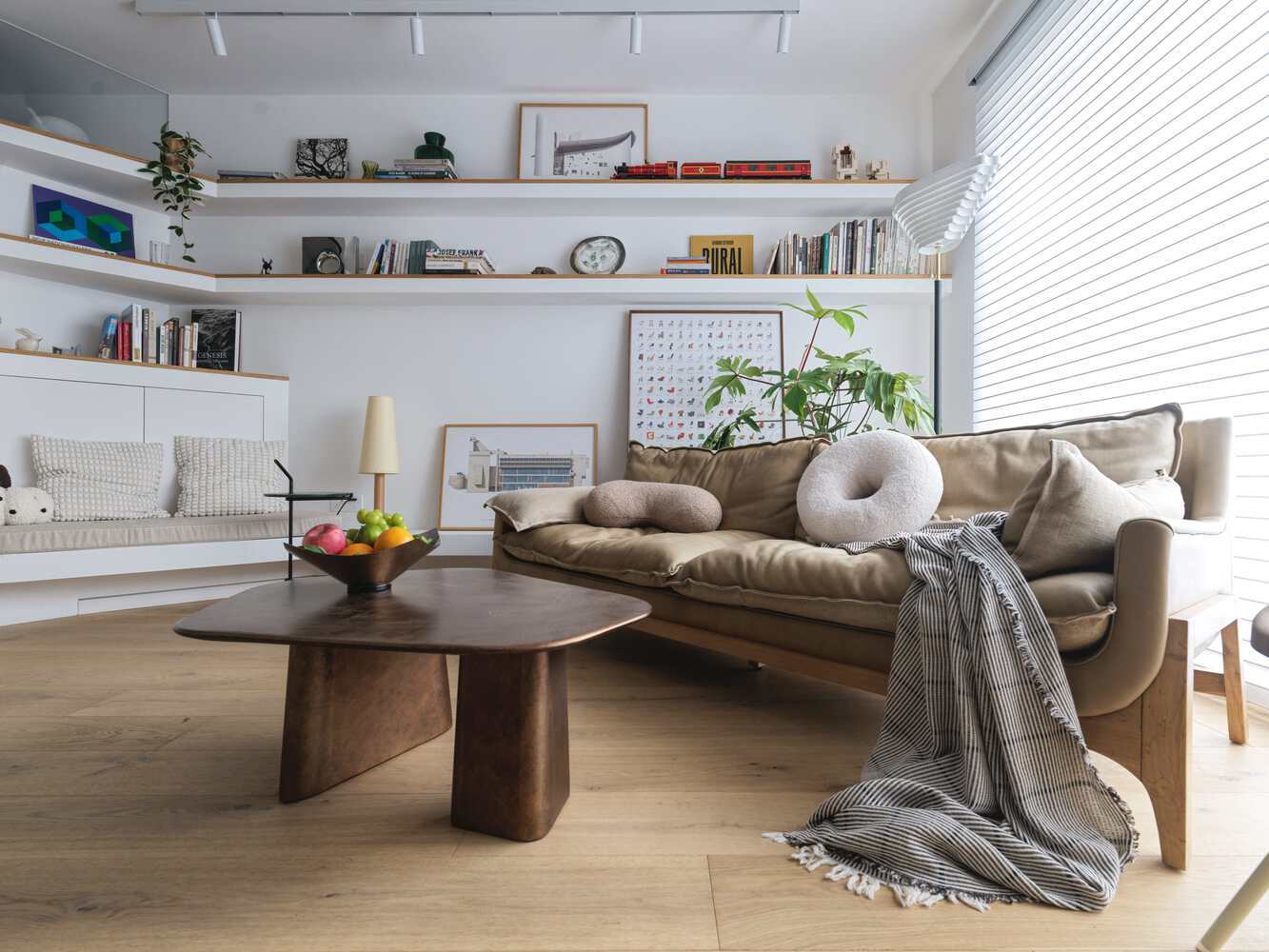
幸好,园林作为一种思想方法和设计语言并未局限在“古典园林”的狭义层面,它的方法论内核是“因借”,即理性处理杂多条件,“俗则屏之,嘉则收之”,最大化的展现层次和丰富性,小中见大,就是计成所说的“不分町疃,尽为烟景”。就像茧宅中的小走廊,不是故意追求曲折,也不是照搬某种风格,而是理性思考、耐心推敲,方案就自然呈现出“曲折尽致”的样子。“园林”在这里代表着顺势设计方法论及其自然达成的丰富多样,极致的功能追求引发了极致的审美体验,让居室成为主人愿望和追求的化身,也就是个体存在姿势的外显。所以,如果有人问我未来住宅该长什么样,我希望不是汽车、手机那种标准化产品,而是园林那样丰富又个性化的存在。当个体得到真正的尊重、当个性得到充分的表达,每个人都可以是一座园林的。
© 金秋野建筑工作室