模块化与可逆性:城市空间的灵活介入:该项目作为一种过渡性基础设施,其核心亮点在于高度模块化和完全可逆的建造方式。由6米x8米x5米的标准单元构成,通过干接合技术实现快速组装和拆卸,使其能够适应波哥大城市中各种不规则的公共空间,如街道、广场或庭院。这种“出现和消失”的特性,避免了对场地造成不可逆的物理影响,尤其是在遗产环境中,体现了对城市文脉的尊重与审慎介入,完美契合了临时性干预策略。
河流意象的抽象表达与文化激活:设计深度融合了对波哥大城市水系统和河流的哲学思考。顶棚采用的流动材质和内部“幻影河流”的装置,通过15,000片蓝色织物碎片对水体的动态特性进行抽象再现。风吹动碎片产生的位移,不仅与河流的物理属性形成对话,更在光影变化中营造出不断变化、富有生命力的内部氛围。这种设计策略成功地将文化活动与场地记忆(河流记忆)紧密联系起来,实现了城市空间的功能性激活与文化叙事的统一。
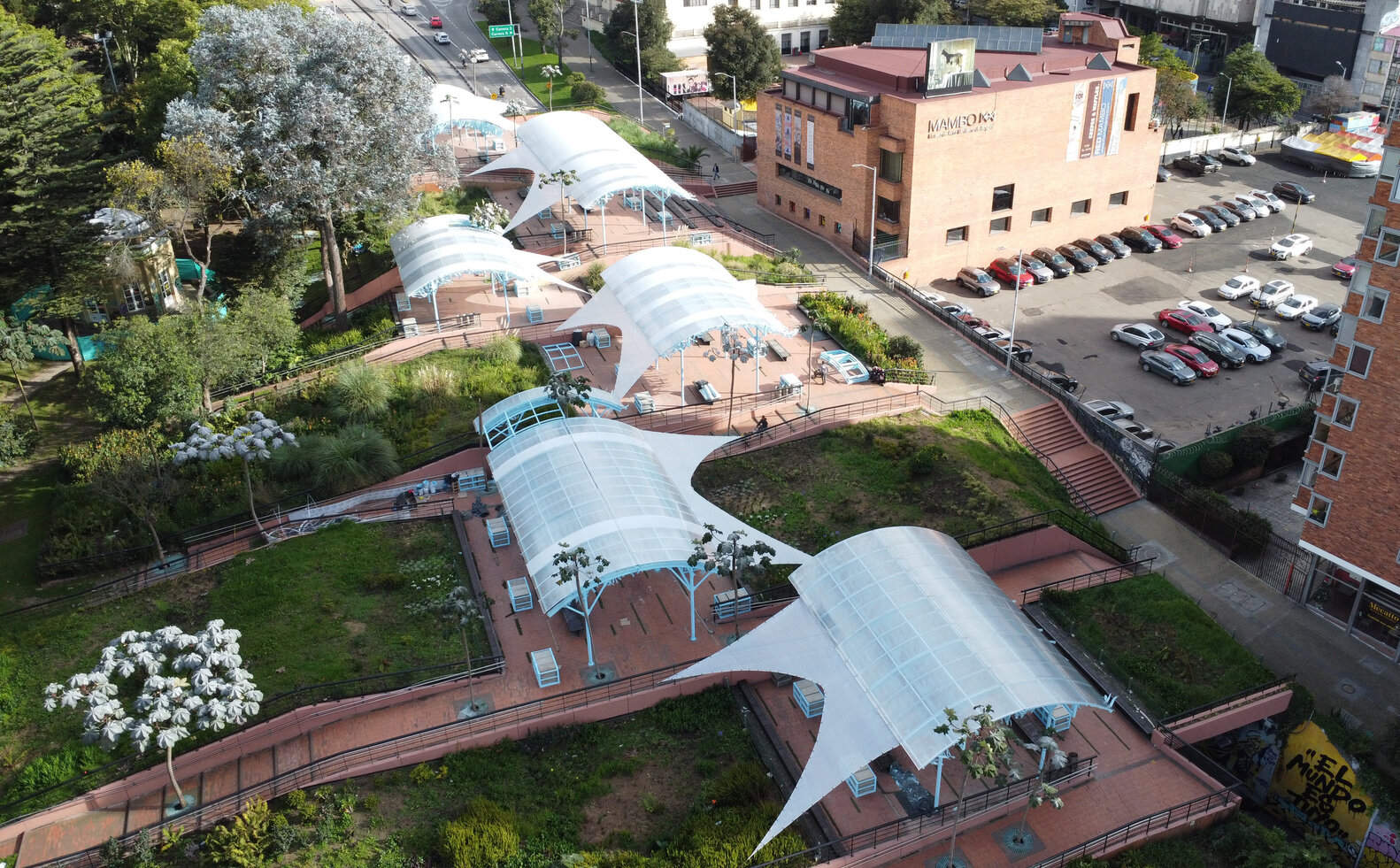
适应性布局与巡回文化基础设施定位:该项目成功地在复杂多变的城市环境中展示了强大的适应性。在双百年公园的初始选址中,其布局模拟了河流在山谷中的自然流淌,展现了建筑对特定场地条件的响应能力。作为一项移动文化基础设施,其设计初衷即是为了在城市不同街区间巡回,举办多样的文化活动。这不仅拓宽了文化设施的服务半径,也使其超越了传统临时建筑的范畴,成为一个伴随城市节奏、强化社区联系的动态艺术装置。
The "Memory of the River" installation is situated at the intersection of public art and temporary architecture. It is conceived as a transitional infrastructure aimed at reactivating urban spaces in Bogotá through cultural uses. The project was initiated by the Ministry of Culture, Recreation, and Sports (SCRD), led by Minister Santiago Trujillo, with Diego Parra as the Director of Arts, Culture, and Heritage, and specifically planned and executed by the Infrastructure and Cultural Heritage division, headed by Edgar Figueroa. Team members included Edgar Bernal, Emmanuel Guerra, Juliana Mendoza, Diego Rodríguez, and Juan Sebastián Robayo. They advocated for temporary intervention over permanent construction as a strategy to decentralize cultural uses and enable events across different city neighborhoods.
“河流记忆” 装置坐落于公共艺术与临时性建筑的交汇点,它被构想为一种过渡性基础设施,旨在通过文化用途重新激活波哥大市的城市空间。该项目由文化、娱乐与体育部(SCRD)发起,部长为圣地亚哥·特鲁希略(Santiago Trujillo),艺术、文化与遗产局局长为迭戈·帕拉(Diego Parra),并由该部基础设施与文化遗产处具体策划实施,该处处长为埃德加·菲格罗亚(Edgar Figueroa),团队成员包括:埃德加·贝尔纳尔(Edgar Bernal)、埃马纽埃尔·格拉(Emmanuel Guerra)、胡利安娜·门多萨(Juliana Mendoza)、迭戈·罗德里格斯(Diego Rodríguez)和胡安·塞巴斯蒂安·罗瓦约(Juan Sebastián Robayo)。他们主张采用临时性干预而非永久性建设,以此作为分散文化用途、让城市不同街区都能举办活动的策略。
© Alsar-Atelier
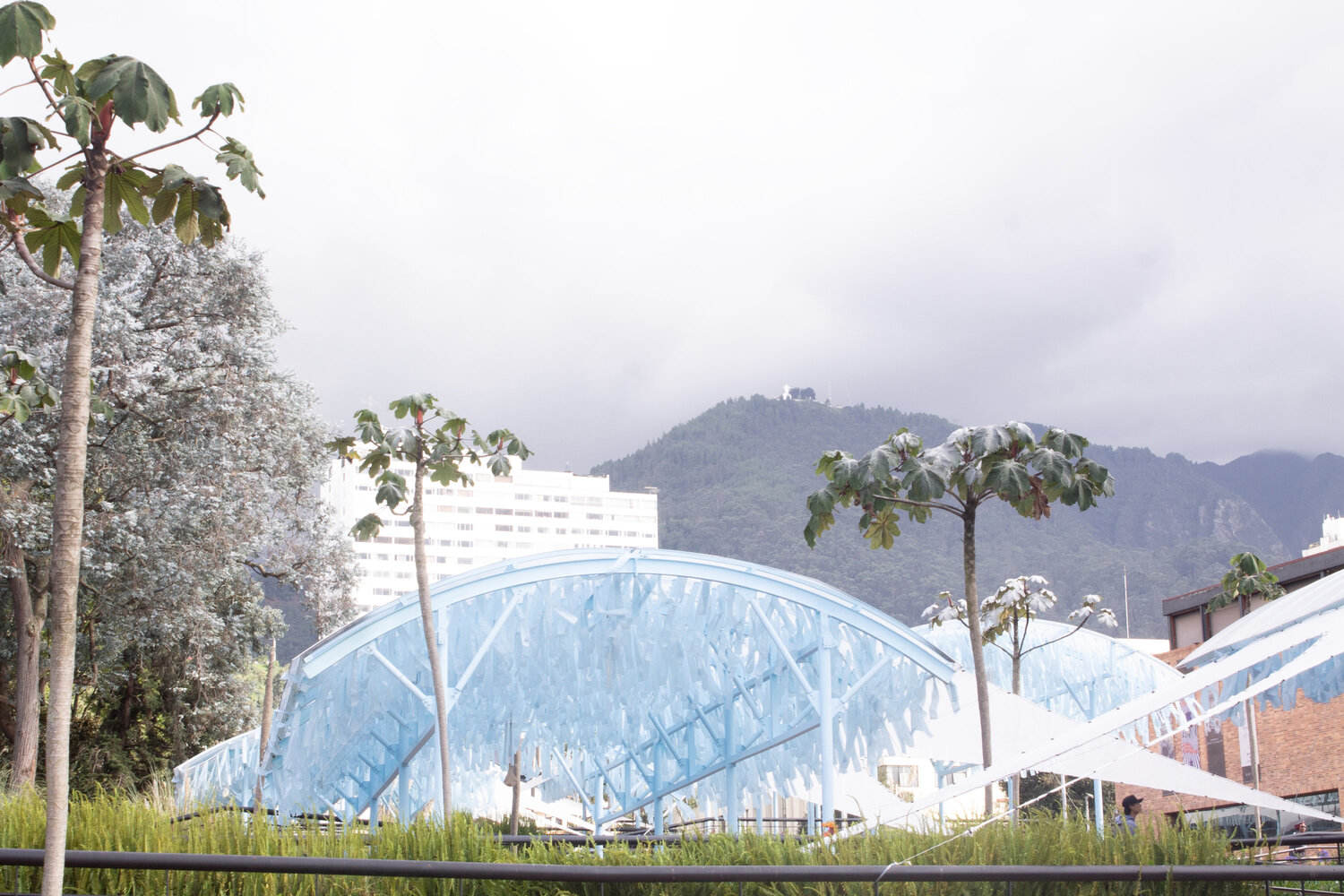
The project proposal's concept references the city's water systems, particularly the rivers—natural infrastructures that have long been underutilized in Bogotá's urban development. Originating from the Eastern Hills, these systems are characterized by their dynamic nature and ability to adapt to different spatial and temporal conditions. This phenomenological feature laid the groundwork for conceiving a modular, flexible, and adaptable canopy, whose fluid materiality is intended to evoke and celebrate the páramo's water systems.
该项目提案的概念参考了城市的水系统,特别是河流 —— 这些在波哥大城市发展过程中长期未得到充分利用的自然基础设施。这些水系统发源于东山,以其动态特性和适应不同时空条件的能力而著称。这一现象学特征为构思一个模块化、灵活且适应性强的顶棚奠定了基础,其流动的材质旨在唤起并颂扬草原的水系统。
© Alsar-Atelier
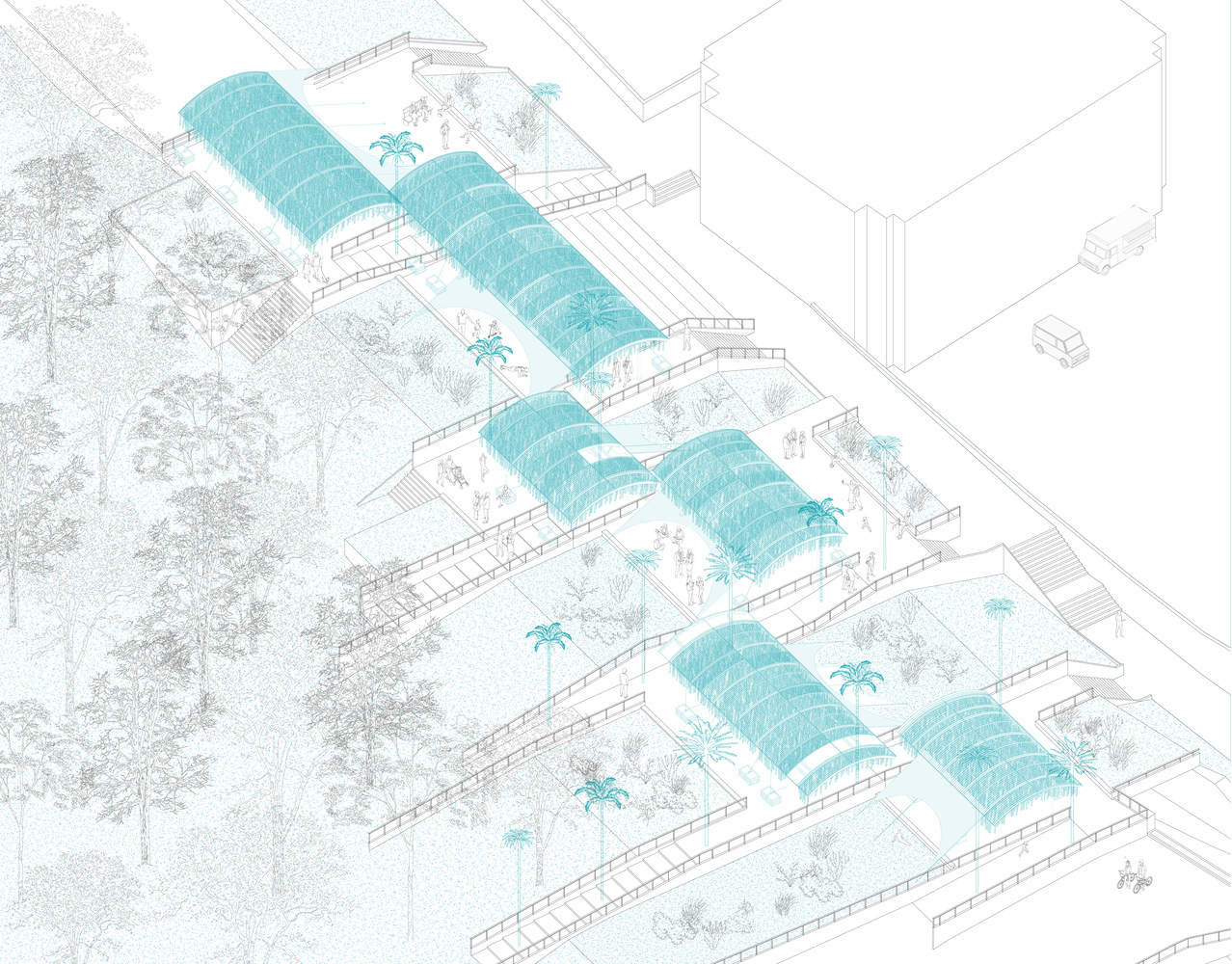
Axonometric view
Guided by these concepts, the team—comprising El Líder S.A.S., INGEACERO, and Alsar-Atelier—developed a module measuring 6 meters in length, 8 meters in width, and 5 meters in height, defined by an arched lifting structure that allows for unidirectional expansion. The building system is entirely dry-assembled, enabling the modules to function as prefabricated components suitable for various urban environments—streets, plazas, or courtyards—and adaptable to different spatial layouts. Furthermore, the module can be subdivided to activate multiple city spaces simultaneously. Due to the absence of permanent anchors, the structure can even be installed in heritage environments without causing irreversible impact, reinforcing its status as reversible architecture capable of appearing and disappearing, leaving only a trace in memory.
基于这些概念指导,由 El Líder S.A.S.、INGEACERO 和 Alsar-Atelier 组成的团队开发了一个长 6 米、宽 8 米、高 5 米的模块,其单向扩展性由拱形提升结构定义。该建筑系统完全采用干接合方式,使模块能够作为可组装部件发挥作用,适用于各种城市环境 —— 街道、广场或庭院,并能适应不同的空间布局。此外,该模块还可细分,以同时激活城市中的不同空间。由于没有永久性锚点,该结构甚至可以在遗产环境中安装,而不会造成不可逆的影响,从而强化了其作为可逆建筑的条件,能够出现和消失,仅通过记忆留下痕迹。
© Alsar-Atelier
© Alsar-Atelier
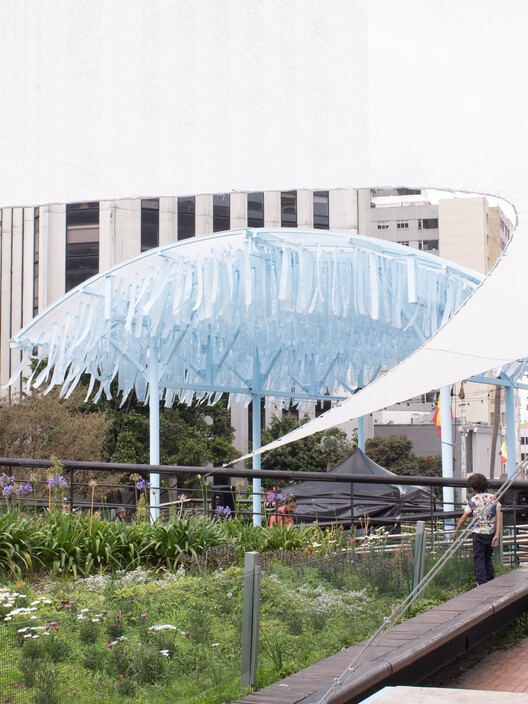
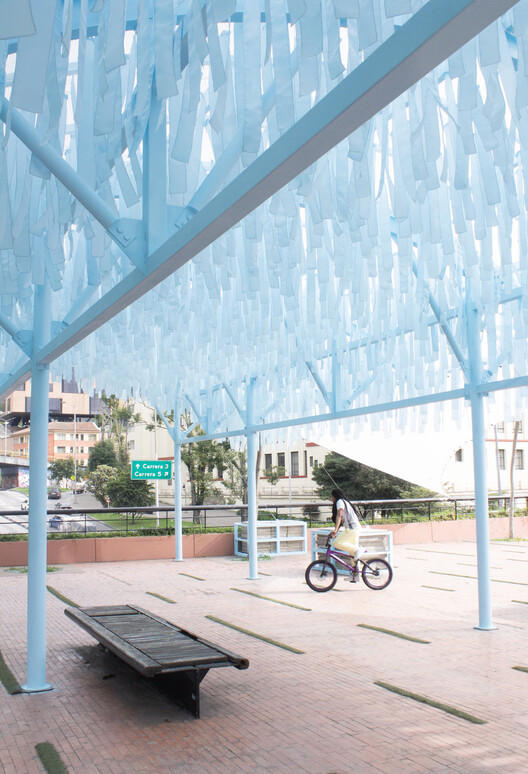
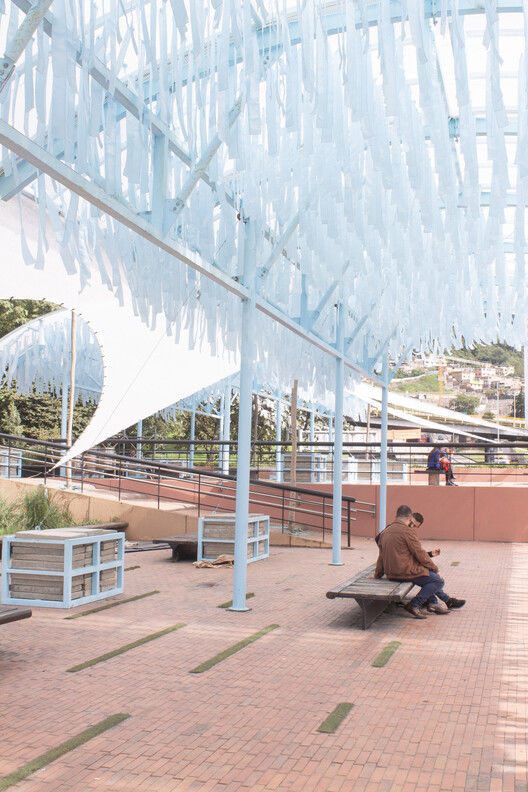
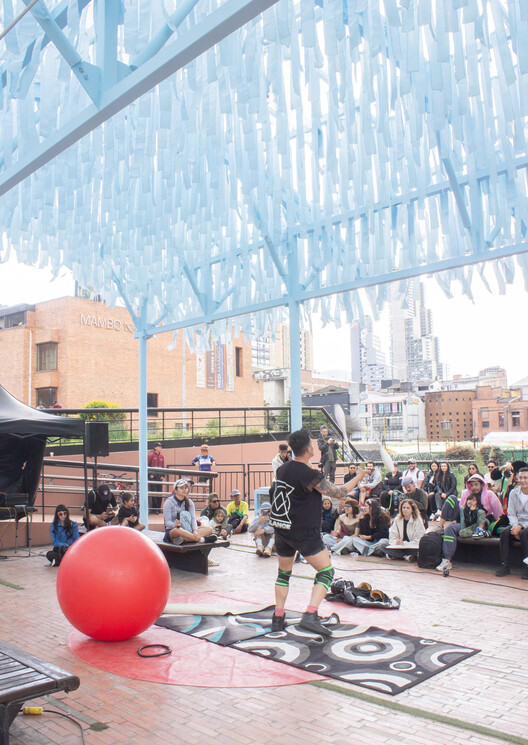
Within this conceptual framework, the internal atmosphere of the project aims to abstractly represent the behavior of water, paying homage to the memory of the river through the "Phantom River" image suspended from the canopy. Water, as a liquid substance composed of constantly moving particles, is rendered on the ceiling by 15,000 pieces of blue fabric. The displacement generated by the wind establishes a direct dialogue with the physical properties of the river, creating a constantly changing atmosphere under the transparent polycarbonate canopy, varying with changes in light, shadow, and transparency.
在这一概念框架下,项目的内部氛围旨在抽象地表现水的行为,通过悬挂在顶棚上的“幻影河流”形象向河流的记忆致敬。水,作为一种由不断运动的粒子组成的液态物质,在天花板上通过 15,000 片蓝色织物碎片得以呈现。风产生的位移与河流的物理属性建立了直接对话,当位于透明聚碳酸酯顶棚下时,则根据光影和透明度的变化产生不断变化的氛围。
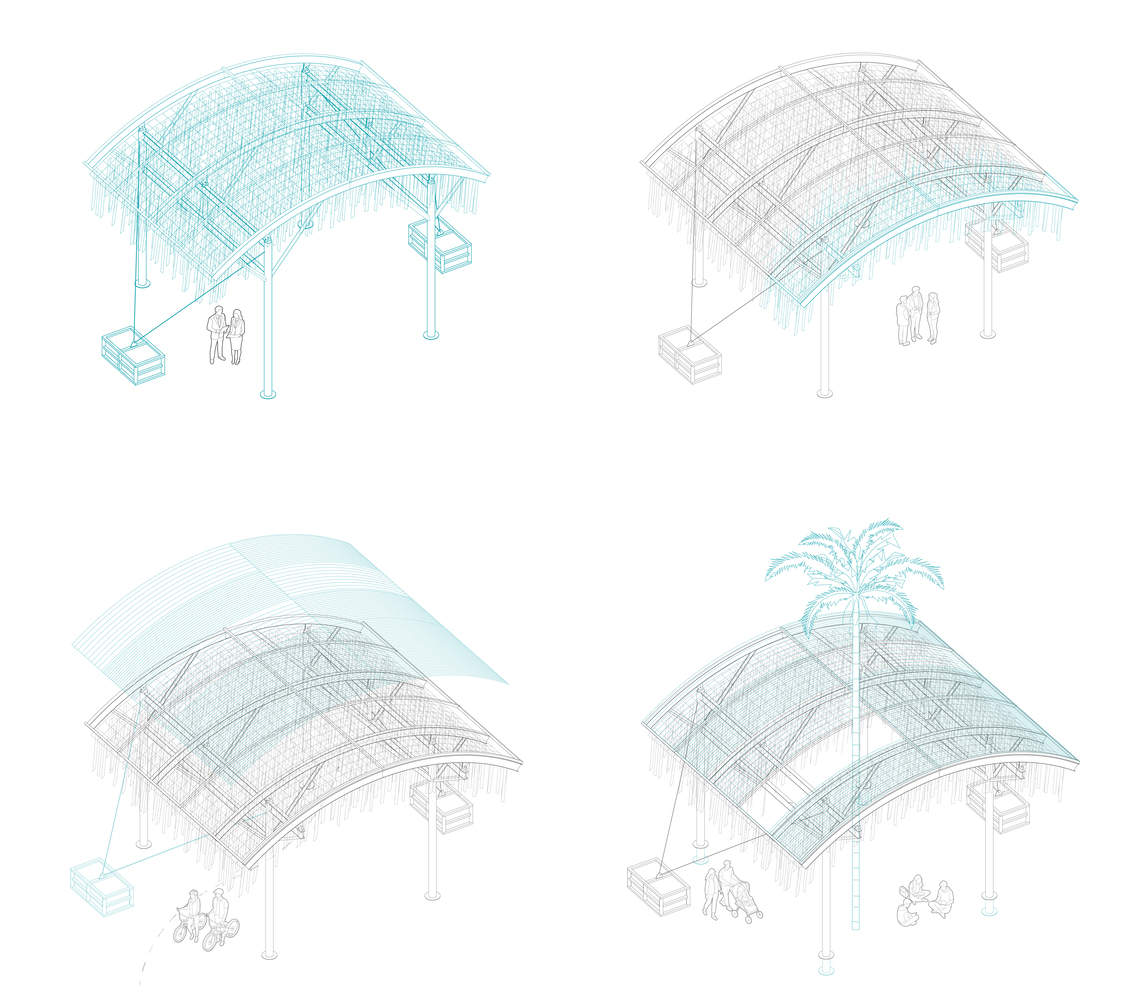
Diagram
The primary installation site and functional testing ground was the Bicentennial Park, designed by architect Giancarlo Mazzanti, situated between the Parque Independencia and the Museum of Modern Art in Bogotá. In an environment lacking clear dimensional order and with variable topography, "Memory of the River" adapted its layout in a manner similar to how a river naturally flows through a valley. The project took four weeks to build and has hosted various cultural events, including gastronomy, circus, art, and theater performances. It will remain in this location until the first half of 2026, after which it will tour to different points in the city, solidifying its status as a mobile cultural infrastructure.
作为初始安装地点和功能测试地,选择了位于独立公园与波哥大现代艺术博物馆之间的由建筑师吉安卡洛·马赞蒂(Giancarlo Mazzanti)设计的双百年公园。在这样一个缺乏明确尺寸秩序且地形多变的环境中,“河流记忆”以类似于河流在山谷中自然流淌的方式进行了适应性布局。该项目耗时四周建成,已举办了包括美食、马戏、艺术与戏剧表演在内的各种文化活动。2026 年上半年,该项目将继续留在此地,随后将在城市的不同地点进行巡回安装,巩固其作为移动文化基础设施的地位。
© Alsar-Atelier
"Memory of the River" is conceived as more than just a temporary structure; it is a public art sculpture: a piece of ephemeral architecture that paces the rhythm of the city, aiming to reconnect Bogotá with the memory of its rivers and showcase the transformative potential of culture within urban space.
“河流记忆”不仅仅是一座临时建筑,它更被设想为一座公共艺术雕塑:一座伴随城市节奏的临时性建筑,旨在让波哥大重新与河流的记忆相连,展示文化在城市空间中的变革潜力。
© Alsar-Atelier