核心理念与空间原型:该项目巧妙地将“开放共享式教育”理念植入深圳高密度城市背景下。以“U”型半围合院落为空间原型,将教学单元环绕共享核心功能区,成功打破了传统校园的封闭性。通过将图书馆、体育馆等共享设施面向中庭开放,实现了教育功能向全校园的渗透,创造了一个鼓励偶然交流与知识碰撞的复合学习环境,充分体现了对新型教育模式的空间回应。
水平化与垂直平等的设计策略:项目通过创新的“多零层活动平台”设计,强调建筑的水平性延展,将原本被视为“碎片时间”的课间十分钟转化为有价值的阳光与游戏时间。更重要的是,这种设计策略消弭了传统高密度建筑中因楼层差异带来的空间不平等,确保了所有学生都能平等享有活动空间,这不仅是对儿童行为模式的深刻理解,也是对教育公平性的空间实践,增添了“随意”的“玩具”丰富日常体验。
高密度环境下的可持续与场所精神:面对容积率2.26的高密度挑战,设计并未屈服于压抑,而是通过“多孔、开放”的形态促进了自然通风和微气候调节,体现了对深圳湿热气候的积极应对和可持续性考量。最终,建筑的开放与自由气质与周边城中村的有机肌理相融合,实现了设计初衷与社区环境的良性互动,使高密度校园转化为塑造场所特色的机遇,展现出设计与日常行为之间难得的默契。
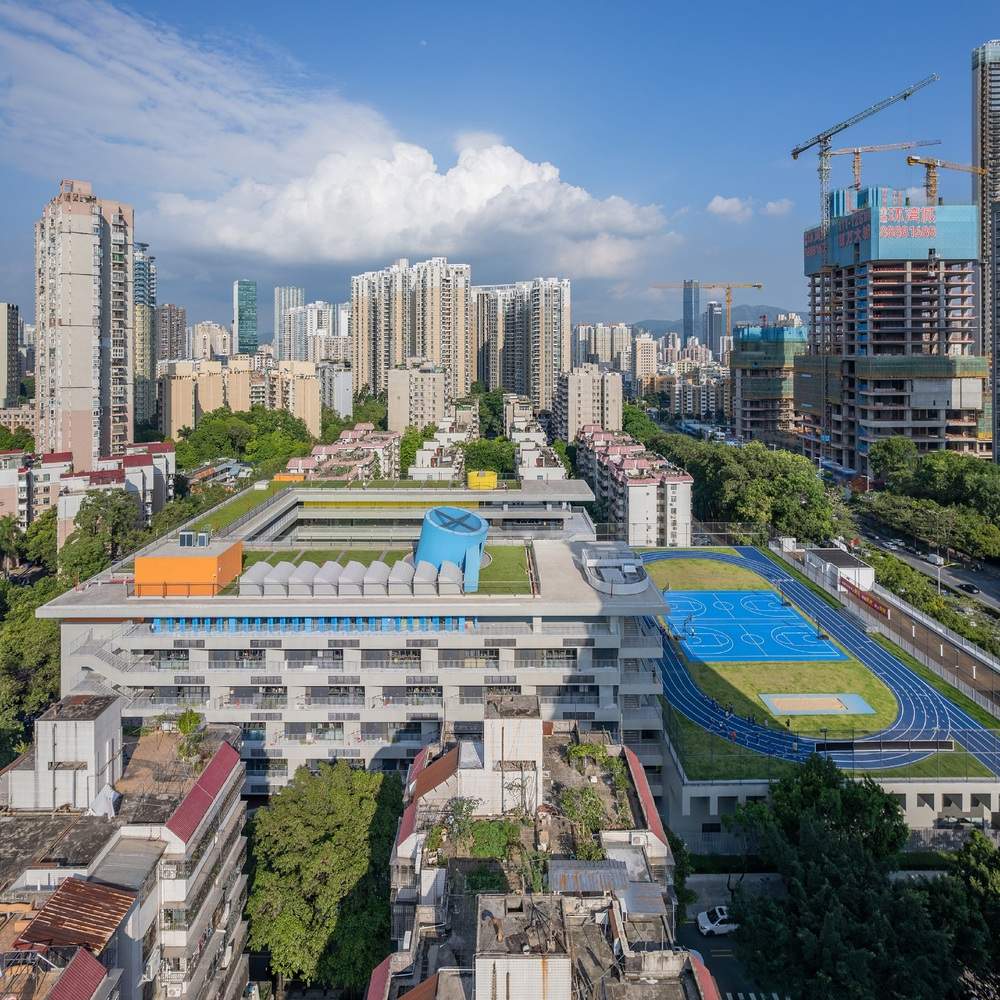
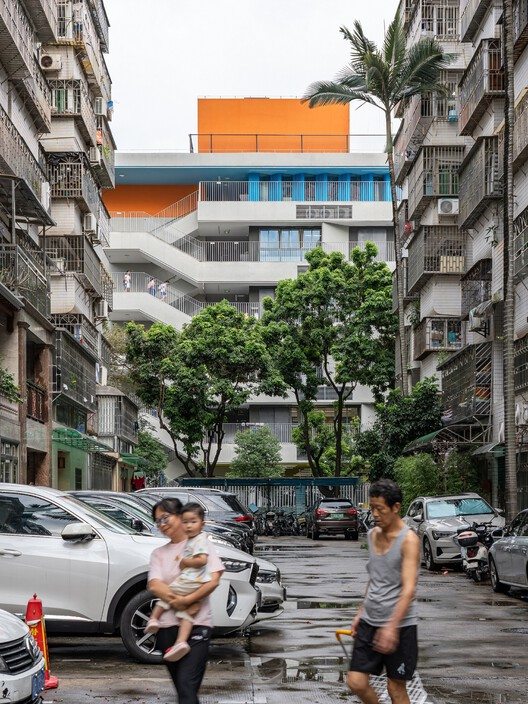
The site is located in Xinzhou, an important residential area south of the Futian Central Business District in Shenzhen. Years of mixed commercial and residential use, along with urban villages, have created a rich urban fabric characterized by diverse communities and street life. I lived in Xinzhou for seven years after first settling in Shenzhen. It may not be "beautiful" or "efficient," but it offers what is increasingly rare in standardized urban development: the serendipity of life, social diversity, spatial inclusivity, and organic growth. It serves as an honest mirror reflecting the subtle yet resilient force of daily life beneath the grand narrative of a megacity. Fuqiang Road to the southwest is a main urban artery with significant noise. Xinzhou 5th Street to the northwest and Xinzhou 7th Street to the northeast are secondary roads, serving as the main interfaces for building access. The overall floor area ratio (FAR) of 2.26 is typical for densely built campuses in Shenzhen. To mitigate noise and explore spatial opportunities "up in the sky and down in the earth," a relatively rational overall layout was achieved after comparing multiple schemes, after which the architectural design commenced.
场地西南侧福强路是城市主干道,噪音较大。西北新洲五街,东北侧新洲七街为城市支路是建筑组织出入的主要界面。项目整体容积率 2.26,是深圳高密度校园的典型。规避噪音,“上天下地”寻找空间,很快通过多方案比较得到了一个较为理性的总体布局,随后便展开建筑的设计。
© 樊钊明
© 樊钊明
Open and Shared Education
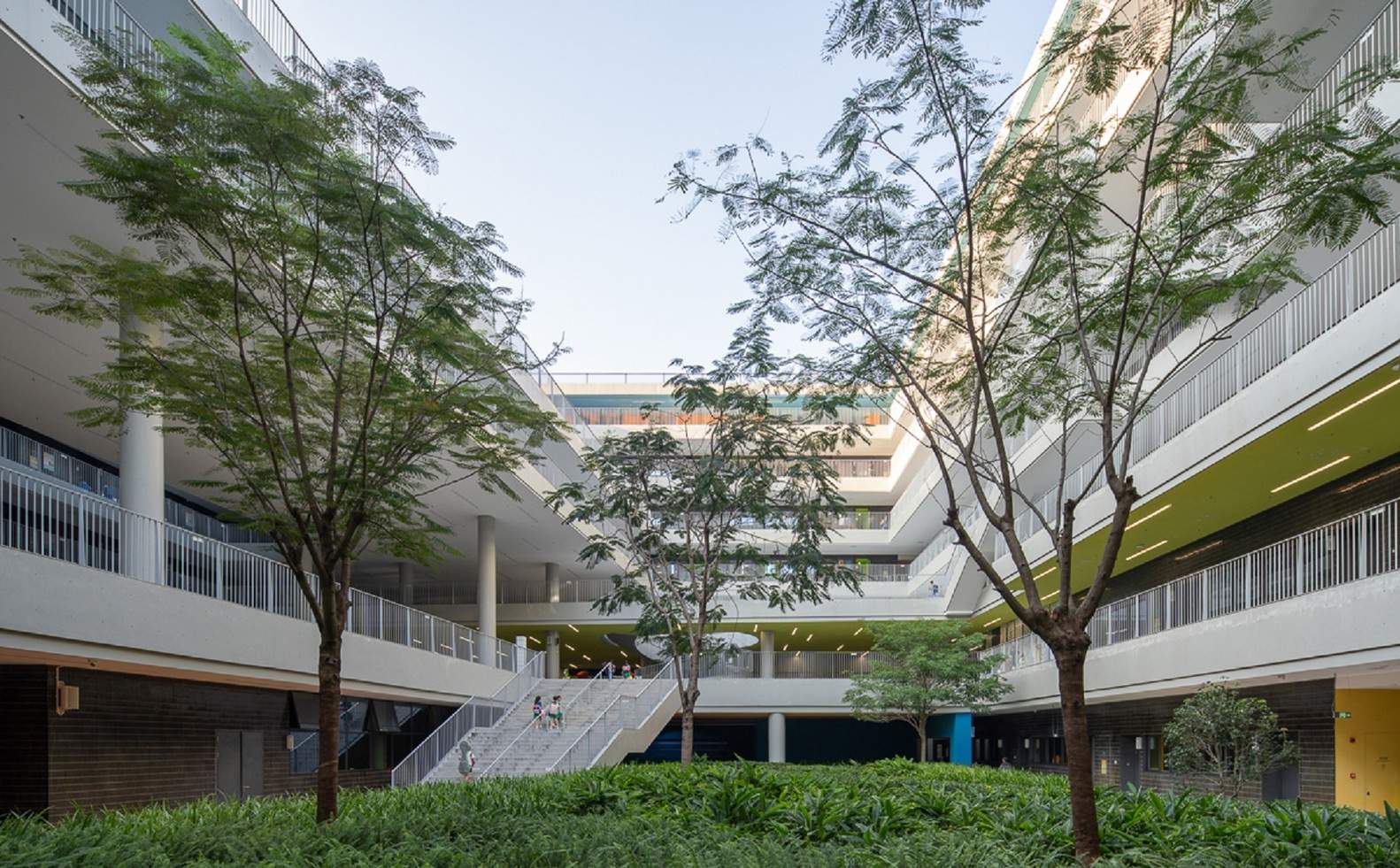
The concept of the open school originated in the United States in the 1950s, aiming to break down grade barriers by centralizing various electronic teaching facilities into a school-wide information resource center. This space is usually located in the center of the campus plan, forming a multifunctional, integrated "Learning Center." The design of Green Oasis Primary School adopts the spatial prototype of a "U"-shaped semi-enclosed courtyard. Standard classrooms are arranged around the perimeter, centralizing all shared functions and greenery around the atrium to create a venue for open and shared education.
开放共享式教育
开放式学校出现在上世纪 50 年代美国,它打破年级界限,把各式电子教学设施集中起来形成全校的教学情报资料中心。这个空间通常布置在校园平面的中心部位, 形成一个多功能综合性的“学习中心”。绿洲小学的设计以 “U” 型半围合的院子为类型作为空间原型,普通教室单元布置在周边,把所有共享功能,绿化围绕中庭展开,形成一个开放共享教育的发生场地。
© 樊钊明
© 樊钊明
© 樊钊明
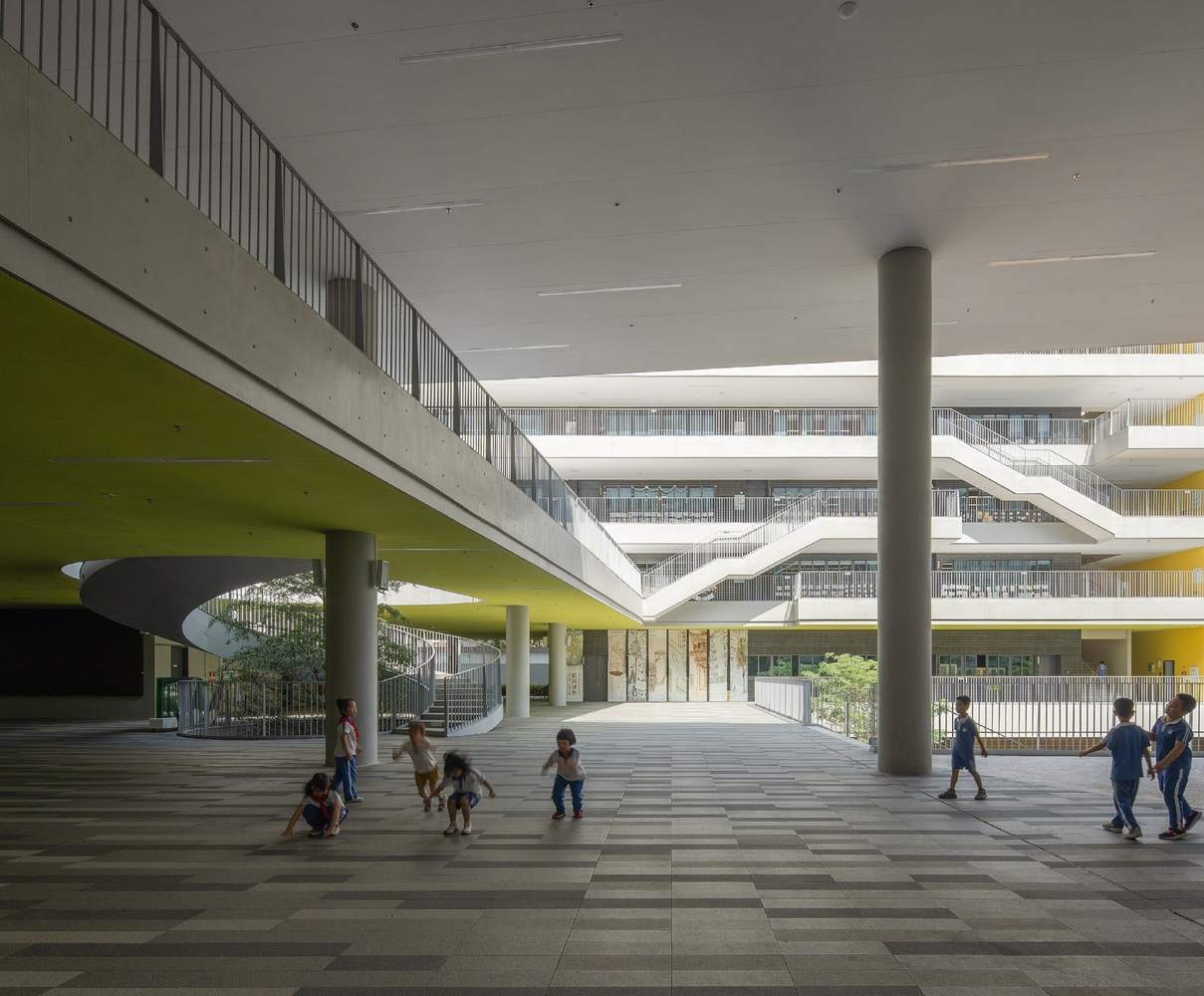
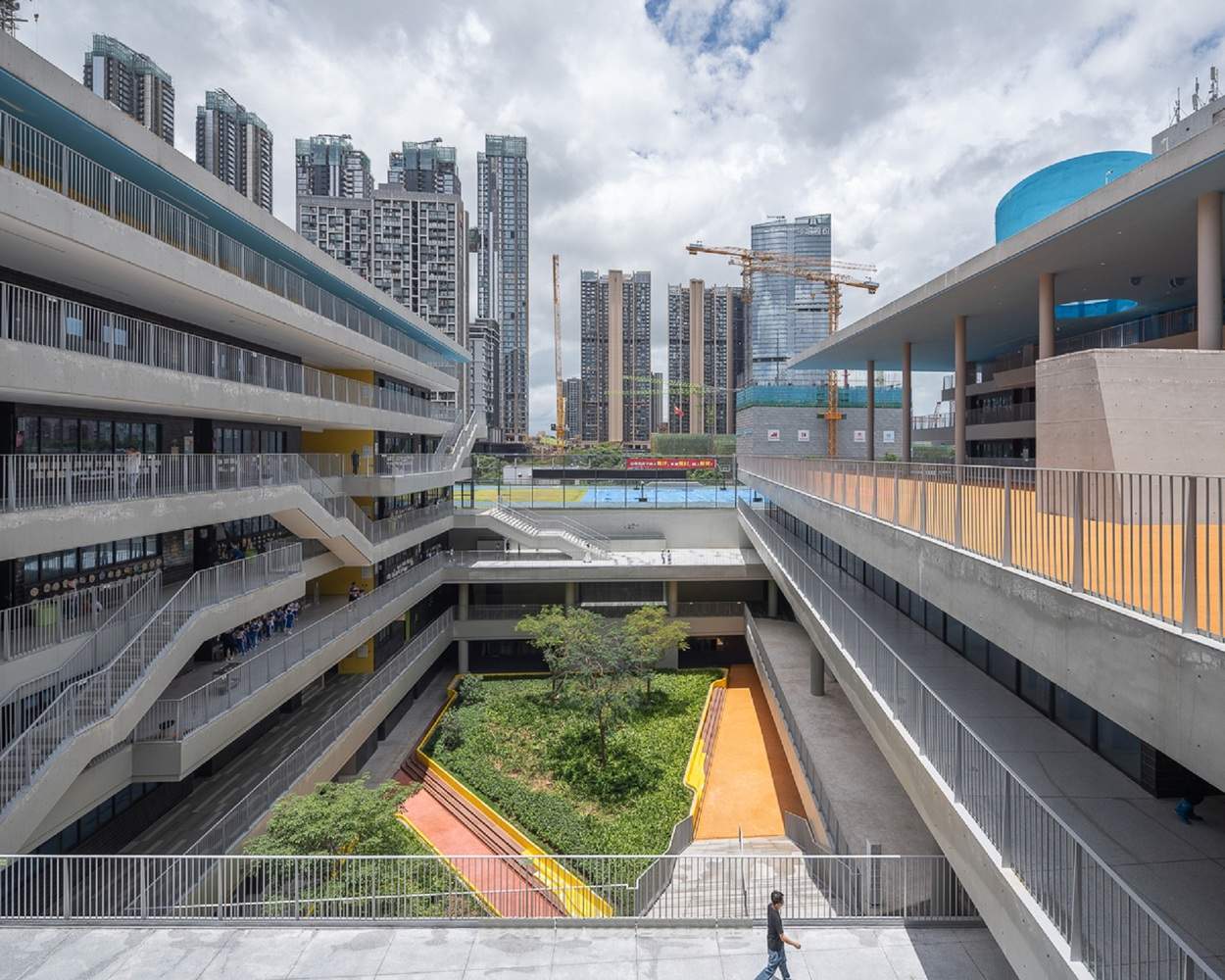
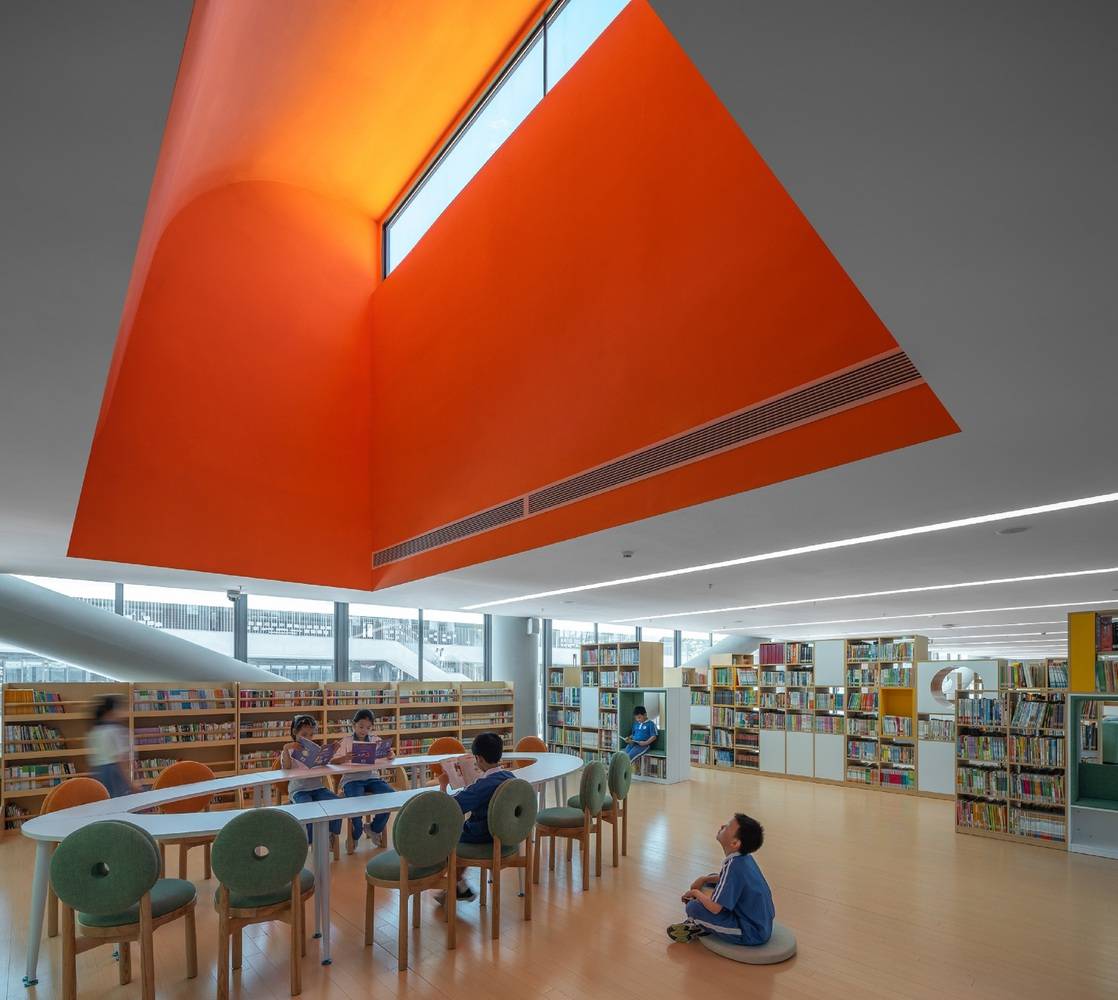
The central courtyard is not only a visual focal point but also the core stage for various school activities. Shared functional spaces such as the library, lecture hall, gymnasium, swimming pool, art studios, and science laboratories are open to the courtyard, extending learning from the closed classroom to the entire campus. This layout encourages inter-grade exchange and stimulates chance encounters and knowledge collision, materializing the concept of "open education" into a perceptible and experiential spatial reality.
中央庭院不仅是视觉焦点,更是学校各类活动的核心舞台。图书馆、报告厅、体育馆、游泳馆、艺术教室、科学实验室等共享功能空间面向庭院开放,使学习从封闭的教室延伸到整个校园。这种布局鼓励跨年级交流、激发偶然相遇与知识碰撞,将“开放教育”理念具象化为可感知、可体验的空间现实。
© 樊钊明
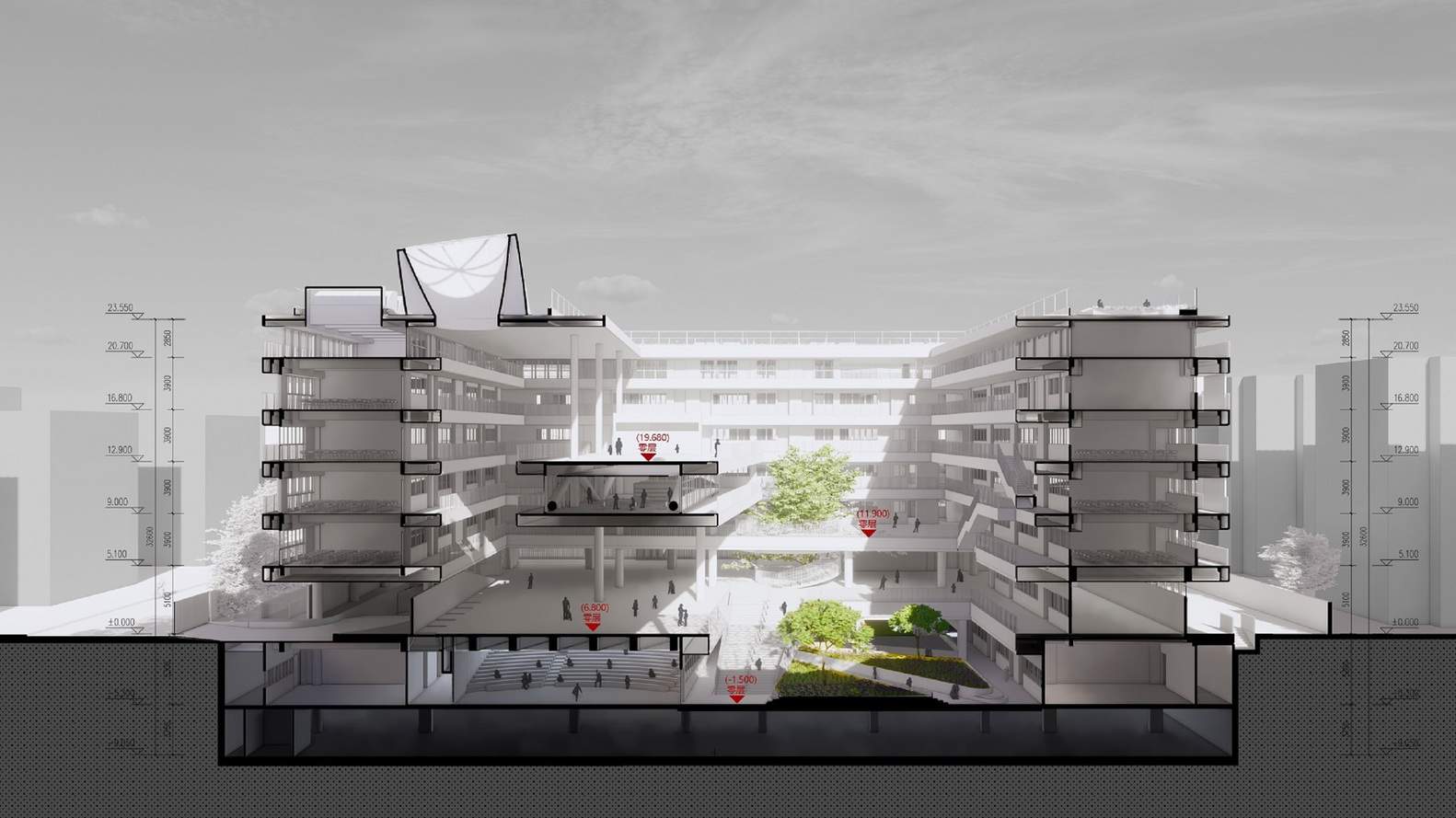
Section View
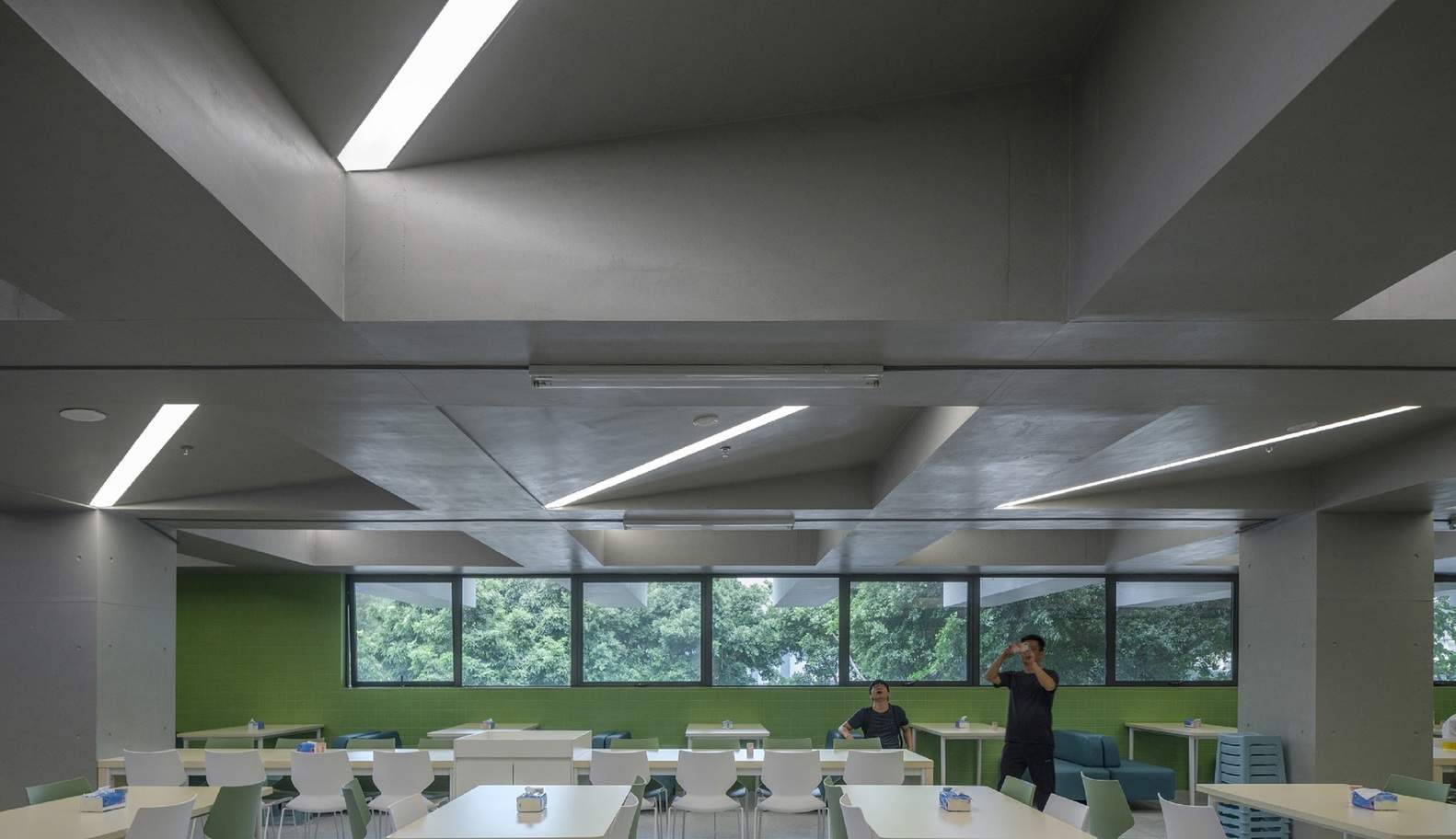
© 袁小宜
Multi-Zero-Floor Activity Platforms
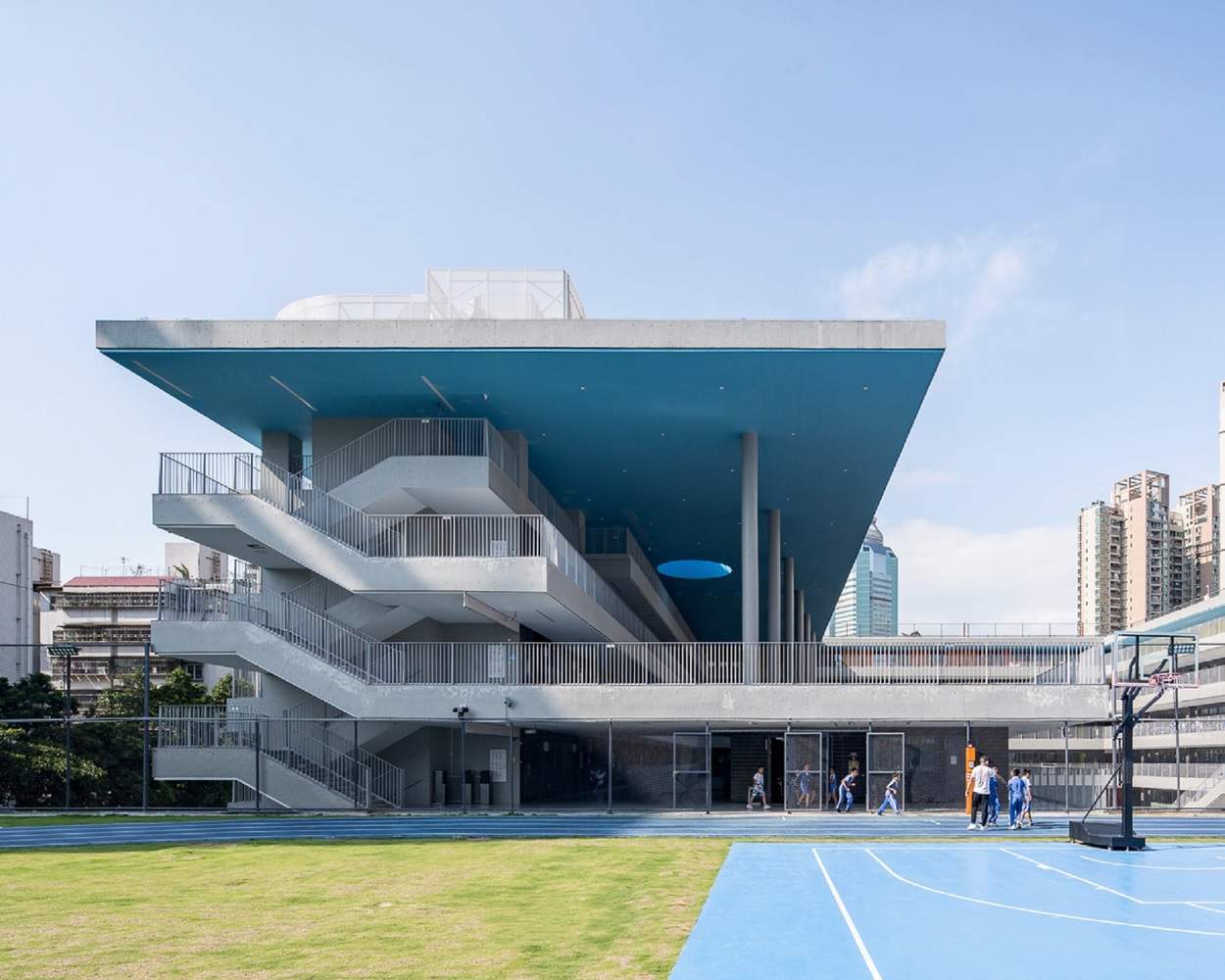
Activity spaces are organized through horizontal floor slabs, emphasizing the building's horizontality. The cross-section of the slabs integrates air conditioning and utility pipelines, forming a pure "plate" that interlocks with others, creating variation. The ten-minute breaks between classes, often considered "unusable fragmented time," are given new value at Green Oasis Primary School. Students can reach the platforms from their classrooms in just a few steps to enjoy sunshine, fresh air, and brief play. This design deeply understands children's behavioral characteristics—they require frequent rest and activity to maintain attention, rather than being confined to fixed seats for extended periods.
多零层活动平台
通过水平楼板组织活动空间,强调建筑的水平性,楼板截面整合空调、设备管线,形成一块纯粹的“板”,层与层交错,富有变化。课间十分钟通常被认为是“无法有效利用的碎片时间”,但在绿洲小学,这段短暂的时间被赋予了新的价值。学生只需几步就能从教室来到平台,享受阳光、新鲜空气和短暂的游戏。这种设计深刻理解儿童行为特征 —— 他们需要频繁的休息和活动来维持注意力,而非长时间困在固定座位上。
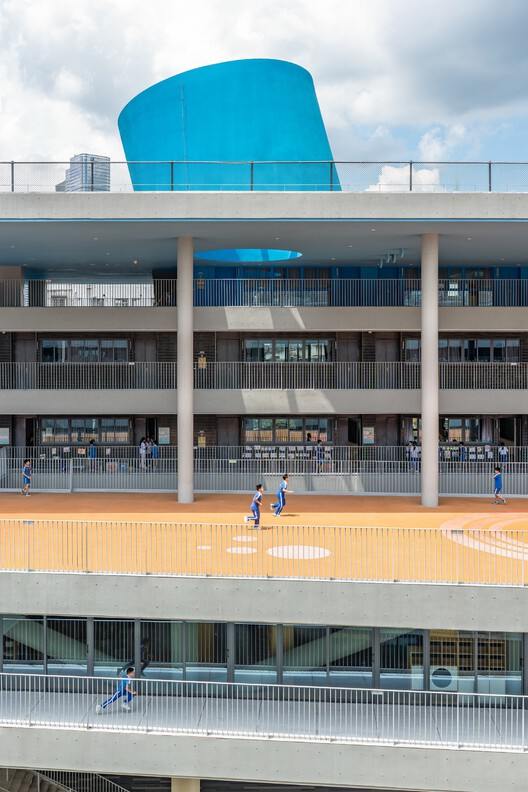
© 樊钊明
© 樊钊明
Equalization in the Vertical Dimension
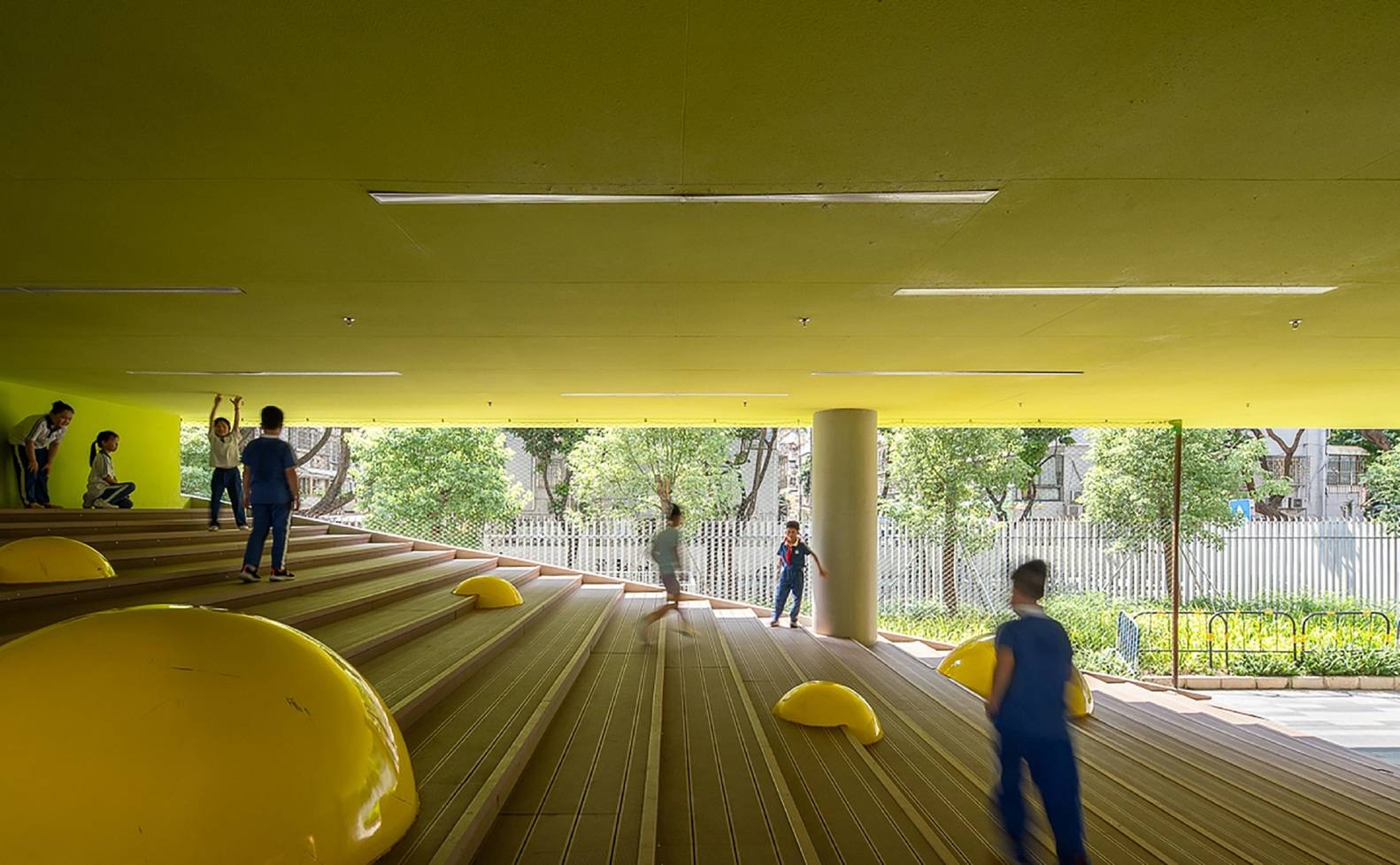
In traditional school buildings, students in higher-floor classes often have difficulty accessing ground-level activity areas during breaks. The multi-platform design eliminates this vertical inequality, ensuring that every student, regardless of their floor level, enjoys equal access to activity spaces. These platforms are not merely transitional areas; they also serve as small social hubs, temporary exhibition spaces, and informal learning spots, greatly enriching the layers of campus life.
At the same time, we have "casually" placed several "foreign objects" within these slabs to meet the students and become everyday "toys."
垂直维度的平等化
传统教学楼中,高层班级的学生往往难以在课间到达地面活动场地。多平台设计消除了这种垂直不平等,确保每个学生,无论所在楼层高低,都能平等享受活动空间。这些平台不仅是过渡区域,更是小型社交中心、临时展览空间和非正式学习场所,极大地丰富了校园生活的层次。
同时,我们在这些平板之中“随意”放置了若干的“异物”,与学生相遇,成为日常的“玩具”。
© 樊钊明
© 樊钊明
Porous and Open Campus
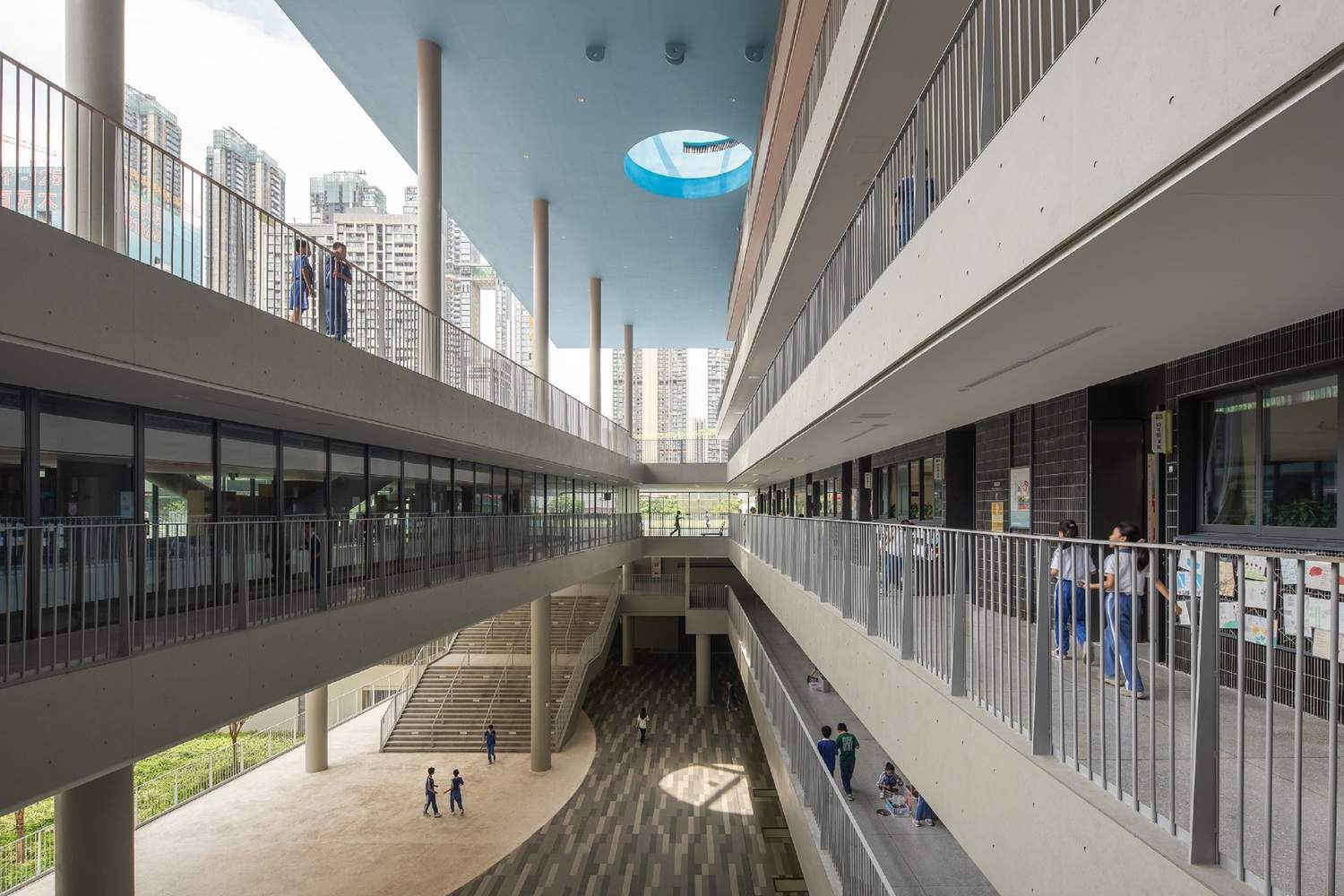
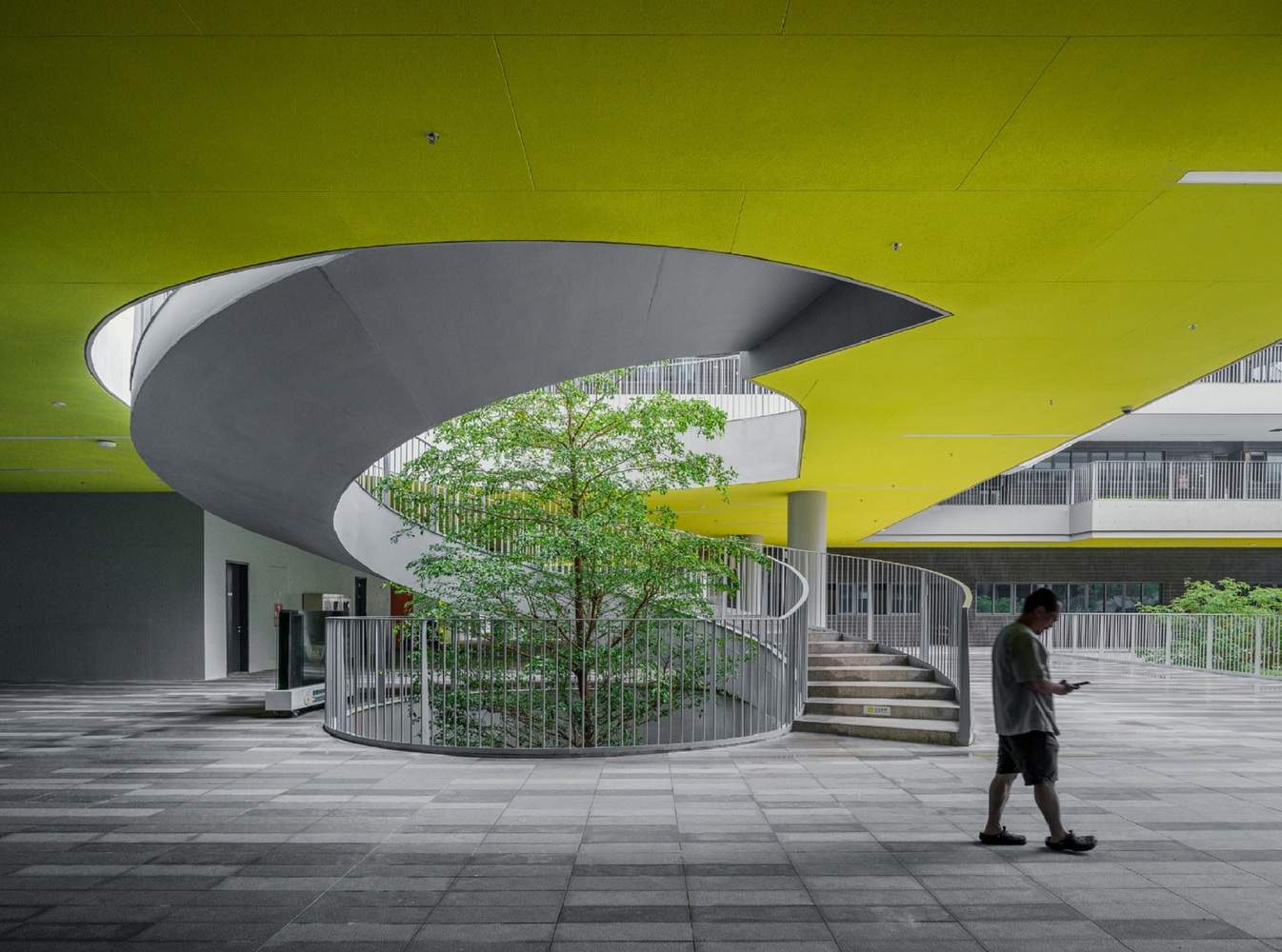
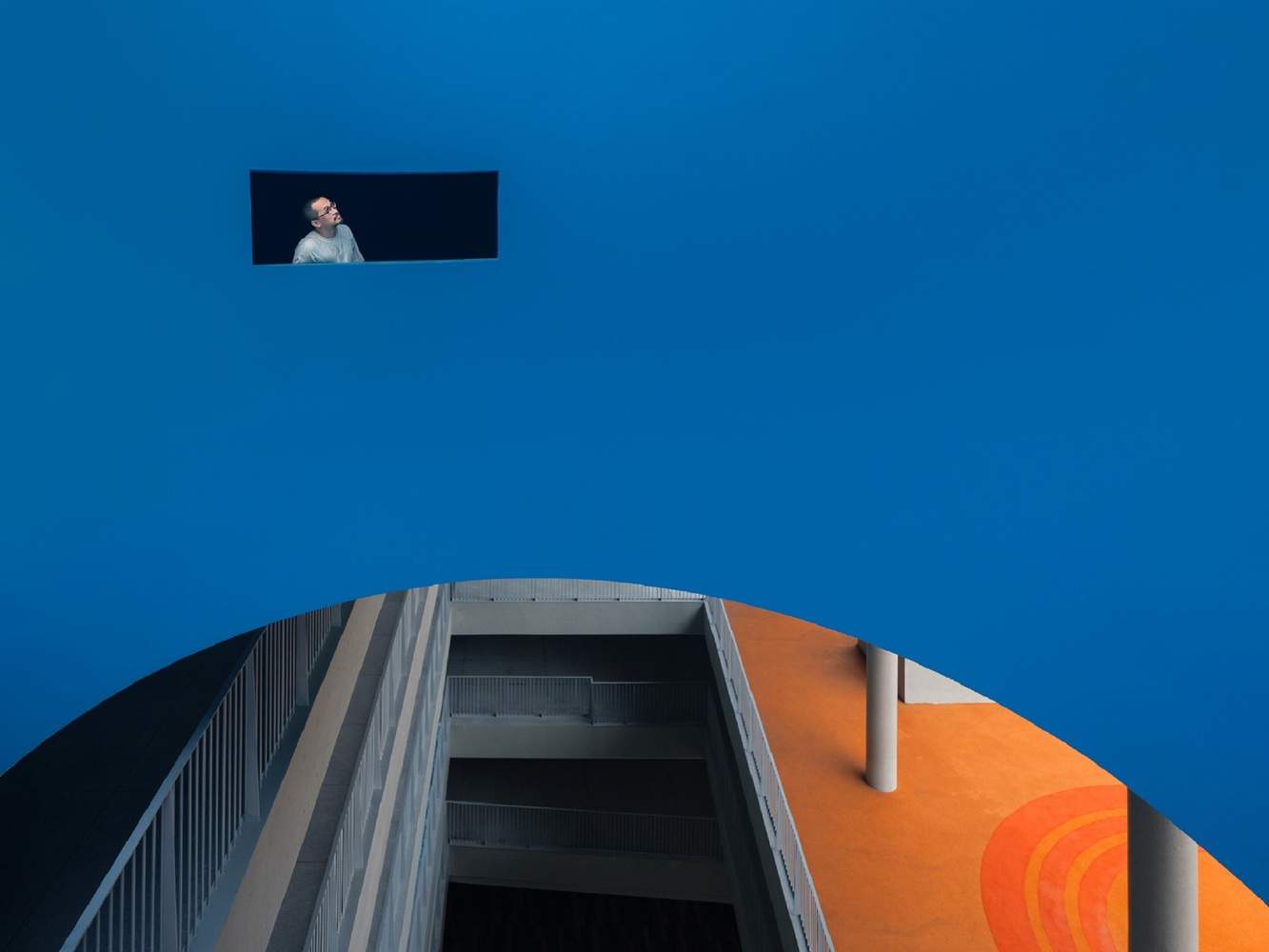
In Shenzhen's hot and humid climate, the porous design promotes natural ventilation and heat dissipation. The staggered openings form wind corridors, guiding airflow through the building complex; shading devices combined with greenery create a comfortable microclimate. This design not only reduces energy consumption but also allows students to personally experience the value of sustainable design.
多孔、开放的校园
在深圳湿热的气候条件下,多孔设计促进了自然通风和散热。错落有致的开口形成风道,引导气流穿越建筑群;遮阳设施与绿植结合,创造了舒适的微气候。这种设计既降低了能耗,也让学生亲身体验可持续设计的价值。
© 袁小宜
© 袁小宜
© 樊钊明
Beyond High Density
In the evolving landscape of new campus construction in Shenzhen, design strategies for addressing high-density challenges have become increasingly refined, forming a mature and flexible "toolkit." High density no longer inevitably leads to oppression and monotony; instead, it can be transformed into a unique opportunity to shape place identity and stimulate spatial potential. After solving the high-density issue, our focus must ultimately return to the essential relationship between education and space. Through repeated visits and observations, we find that the intrinsic character of this campus, embedded within the urban village, seems to subtly absorb the unique environmental atmosphere of the Xinzhou community. Here, excessive control and restriction quietly recede, replaced by a natural sense of freedom and ease. It is gratifying to see that the way space is used largely aligns with the initial design concepts and expectations—there is a rare, benign, and lively rapport between the space and behavior.
高密度之后
在深圳持续演进的新校园建设中,应对高密度挑战的设计策略已日趋完善,形成一套成熟而富有弹性的“工具包”。高密度不再必然指向压抑与单调,反而能被转化为塑造场所特色、激发空间潜力的独特机遇。解决高密度问题之后,我们的目光终究需要回归到教育与空间的本质关系上。通过多次的回访与观察,我们发现这所嵌入城中村的校园,其内在气质似乎也悄然浸润着新洲社区特有的环境氛围。在这里,过度的管控与约束悄然退场,取而代之的是一份自然而生的自由与轻松。令人欣慰的是,这种氛围让空间的使用方式,在很大程度上贴近了设计最初的构想与期待 —— 空间与行为之间,呈现出一种少见的、良性而活泼的默契。