叙事驱动的超能力空间构建:该项目最精妙之处在于其叙事驱动的设计理念——将家庭运动空间构想为一个“超能力图谱”,并围绕“干旱土地上的仙人掌超能力”这一主题展开。这种虚构叙事为功能性空间注入了强大的想象力和吸引力,使得传统的运动设施转化为具有特定意义的“超级有机体”。设计师成功地将建筑装置本身转化为可互动的游戏元素,而非仅仅是设备的背景或支撑结构,极大地提升了家庭成员,尤其是儿童对运动的参与度和探索欲,实现了从“功能性场所”到“沉浸式体验场”的转变。
建筑装置与运动机能的深度融合:项目核心的亮点在于对建筑构件与运动设备之间界限的消融。设计师没有采用现成的运动器械,而是从家庭成员最本质的身体机能需求(如爬、钻、拉)出发,通过提炼仙人掌的形态特征,设计出仙人球、仙人掌和仙人掌立柱等独特的建筑装置。这些装置不仅是空间中的“构件”,更是功能载体,例如球体内部的网络结构鼓励攀爬,圆环结构承载攀爬网,立柱提供直观的抓握点。这种由内而外的设计方法,确保了形式服务于功能,使空间天然地引导和激发本能运动。
多维度的地形创造与体验层次:“沙丘地形”的地面设计是实现整体运动场景完整性的关键。通过标准模块的堆叠抽象出沙丘形态,地面不再是平坦的背景,而是转化为一个基础的物理障碍训练区。结合拟态的仙人掌装置,空间形成了高低起伏、中空与凸起并存的复杂地形。这种三维地形变化,配合以“爬”、“钻”、“探”为核心的两种主要运动场景,确保了从地面到高空的连续探索路径,为不同年龄段的家庭成员提供了丰富且富含挑战性的感官和身体本能体验。
This is a family-friendly sports space focused on cultivating awareness and development of physical movement through play. We treat it as an "atlas of superpowers," a collection of superpowers observed in the world around us. waa was commissioned to design a series of "Superplay" sports spaces called "One Element Workshop" (一工元). We believe in collecting the superpowers developed by family members of all ages, with each sports center representing one of these superpowers. The design concept of the site revolves around a fictional mysterious island where special super-organisms in specific locations possess superpowers. In the first phase of this series, we chose arid land and observed the "superpower" of plants to overcome extreme climates. Cacti can store water in extremely dry environments, and their sturdy root systems and needle-like leaves provide self-protection. We simulated three representative cactus plants within the venue: Saguaro (Carnegiea), Golden Barrel Cactus (Echinocactus), and Prickly Pear Cactus (Opuntia).
这是一个对家庭友好的运动空间,专注于通过游戏来培养身体运动的意识和发展。我们把它当作一个“超能力图谱”,是我们周围的世界中观察到超能力的集合。waa受委托设计一系列的超级玩法运动空间“一工元”。我们认为要收集家庭各年龄段成员发展的超级力量,而每一个运动中心代表其中一种超级力量。场地的设计概念围绕着一个虚构的神秘岛展开,在这个岛上特定地点的特殊超级有机体具有超能力。在这个系列的第一期中,我们选择了干旱的土地,观察到植物具有能够克服极端气候的“超能力”。仙人掌可以在极端干旱的环境中存储水分,它们坚固的根系和针状的叶子为自身提供了保护。我们在场馆内模拟了三种具有代表性的仙人掌植物:仙人掌(Carnegiea)、仙球(Echinocactus)和仙人掌立柱(Opuntia)。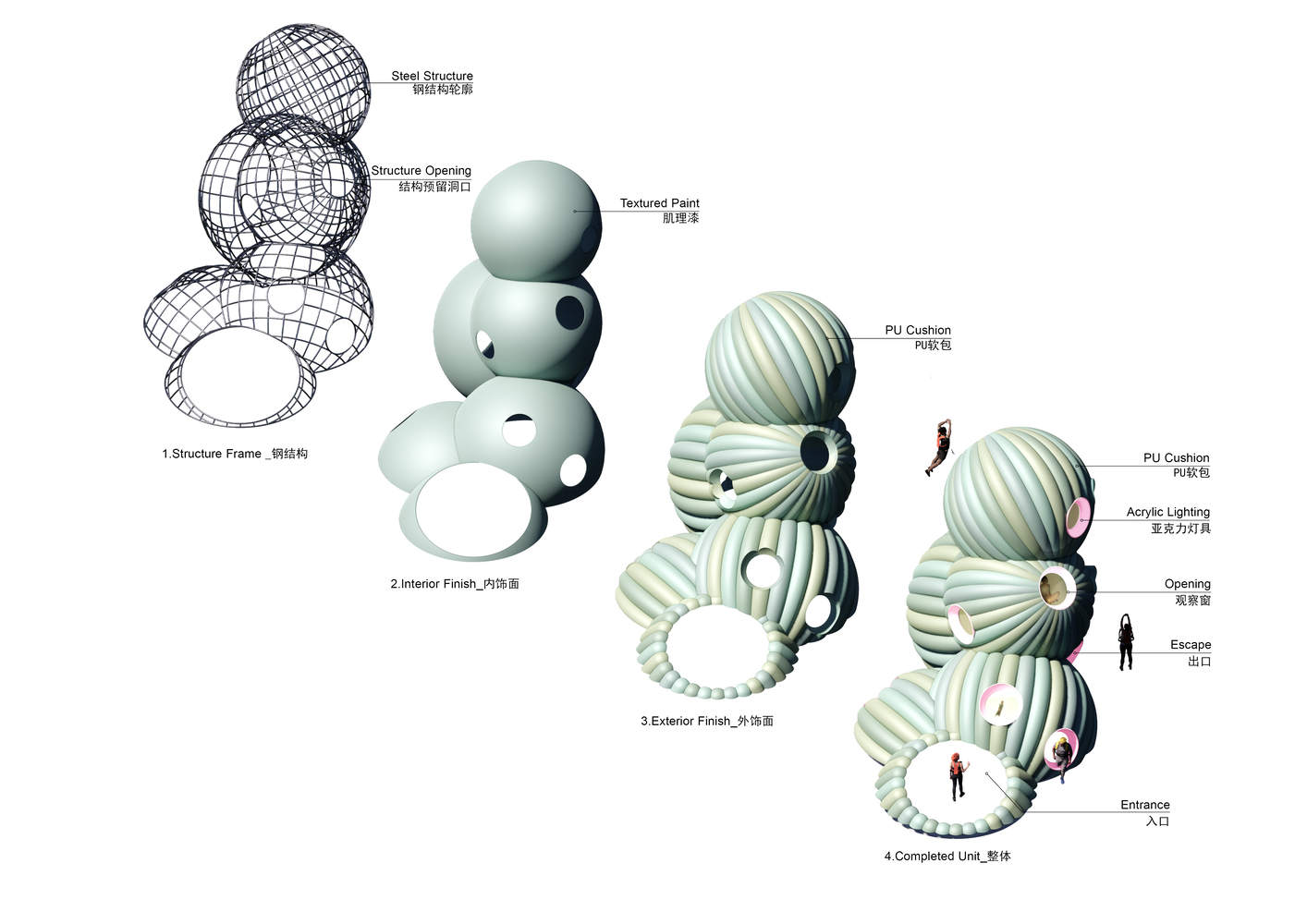
Detail drawings
细节详图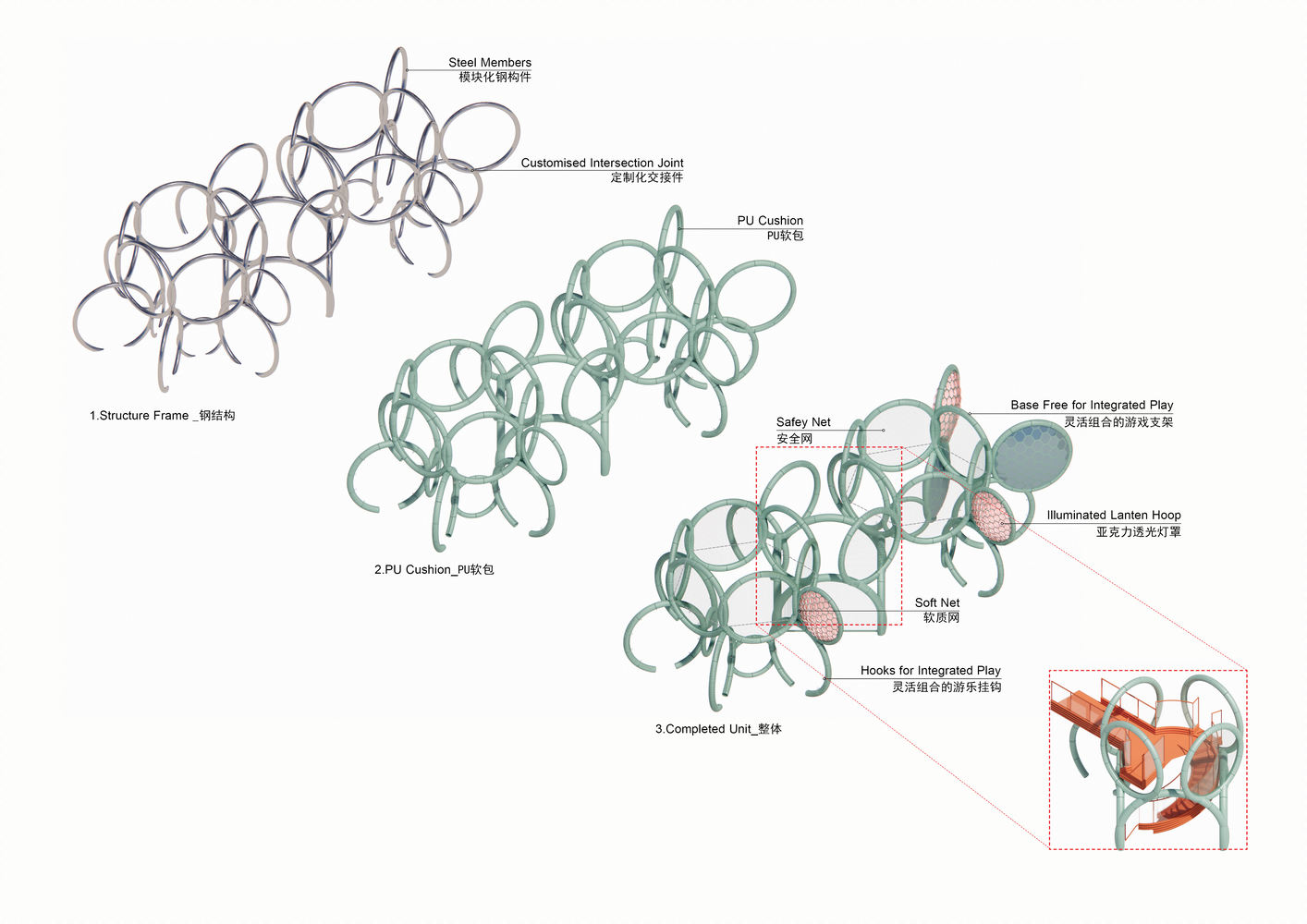
Detail drawings
细节详图The main functions consist of sports facilities and activities that families participate in together. Activities include various sports courses and virtual reality group games, as well as traditional games like high-altitude coordination obstacles, accompanied by beverage and rest areas, aiming to provide a space for family members of all ages to release energy through exercise. In our design, we tried to find a balance between architectural installations and sports play equipment. We believe that to make the space more interesting and entertaining, opportunities for integration must be provided for both elements, rather than simply decorating existing equipment. In this venue, due to scale constraints, we chose two main sports scenarios: one focused on climbing and stretching, and the other focused on crawling and exploring.
主要的功能由运动设施和家庭共同参与的活动所组成。活动内容包括各类运动课程和虚拟现实的团体游戏,以及高空协调障碍等传统游戏,配以饮品和休息空间,目的是让家庭中各年龄段成员都有运动释放能量的场所。我们在设计中试图寻找建筑装置和运动玩乐设备之间的平衡。我们认为要使空间更富有趣味性和娱乐性,必须为这两个元素提供融合的机会,而不是单纯的装饰既有设备。在这个场所里,因为尺度受限,我们选择了两个主要的运动场景,一个是以爬和拉伸为主,一个是以钻和探为主。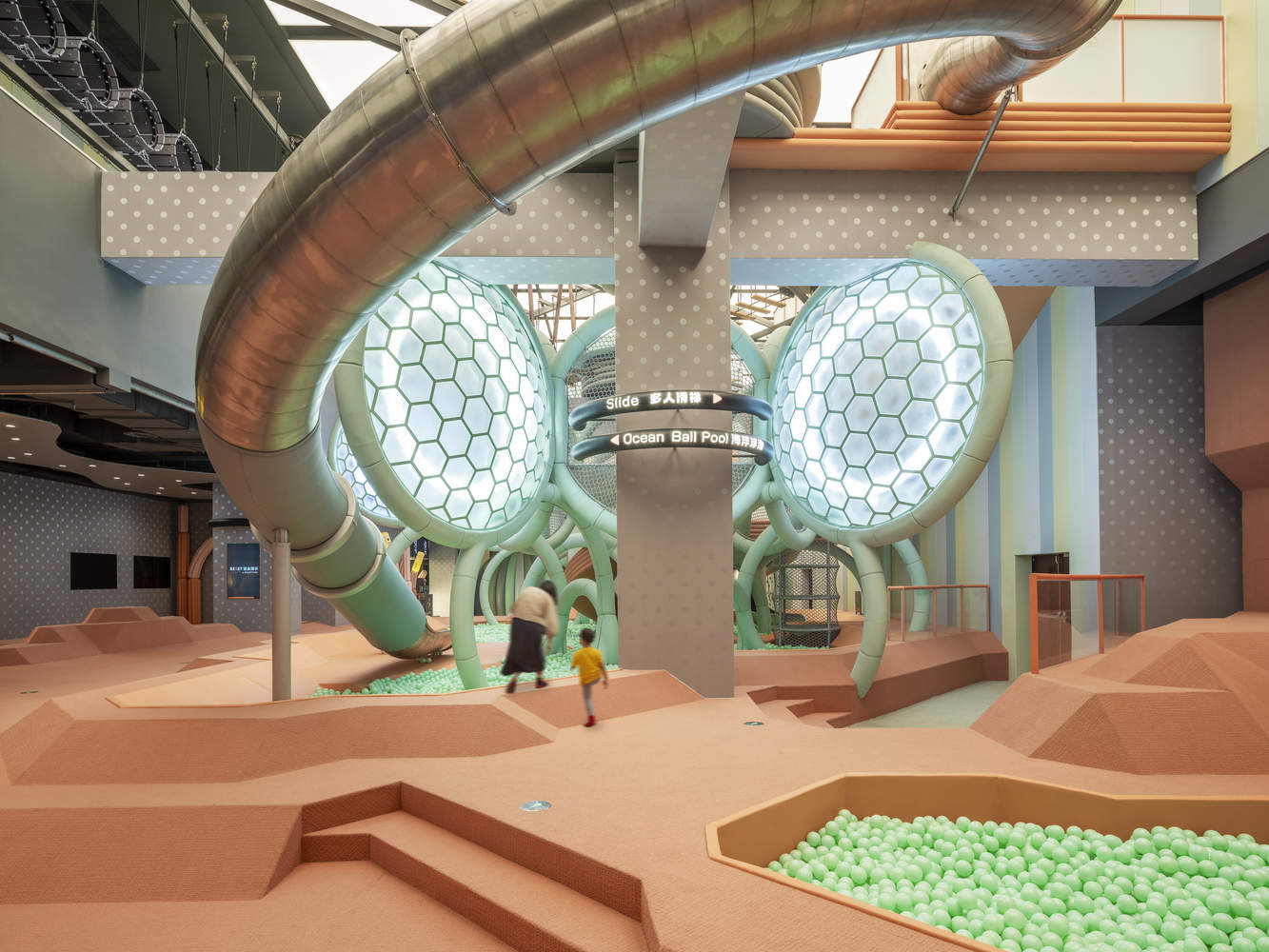
© Tian Fangfang
© 田方方Design Focus: We integrate architectural installations and sports equipment through four main design elements to construct an exploration space.
设计重点:我们通过四个主要设计元素将建筑装置和运动设备整合构建一个探索空间。Barrel Cactus (Echinocactus): By utilizing the spatial relationships between seven spherical forms, we transform the interior into a large-scale exploration tool that allows family members to exercise climbing and crawling abilities. The internal structure arrangement inside the barrel-shaped spheres is a networked structure projected onto the sphere's surface. Where necessary, additional independent columns are used to support the internal play, and the periphery of the barrel can also be explored, so the exploration process also forms an additional activity.
仙人球:利用七个球形形体之间的相互关系,我们将室内改造成一个大型的探索工具,让家庭成员锻炼攀爬和爬行的能力。桶形球体内部的结构排列形式是一种投射到球体表面上的网络状结构。在需要的地方,额外的独立柱被用来支撑内部游戏,同时也可以探索桶的周边,所以探索的过程也形成了额外的活动。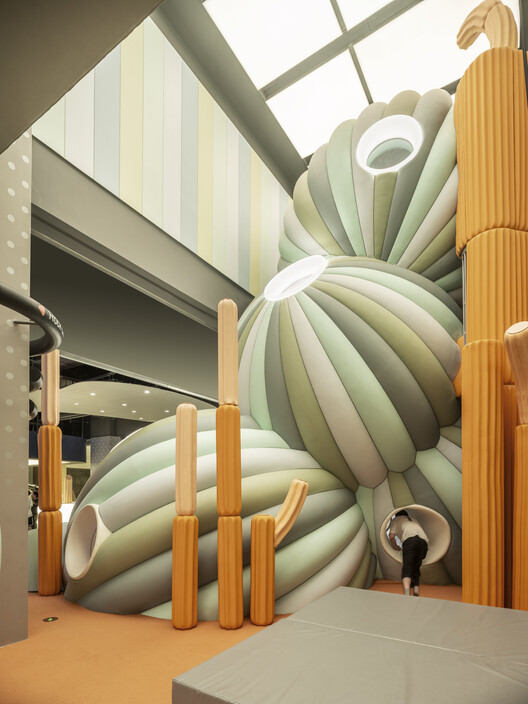
© Tian Fangfang
© 田方方Cactus (Carnegiea): We optimized the structural form of the cactus, referencing spatial relationships found in cell structures. Two symmetrical spatial structures are built using 28 rings with diameters of 4.14 meters and 3.1 meters, with each ring arranged radially. Prefabricated steel pipe sections are used to build the frame, fixed by welding and covered with cushioning material, with each ring divided into 12 segments. Horizontal climbing nets, slides, high-altitude training elements, and decorative lighting are added onto this ring frame. It serves as the main framework within the space, supporting and positioning the primary vertical play facilities.
仙人掌:我们优化了仙人掌的结构形态,并参考了细胞结构中发现的空间关系。利用直径为4.14米和3.1米的28个圆环,构建两个对称的空间结构,每个环都以径向方式排列。采用预制的钢管段构建框架,通过焊接固定并覆盖缓冲材料,每个环分为12个段。在这个环形框架上,我们加入了水平攀爬网、滑梯、高空训练元素和装饰性照明。它作为空间内的主要框架,支撑和定位主要的垂直游戏设施。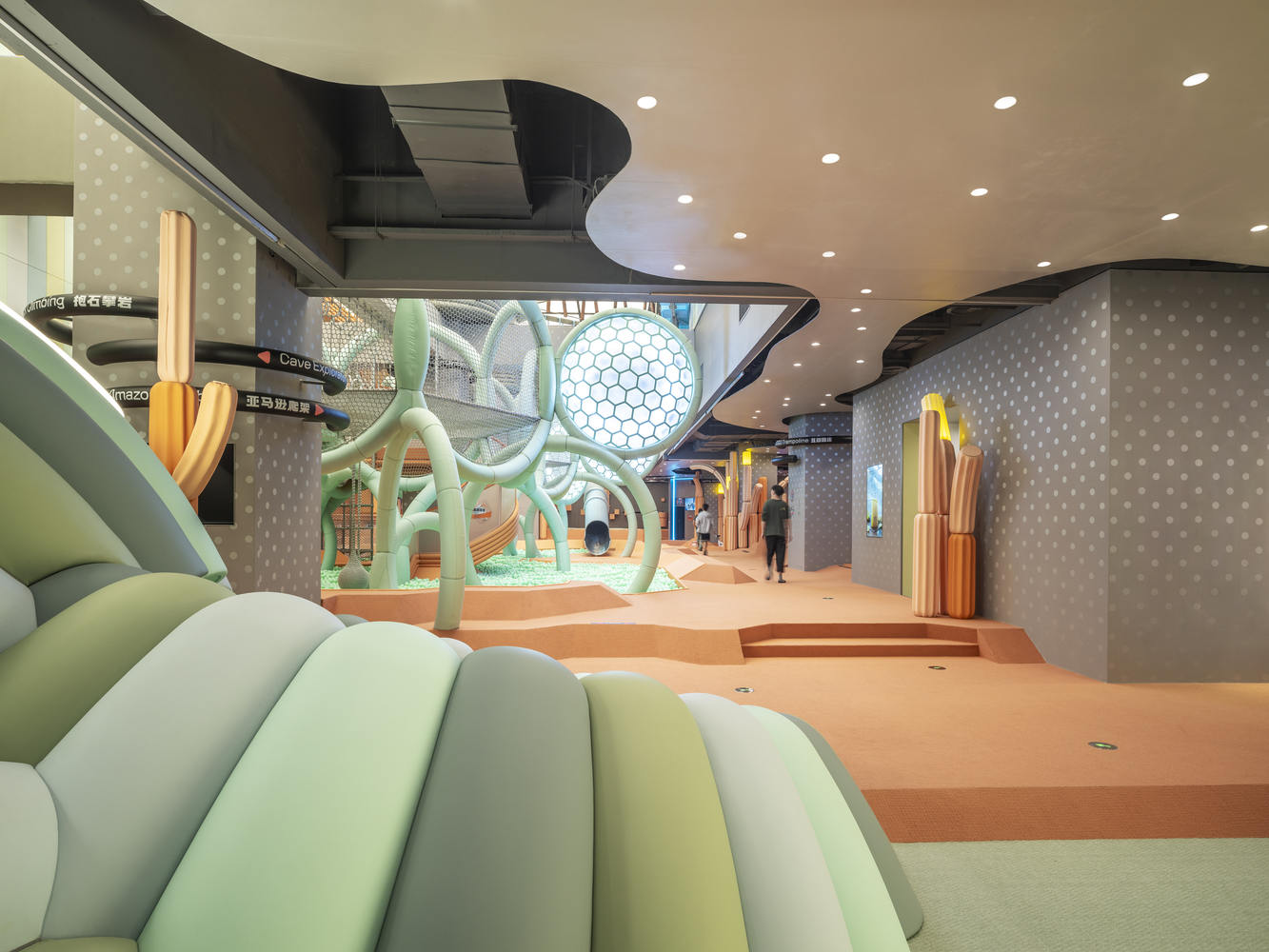
© Tian Fangfang
© 田方方Saguaro Column (Opuntia): Utilizing the vertical form of the Saguaro column, it is uniformly distributed throughout the space as a furniture element. Padded modules protrude from the furniture and are used as design tools to support intuitive play functions, including climbing points, swinging arms, and steps, or higher observation points. As a planning tool, the Saguaro columns can be used to divide elements between different zones, serve as a visual navigation system, and implement functional lighting fixtures through a single modular element.
仙人掌立柱:利用仙人掌立柱的垂直形态,将其作为家具元素均匀分布在整个空间中。软垫模块从家具中凸起,并被用作设计工具,以支持直观的游戏功能,包括攀爬点、摇摆的臂膀和台阶,或更高的观察点。作为规划工具,仙人掌立柱可以用来划分不同区域之间的元素,作为视觉导航系统,并通过单一模块化元素实施了功能照明的固定装置。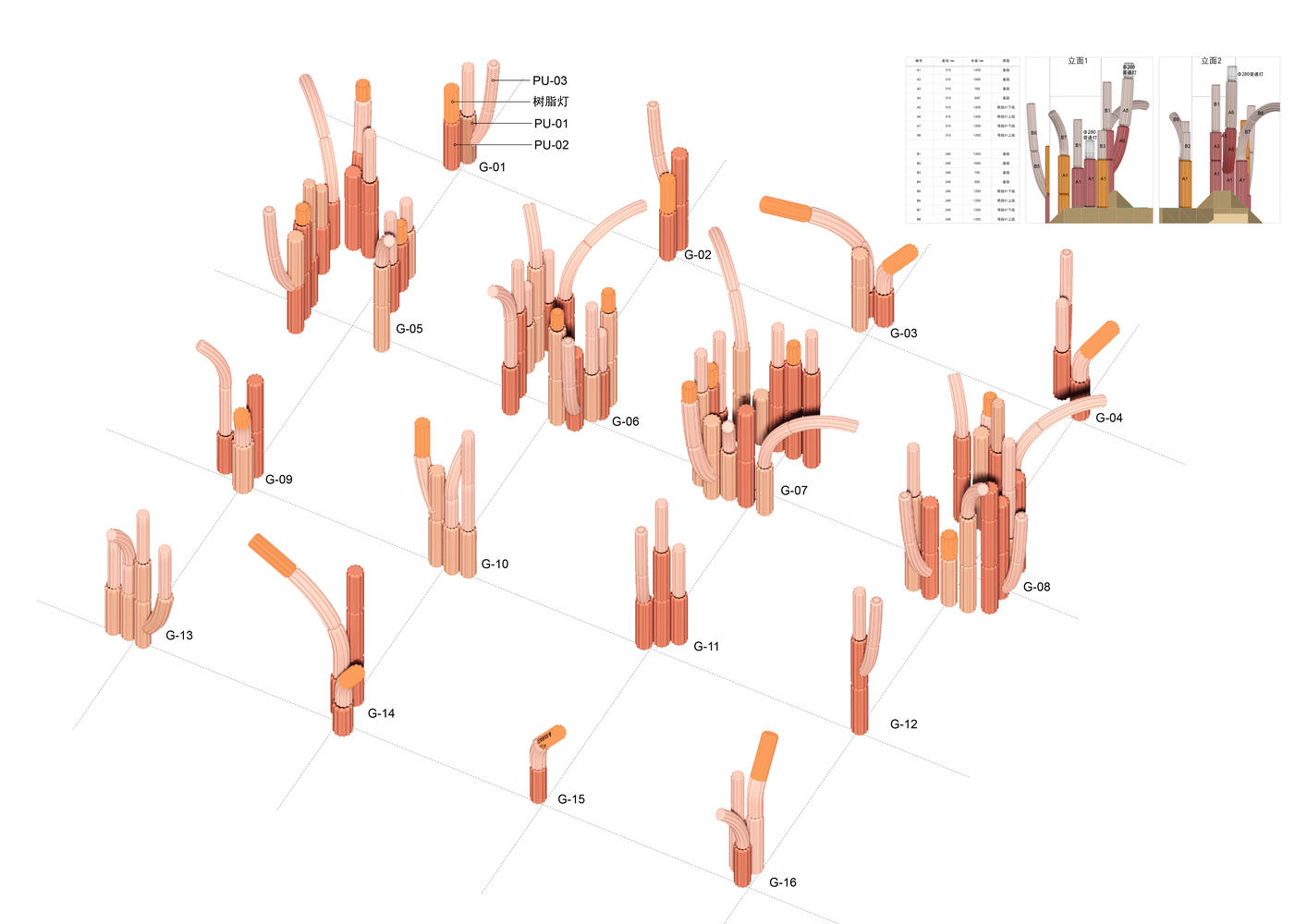
Detail drawings
细节详图Dune Topography: The topography of the entire venue floor is designed in the shape of sand dunes. We use trapezoidal standard blocks, measuring 450x450mm, to abstract the form of sand dunes. By stacking and arranging these standard modules in three dimensions, the ground is transformed into a basic physical obstacle training area. Combined with the hollow and protruding areas formed by the different shapes of the cacti, a complete sports venue is created.
沙丘地形:整个场馆地板的地形设计成沙丘的形状。我们使用梯形标准块,尺寸为450x450mm,来抽象沙丘的形态。通过在三个维度上堆叠和排列这些标准模块,地面被转化成一个基本的物理障碍训练区域。结合不同形态的仙人掌形成的中空和凸起区域,创造出一个完整的运动场馆。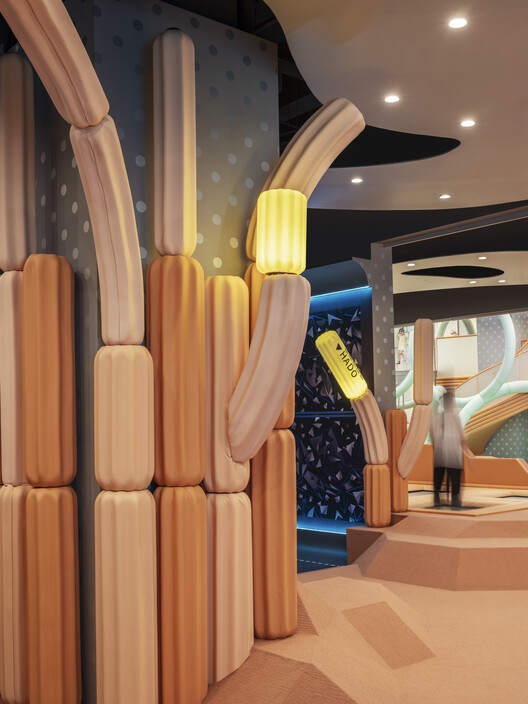
© Tian Fangfang
© 田方方We tried to distill the most essential needs for movement for each family member into several basic physical functional requirements, such as: crawling, burrowing, jumping, pulling, etc., using these as the core for research and design expansion. We use architectural components and spatial installation techniques to solve these movement functional needs, developing a system that satisfies functional requirements while possessing the vocabulary of architectural components, rather than decorating existing equipment. The final result is a unique scene. Here, movement returns to instinctive needs, and physical training can occur in any corner of the space, rather than through piece after piece of equipment. We hope that playing and exercising can return to their essence, and family activities can fulfill bodily and sensory instinctual experiences.
我们尝试通过研究家庭各成员对运动最本质的需求提炼出几个基础身体机能需求,比如:爬、钻、跳、拉等,以此作为研发和设计拓展的核心。用建筑构件与空间装置的手法,来解决这些运动机能的需求,研发出既满足机能需求,又具有建筑构件语汇的体系,而不是装饰现成的设备设施。最终所获得的是独一无二的场景。在这里,运动回归本能需求,在空间任意角落中都可以进行身体的训练,而不是通过一个又一个器械设备,我们希望玩耍、运动可以回归本质,家庭活动可以成就身体的和感官的本能体验。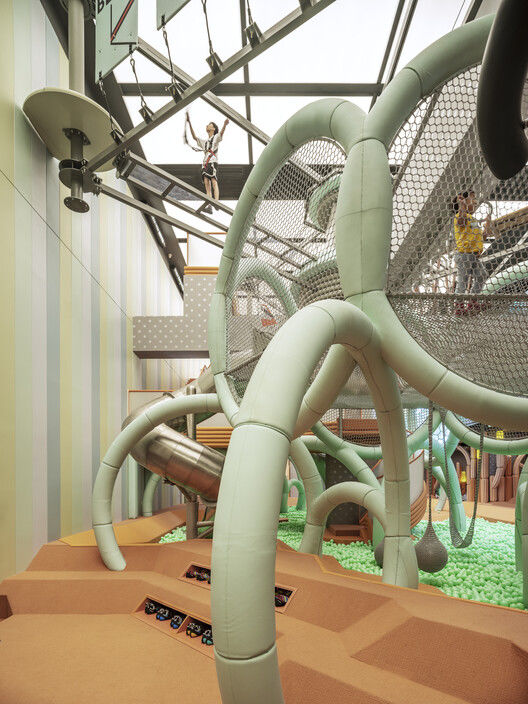
© Tian Fangfang
© 田方方