历史文脉与城市绿地的有机融合:该项目巧妙地将让·多热体育综合体的改造置于巴约讷绿带的历史背景和城市规划之中。通过激活原军事演习场和护城河区域的公共属性,建筑不仅尊重了场地的历史文化地位,更强化了其作为城市绿岛和老城区与周边街区之间界面的作用。设计强调主动出行(步行、骑行)的优先性,使体育场成为绿色网络中一个可渗透、可参与的节点,实现了体育功能与城市生活空间的无缝衔接,尤其是在非赛事期间,建筑服务于更广泛的城市公共生活。
“巨鼎式”改造与沉浸式观赛体验:通过将原有的田径场馆改造为“巨鼎式”橄榄球场,设计显著增强了球迷与球员之间的互动和氛围。通过最小化看台与球场的距离,并保留和优化主看台,改造实现了强烈的向心力。这种布局释放了看台后方的空间,用于创建公共集散区和环形高架步道,不仅优化了球迷体验,还通过精妙的景观处理(如降低南侧看台的视觉高度),弱化了建筑对周边环境的压迫感,实现了宏大尺度与城市尺度的平衡。
结构美学与功能多样的空间策略:新设计成功地将传统体育场复杂的内部交通系统“外置化”,通过轻盈的、蛛网般的金属结构承载楼梯和步道,使其穿梭于树木之间,极大地提升了建筑的通透性和与环境的对话性。裸露的混凝土拱结构与外部轻盈的交通系统形成对比,界定了内部空间的同时,也为看台赋予了承载节庆、会议等多样化活动的能力。AB园区的设计同样通过拱形结构和景观土丘的融合,将建筑体量消隐于城市肌理中,展现了对场地文脉的高度尊重和克制的建筑表达。
The redevelopment of the Jean Dauger sports complex is an integral part of the planning for the Bayonne green belt. This area, originally a military training ground and occupied by a moat at the foot of the ramparts, has been transformed into leisure gardens and open-air sports facilities. With its historical and cultural significance, this green space asserts its importance and is protected from excessive urban development.
让·多热(Jean Dauger)体育综合体的重新开发,是考量巴约讷(Bayonne)绿带规划时不可或缺的一环。这片绿地原为军事演习场地,且城墙脚下曾被护城河占据,后经改造,建起了休闲花园与露天体育设施。凭借其历史与文化地位,这片绿地彰显出重要意义,并得以免受过度城市开发的侵扰。
© Mathieu Choiselat
© Sandrine Iratçabal
This location also helps establish it as an urban dividing line between the old town and the surrounding neighborhoods. Today, as bicycle paths and walkways are prioritized in urban development and transport planning, and urban green islands are considered essential for creating a comfortable urban life, the importance of this green belt is increasingly highlighted. Pedestrians and cyclists move through it or walk in its shade, "reclaiming" the area. The Jean Dauger Stadium is an indispensable component of this green belt, forming its southern section.
这一区位还助力其成为老城区与周边街区之间的城市分界线。如今,随着城市发展与交通规划中自行车道和步行道被置于优先地位,且城市绿岛被视为营造舒适城市生活不可或缺的要素,这片绿带的重要性愈发凸显。行人与骑行者穿梭其间,或在其树荫下绕行,重新“占领”了这片区域。让·多热体育场是这片绿带不可或缺的组成部分,构成了其南段区域。
© Cléa Meksvanh
© Jean-François Tremege
Each individual project in this area belongs to an overall strategy aimed at promoting active mobility (such as walking and cycling) along the sports facilities and the surrounding park area, opening up active mobility channels running through it, and creating public spaces around the site. The core idea is that the stadium stands and ancillary buildings should serve urban life during non-use times outside the rugby season.
该区域内的每一项单体项目均隶属于一项整体战略,旨在促进人们沿体育设施及其周边公园区域开展主动出行(如步行、骑行等),并打通贯穿其中的主动出行通道,同时在场地周边打造公共空间。其核心理念在于,在橄榄球赛季之外的非使用时段,体育场的看台及其附属建筑应服务于城市生活。
Plan
The park concept—the Jean Dauger sports complex is first and foremost a sports facility situated in a green space connected to the historic old town and located in the city center. Its urban planning and landscape design features make this rugby stadium a unique venue for sporting events, creating the special atmosphere characteristic of such events.
公园理念——让·多热体育综合体首先是一座坐落于绿色空间中的体育设施,该绿色空间与历史悠久的老城区相连,且地处城市中心。其城市规划与景观设计特色,使得这座橄榄球场成为举办体育赛事的独特场所,并营造出赛事所特有的热烈氛围。
© Agnès Clotis
© Agnès Clotis
Rugby Stadium Renovation—The project transforms a stadium based on the geometric layout of bicycle and athletics tracks into a "cauldron type" stadium. By minimizing the distance between the stands and the pitch, a more intense atmosphere is created, and the interaction between players and fans is strengthened. During the renovation, the original main stand was retained, and the pitch position was adjusted to be closer to this stand. The other three sides of the stands were moved as close as possible to the sidelines and end lines. This inward-focused layout frees up the space behind the stands for the creation of parks, public areas for spectator assembly, and elevated embankment walkways surrounding the pitch.
橄榄球场改造——本项目将一座围绕橄榄球场、以自行车与田径赛道几何布局为基底的体育场,改造为“巨鼎式”(cauldron type)体育场。通过将看台与球场的距离压缩至最小,营造出更热烈的氛围,并强化球员与球迷间的互动。改造过程中保留了原有主看台,并调整球场位置使其更贴近该看台;同时将另外三侧看台尽可能向边线与端线靠拢。这种向心式布局释放了看台后方的空间,用于打造公园、观众集散公共区域,以及环绕球场的堤岸高架步道。
© Jean-François Tremege
The stadium is built on a site that slopes slightly from south to north, and its visual relationship with the surrounding landscape varies depending on the orientation. The collective memory still retains an image of the stadium surrounded by a velodrome track with spectators high above the field. The new project takes full advantage of the elevated terrain of the south stand by adding an outer embankment, thus reducing the perceived height from the stands when viewed from surrounding areas and mitigating its impact on public space.
体育场建在一片自南向北略微倾斜的地块上,其与周边景观的视觉关系因方位不同而呈现差异。集体记忆中仍留存着这样一幅画面:体育场被自行车赛道坡道环绕,观众席高居赛场上方。新项目充分利用了南侧看台地势较高的特点,增设外围堤岸,从而降低了从周边区域看台时给人的视觉高度感,并削弱了其对公共空间的影响。
© Jean-François Tremege
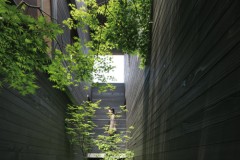
East Stand + Embankment—To break the conventional design pattern where traditional stands embed vertical circulation facilities (stairs, elevators, etc.) deep within the structure and seating levels, this project places the stairs and walkways leading to the seats on the exterior of the building. These facilities wind upwards through the canopy of the park trees, supported by a slender, web-like metal structure. The plaza and embankment serving the entrance area are enlivened by the rich architectural landscape and vegetation layers nearby, while the glimpses of internal activities visible through the stand windows further build an organic connection between the stadium and the city.
东看台 + 堤岸——为打破传统看台将垂直交通设施(如楼梯、电梯等)内置于结构与看台层深部的常规设计模式,本项目将通往座席的楼梯与步道设置于建筑外部。这些设施依托纤细如蛛网的金属结构,在公园树木的枝叶间蜿蜒攀升。服务于入口区域的广场与堤岸,因周边丰富的建筑景观与植被层次而充满活力,同时透过看台窗户隐约可见的内部活动场景,进一步构建起体育场与城市之间的有机联系。
Section
This aims to give the stands the potential to host diverse activities, creating venues for gatherings, festivals, and conferences, thus extending their use beyond rugby matches. The resulting open internal space is clearly visible from both the park and the pitch ends, enclosed by massive exposed concrete arch structures. The straightforward presentation of the stand structure and internal configuration, combined with the delicate structures subtly interspersed among the foliage, creates a layered visual experience of the stadium and its stands within the park.
此举旨在让看台具备承载多样化活动的潜力,打造可供人们聚集、举办节庆活动与会议的场所,从而将其使用场景拓展至橄榄球赛事之外。由此敞开的内部空间,从公园与球场两端均清晰可见,空间由粗犷的裸露混凝土拱结构围合而成。看台结构与内部构造的直观呈现,搭配轻盈结构在枝叶间若隐若现的穿插,使体育场及其看台在公园中形成层层递进的视觉画面。
© Sandrine Iratçabal
East Stand—The newly built stands share a unified design, with a structural system composed of a series of recessed structural elements supporting the seating levels. The overall form of the stands is tall and steep, enhancing the visual effect of the overhang above the pitch by increasing the height-to-width ratio of the seating tiers. The stands consist of a lower tier and an upper tier of boxes (balconies), supported by transverse walls featuring asymmetrical arched openings, which lend a sense of rhythm to the internal spaces beneath the stands.
东看台——新建看台均采用统一设计,其结构体系由一系列内凹式结构构件构成,为看台层提供支撑。看台整体造型挺拔陡峭,通过增大看台层的高宽比,强化了悬挑于球场上方的视觉效果。看台由下层看台与上层包厢(阳台)组成,包厢由横向墙体承托,墙体上开设有不对称拱形孔洞,这些孔洞为看台下方的内部空间赋予了韵律感。
Section
South Stand + Southeast Corner—The lower tier of the south stand is designed as a sunken structure, positioned below the natural ground level and the Avenue du Docteur Léon Moynac. At the box level (balcony level), the VIP lounges facing the pitch have direct access to the public space at street level. To ensure clear visibility from both the park and the pitch ends, the VIP lounges feature large glass curtain walls, and the transparent and open visual effect is achieved by relying on the magnificent arcade structure supporting the upper tier of the stands.
南看台 + 东南角——南看台的下层看台被设计为下沉式结构,其位置低于自然地面标高及莱昂·莫伊纳克医生大道(Avenue du Docteur Léon Moynac)。在包厢层(阳台层),面向球场的贵宾休息室可直接与街道层面的公共空间连通。为确保从公园与球场两端均清晰可见,贵宾休息室采用大面积玻璃幕墙设计,同时依托支撑上层看台的宏伟拱廊结构,营造出通透开阔的视觉效果。
© Mathieu Choiselat
As pedestrians or cyclists move along the avenue under the tall plane trees, the spatial sequence from the public space to the entrance plaza, VIP lounges, and finally the pitch constitutes a unique urban experience. The southeast corner features a curved design, cleverly connecting the VIP lounge areas of the East Stand and the South Stand. A restaurant is located here, and its sectional design continues the line of the arcade supporting the upper tier of the stands. The resulting arched space offers an unobstructed view of the glass curtain wall of the stand's end wall, further enhancing the transparency of the area.
行人或骑行者沿着大道在高大悬铃木下行进时,从公共空间到入口广场、贵宾休息室,再到球场的这一系列空间序列,构成了一场别具一格的城市体验。东南角采用弧形设计,巧妙衔接了东看台与南看台的贵宾休息区域。这里设有一家餐厅,其剖面设计延续了支撑上层看台的拱廊线条,由此形成的拱形空间,让看台端墙的玻璃幕墙一览无余,进一步增强了空间的通透感。
© Cléa Meksvanh
© Cléa Meksvanh
AB Park—Located on the western edge of the Jean Dauger sports complex, this project is a crucial part of the reconstruction of the stadium and its surrounding areas. Serving as the training and competition center for the Aviron Bayonnais rugby team, the AB Park integrates training facilities for amateur and professional players within a single building. The building is organized around a large covered training hall equipped with training grounds, strength training areas, fitness and leisure facilities, and player medical rehabilitation areas, including a spa, physiotherapy rooms, changing rooms, and showers/toilets. The upper level houses office spaces, areas for the coaching team, and a canteen and kitchen providing catering services for players and staff. The building eschews purely architectural expression in favor of an arched structure, whose form echoes the landscape engineering created by the city for dedicated bus lanes.
AB 园区——该项目位于让·多热(Jean Dauger)体育综合体的西侧边缘,是体育场及其周边区域重建工程的重要组成部分。AB 园区作为巴约讷水上运动俱乐部(Aviron Bayonnais)橄榄球队的训练与竞技中心,将业余球员与职业球员的训练设施整合于同一建筑体内。建筑围绕一座大型有顶训练厅布局,内部配备训练场地、力量训练区、健身与休闲设施,以及球员医疗康复区域,包括水疗中心、理疗室、更衣室及淋浴/卫生间。楼上区域则设有办公空间、教练团队工作区,以及为球员与教练团队提供餐饮服务的食堂及厨房。该建筑摒弃纯粹的建筑造型表达,转而采用拱形结构,其形态与城市为专用公交车道打造的景观工程相呼应。
© Agnès Clotis
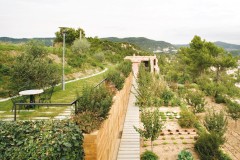
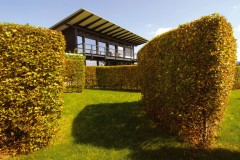
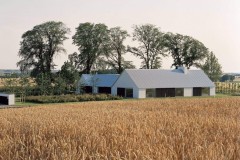
The building is integrated into a series of landscape mounds along the route, its curves and bulges echoing those of the mounds, with a metallic roof replacing the original green lawn. This design technique, which uses landscape to dissolve the building volume, allows the imposing presence of the original main stand to stand out in the urban environment, with the spires of distant churches and the contours of the ramparts also coming into view. Trees planted along the bicycle and pedestrian paths form a continuous canopy, extending the green network composed of the green belt, the moat, and the Avenue des Allées Paulmy. Based on the concept of lowering the sports fields below the elevation of the urban transport network, the project aims to conceal the building volume from the west while ensuring visibility from the east, from the direction of the rugby field. From this perspective, a single large roof structure unifies all the buildings, with the large covered training hall in the center clearly visible, forming a strong visual focal point.
该建筑沿路线融入一系列景观土丘之中,其曲线与隆起形态与土丘相呼应,金属质感的屋顶取代了原本的绿色草坪。这种以景观消解建筑体量的设计手法,使原有主看台的雄伟气势在城市环境中得以凸显,远处教堂的尖顶与城墙轮廓亦映入眼帘。沿自行车道与人行步道栽种的树木形成连片树冠,延伸了绿地、护城河与保罗米林荫大道(Avenue des Allées Paulmy)构成的绿色脉络。项目基于将运动场地降至城市交通网络标高之下的设计理念,旨在从西侧隐藏建筑体量,同时确保从东侧橄榄球场方向来的访客可见。从这一视角望去,单一的大型屋顶结构统摄所有建筑,中央的大型有顶训练厅清晰可见,形成强烈的视觉中心。
© Mathieu Choiselat
The building adopts a minimalist architectural language, based on exposed concrete, natural wood, and dark green painted masonry, topped with a large aluminum roof. This restrained architectural expression allows the project to better integrate into the surrounding landscape, avoiding any decorative or abrupt elements that might disrupt its simplicity.
该建筑采用极简的建筑语言,以裸露混凝土、天然木材与深绿色涂漆砖砌结构为基调,上方覆盖大面积铝制屋顶。这种克制的建筑表达手法,使项目更好地融入周边景观,避免了任何可能破坏其简洁性的装饰性或突兀元素。
© Mathieu Choiselat
Project Phasing—Although the ultimate goal of the entire stadium project is to increase spectator capacity from 13,500 to 16,500, the actual construction is carried out in phases, progressing stand by stand and corner by corner. This implementation strategy, which breaks down the whole into a series of completed and interconnected sub-projects, is based both on budget constraints for specific periods and on uncertainties regarding future development, avoiding a project that requires subsequent work to realize its full integrity.
项目规划——尽管整个体育场项目的最终目标是将观众容量从 1.35 万人提升至 1.65 万人,但实际施工采用分阶段、逐看台、逐角落推进的方式。这种将整体拆解为一系列已完成且相互关联的子项目的实施策略,既基于特定时期的预算约束,也考虑到未来发展的不确定性,避免了完成一个需后续工程才能体现完整性的项目。
© Agnès Clotis
From east to north, commercial spaces are planned on the ground floor seating areas along the embankment, and higher education institutions will be introduced in the future, which will give the seating areas a completely new functional positioning.
从东至北,沿堤岸分布的首层看台区域规划了商业空间,未来还将引入高等教育机构,此举将为看台区域赋予全新的功能定位。
© Pierre Chambion