场地限制下的创新布局与功能整合:本项目最核心的亮点在于其对复杂场地条件的深刻洞察与创造性应对。设计巧妙地将地铁咽喉区这一先天限制转化为空间组织的核心驱动力,通过“运动谷”的策略,将低干扰、低荷载的功能(操场、绿地)设置于地下结构上方,实现了基础设施与校园活动的有机共存。这种顺应约束而非简单规避的布局方式,展现了高超的场地适应性设计能力,有效化解了结构避让、振动隔离等技术难题,使原本碎片化的空间重构为一个连续且富有活力的整体。
高密度开发下的立体空间激活:面对实际高达1.3的容积率压力,项目通过精妙的垂直空间策略成功激活了被压缩的场地。设计核心是通过多组主题院落的组合打破地面的局限性,并利用架空层、屋顶平台等立体空间,通过积极的竖向交通体系(大台阶、坡道)将其串联起来。这种“院落组合+立体连接”的策略,不仅解决了采光通风问题,更创造出一个流动、趣味性强的非正式学习与社交网络,实现了高密度开发下空间品质的提升,超越了传统对容积率的简单满足。
跨越物理隔阂的教学一体化:为解决城市道路对校园功能分割的问题,设计采用了极具前瞻性的“空中连廊+核心庭院”策略。封闭式空中连廊确保了中小学间安全便捷的交通流线,而下方的入口庭院则与连廊共同围合成一个内向、共享的“智慧谷”。这种动静结合(“运动谷”与“智慧谷”)的空间格局,不仅实现了公共教学资源的优化配置和高效共享,更在物理上连接了功能上分离的两个地块,最终塑造了一个在安全、活力与共享性上达到高度平衡的现代化教育复合体。
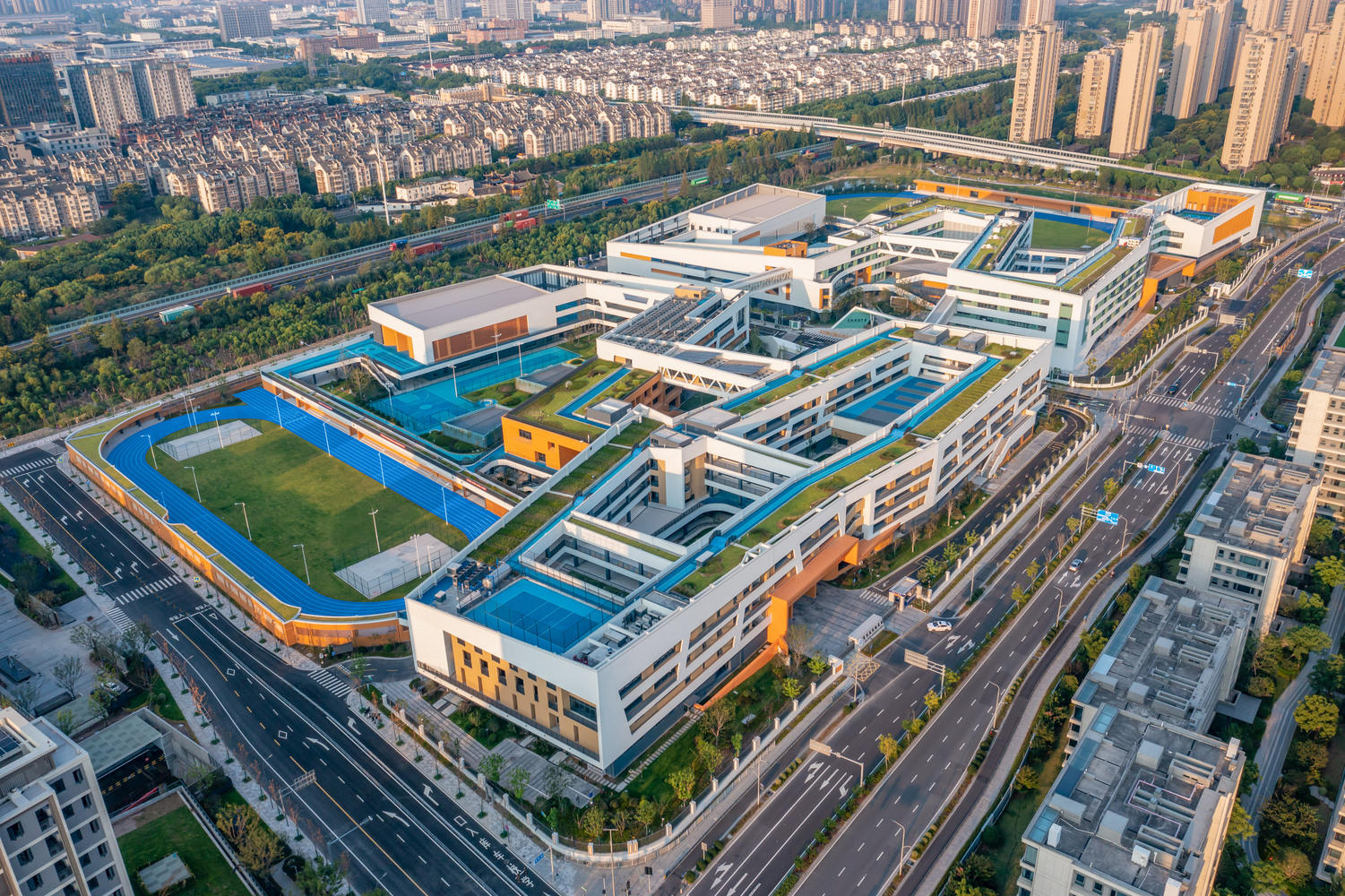
The project is located in the Qianyin block of Yinzhou District, Ningbo City, Zhejiang Province. The site borders Panhu Avenue to the north, is adjacent to the urban green belt and the Yongtaiwen Expressway to the south, is flanked by a landscape water system and Jinda North Road to the west, and is next to the metro-deck residential area to the east. The project is divided into two parcels, with a total land area of 93,427 ㎡. Parcel 1, with an area of 48,916㎡, is planned for a 48-class junior high school, and Parcel 2, with an area of 44,511㎡, is planned for a 60-class primary school. The planned plot ratio for both parcels is 0.9.
项目位于浙江省宁波市鄞州区前殷区块,场地北至潘火大道,南侧紧邻城市绿带及甬台温高速路,西侧为景观水系及金达北路,东侧为地铁上盖住宅区。该项目分为两个地块,项目总用地面积 93427 ㎡。其中 1# 地块用地面积 48916㎡,拟建一个 48 班的初中,2# 地块用地面积 44511㎡,拟建一个 60 班的小学。两个地块规划容积率均为 0.9。
© DC Alliance
© DC Alliance
Compared to conventional campus design, this project mainly faces three major challenges: First, the metro entrance and exit lines traverse the campus from east to west, dividing the original two parcels into four fragmented areas, involving issues of structural clearance, vibration isolation, and safety protection. Second, due to the need to avoid the metro shield lines during construction, the available site is extremely tight, creating a conflict with the requirement for a high floor area ratio (the actual FAR is 1.3). Third, a central urban road separates the primary and junior high schools, necessitating solutions for physical segregation and functional linkage.
与常规校园设计相比,本项目主要面对三大挑战:一是地铁出入场线东西向横穿校园,将原本两个地块分成四个碎片化区域,涉及结构避让、振动隔离与安全防护问题;二是由于建设场地需避让地铁出入场盾构线,造成可用场地极度紧缩与高容积率(实际容积率为 1.3)要求的矛盾;三是中间城市道路横亘于中小学之间,需解决物理隔离与使用功能联动问题。
© DC Alliance
© DC Alliance
II. Design Strategy
1. Adaptive Layout in the Metro Throat Area
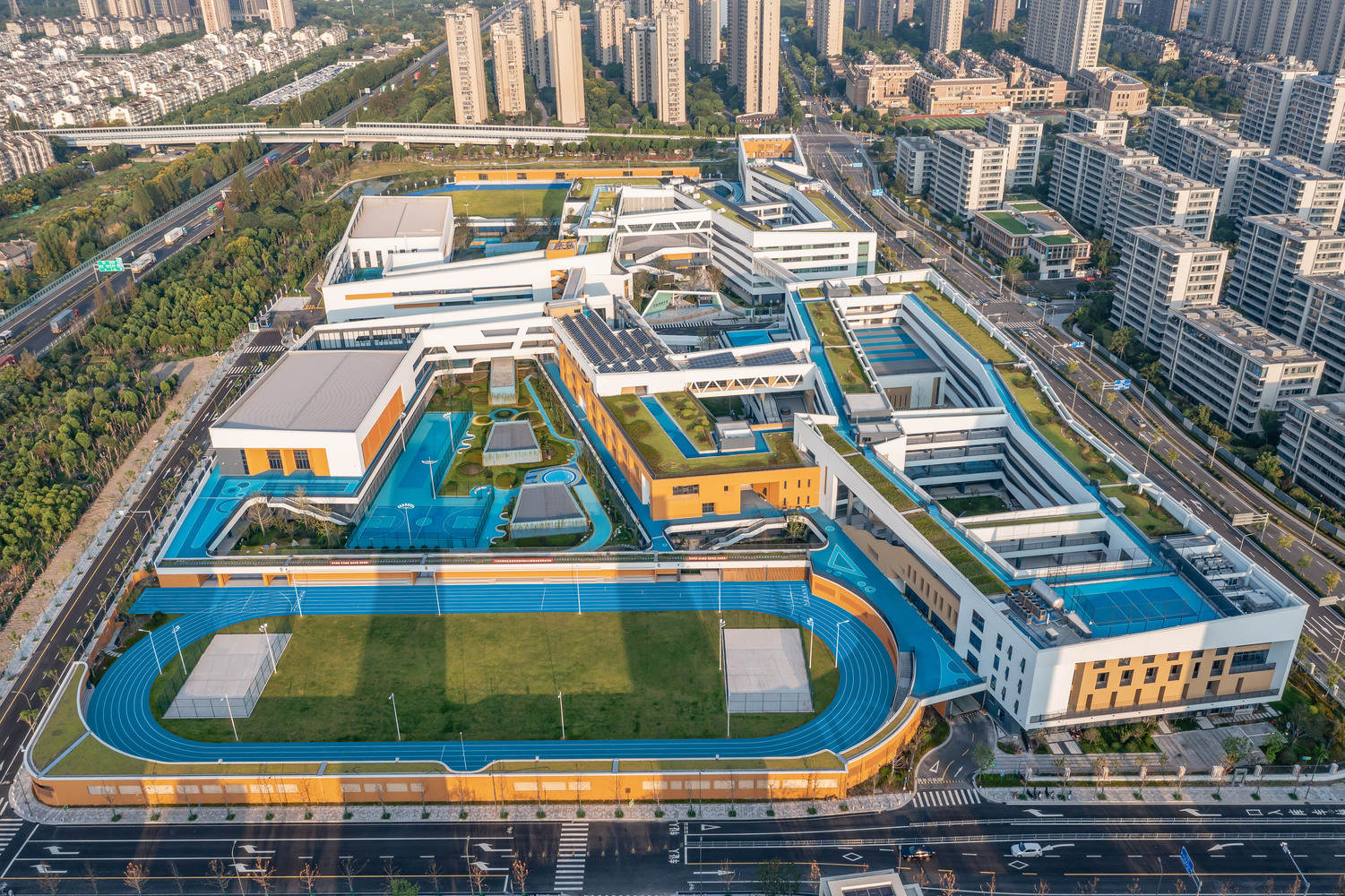
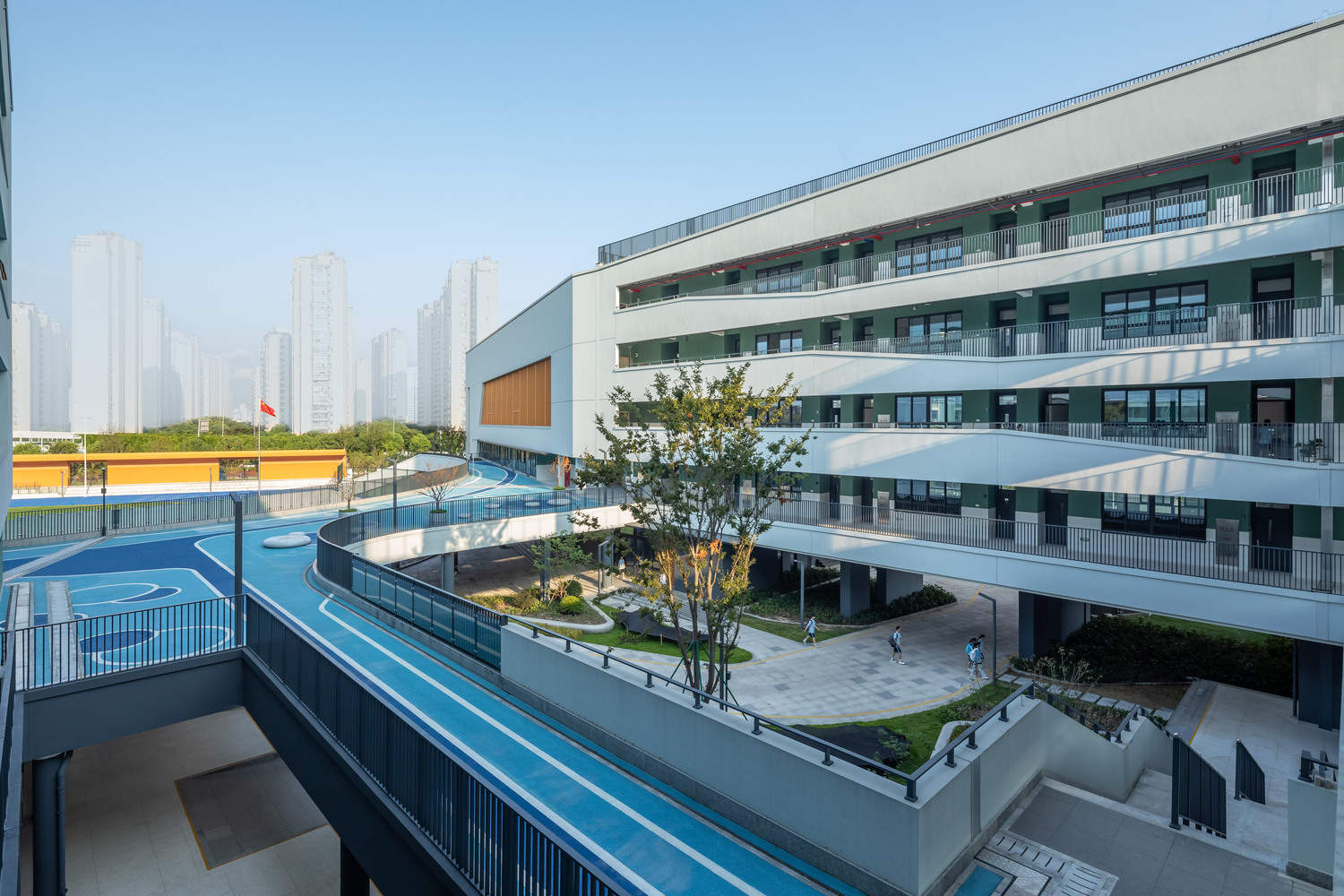
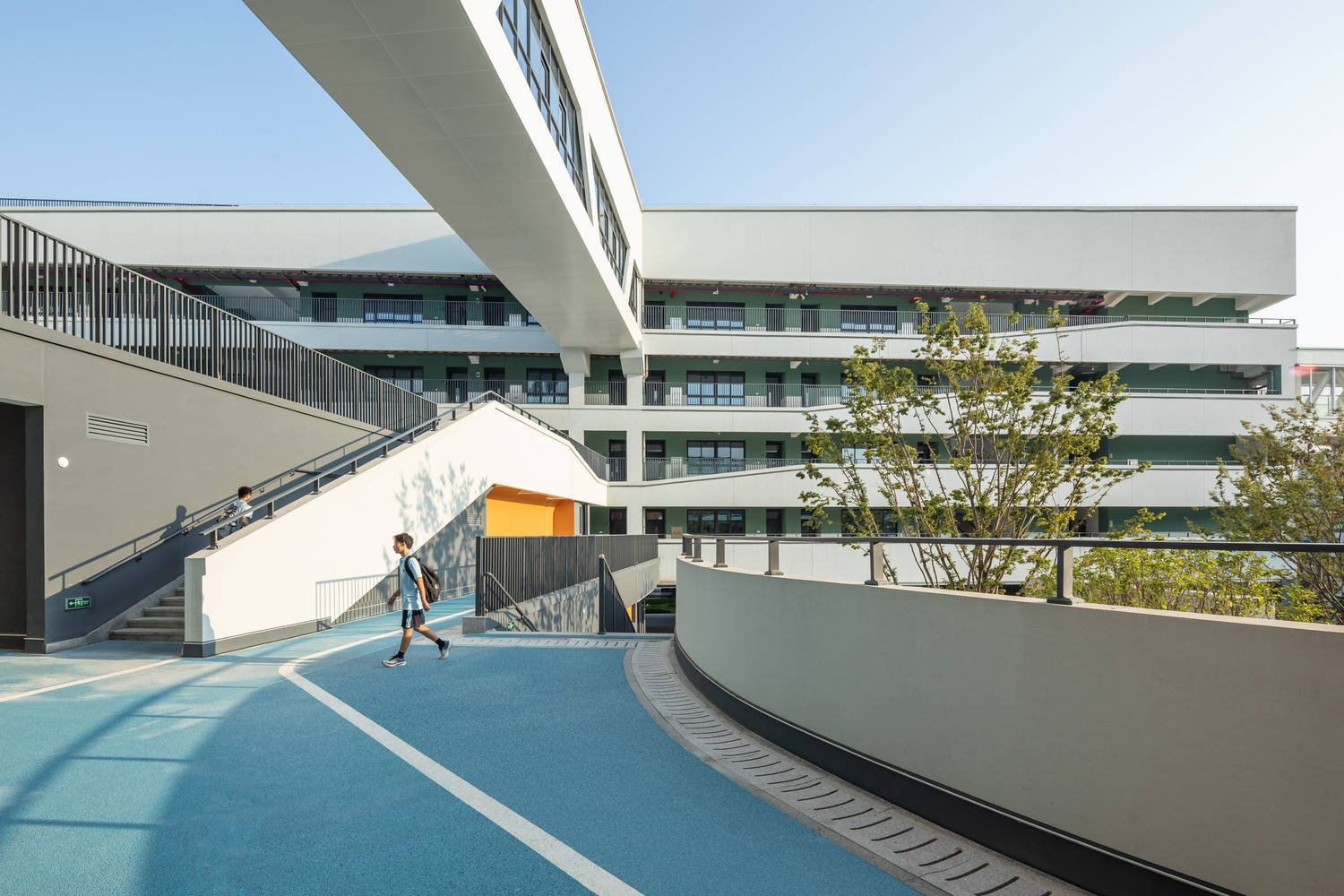
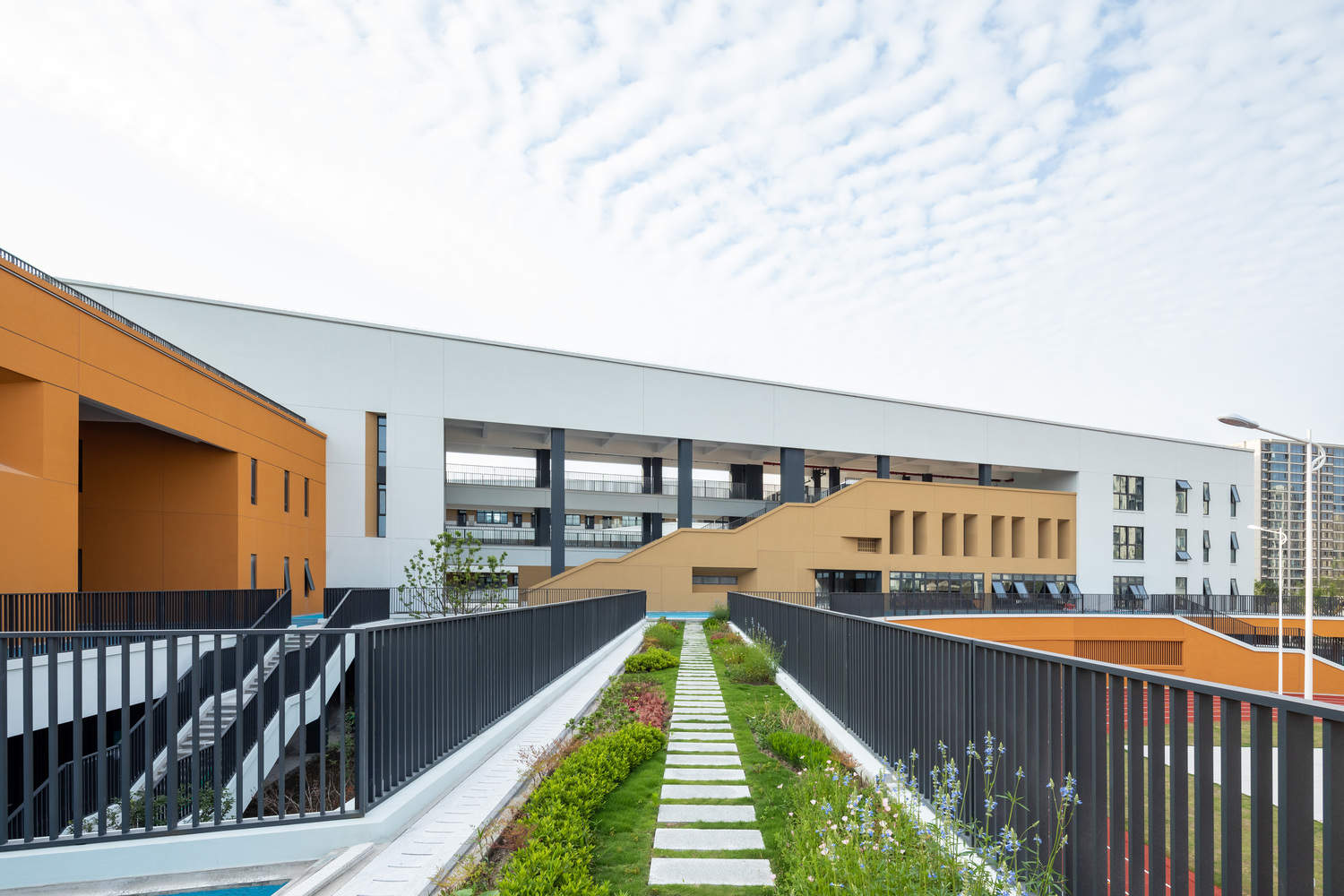
Under the complex requirement of simultaneous construction for the metro throat area and the school, based on prior communication with the metro company, the following constraints must be met: the main school buildings must be completely separated from the metro throat area; the boundaries of above-ground structures and basements must maintain a certain setback distance from the metro shield lines; and the grid of the throat area structure must be utilized to place metro smoke exhaust facilities directly above it. Faced with these restrictions, the design adopts a strategy of conforming to the site: the main teaching buildings and basements for both the primary and junior high schools are arranged north of the throat area, while the gymnasium and physical activity rooms are concentrated on the south side. The northern and southern parts are connected by elevated corridors. The area directly above the throat area, aside from necessary smoke exhaust shafts, is primarily used to bear low-load functions that have no structural interference, such as playgrounds, sports fields, leisure areas, and green spaces, forming an east-west extending, nearly 500-meter outward-facing "Sports Valley," cleverly achieving an organic integration of function and constraint.
二、设计策略
1. 地铁咽喉区的适应性布局
在满足地铁咽喉区与学校同步建设的复杂要求下,基于前期与地铁公司沟通确认需满足以下约束条件:学校主体建筑需与地铁咽喉区完全脱开;地上结构与地下室边界均需退让地铁盾构线一定距离;并需利用咽喉区结构柱网,在其正上方设置地铁排烟设施。面对上述限制,设计采取顺应场地的策略:将中小学教学主体及地下室布置于咽喉区北侧,南侧则集中设置体育馆及体育活动用房。南北两部分建筑通过架空连廊进行连接。咽喉区正上方区域,除设置必需的排烟井外,主要用于承载操场、运动场地、休闲活动空间及绿地等荷载要求低、且无结构干扰的功能,形成东西延展近 500 米的外向型开放式“运动谷”,巧妙实现功能与限制的有机融合。
© DC Alliance
© DC Alliance
2. Adaptive Spatial Organization under High Density and High FAR
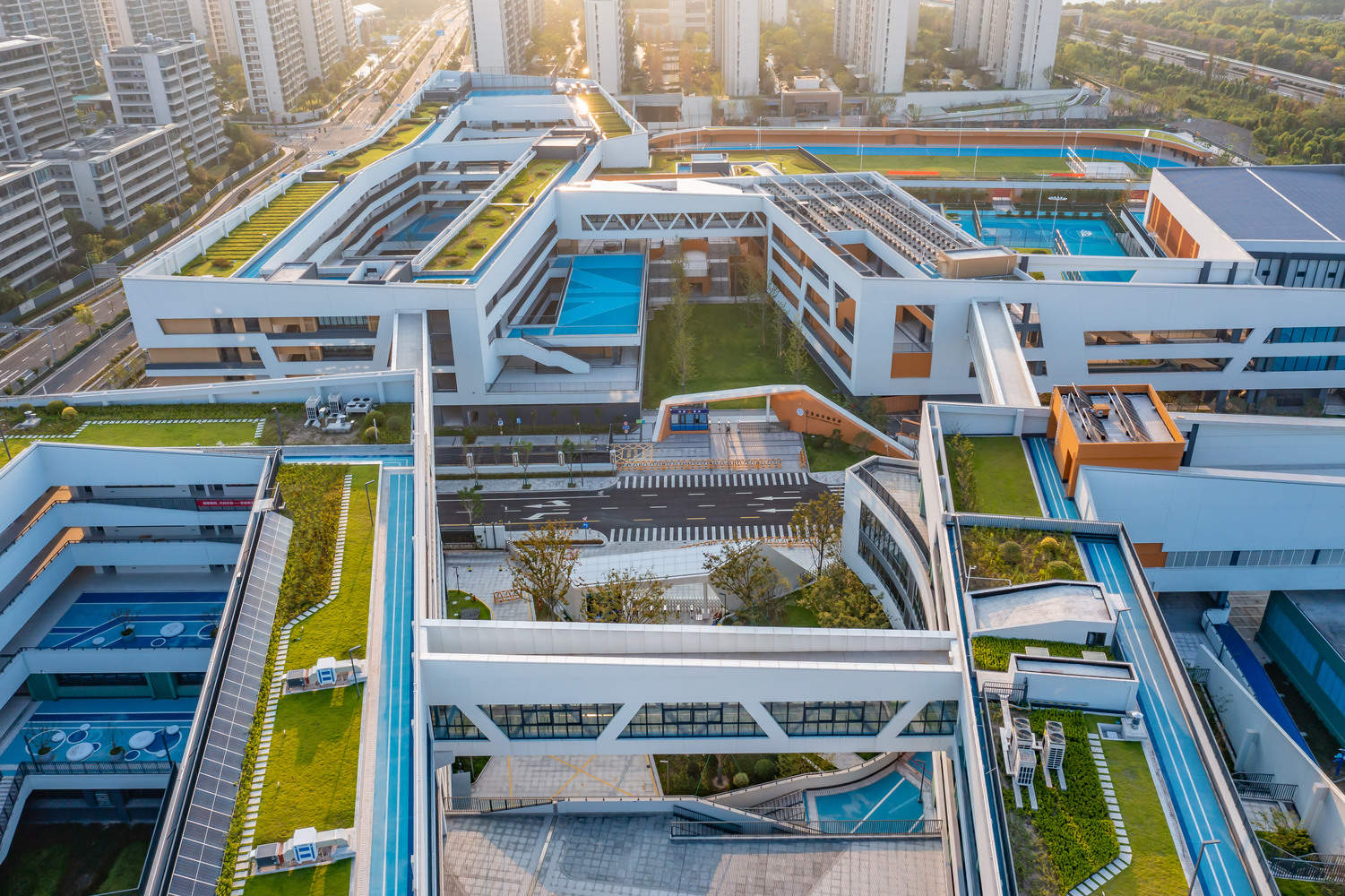
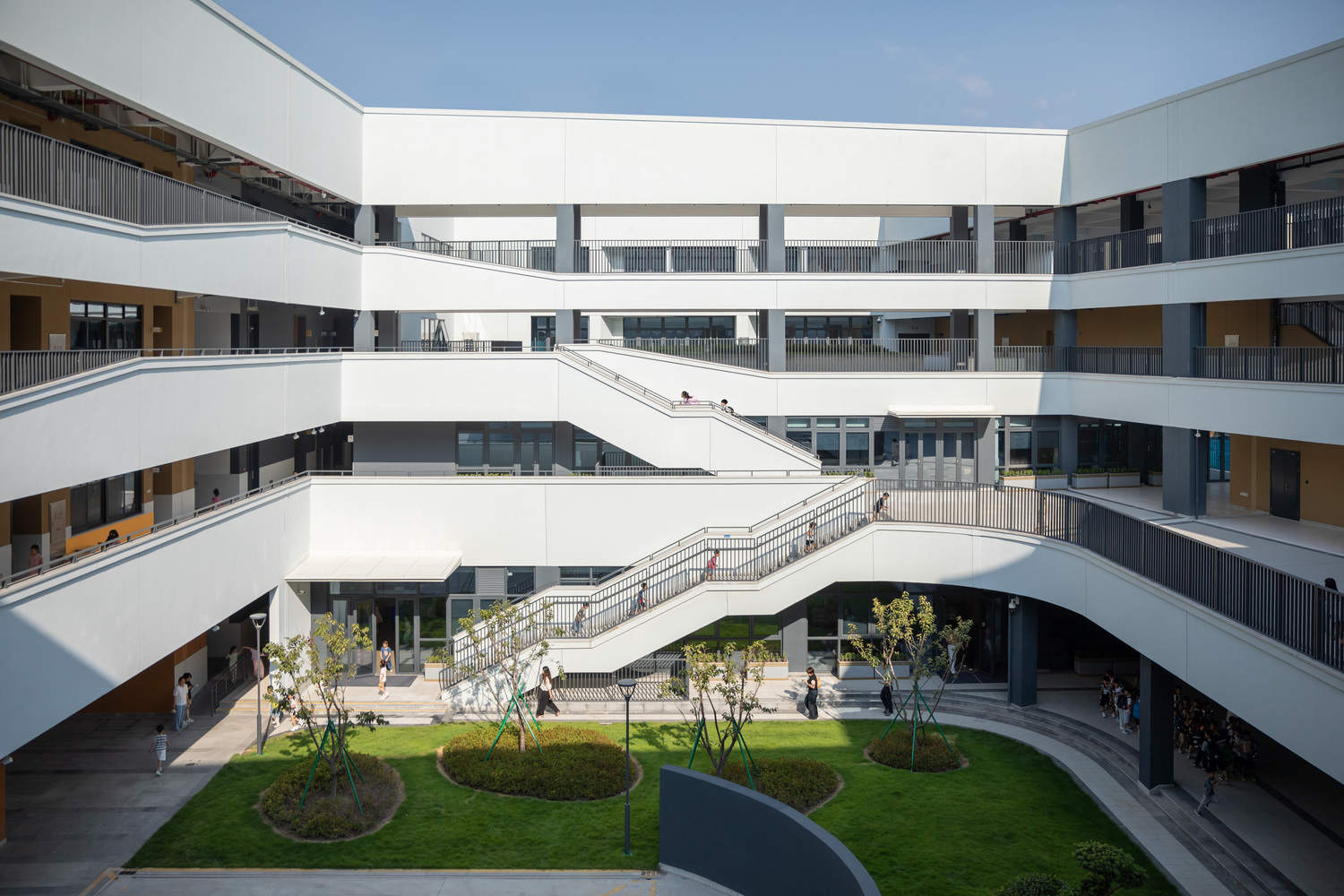
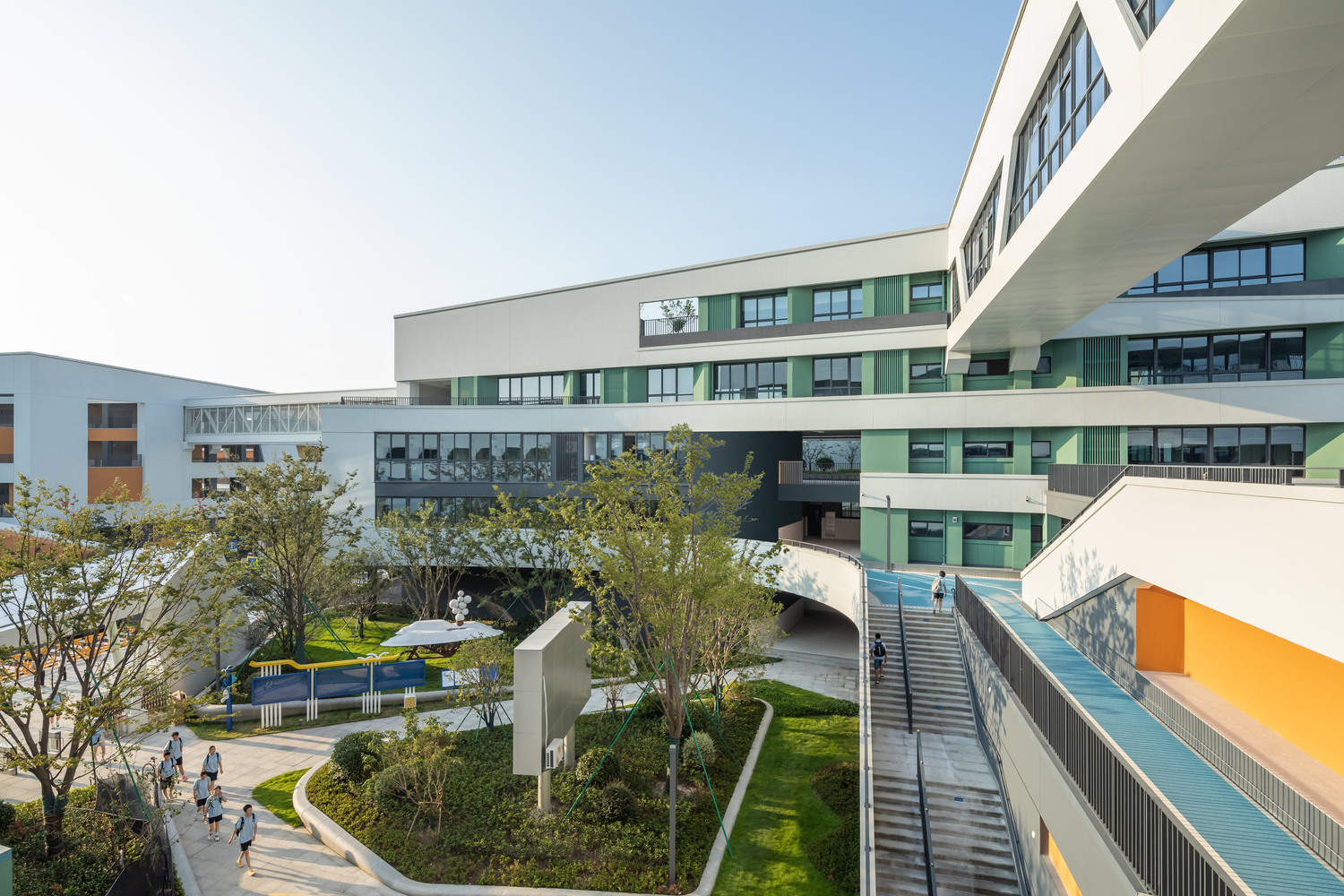
To resolve the spatial limitations and high FAR challenges caused by avoiding the metro shield lines, this project adopted a dual strategy: Firstly, breaking spatial limitations through a courtyard combination model. The design implants multiple themed courtyards with different functions (e.g., learning courtyards, ecological gardens, cultural atriums) and cleverly connects them using elevated floors to form an organic whole. Although these courtyards vary in form, scale, style, and elevation, they all derive from the topological deformation of the throat area's form. This effectively improves daylight and ventilation while also constituting a highly engaging system of informal learning and communication spaces. Secondly, actively pursuing vertical development and platform linkage. Due to limited ground space, the design seeks solutions in three-dimensional space, fully utilizing the space above the throat area, elevated floors, and various rooftops. Through active vertical circulation design such as large steps and ramps, these platforms at different elevations are linked together, ultimately constructing a complete, unified, fluid, and vibrant three-dimensional public space network.
Ultimately, these strategies complement each other, allowing the campus to transcend the simple satisfaction of high-density, high-FAR metrics, evolving into a campus site that coexists with its environment and continuously inspires vitality in learning and socializing.
2. 高密高容下的适应性空间组织
为化解因避让地铁盾构线导致的用地局限与高容积率挑战,本案采用了双管齐下的设计策略:首先,通过院落组合模式打破空间局限。设计植入多组功能有别的主题院落(如学习庭院、生态花园、文化中庭),并利用架空层将其巧妙连接,形成一个有机整体。这些庭院虽在形态、尺度、风格和标高上各有特色,但均来自于咽喉区形态的拓扑变形,在有效改善采光通风的同时,更构成了一个极具趣味性的非正式学习与交流空间体系。其次,积极进行垂直开发与平台联动。由于地面场地有限,设计转而向立体空间寻求解决方案,充分利用了咽喉区上方、架空层以及各层屋顶等空间。通过大台阶、坡道等积极的竖向交通设计,将这些不同标高的平台串联起来,最终构建出一个完整统一、流动而富有活力的立体公共空间网络。
最终,这些策略相辅相成,使校园超越了对高密高容指标的简单满足,演进为一个与场地共生、能持续激发学习与社交活力的校园场所。
© DC Alliance
© DC Alliance
3. Integrated Connectivity and Sharing Across the Roadway
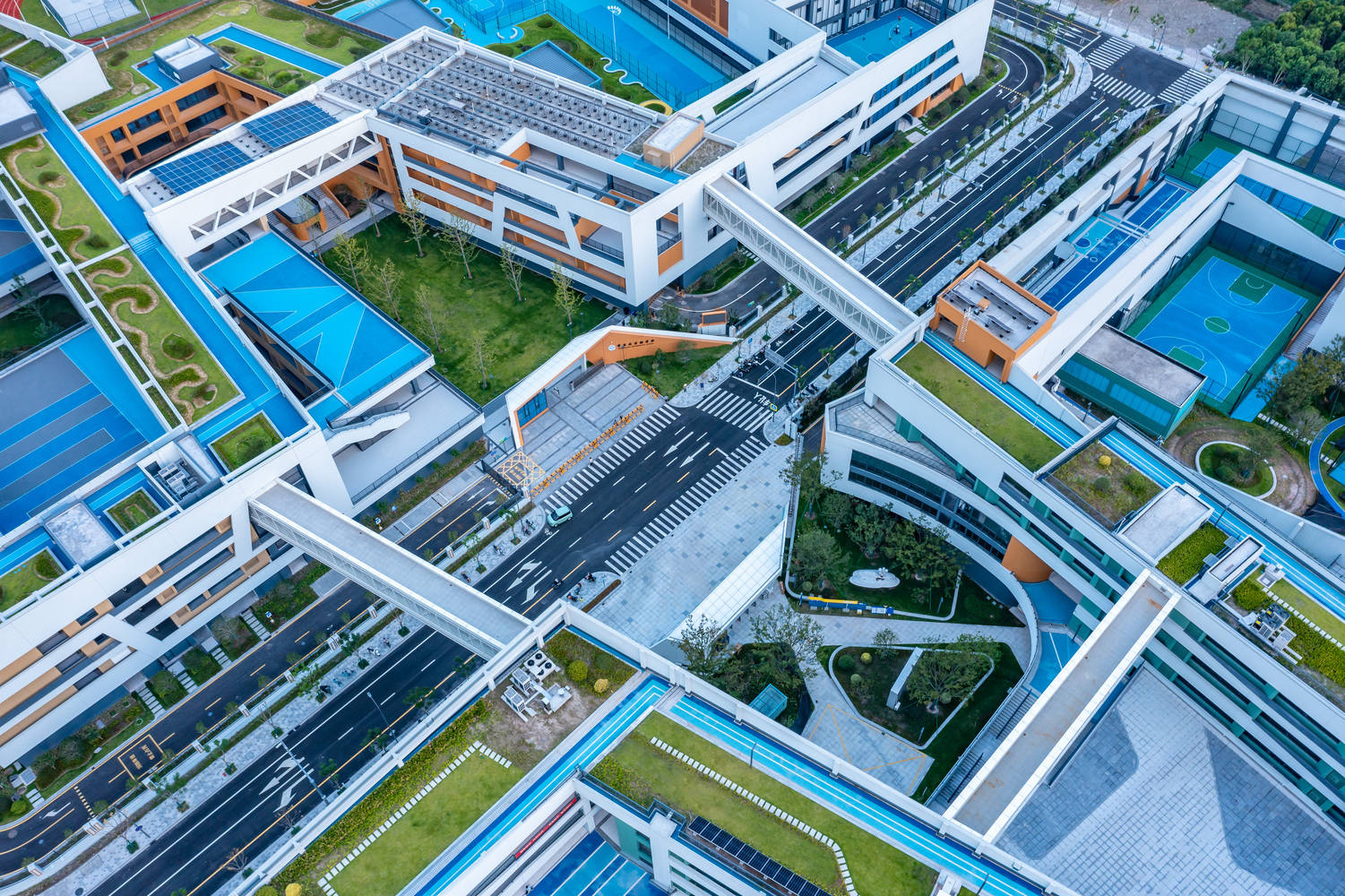
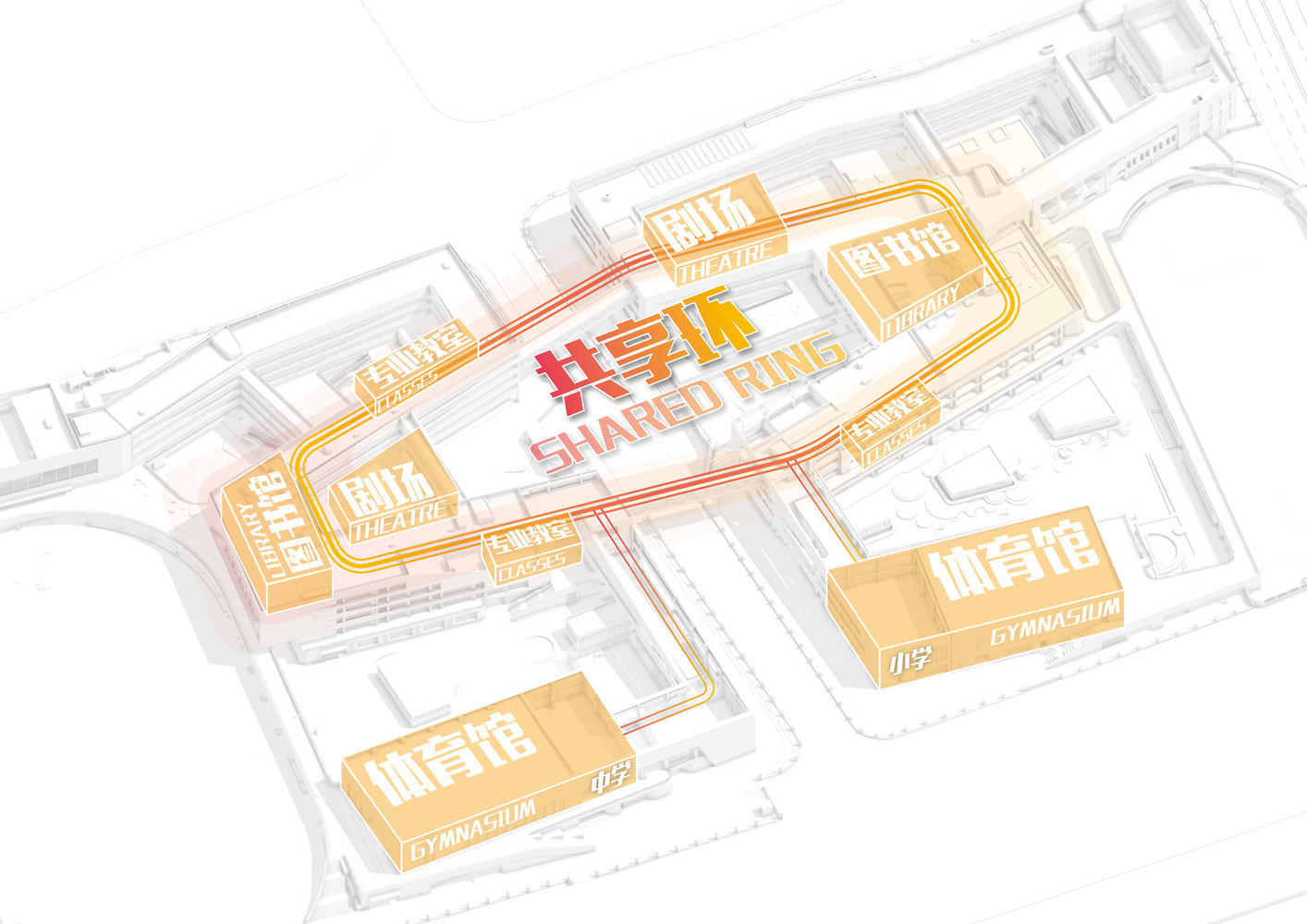
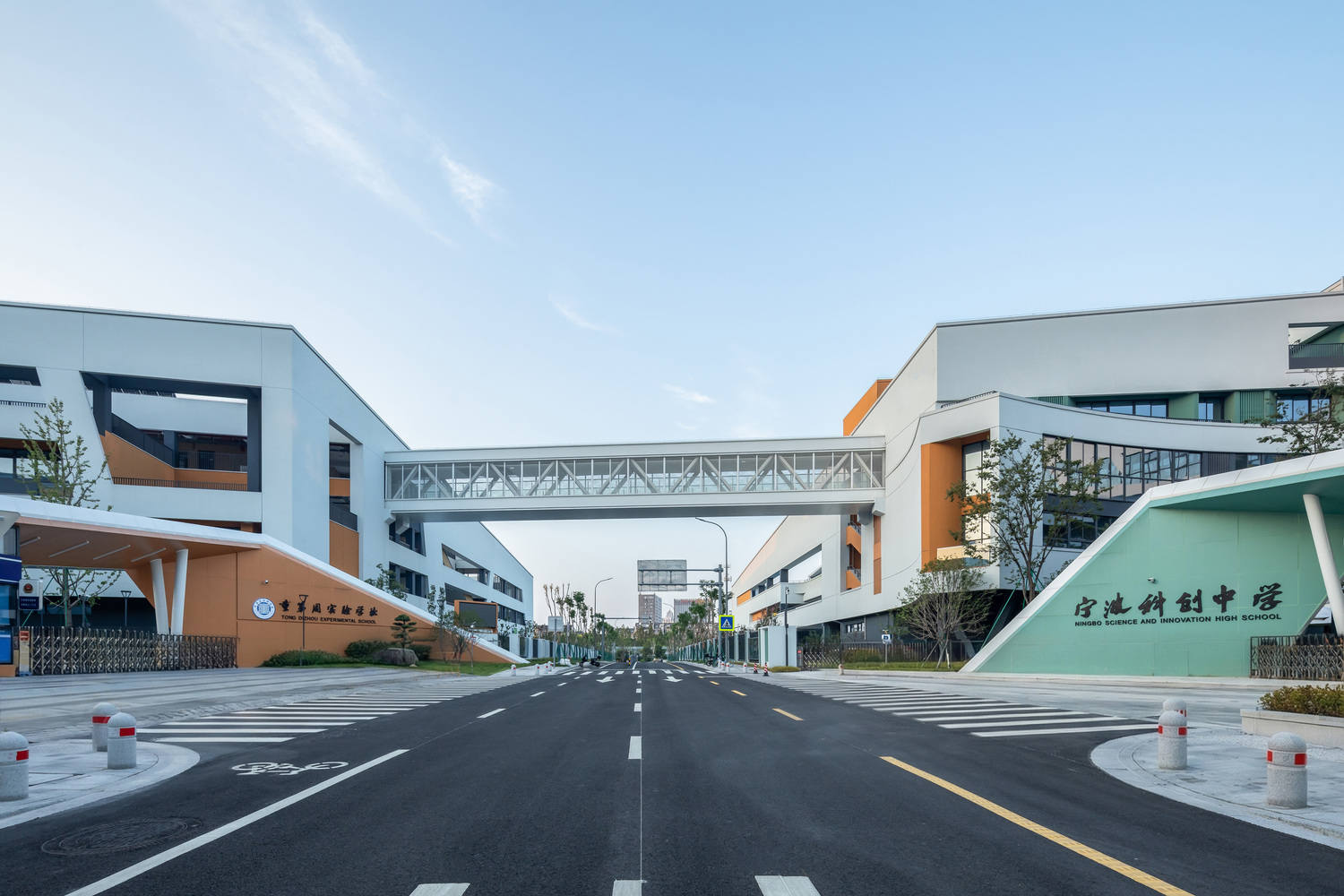
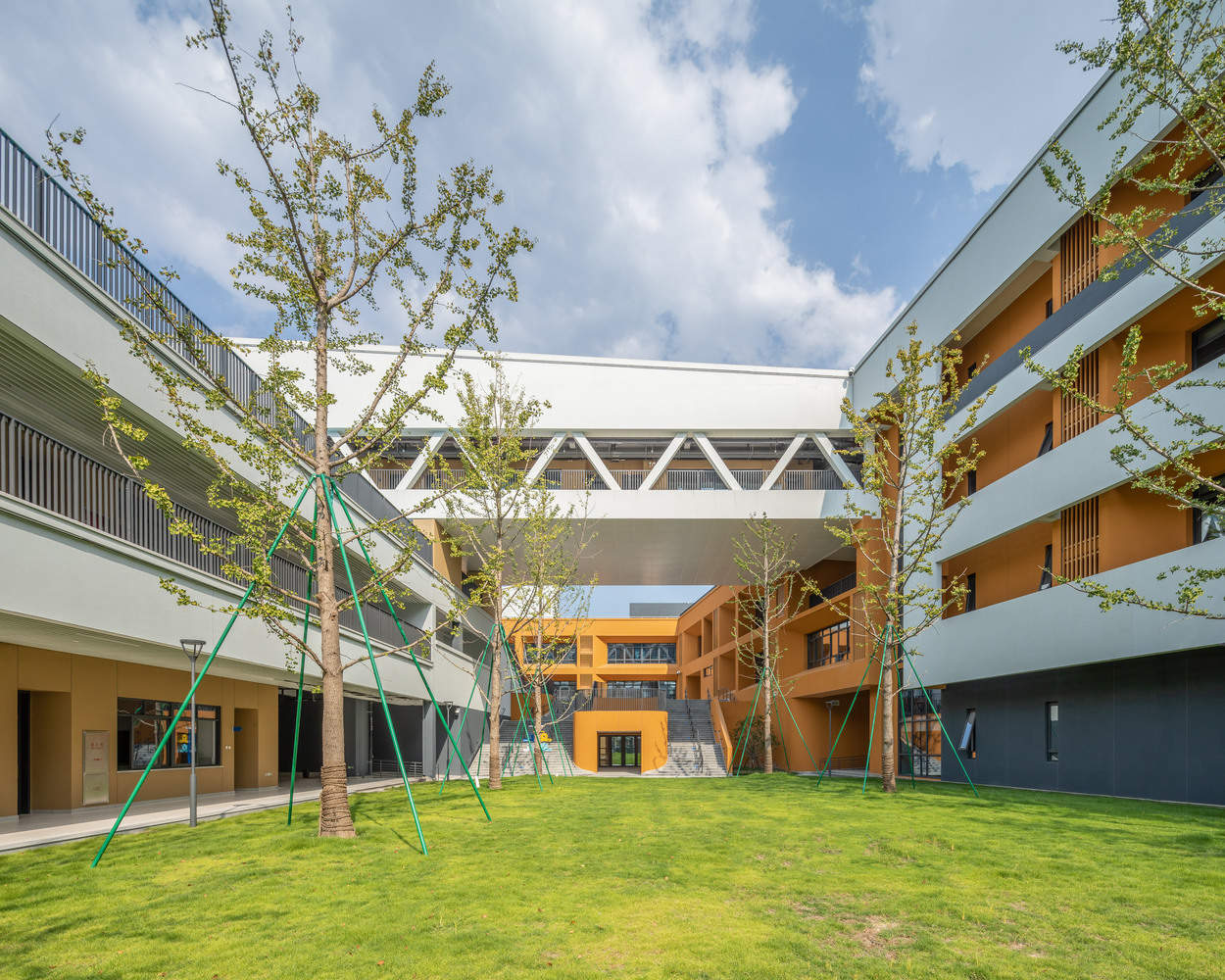
To address the issue of the central urban road separating the primary and junior high schools, the design employs a strategy of three-dimensional connectivity and functional sharing, aiming to break down physical barriers and promote integrated campus use. In terms of three-dimensional connectivity, the design sets up two enclosed aerial corridors, 4 meters wide and 40 meters long, spanning over the road to directly connect the teaching areas on both sides. This all-weather corridor design ensures safe and convenient passage for students, unaffected by weather, and effectively avoids the crossing of pedestrian and vehicle flows, enhancing campus safety and accessibility. Regarding functional layout and sharing, the main entrances and exits for both schools are situated on either side of the central road, integrating the entrance courtyards with the aerial corridors to jointly enclose a spacious and relatively inward-looking core teaching courtyard. This courtyard is surrounded not only by regular classrooms but also by highly public teaching spaces such as the library, lecture hall (small theater), calligraphy classroom, and art classroom. This layout aims to promote resource sharing between the two schools, increase facility utilization efficiency, and form a complex and culturally rich teaching and exchange center. This teaching core courtyard is not only the spatial organizational hub but also the functional convergence center. Enclosed by a series of teaching spaces, it forms an inward-looking, tranquil, and intimate "Wisdom Valley." Echoing the open and active "Sports Valley" to the south, the contrast of "dynamic and static," "open and private," creates an organically complementary Yin-Yang spatial pattern, shaping a harmonious yet richly tense campus configuration.
3. 跨道路一体化连通与共享
为解决中小学被中间城市道路分隔的问题,设计采用立体连通与功能共享的策略,旨在打破物理隔阂,促进校园一体化使用。在立体连通方面,设计在道路上空设置了两条宽 4 米、长 40 米的封闭式空中连廊,直接连接道路两侧的教学区。这种全天候的连廊设计,不仅能保障学生安全、便捷地通行,不受天气影响,也可有效避免人车流线的交叉,提升校园的安全与通达性。在功能布局与共享方面,将中小学的主要出入口设置在中间道路两侧,使入口庭院与空中连廊相结合,共同围合出一个宽敞且相对内向的教学核心庭院。庭院周边除布置普通教室,还集中设置了图书馆、报告厅(小剧场)、书法教室、美术教室等公共性较强的教学空间。这种布局方式旨在促进中小学资源共享,提高设施使用效率,同时形成一个功能复合、氛围浓厚的教学交流中心。这个教学核心庭院,不仅是空间组织的枢纽,也是功能交汇的中心。它由一系列教学空间围合而成,形成一个内向、静谧且具有私密感的“智慧谷”。与南侧开放活跃的“运动谷”相呼应,一动一静,一开放一私密,二者形成阴阳互补的有机整体,共同塑造出和谐而富有张力的校园空间格局。
© DC Alliance
© DC Alliance
© DC Alliance
III. Conclusion and Outlook
Faced with the inherent constraints imposed by the metro line traversing the campus, we transformed limitations into opportunities. Through innovative layout and flexible spatial strategies, and while satisfying all safety regulations, we successfully created a modern campus that integrates sharing, efficiency, and vitality. This design not only broke through the shackles of infrastructure but also pioneered a new model for the integrated development of "Rail + Education," which is expected to provide a valuable practical template for the symbiosis of future urban and educational spaces.
三、结论与展望
面对地铁线横穿校园的先天限制,我们化制约为机遇,通过创新性布局与灵活的空间策略,在满足所有安全规范的基础上,成功打造出一座集共享、高效与活力于一体的现代化校园。这一设计不仅突破了基础设施的桎梏,更开创了“轨道+教育”融合发展的新模式,期望能够为未来城市与教育空间的共生提供富有价值的实践范本。