“山水之谷”与“东方未来主义”的融合:本项目最精髓之处在于CAA建筑事务所提出的“东方未来主义”核心理念,并以一条贯穿地块的“山水之谷”作为设计轴线。这不仅仅是形式上的模仿,更是文化精神的在地化表达。通过将西山、香山群山的自然禀赋与“三山五园”的历史文脉相结合,设计成功地将传统的东方山水意象转化为具有未来感的建筑形态。这种处理方式使得项目在承载高科技创新功能的同时,也深刻植根于北京独特的地域文化和哲学思想,实现了人文精神与前沿科技的有机统一。
“山合院”的形态创新与空间叙事:“北·院”地块的设计是本次规划的亮点,其核心是“山合院”的理念。将山形塔楼的向上生长与围合式裙房的“云环”形态相结合,创造出既有传统“合院”意象又充满现代感的建筑群落。这种设计逻辑清晰地呈现了从自然(山水)到科技(高耸的塔楼)的生长过程。特别是塔楼大幅度扭转以拥抱景观,以及裙房的大面积架空,不仅解决了体量感,更在塔楼与裙房之间创造了富有弹性的渗透性空间,为共享与社交提供了理想载体。
立体化的生态渗透与共享空间系统:项目在空间组织上达到了极高的复杂性和流畅性,成功构建了一个“立体城市花园”。通过层层退台、架空裙房、屋顶花园和下沉庭院,实现了人车分流并创造了大量灰空间。这种多层级的自然景观交织,使得绿化从地面延伸至屋顶,并渗透至地下空间,极大地丰富了用户体验。这种对生态的立体渗透,不仅创造了高绿化率的环境,更通过有机的流线连接了内部功能与外部城市环境,体现了面向未来的可持续设计策略。
Located in the Sujatuo area of Haidian, Beijing, nestled within the embrace of the Western Hills and Xiangshan mountains, the "West Mountain Innovation Valley | Beijing Collaborative Innovation Park" is adjacent to the "Three Hills and Five Gardens" royal garden historical and cultural heritage represented by the Summer Palace, Yuanmingyuan, and Yuquan Mountain. This area is a key development zone extending from Haidian's Zhongguancun, known as "China's Silicon Valley," and is also a core area of the Beijing Free Trade Zone. The project covers a total area of approximately 12 hectares, with a total construction area of about 288,000 square meters, divided into three main parcels: West, North, and East. CAA Architects, led by Hao Wei Liu, began the overall planning and architectural design of the entire project starting in 2020. This project was listed as one of the "100 Key Science and Technology Innovation Projects" in Beijing for 2021.
位于北京海淀苏家坨地区,在西山、香山群山环抱之中,毗邻以颐和园、圆明园、玉泉山为代表的“三山五园” 皇家园林历史文化遗产;这里是被称为“中国硅谷” 的海淀中关村北部外溢的重点发展区,同时也是北京自贸区的核心区域。项目总占地面积约 12 公顷,总建筑面积约 28.8 万平方米,主要分为西、北、东三个地块。刘昊威带领的 CAA 建筑事务所自 2020 年起开始整个项目的总体规划和建筑设计。该项目被评为北京市 2021 年的 “100 个科技创新重点项目”之一。
© DONG Image
© Arch-Exist
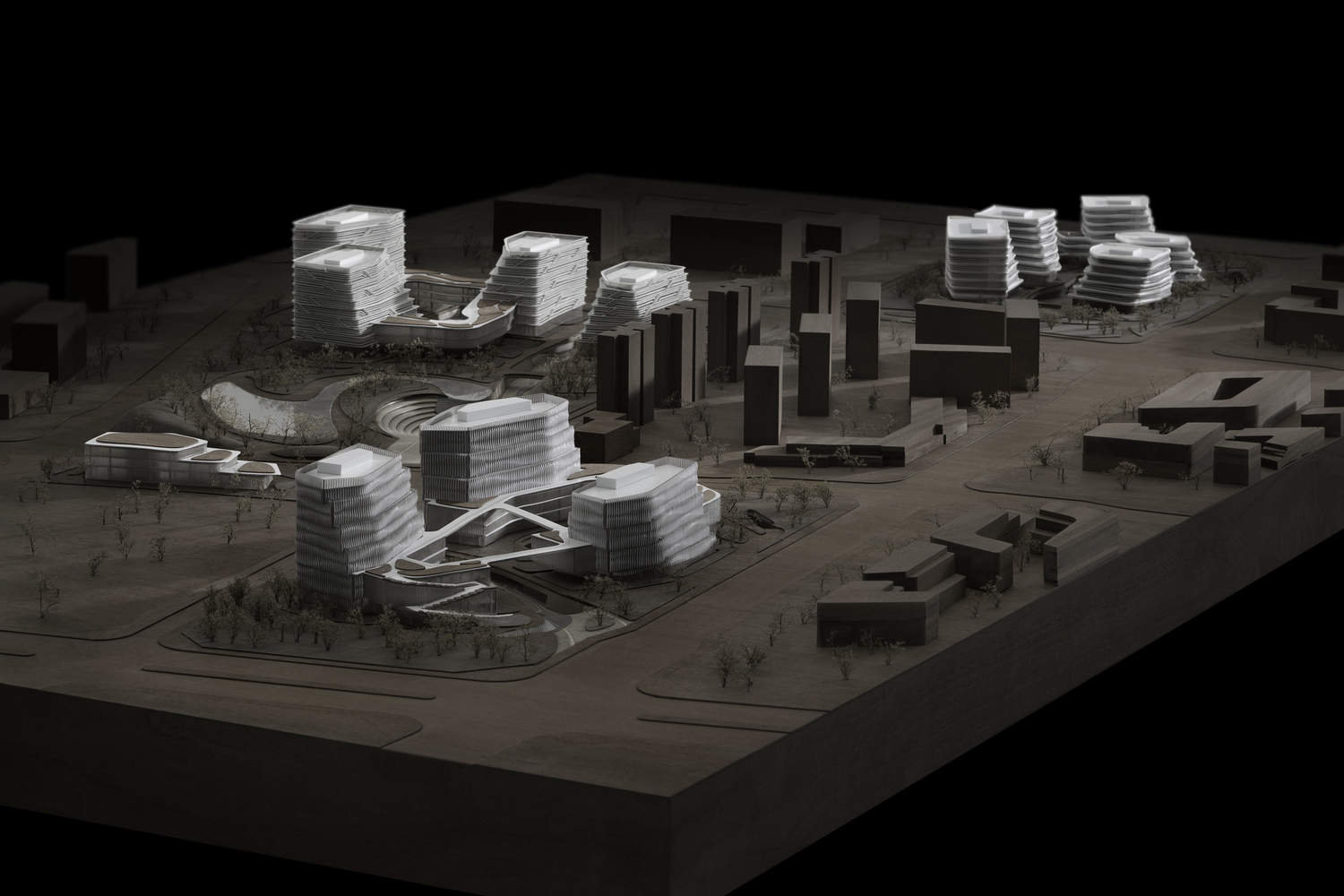
Facing the crucial and special intersection where historical culture, ecological resources, and urbanization converge—the Western Hills in the East, the Valley of Wisdom in the future—CAA adopts "Oriental Futurism," proposed by Hao Wei Liu, as its core concept. Utilizing a "Valley of Mountains and Waters" spanning across all parcels as the design axis, the three parcels are individually imbued with the design concepts of "West · Mountain," "North · Courtyard," and "East · River Valley."西山之于东方,智谷之于未来,面对历史人文、生态资源与城市化多元交汇的重要特殊节点,CAA以刘昊威提出的"东方未来主义"为核心理念,以一条跨越各地块的“山水之谷”作为设计轴线,分别赋予三个地块“西·山”、“北·院”、“东·川”的设计概念。
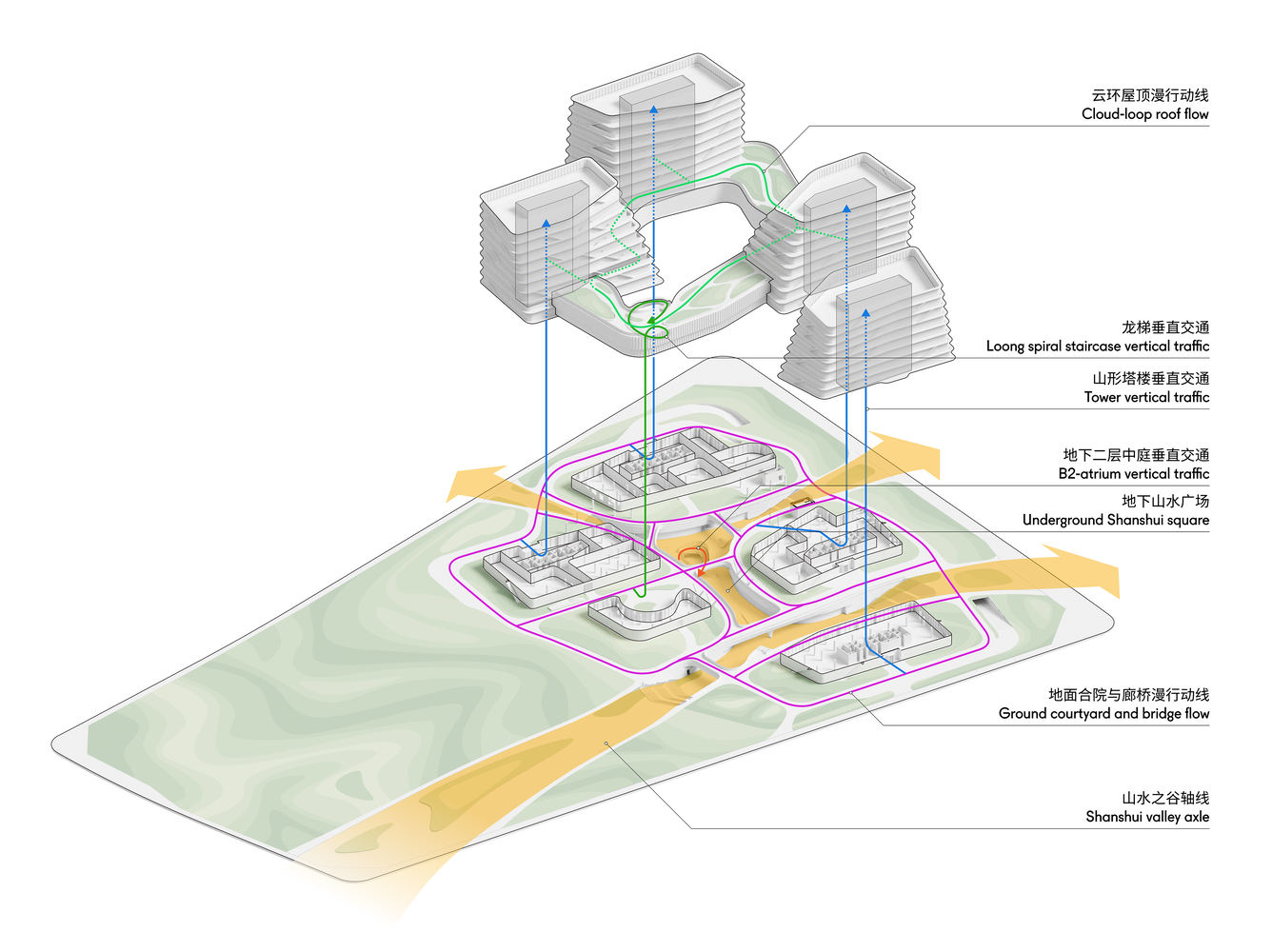
分析图
© DONG Image
North · Courtyard
"North · Courtyard," as the first phase of construction for the "West Mountain Innovation Valley," is the largest architectural cluster in the overall project, with a total construction area of approximately 110,000 square meters, comprising 72,000 square meters above ground and 39,000 square meters underground. This area is slated to host national key laboratories, artificial intelligence, chip R&D, new energy, and graphene high-tech research enterprises, aiming to become an engine for promoting global technological innovation development in Beijing. The "Valley of Mountains and Waters" in the master plan flows from southwest to east, crossing the central green space, meandering into the "North · Courtyard," and introducing the regional ecological landscape into the park, growing into the underground "Mountain and Water Plaza" courtyard. CAA integrates traditional courtyard layouts with natural landscape imagery, embodying both the "He Yuan" (enclosed courtyard) form and the layered mountainous architectural morphology, creating the design concept of the "Mountain Courtyard." Mountain-shaped towers rise from the ground, enclosed by a podium structure like "Cloud Rings" circling among the mountains, constructing a parallel spatial interface in the courtyard style. The overall building cluster engages in a dialogue with the Western Hills, based on traditional Chinese humanism and philosophical thought, merging Eastern landscape imagery with future construction, creating a futuristic Oriental romance fostered by mountains, rivers, valleys, and courtyards.
北 · 院
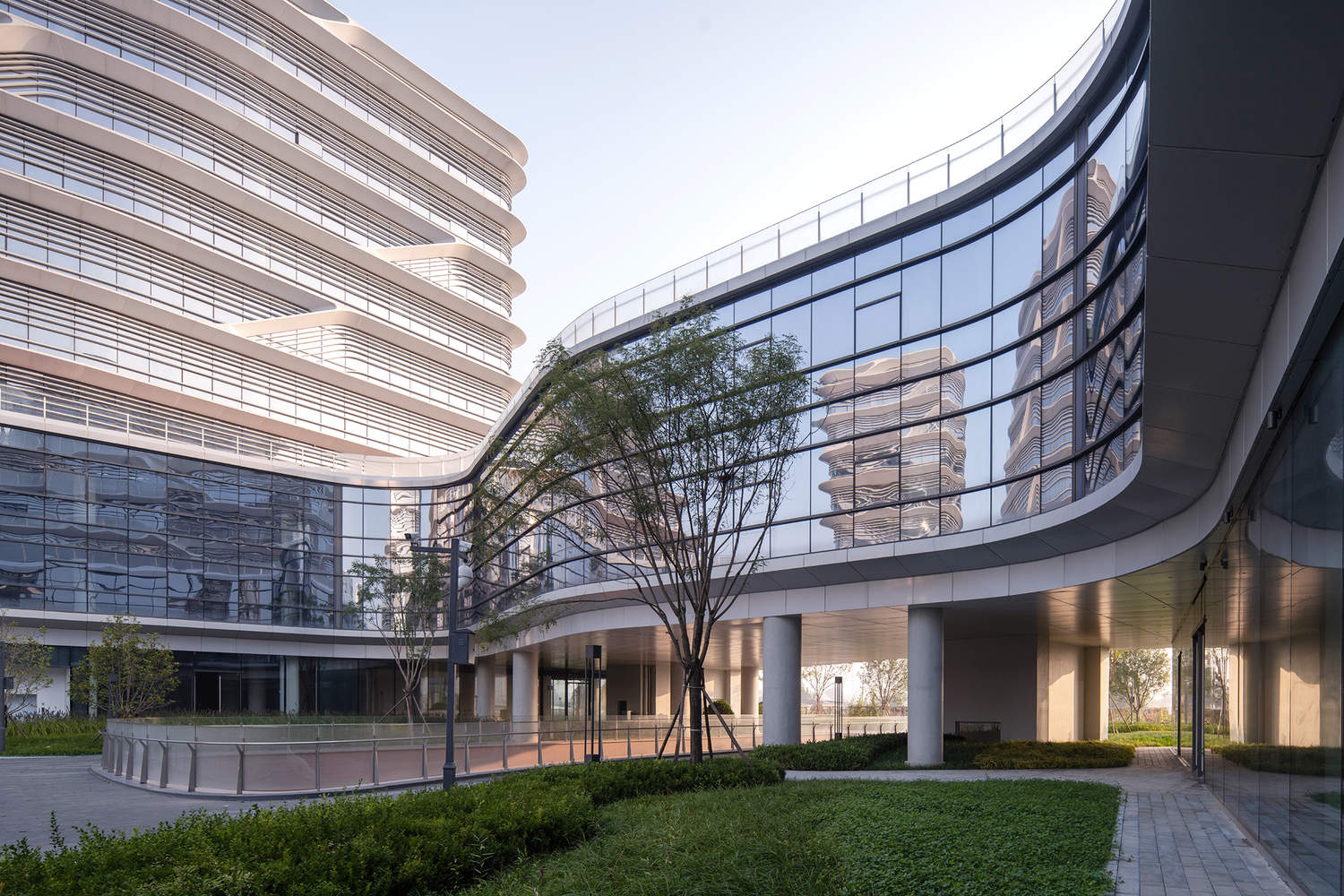
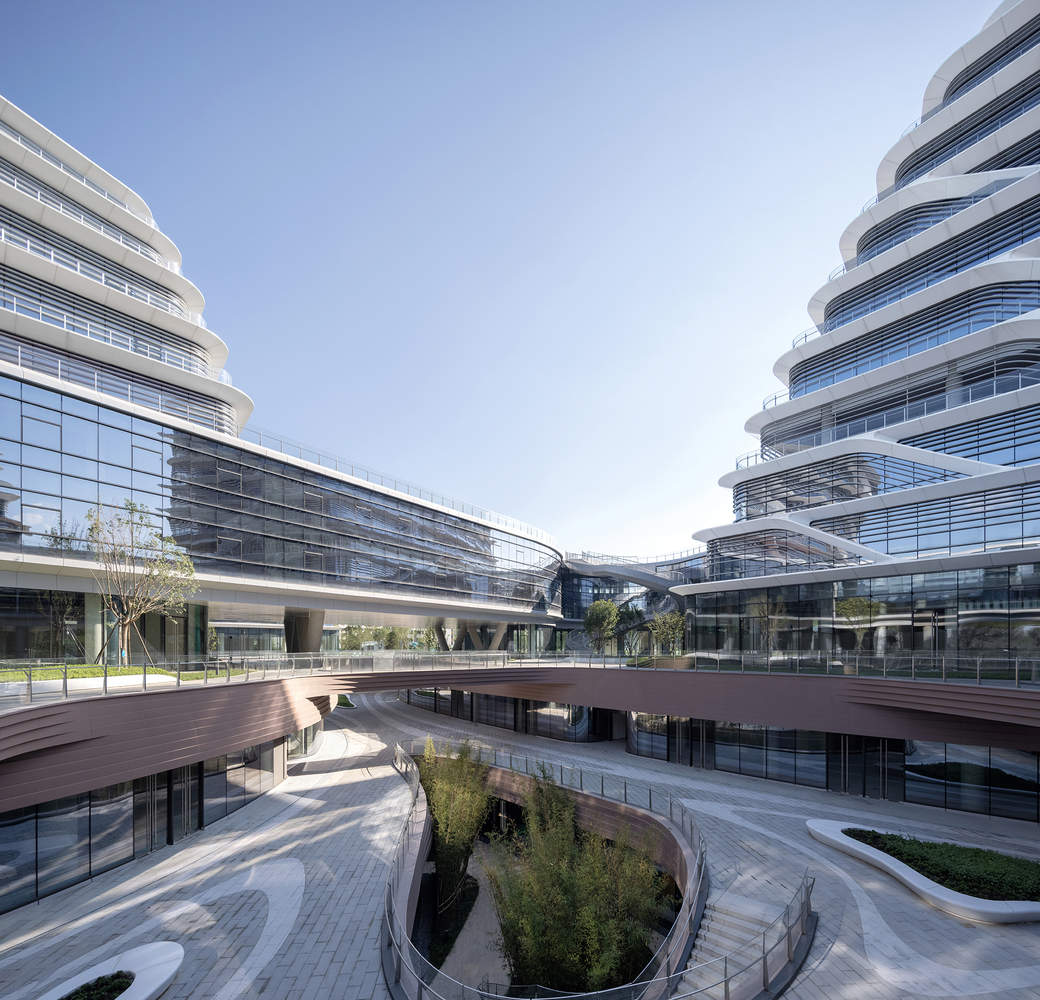
“北·院”作为“西山智谷” 一期建设地块,是总体项目中规模最大的建筑组团,总建筑面积约 11 万平方米,其中地上建筑面积 7.2 万平方米,地下建筑面积 3.9 万平方米。这里拟定引入国家重点实验室、人工智能、芯片研发、新能源、石墨烯等高科技研发企业的入驻,成为北京推动全球性科技创新发展的引擎。总体规划中的“山水之谷”由西南向东穿过中央绿地公园,川流蜿蜒进入“北·院”,同时将大区域的生态景观引入园中,生长为地下层的“山水广场”庭院。CAA 将传统院落布局与自然山水意象相融合,既具有 “合院”之象,又有层峦叠嶂的山形建筑形态,形成“山合院”的设计理念。山形塔楼从地面升起,围合式的裙房又如“云环”系于山间,构筑成合院式平行空间界面。整体建筑群形态与西山展开对话,以中国传统人文与哲学思想为基底,将东方山水意象与未来建构相融,由山川、河谷、院落共同营造出了未来主义的东方浪漫。
© Arch-Exist
© DONG Image
© Arch-Exist
Mountain · Cloud · Water
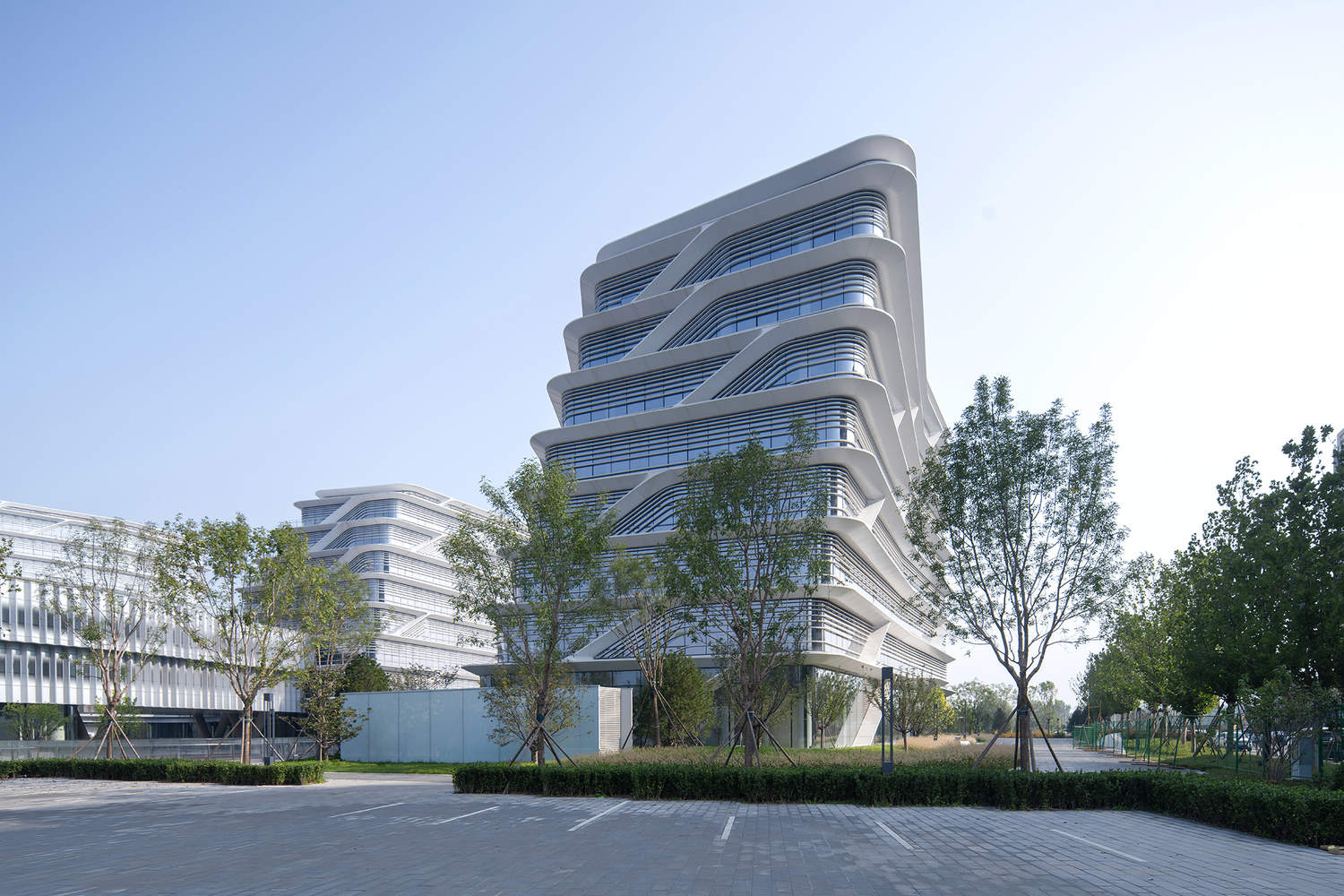
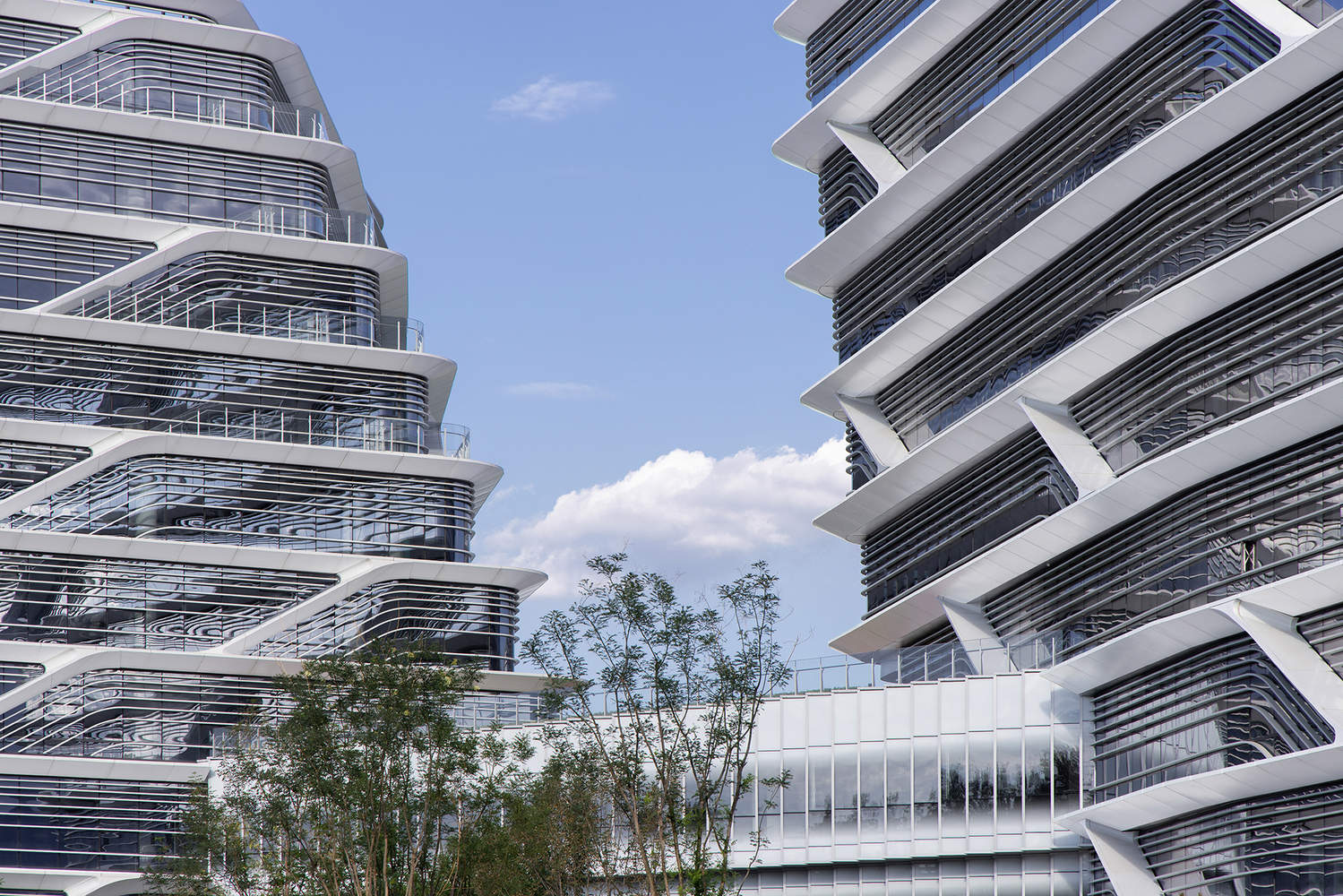
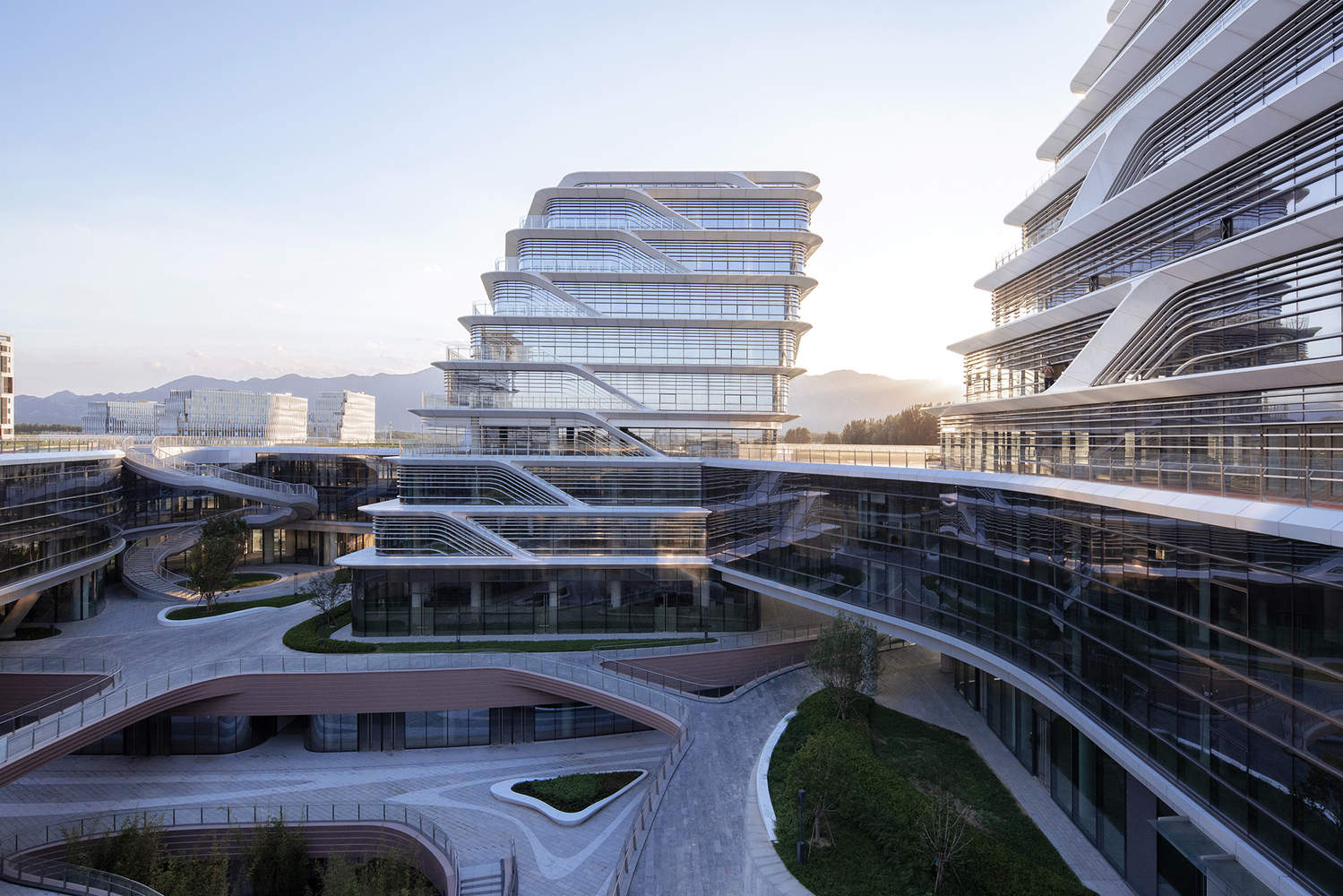
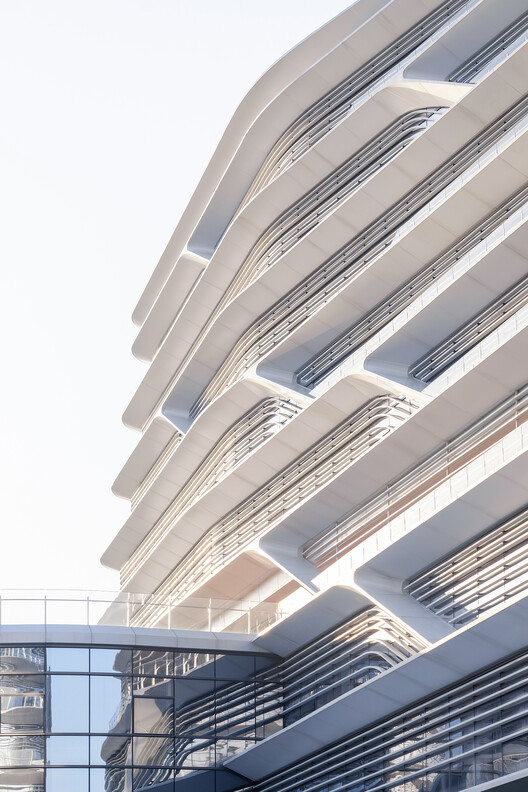
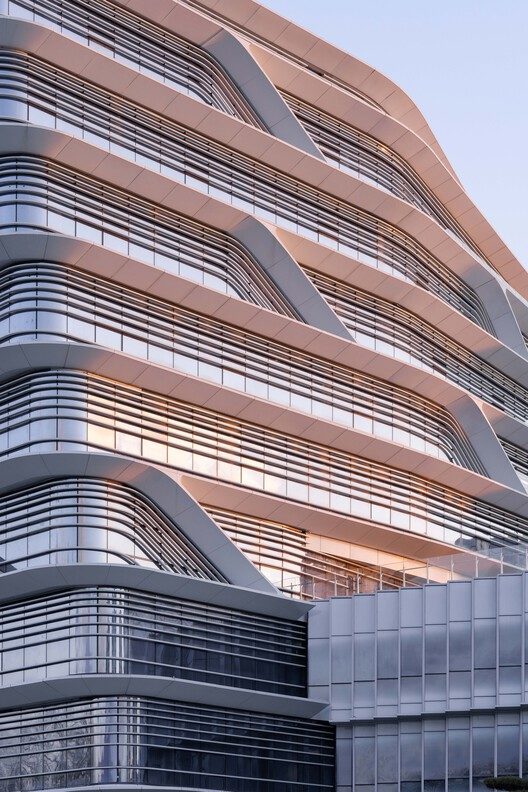
The four mountain-shaped towers are significantly twisted towards the best Western Hills views, growing upwards to stand among the clouds, possessing the dynamic and ethereal movement characteristic of Oriental landscape painting. Simultaneously, the mountain-like forms tighten as they ascend, creating stepped terraces that ease the density overhead while allowing every floor to open up to nature, embracing the ecological landscape. These independent high-rise buildings are planned as headquarters for large enterprises or unicorn companies, while also supporting flexible subdivision into diverse spaces suitable for the development of SMEs. The planar layouts of different scales and sizes can evolve with the changing needs of the companies, forming a place of innovation filled with future elasticity.
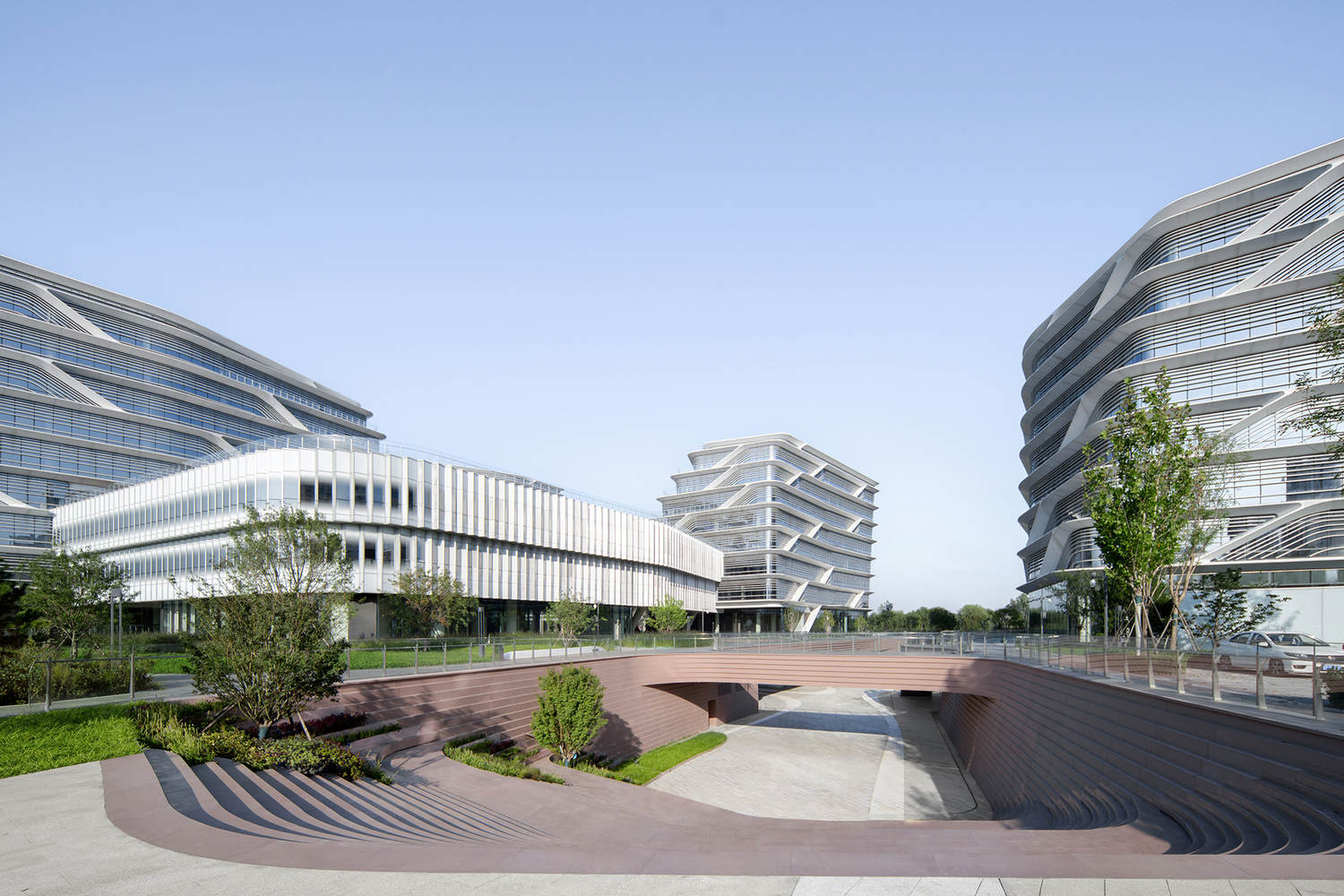
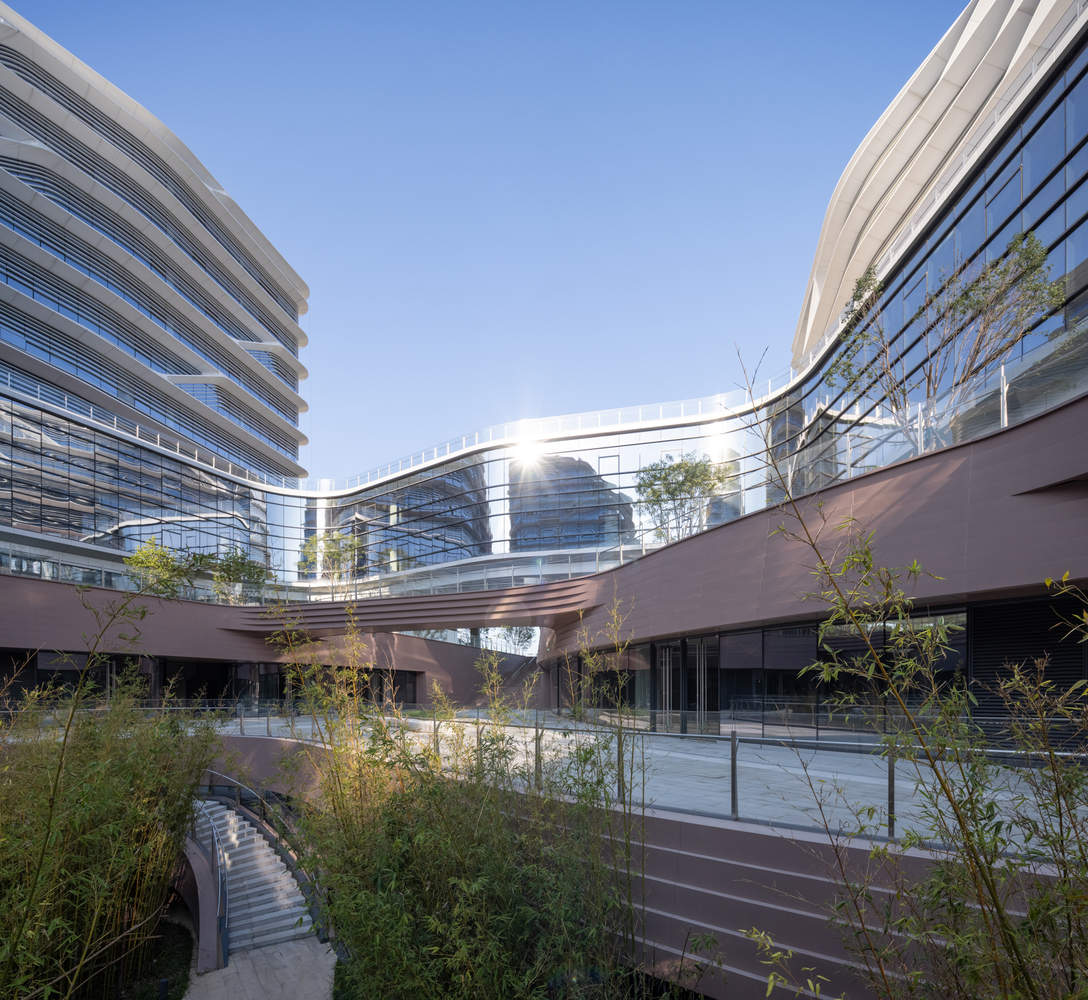
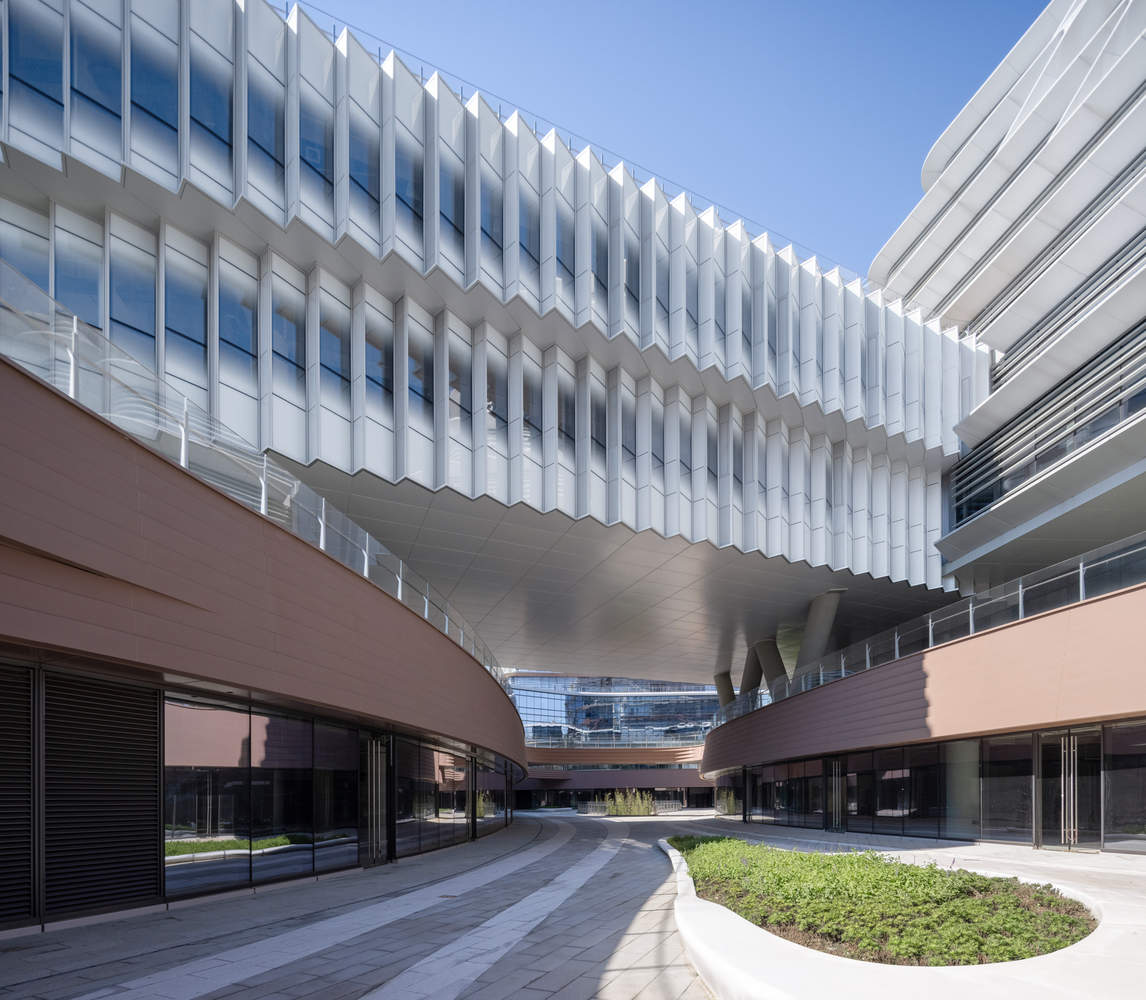
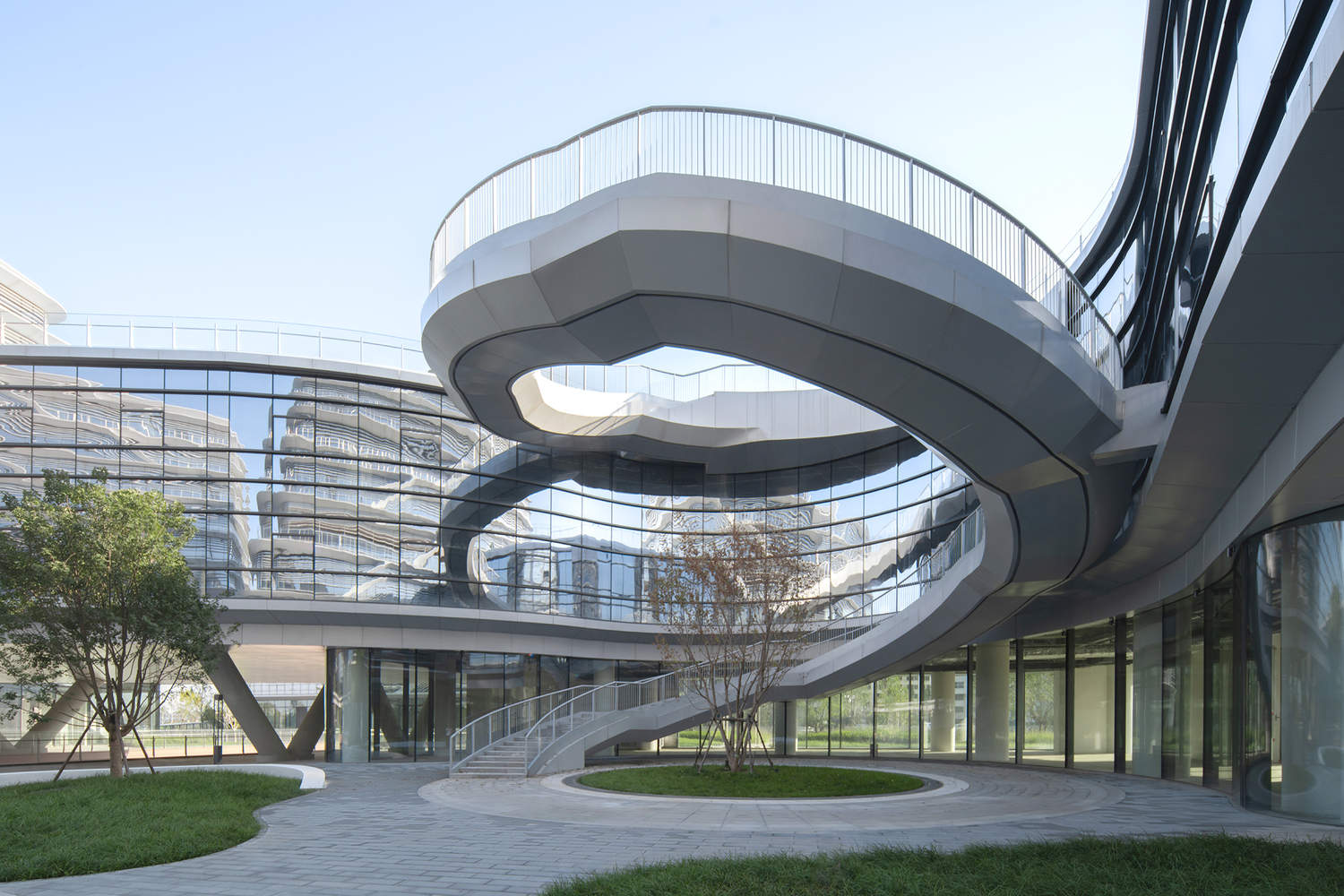
The podium structure, the "Cloud Ring," features large-area open space at the ground level, allowing a super-large enclosed podium structure with a perimeter of 400 meters to lightly and flexibly float above the ground, encircling the three towers. This permeable spatial system connecting the towers and the podium is more elastic and facilitates dynamic sharing and social functions. The top of the "Cloud Ring" forms a rooftop garden organically linking the three towers, which also serves as an aerial green park open to the public. The red pathways on the rooftop garden harmonize with the reddish-brown language of the GRC three-dimensional curved facades of the sunken courtyard, contrasting with the green plant landscape—all echoing the red walls and green trees of the "Three Hills and Five Gardens," painting an Oriental historical and cultural color.
This area is designated for SMEs and flexible, shared integrated office spaces, adhering to principles of spatial modularity and dynamic linkage, aiding the boundless extension of social interaction, collaboration, and contemplation, adapted to the future developmental needs of enterprises. The "Valley of Mountains and Waters" flows from the southwest into the park's inner courtyard, organically connecting the leisure commerce and public service functions on the first floor and basement level of the "North · Courtyard," generating a dynamic, sunken slow-traffic commercial streetscape. This streetscape extends into the gaps between each tower, connecting to the surrounding urban landscape and public green spaces, forming landscape entrances that are open to citizens from all directions.
山 · 云 · 水
四座山形塔楼朝向最优质的西山景观大幅度扭转,向上生长,伫立云间,形态具有东方山水写意的动势与消隐;同时犹如山式顺势向上收紧,创造出层层退台,既舒缓了上空密度,也使每层空间都向自然敞开,拥抱生态景观。这些独立小高层规划将作为大型企业或独角兽企业的总部办公大楼,也支持灵活拆分为适合中小企业发展的多元空间。不同尺度与规模的平面布局,可以随企业需求的变化而生长,构成了一片充满未来弹性的创新之地。
“云环”裙房的底层大面积架空,使一个周长达 400 米的超大型围合式裙房轻盈灵动的悬浮于地面之上,萦绕在三座塔楼之间。这种塔楼与裙房连接的渗透式空间体系更具弹性,并带来灵动的共享与社交功能。“云环”顶部是有机串联起三座塔楼的屋顶花园,也是向市民开放的空中绿地公园。屋顶花园红色步道与下沉庭院 GRC 三维曲面立面的棕红色语言统一,并与绿植景观互衬,这都是对“三山五园”红墙绿树的遥相呼应,描绘出东方历史人文色彩。
这里规划为中小企业和灵活、共享的综合办公空间,遵循空间的模块化与动态链接原则,辅助社交、协作与思考无界延展,适配未来企业变化发展需求。“山水之谷”从西南流入园区内庭院,有机连接“北·院”首层与地下一层的休闲商业与公共服务功能,产生灵动的下沉式的慢行商业街区,又延伸至每栋塔楼之间的缝隙,连接起周边的城市景观与公共绿地,形成各个方向为市民开放的流线景观入口。
© Arch-Exist
© Arch-Exist
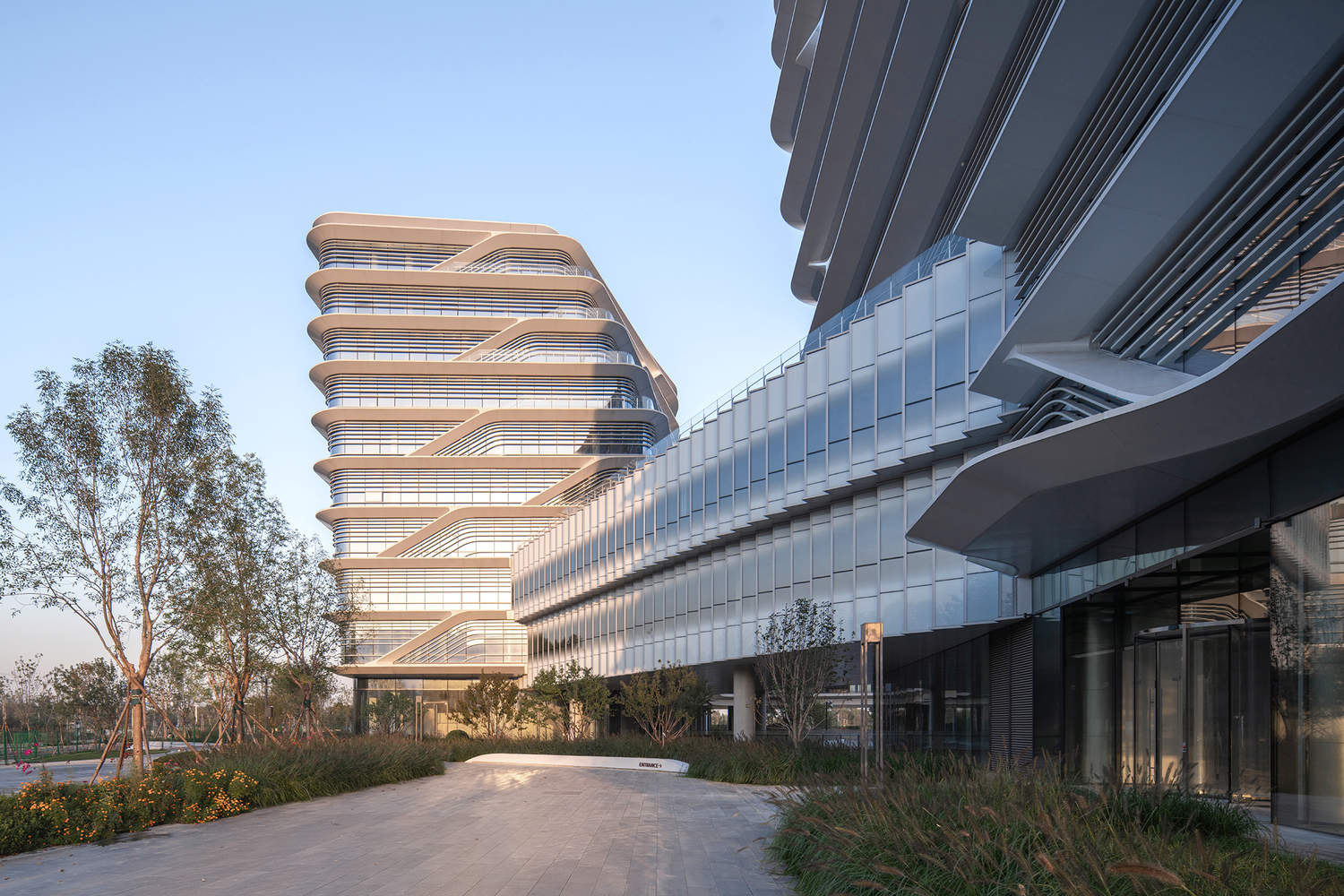
© DONG Image
Three-dimensional Urban Garden
"North · Courtyard" skillfully constructs a spatial design logic transitioning from soft beauty at the bottom to ruggedness at the top, flowing from the movement of the mountain and water valley to the roundness of the Cloud Ring, and finally to the rigidity of the mountain-shaped towers reaching for the sky. This symbolizes the growth from natural landscape to future technology. The stepped terraces of the towers, the elevated podium, the rooftop garden, multiple aerial bridges on the ground, and the water-flow stairs descending directly to the garage in the sunken courtyard together form a smooth, multi-layered three-dimensional pedestrian system. This not only achieves vehicle-pedestrian separation but also creates many unexpected interstitial spaces ("gray spaces") for people, opening and integrating with the surrounding natural environment from above ground to underground.
Multi-level natural landscapes interweave among the buildings, constructing "North · Courtyard" into a true three-dimensional urban garden with an actual green coverage rate reaching 40%, engaging in infinite dialogue with the natural and cultural landscape of the Western Hills and Xiangshan. Viewed from mid-mountain, the central park merges with the site's landscape, resembling layers of ripples spreading through mountain stones, carrying the dynamic movement of Oriental charm, surrounding the mountain-shaped towers. The ground-level green landscape merges with the surrounding natural environment while extending upwards to the tower balconies and permeating downwards into the underground garage atrium, showcasing the integration, gradual transition, and growth from nature to technology, jointly writing a stereoscopic picture of reflected虛实 (emptiness and solidity) and co-existence with nature.
立体城市花园
“北·院”从山水河谷的流动,到云环的圆润,再到山形塔楼向上空的硬朗,巧妙地构建出自下而上从柔美到硬朗的空间设计逻辑,寓意从山水自然向未来科技的生长。塔楼层层退台、架空的裙房和屋顶花园、地面多个空中连桥,以及下沉庭院直达车库的水流楼梯,共同构成空间流畅、层次丰富的立体步行系统,不仅实现了交通的人车分离,同时又为人们创造了很多意想不到的灰空间,从地上到地下都在向场地内外的自然环境开放、融合。
多层级的自然景观错落交织在建筑群之间,构筑“北·院”成为实际绿化率达到40%的立体城市花园,与西山、香山的自然人文景观展开无限对话。从半山看向这里,中央公园与场地内景观融为一体,犹如水流穿过山石泛起层层涟漪,带有东方气韵的动势,环绕在山形塔楼的周围。首层绿地景观既与周围自然环境交融,同时又向空中自然延伸至塔楼阳台,向地下渗透直至车库中庭,都展现着从自然到科技的融合、渐变、生长,共同书写一幅虚实相映、自然共生的立体画卷。
© DONG Image
© DONG Image
From the mountain-shaped towers to the Cloud Ring podium, from the Mountain and Water Plaza to the Cloud Garden, "North · Courtyard" showcases the concrete practice and extension of CAA's core design concept, "Oriental Futurism," in contemporary Chinese architecture. Rooted in Eastern landscape aesthetics, it reflects the vision and symbol of Chinese wisdom, intelligence, and manufacturing facing the future and the world. Here, "Nature" is no longer the opposite of technology but the fundamental source of human creativity; and "Future" is no longer a single narrative of imagination but an Oriental romantic poem deeply embedded in traditional cultural context.
从山形塔楼到云环裙房,从山水广场到云上花园,“北·院”所展现的是 CAA 核心设计观念“东方未来主义”在当代中国建筑的具体实践与延伸;它更以东方山水为灵魂,展现了中国智慧、智能与智造面向未来、面向全球的愿景与象征。在这里,“自然”不再是科技的对立面,而是人类创造力本质的根源;“未来”也不再是单一的想象叙事,而是深植于传统文脉的东方浪漫诗篇。
© DONG Image
© DONG Image