主动介入与综合解决:城市更新的范式突破:本项目最突出的亮点在于建筑师对城市更新需求的积极主动介入和跨界整合能力。从最初的绿地配套建筑设计,延伸至整合地下车库、商业体和学校扩建,建筑师成功地将原本分散的需求转化为一个统一的“多系统复合项目”。这种由点及面、主动协调多方利益(学校用地、城市交通、公共绿地)的策略,体现了建筑设计超越单一功能范畴,向城市综合解决方案提供者的角色转变,是应对复杂城市肌理更新的典范。
立体化布局与空间复合:资源效率最大化的艺术:项目的精髓在于其高超的“立体化布局”策略。通过将学校教学空间悬挑于绿地上方,跨越消防通道,建筑师在极其有限的狭长地块上实现了垂直叠加,有效解决了用地紧张的矛盾。这种三维度的空间重组,不仅扩展了教育容量,更通过教室对城市绿廊的视觉延伸,模糊了校园与城市的边界,实现了有限资源在竖向维度上的最大化利用。
分时段共享与开放边界:构建新型城市公共关系:本设计通过“分时段共享”机制,将城市绿廊重构为步行景观、下沉广场、交通集散和地下车库/运动空间的复合系统。下沉广场的弹性使用和地下运动空间的公私共享,使得空间的使用权在不同时间段灵活切换,服务于学校和市民。这种“开放的边界”设计,打破了传统校园的封闭性,促进了教育空间与城市公共生活在时间与空间上的深度交织,建立了一种更为动态和包容的城市公共关系。
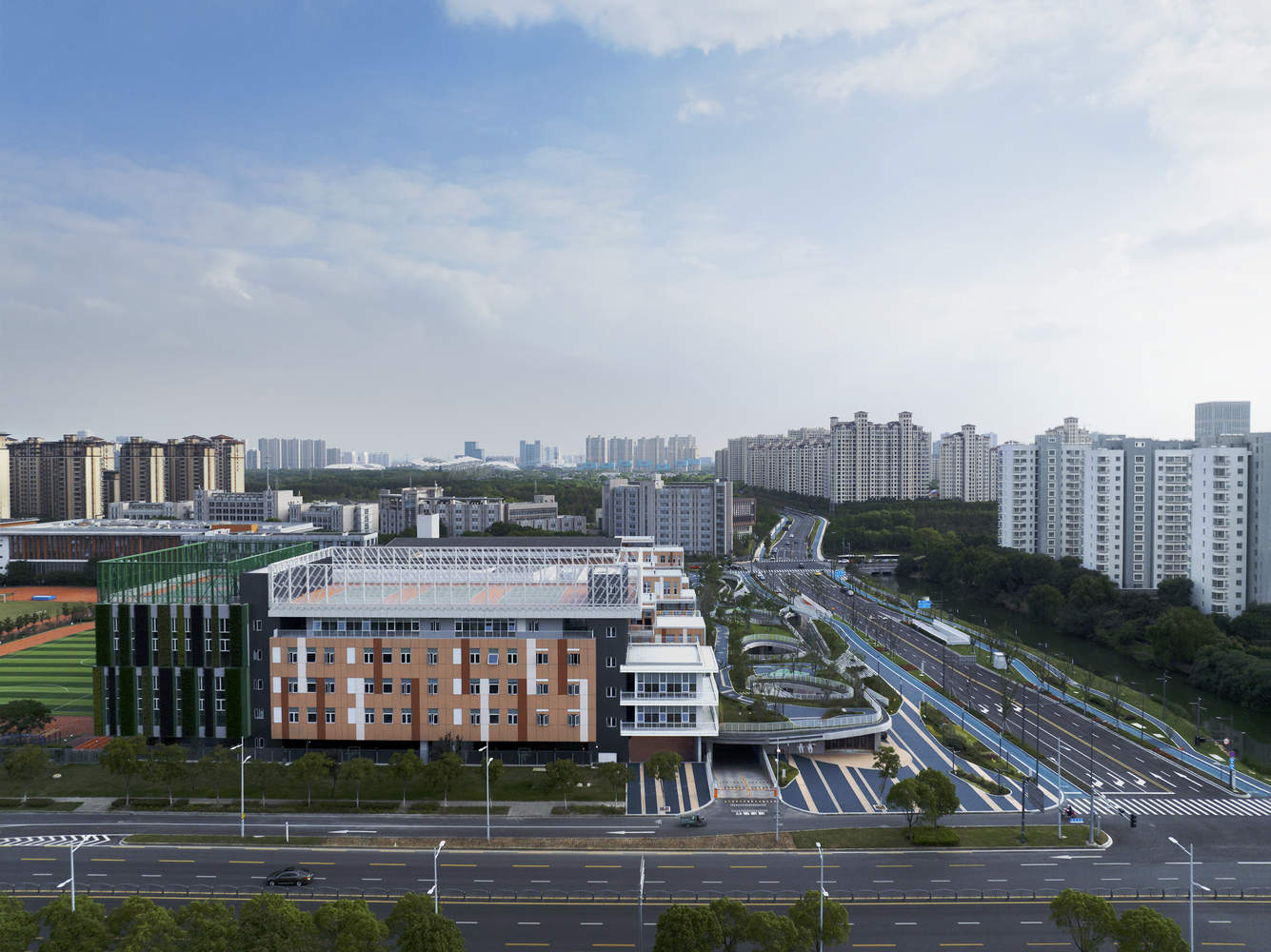
This project has become increasingly "complex" through interaction - the architects promoted the joint renewal of urban space and educational space through continuous coordination and integration. This is a process of architects actively intervening in and comprehensively solving the needs of urban architectural renewal. The project site is elongated, with Kunshan Experimental Primary School on the east, Kunshan Institute of Industrial Technology on the west, and connected to the two major urban green spaces, Dayuhu Lake Park and Forest Park, at the north and south ends.
本项目是一个在互动中越做越“复杂”的项目 —— 建筑师在不断的协调与整合中,推动城市空间与教育空间的共同更新。是一次建筑师对城市建筑更新需求的主动介入与综合解决的过程。项目所在地块呈狭长形态,东侧是昆山实验小学,西侧紧邻昆山工业技术研究院,南北两端连接大渔湖公园与森林公园两大城市绿地。
© 朱润资
The project initially only involved the design task for several small supporting buildings in the green space. The turning point began with an active extension of the design. When we discovered that an urban underground garage was planned to be built beneath the green space, a more integrated concept gradually formed: to design the green space, the garage, and the supporting buildings as a whole, allowing this elongated space to undertake more urban public functions. This idea gained the support of relevant project decision-makers, marking the first "expansion" of the project—forming a complex of urban three-dimensional greening and garage commercial facilities. Meanwhile, Kunshan Experimental Primary School on the east side, due to limited campus land, had its expansion plan to add classrooms and sports space spill over into the design base. Faced with the conflict between space shortage and urban management, the architects proposed a cross-boundary solution: integrating the school expansion with the green space and underground garage into a comprehensive design for a multi-system complex project. By employing strategies of "three-dimensional layout," "staggered-time sharing," and "open boundaries," they reorganized limited urban resources to improve overall efficiency, effectively resolving the issues for all parties.
项目最初仅为绿地中若干小型配套建筑的设计任务。转折始于一次设计的主动延伸,当我们发现绿地之下正计划建设城市地下车库时,一个更具整合性的设想逐渐形成:把绿地、车库与配套建筑作为一个整体来设计,让这片狭长的空间承担更多城市公共功能。这一想法获得了相关项目决策者的支持,这是项目的第一次“扩容” —— 形成一个城市立体绿化的车库商业综合体。而与此同时,东侧的昆山实验小学因校园用地有限,扩建校园规划增加教室与运动空间溢出到设计基地。面对空间紧缺与城市管理的矛盾,建筑师提出了一个跨边界的解决方案:将学校扩建与绿地、地下车库合并为一个多系统复合项目的综合设计,通过“立体化布局”、“分时段共享”与“开放的边界”策略,重组有限的城市资源,提高综合效益,有效地解决了各方的问题。
© 朱润资
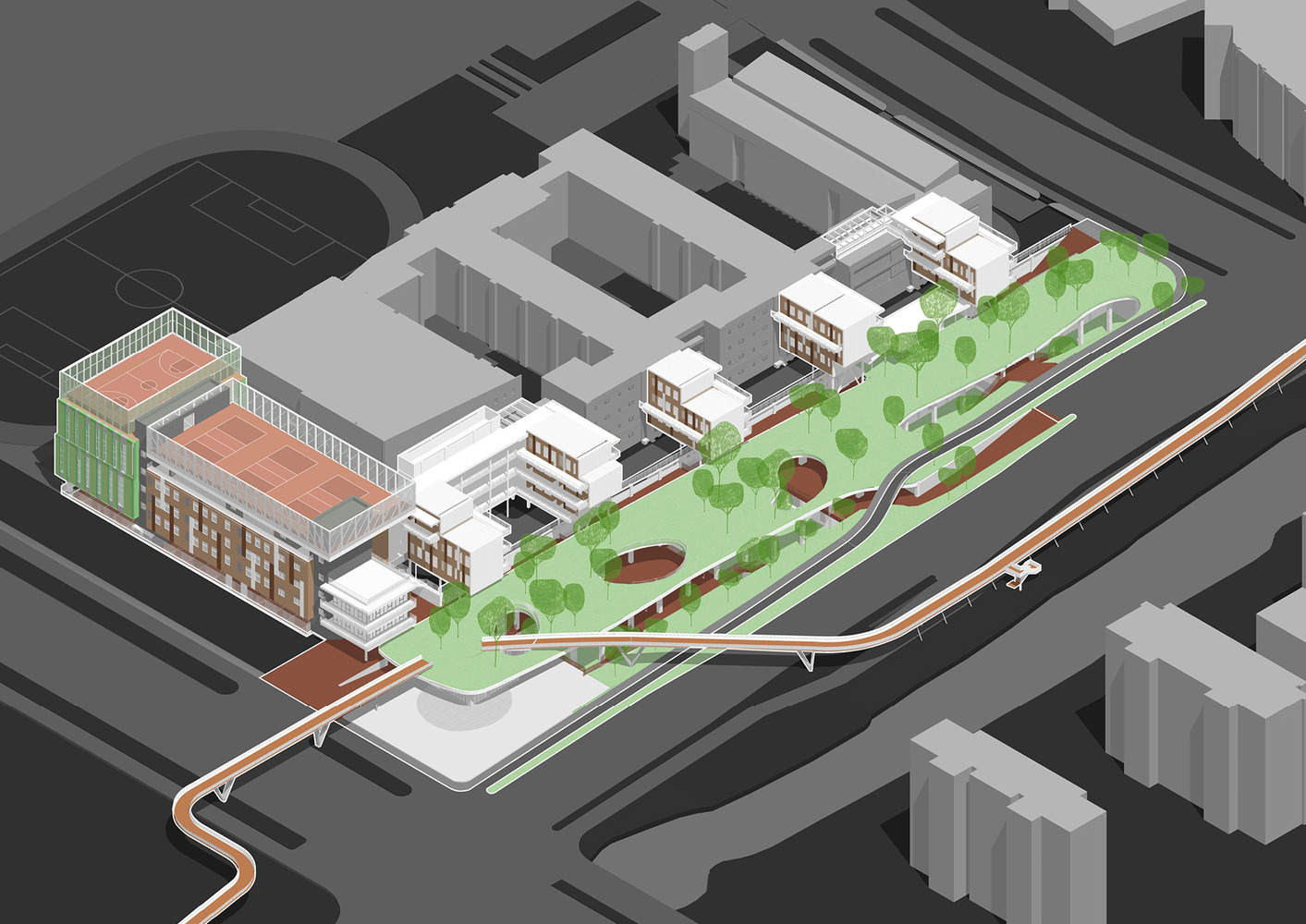
Axonometric Drawing
© 朱润资
Three-dimensional Layout: The School Cantilevering Over the Urban Green Corridor
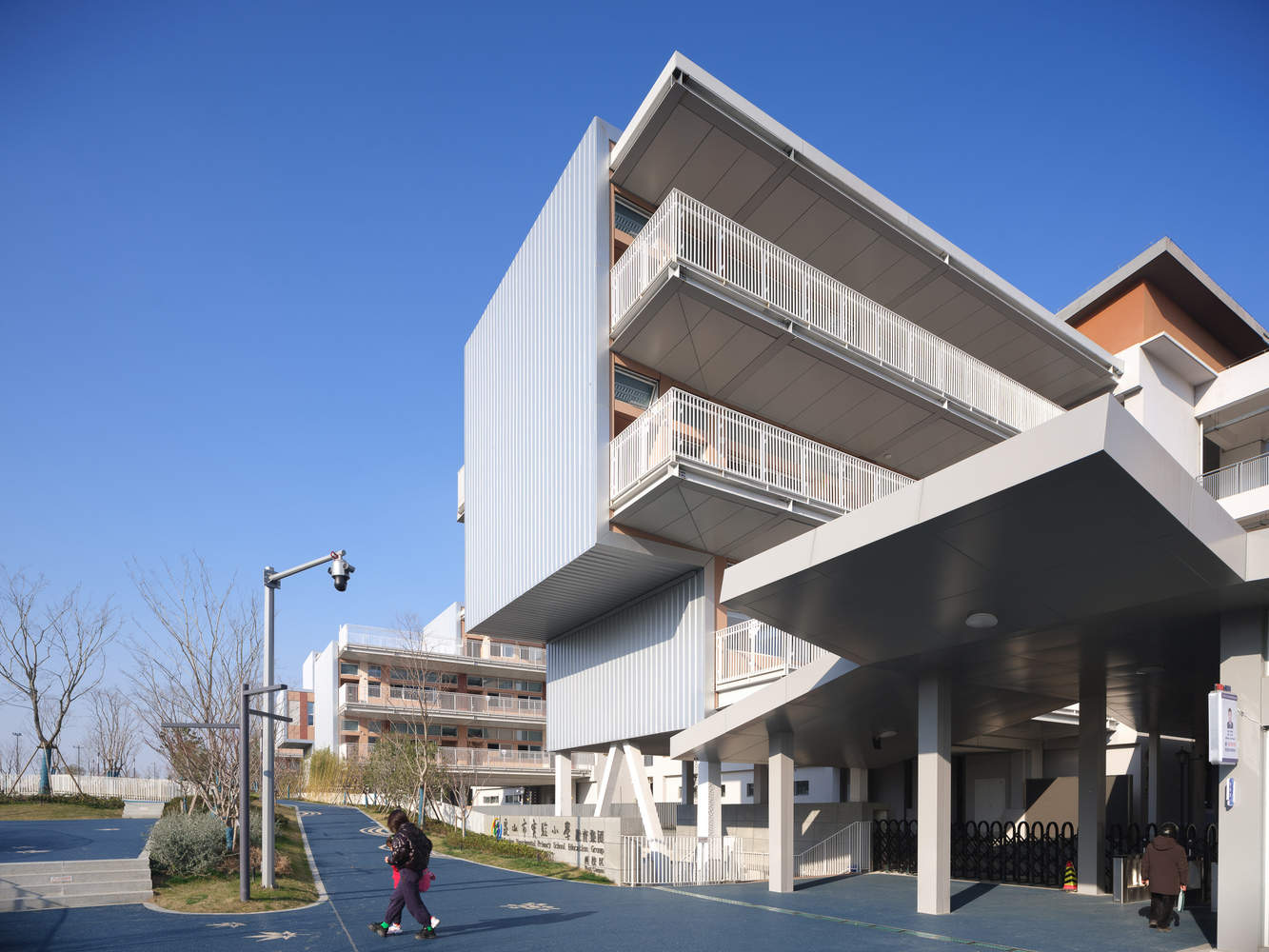
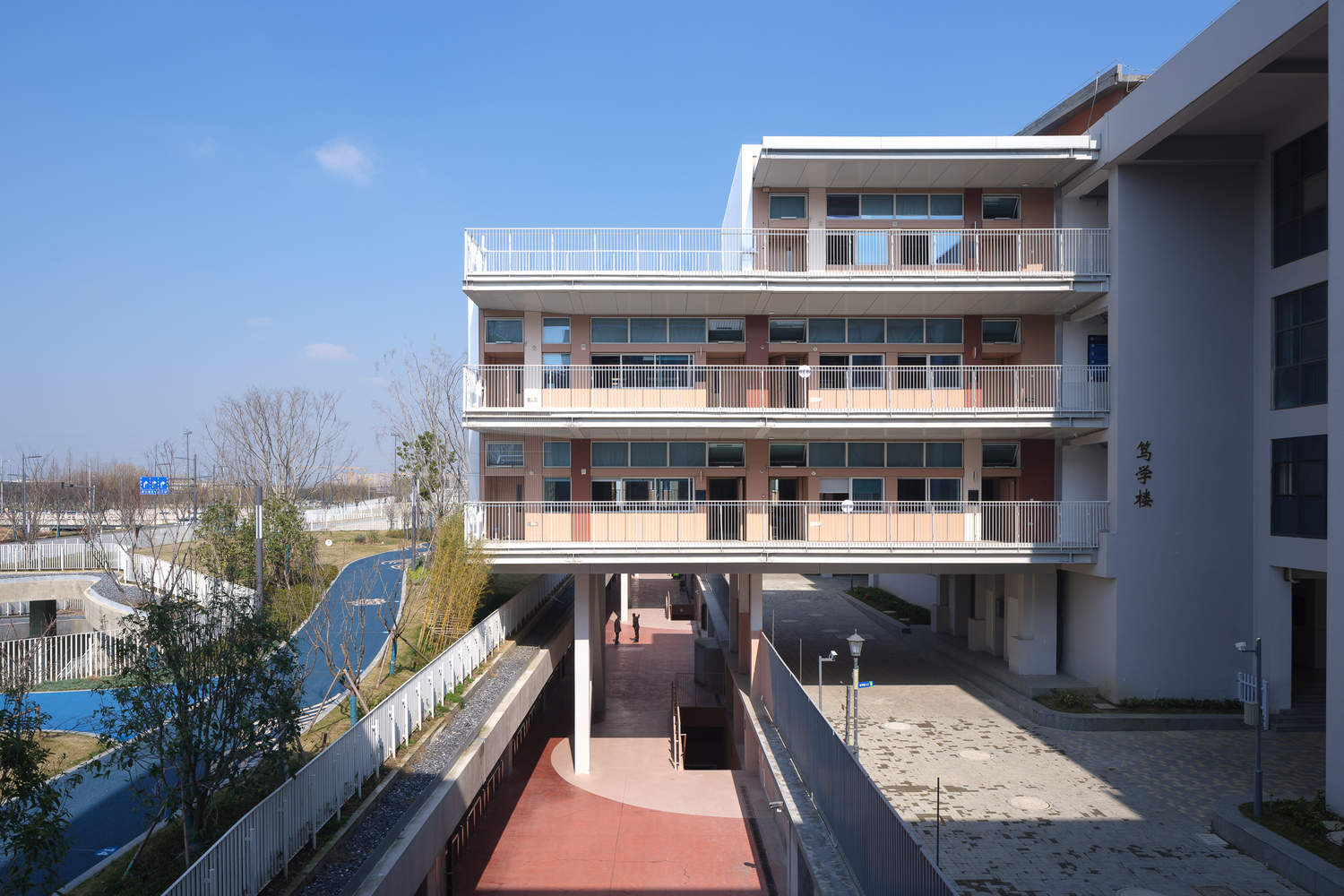
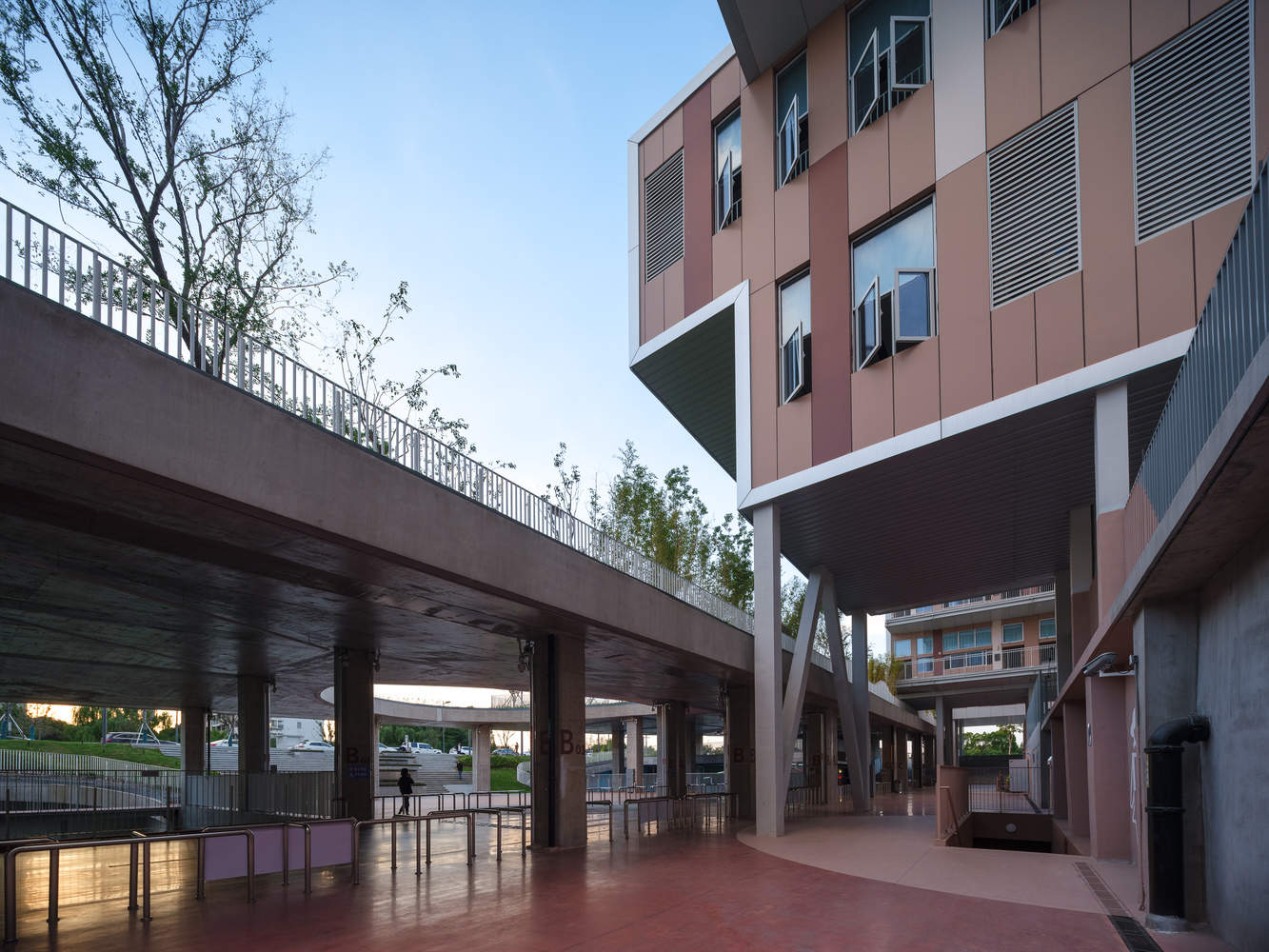
One of the core strategies of the project is to break through the original land use and management boundaries through a three-dimensional layout. The new 24 general classrooms adopt a steel structure system, added outside the main corridor west of the original teaching building, cantilevered over the green space. The construction and building process only occurred on the west and north sides, not affecting the teaching activities of the original school building, allowing for rapid use upon completion.
立体化布局:悬挑于城市绿廊之上的学校
项目的核心策略之一,是以立体化布局突破原有用地与管理边界。新增的 24 间普通教室采用钢结构体系,加建在原教学楼西侧主廊外,悬挑于绿地上方。项目施工建设仅在西侧与北侧进行,不影响原学校建筑教学,完成之后又能快速投入使用。
© 朱润资
© 朱润资
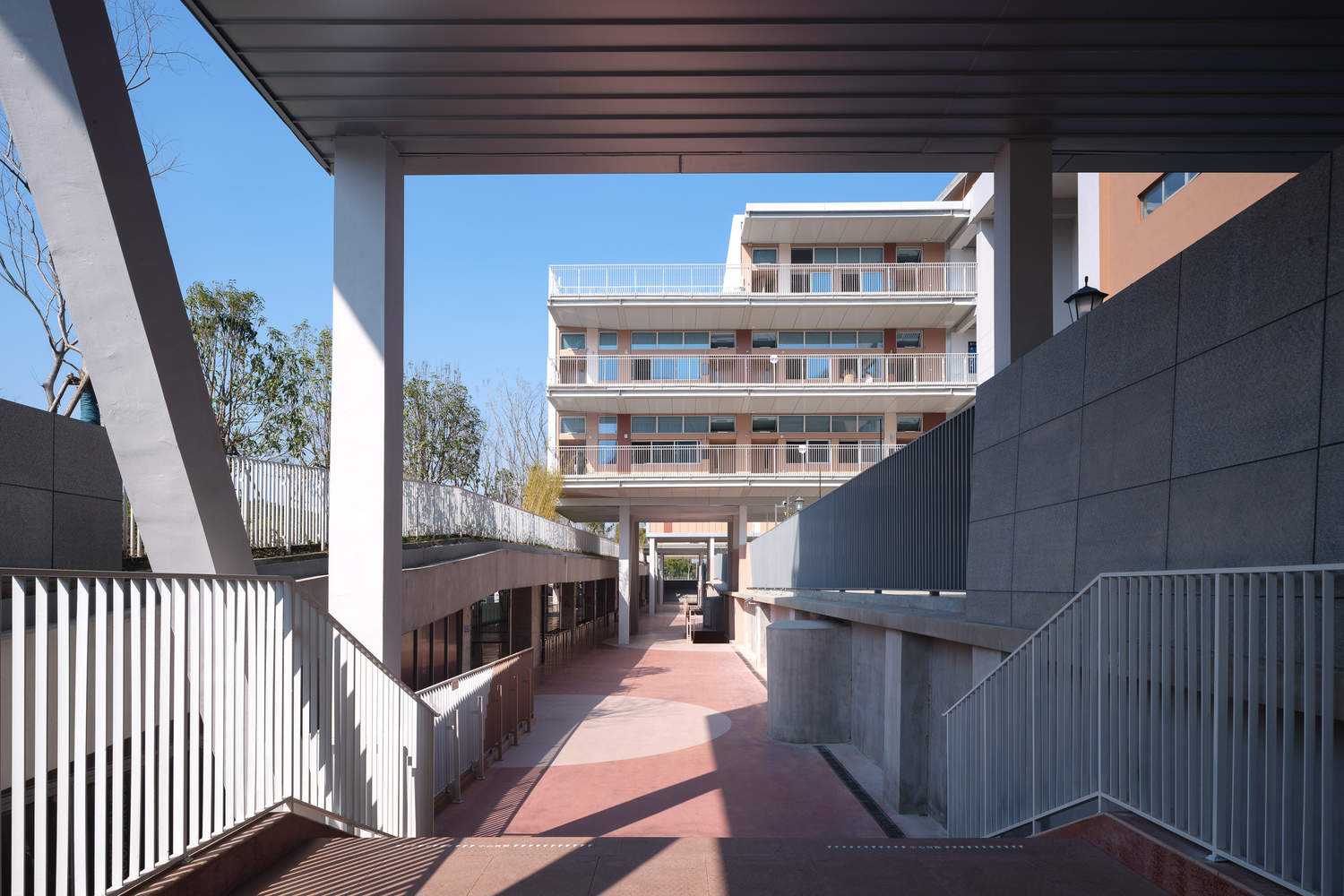
The building expansion on the west side spans the original fire escape route, preserving its function while effectively utilizing the space above. The new complex building on the north side integrates teaching and activity functions, forming a new center for campus teaching and activities. Through this three-dimensional layout, the campus expansion achieves vertical superposition within limited land: the building crosses over the ground, green space, and fire escape route, establishing a new connection between educational space and urban space in the vertical dimension. Students learning in the cantilevered classrooms can see directly through the green corridor to the urban park, leading to a visual and functional extension of the campus into the city.
西侧扩建建筑跨越原有消防通道,保留通行功能的同时有效利用上部空间。北侧新增综合楼整合教学与活动功能,形成新的校园教学与活动中心。通过这种立体化布局,校园扩建在有限的用地中实现了垂直叠合:建筑跨越地面、绿地与消防通道,使教育空间与城市空间在竖向维度上建立新的联系。学生在悬挑教室中学习,视线穿越绿廊直达城市公园,校园与城市由此形成视觉与功能的双重延伸。
© 朱润资
© 朱润资
Staggered-time Sharing: Urban Public Composite System
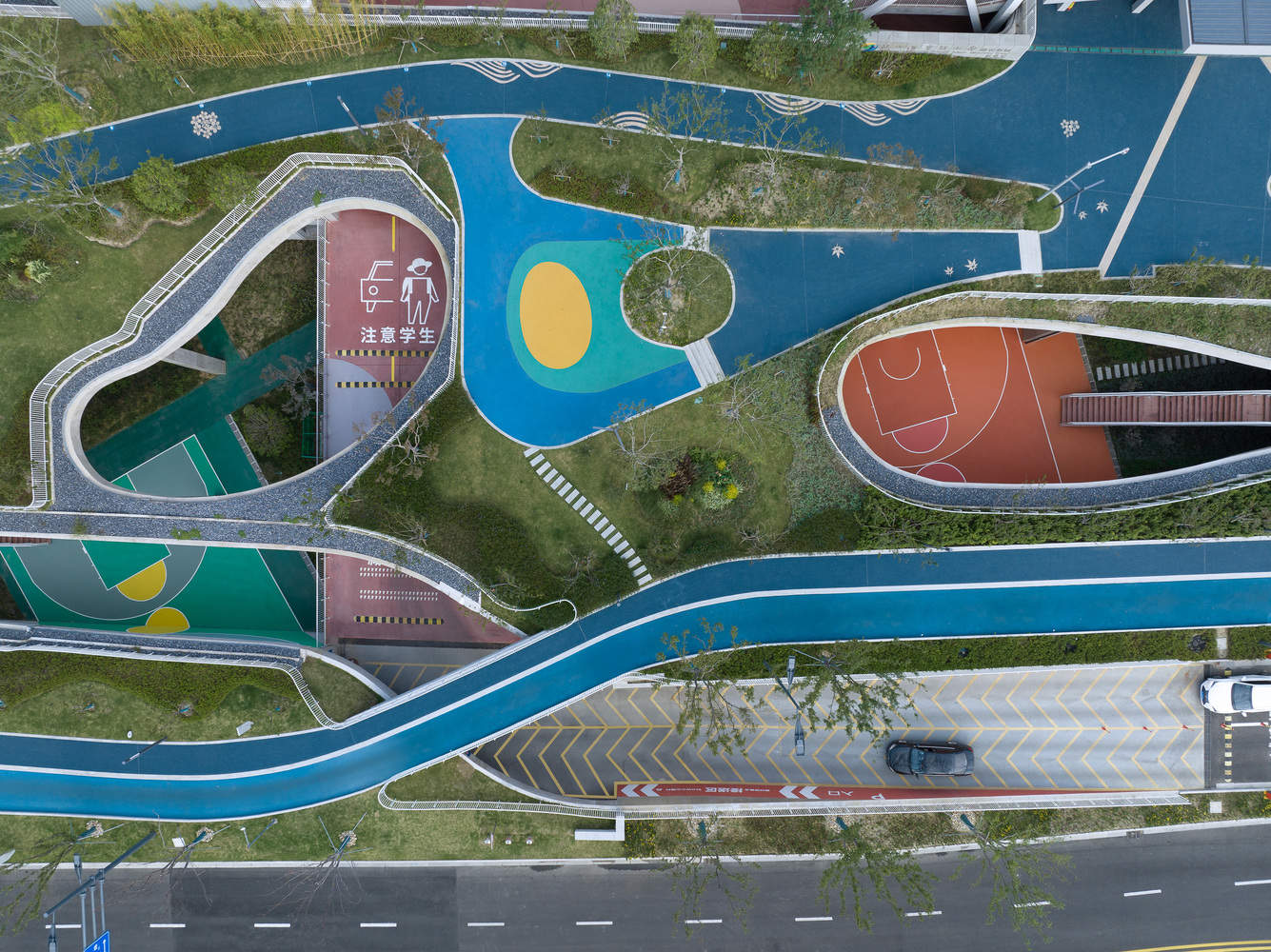
The staggered-time sharing mechanism is the second key strategy, achieving efficient use of multiple layers of public space. The architects redefined the urban green space as a "three-dimensional green corridor," with the upper layer as a pedestrian and landscape system, the middle layer as a sunken plaza and traffic distribution area, and the lower layer as a garage and sports space. These three spaces are continuously stacked vertically, forming an open urban structure.
分时段共享:城市公共复合系统
分时段共享机制是第二个关键策略,实现多层公共空间的高效利用。建筑师将城市绿地重新定义为“立体绿廊”,其上层为步行与景观系统,中层为下沉广场与交通集散区,下层则为车库与运动空间。三个空间在垂直方向上连续叠合,形成开放的城市结构。
© 朱润资
© 朱润资
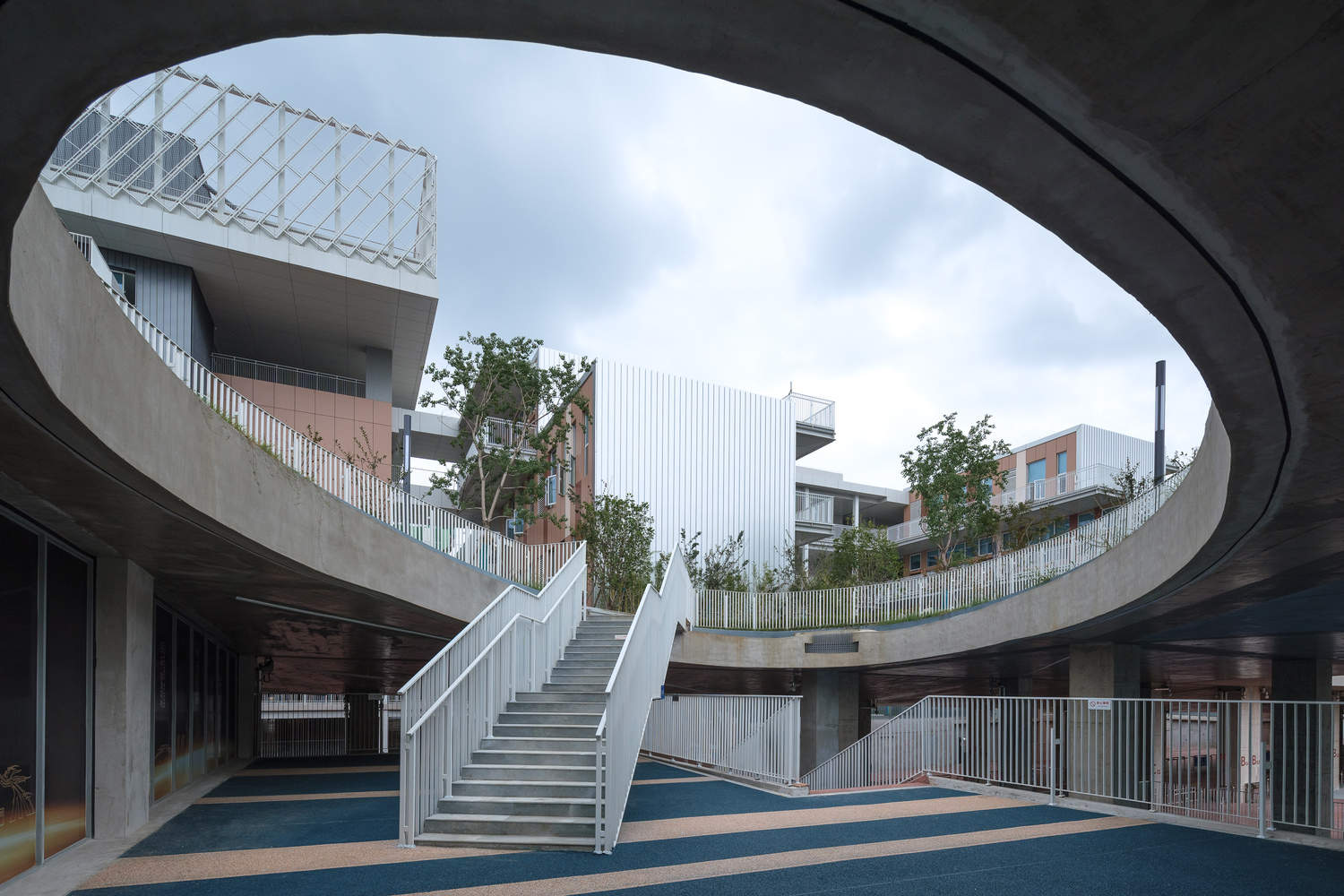
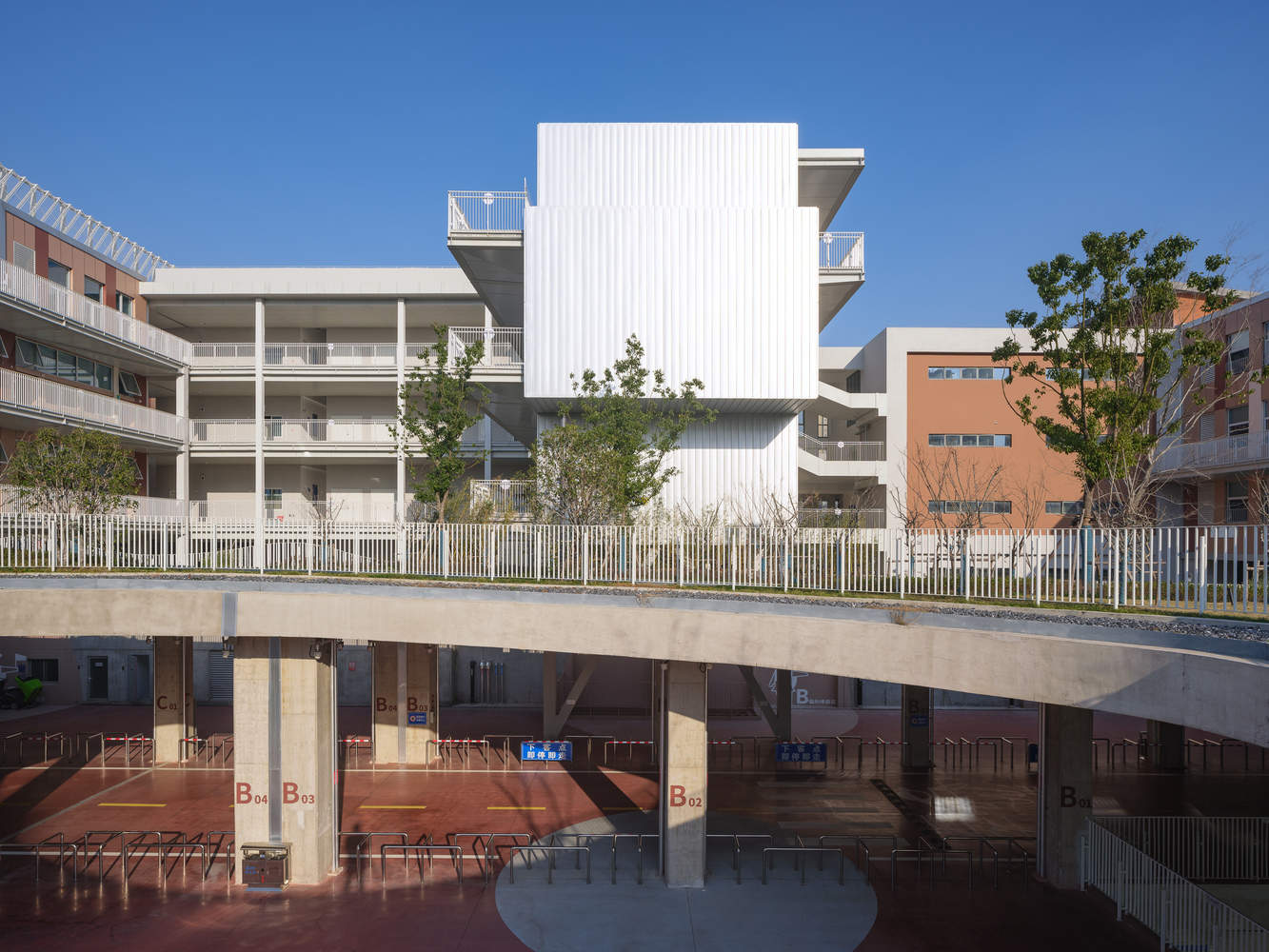
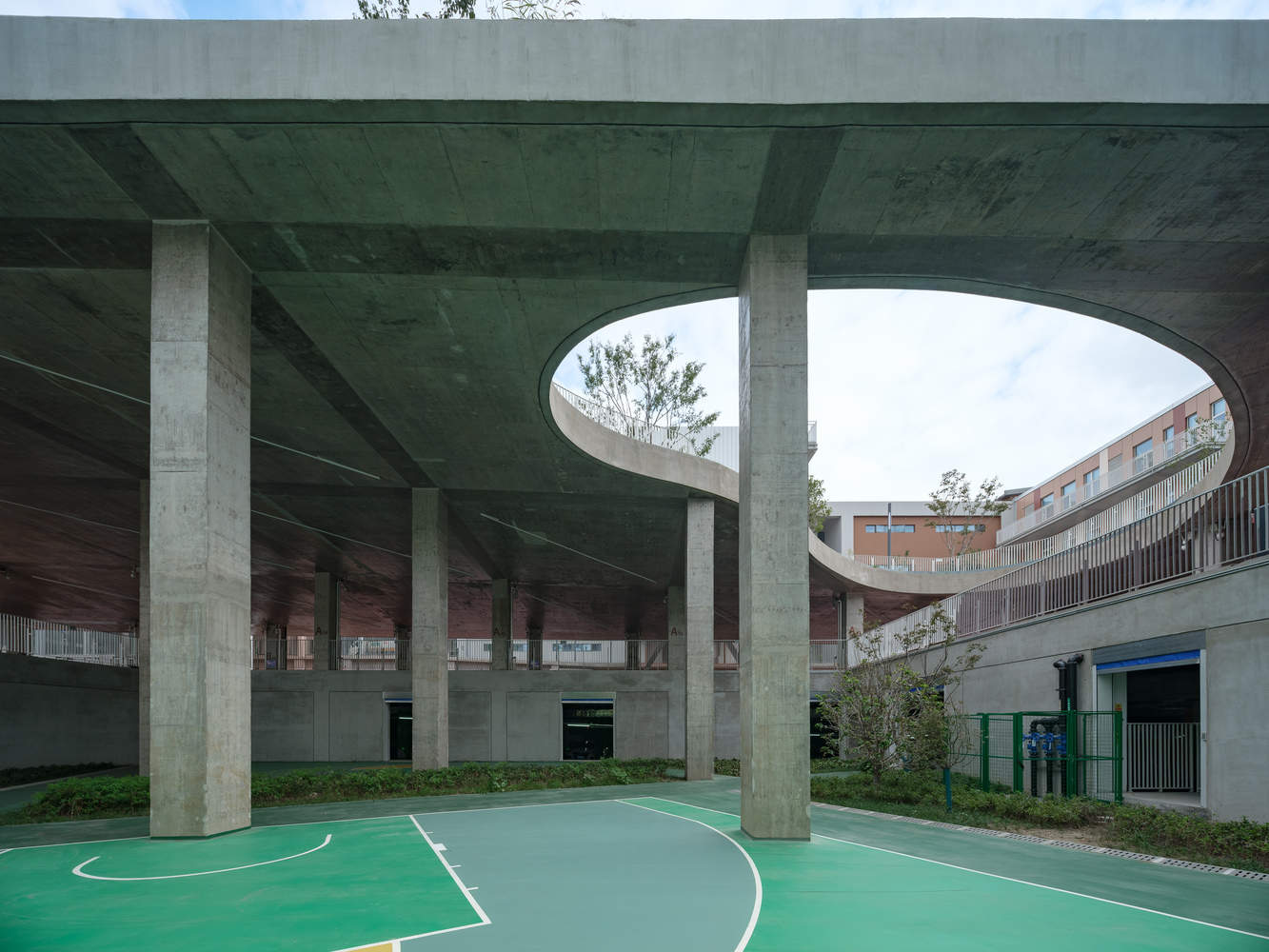
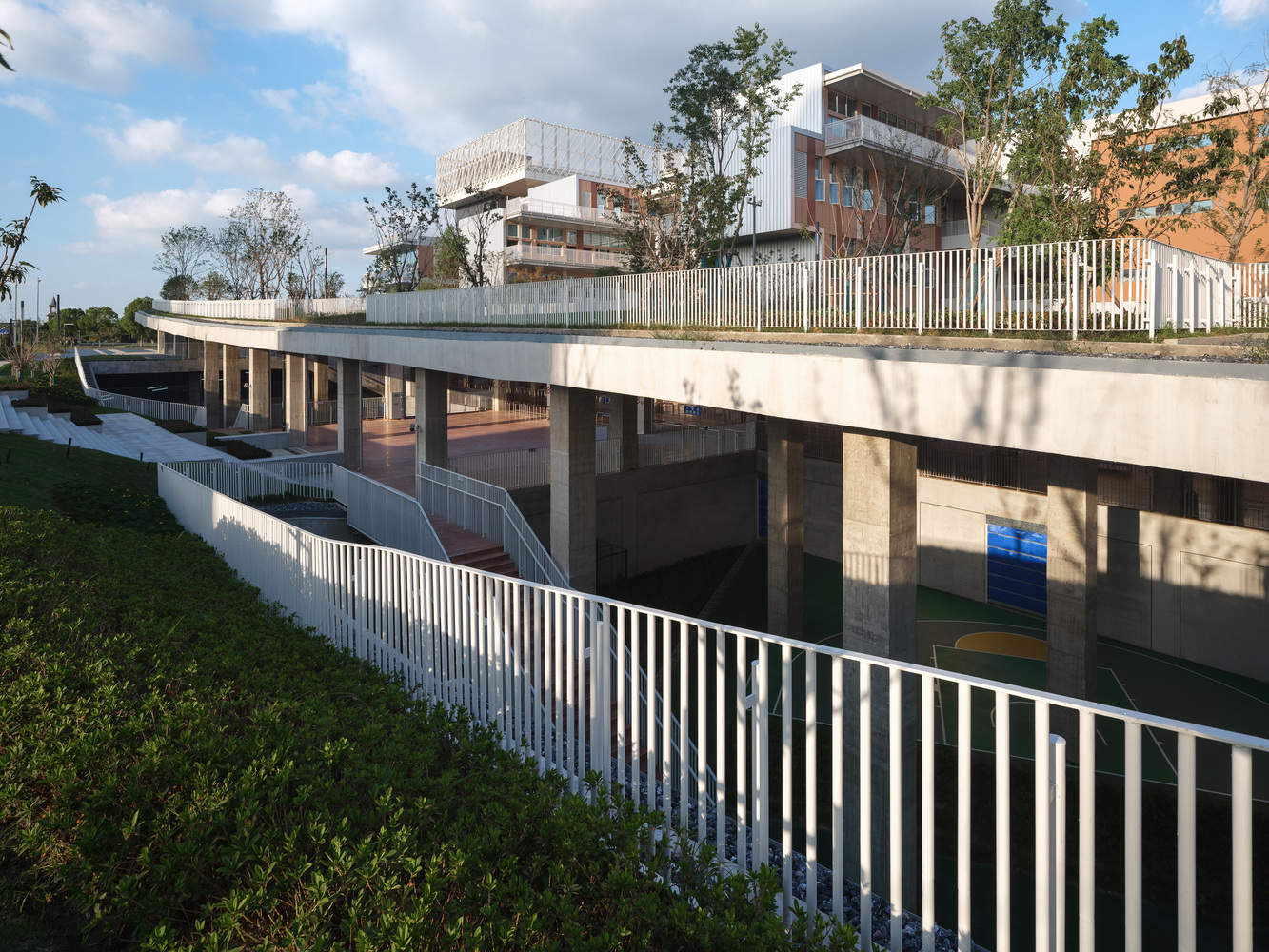
The sunken plaza serves multiple roles; during peak hours, it functions as a temporary drop-off area where parents' vehicles can drive directly in; at other times, it becomes an open space freely available to citizens. Courtyards are introduced into the underground garage to bring in natural light and greenery, with some areas doubling as sports fields to meet the shared needs of the school and surrounding residents. Different spaces are organically connected by ramps and vertical transportation, allowing traffic, pedestrian flow, and usage to unfold layer by layer in the vertical space.
下沉广场承担多重角色,高峰时段作为临时接送区,家长车辆可直接驶入;其他时段则成为市民可自由使用的开放空间。地下车库内设置庭院引入自然光与绿化,部分区域兼作运动场地,满足学校与周边居民用地的共享需求。不同的空间通过坡道与垂直交通有机连接,使交通、人流与使用在竖向空间中层层展开。
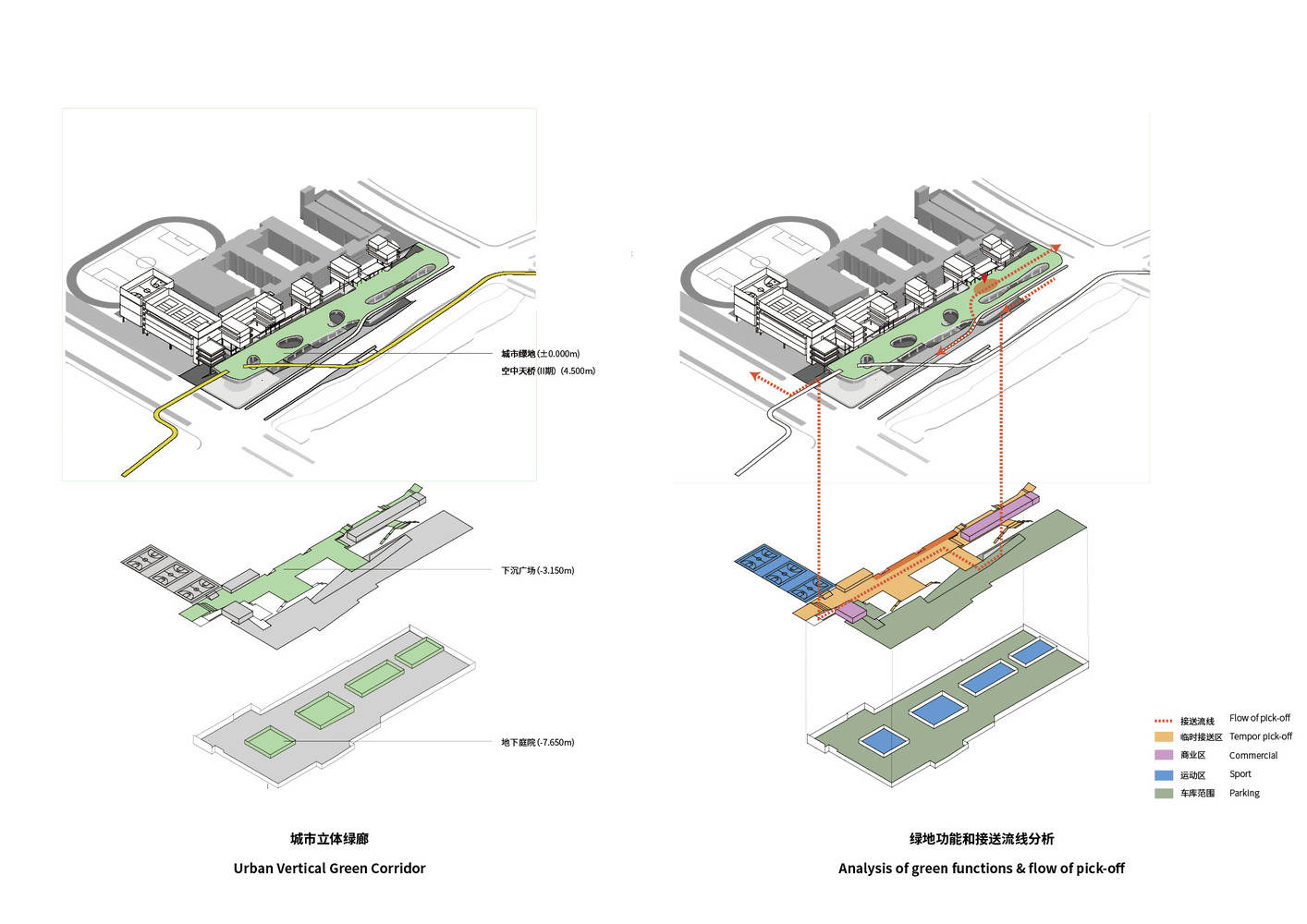
Function Analysis Diagram
© 朱润资
Open Boundaries: Reconnecting the School with the City
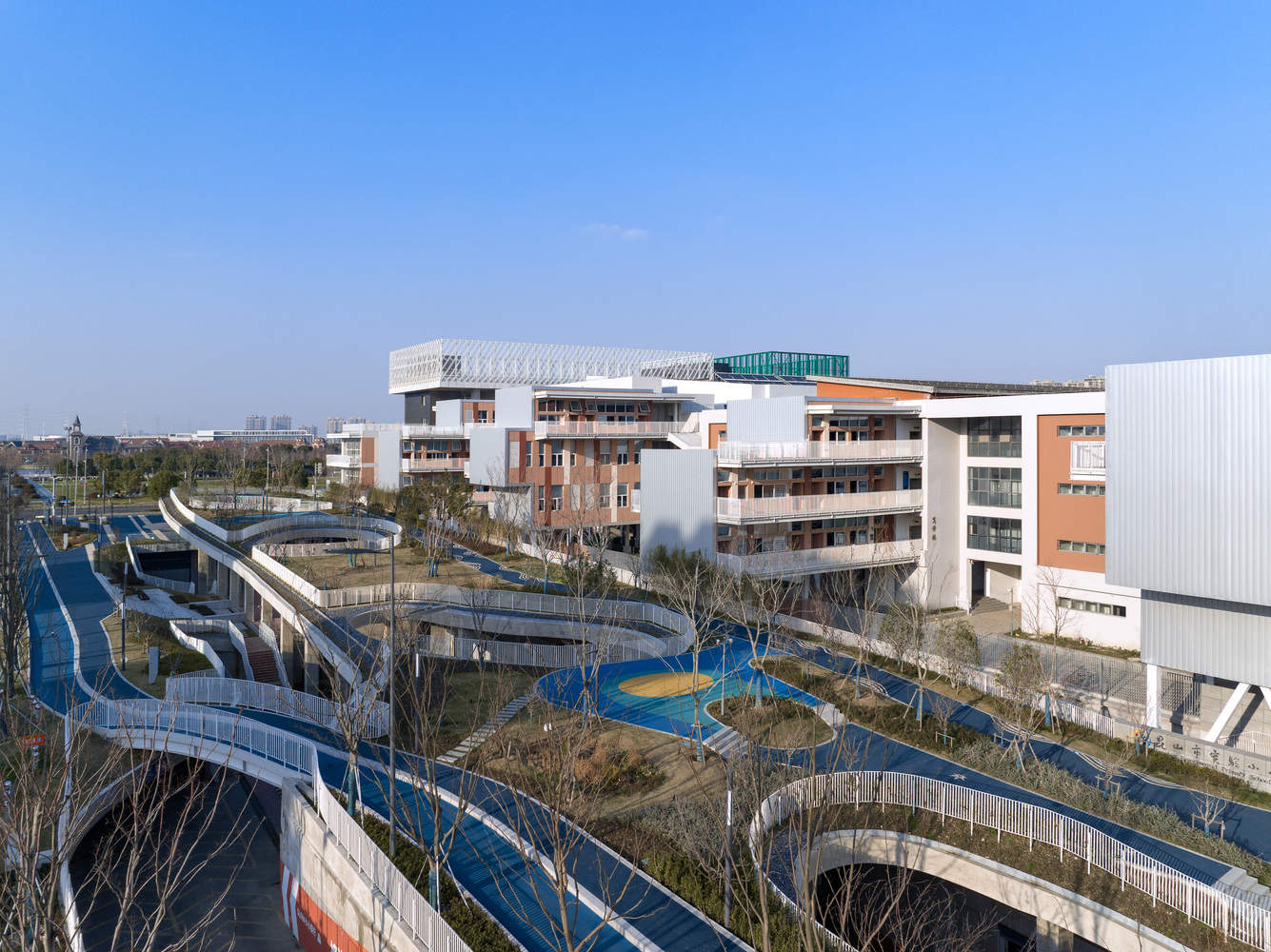
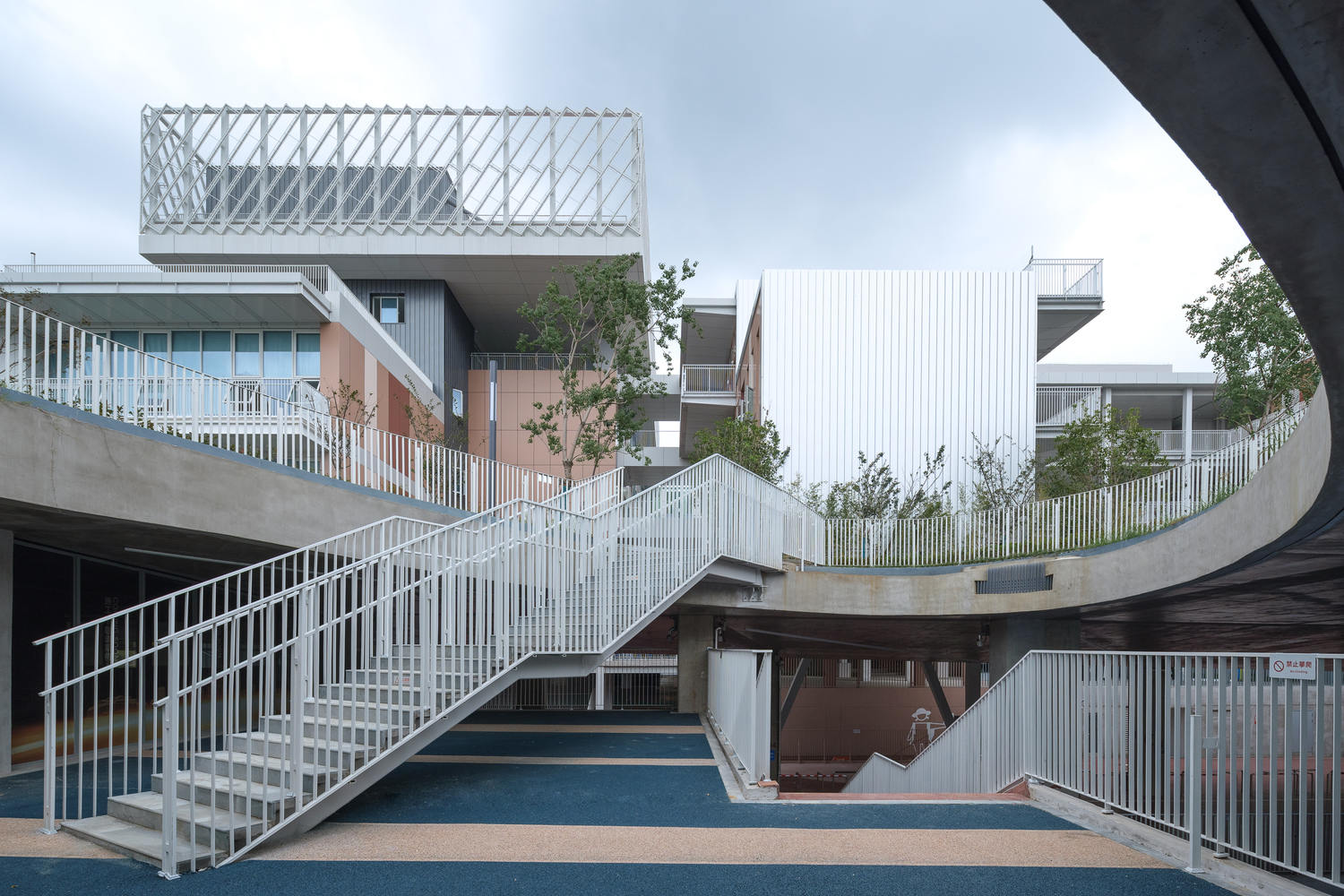
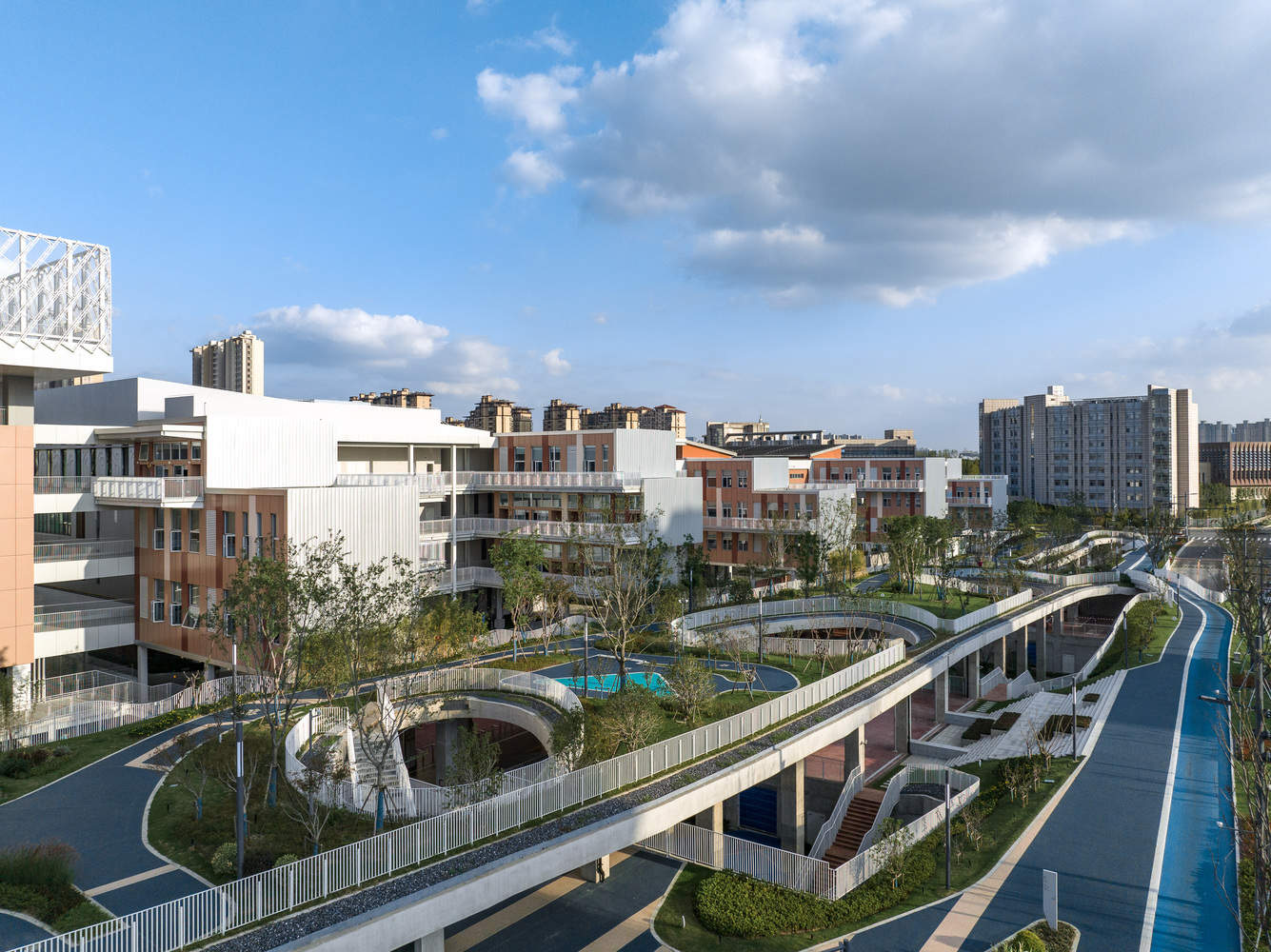
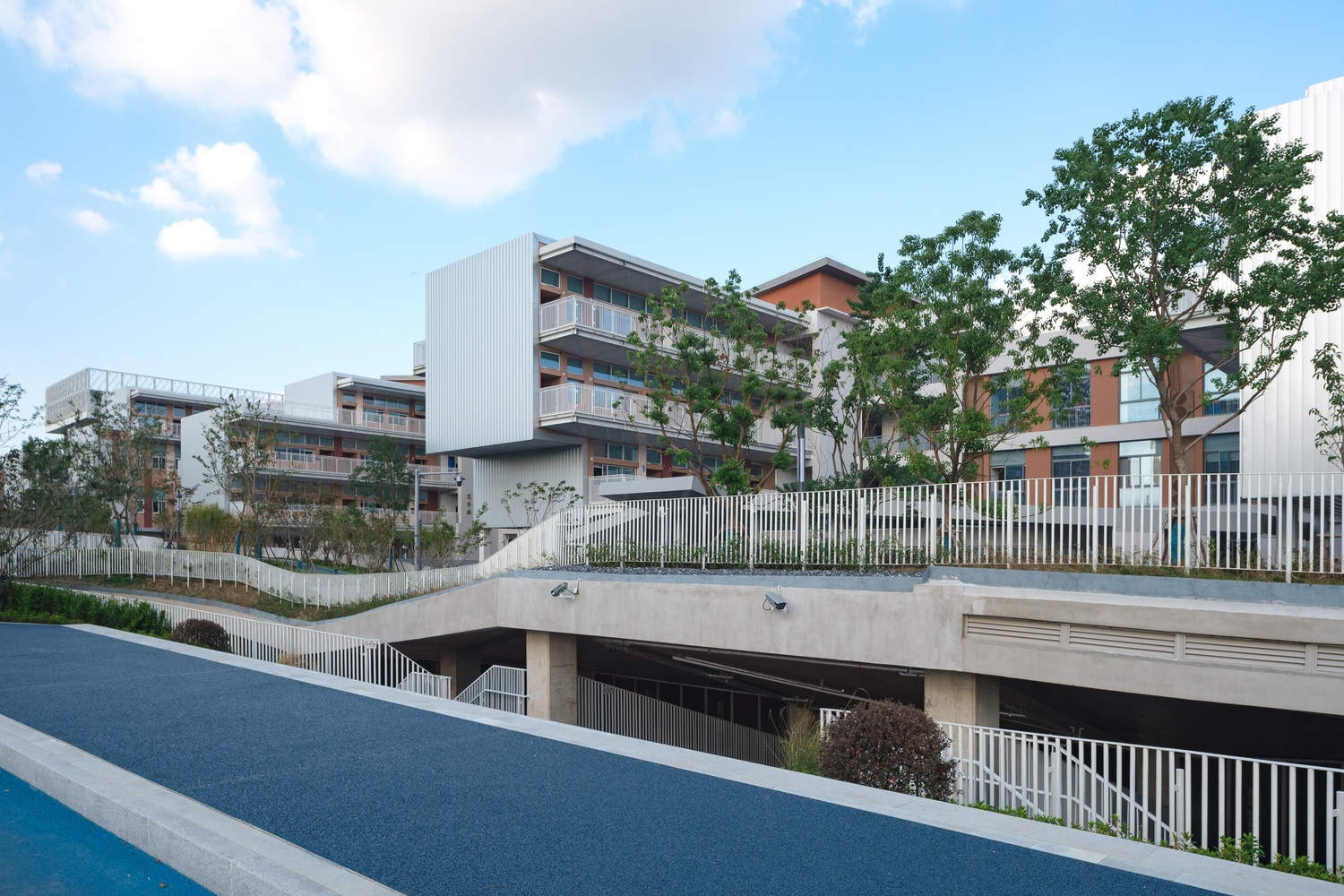
After the design integration, the previously enclosed campus transformed into an open interface. A west school gate was added on the green space side to alleviate traffic pressure at the main entrance, and people flow is stratified through the sunken plaza and underground garage. The landscape green area forms an undulating shape of concrete folded planes, gradually rising from south to north, "floating" on the side of the urban road, visually connecting the northern and southern urban Forest Park and Dayuhu Lake Park.
开放的边界:学校与城市的再连接
在设计整合后,原本封闭的校园转化为开放的界面。项目在绿地侧增设西校门,缓解主入口交通压力,并通过下沉广场与地下车库组织人流分层。景观绿地为混凝土折面构成的起伏形态,由南向北逐渐抬升,“漂浮”在城市道路一侧,空间上连接南北的城市森林公园和大渔湖公园。
© 朱润资
© 朱润资
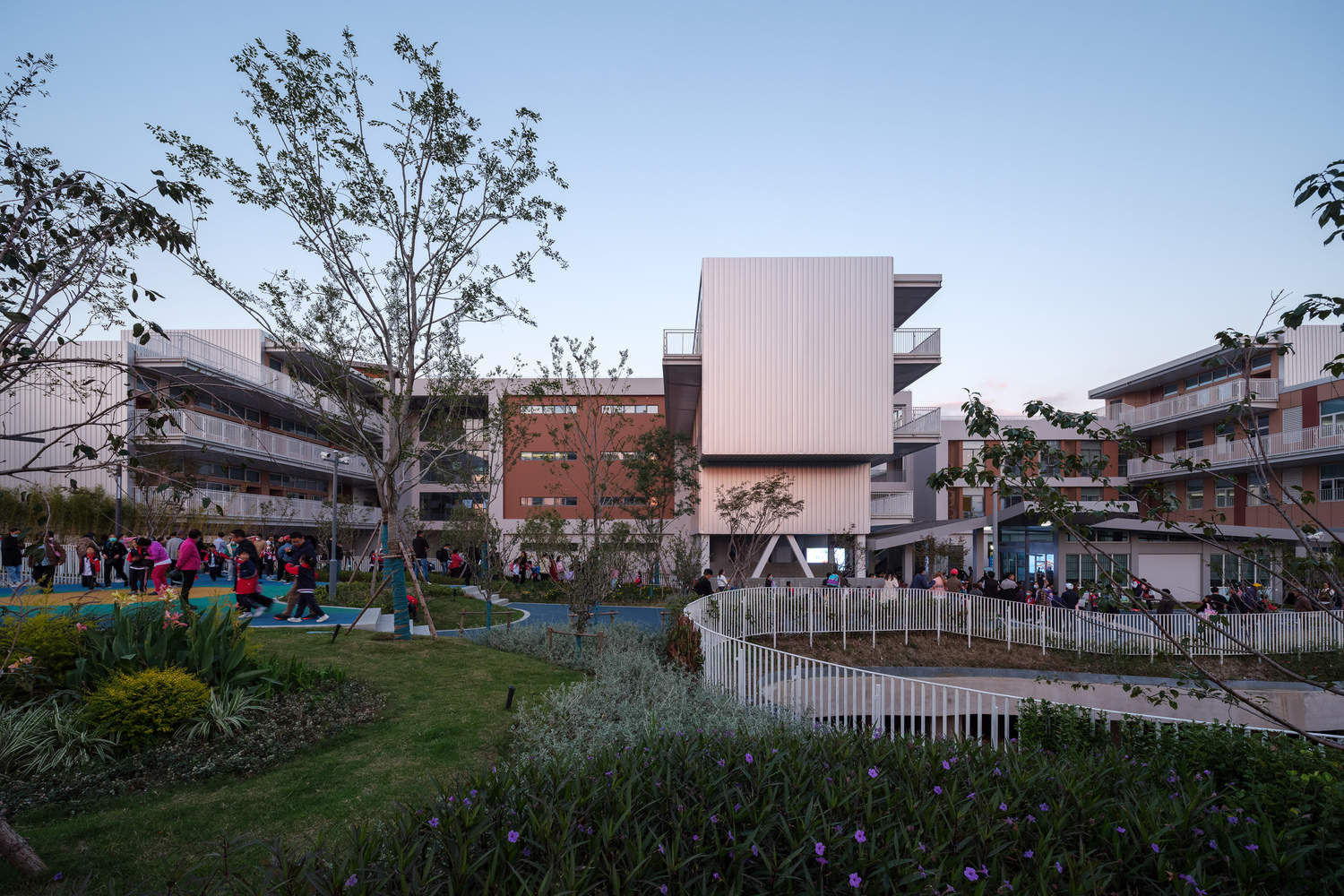
The campus buildings are no longer demarcated by walls but interact through multi-layered spatial interfaces: the upper layer for teaching, the middle layer for congregation and exchange, and the lower layer for sports and parking. The building and the topography together constitute an extension of the urban green corridor, where students and parents, teachers and citizens interweave in the same spatial system, forming a new type of urban public relationship.
校园建筑不再以围墙划定界限,而以多层空间界面实现互动:上部为教学空间,中部为集散与交流空间,下部为运动与停车空间。建筑与地形共同构成城市绿廊的延伸,学生与家长、教师与市民在同一空间系统中交错使用,形成一种新的城市公共关系。
© 朱润资
© 朱润资
The smooth and on-schedule completion of such a multi-departmental, cross-system complex project between 2019 and 2022 was inseparable from the collaboration and perseverance of all participating units under multiple constraints. In this project, the designers and urban construction and management decision-makers collectively seized a primary goal—how to efficiently use core spatial resources to meet diverse needs, while minimizing the impact of existing surface constraints, using design and management innovation to overcome unfavorable conditions hindering the achievement of the goals, making design and management methods and strategies aim more directly and effectively at the target. Through the synergy and interaction of spatial design and construction management, this project serves as a practical sample of complex urban renewal.
这样一个多部门、跨系统的复杂项目在 2019 - 2022 年特殊时期内得以顺利、按时竣工,离不开各参与单位在多重限制下的协同与坚守。在这个项目中,设计者与城市建设、管理决策者共同抓住了一个主要目标 —— 如何高效使用核心的空间资源以满足多种需求,并尽量克服已有的表面限制,运用设计创新和管理创新来突破约束目标实现的各种不利条件,让设计和管理的方法和策略都更直接有效地瞄准目标。通过空间设计与建设管理的协同与互动,该项目是一次复杂城市更新的实践样本。
© 朱润资