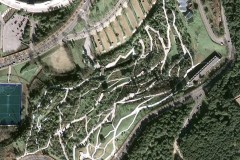
文脉嵌入与针灸式更新策略:该项目精准地融入了上海奉贤区“南桥源”历史城区更新的“针灸式”策略。作为该体系中的核心“文化锚点”,非遗馆的设计摒弃了激进的整体重建,而是通过“克制嵌合”的姿态,在尺度、材料和动线上与既有的20世纪初花园式洋房群形成有机的对话与协同。这种对文脉的敏感性不仅体现在空间布局上对原中轴线的避让和缓冲,更通过材料的对位,实现了新旧建筑在历史肌理中的和谐“沉入感”,为文脉激活提供了精妙的微尺度介入范例。
参数化设计与“砖织幕”的结构-表皮创新:项目的精髓在于其独特的“砖织幕”立面,这是参数化设计、传统材料和结构逻辑完美结合的产物。建筑师将“风掠水面”的自然意象转化为算法控制的“柔性织物”表皮,实现了对传统红砖的“再材料化”和“再构造化”。这个表皮不仅是文化符号,更是一个自稳定的次结构系统,通过可控的孔洞分布实现了优异的采光与遮阳性能,将传统工艺的语汇通过数字技术成功地“柔性化”和“织造化”。
数字建造与室内力学叙事:该项目在建造实践上展示了前沿的数字建造技术,通过机器人砌筑实现了高精度、高效率的复杂砖幕工厂预制和现场干式装配,显著缩短了工期并减少了浪费。在室内,设计将“结构、动线与环境性能”深度耦合,通过BESO拓扑优化生成的清水混凝土核心体,将交通路径转化为可感知的力学剖面。这种将结构理性、环境调控(被动降温)与步行体验融为一体的“结构-环境仪器”化设计,是当代建筑从物理容器向文化机制转译的成功探索。
01 Construction of Cultural Anchors in an Acupuncture-Style Strategy
The "Nanqiao Yuan" is a significant planning pilot project proposed by Nanqiao Town, Fengxian District, Shanghai, under the context of historical urban renewal. It introduces an "acupuncture-style" renewal strategy of "one river linking nine pearls," using the Punan Canal as a link to activate multiple cultural nodes, including the Sangu Commercial City, Shenjia Garden, and Guhua Garden. The Shenjia Garden Intangible Cultural Heritage Pavilion (ICH Pavilion), as a newly constructed cultural space, undertakes the multiple roles of connecting tradition and modernity, and the community with craftsmanship. This paper discusses the design strategy, structural logic, and construction practice of the ICH Pavilion based on the overall renewal system, focusing on its comprehensive application in parametric design, robotic brick masonry, and structural topology optimization, attempting to propose a renewal path centered on the integration of "Culture-Structure-Construction."
在历史城区更新的背景下,上海奉贤区南桥镇提出了“南桥源”这一重要规划试验项目,并采用了“一河链九珠”的针灸式更新策略,以浦南运河为纽带,激活了包括三古商城、沈家花园、古华园在内的多个文化节点。其中,沈家花园非遗馆作为新建的文化空间,承担着连接传统与当代、社区与手工艺的多重角色。本文基于整体更新体系,围绕非遗馆的设计策略、构造逻辑与建造实践展开论述,重点分析其在参数化设计、机器人砖构、结构拓扑优化等方面的综合实践,尝试提出一种以“文化-结构-建造”三位一体为核心的更新建筑路径。
Facing the complexity of scale, ecology, and culture in traditional urban renewal, Nanqiao Town proposed the systematic strategy of "one river linking nine pearls" in the "Nanqiao Yuan" renewal system—using the Punan Canal as the framework to string together cultural and commercial segments such as Sangu Commercial City, Shenjia Garden, and Guhua Garden, gradually releasing public and cultural energy through 9 nodes. Compared to whole-block reconstruction, this strategy emphasizes "acupuncture-style intervention," valuing detailed activation and synergy with the existing fabric.
面对传统城区更新的尺度、生态与文化复杂性,南桥镇在“南桥源”更新体系中,提出“一河链九珠”的系统策略 —— 以浦南运河为骨架,串联三古商城、沈家花园、古华园等文化与商业片段,通过 9 个节点逐步释放公共性与文化能量。相较整街区重建,该策略强调“针灸式介入”,重视细部激活与原有肌理协同。
The project is situated at the end of the central axis of the historical main building of Shenjia Garden, facing the restored historical structure. The design intervenes in the site with a stance of "restrained embedding," achieving synergy with the existing garden context through negotiation of scale, material, and circulation: the project's massing expands horizontally rather than confronting vertically, integrating into the low-rise order of the park, and the entrance avoids a direct confrontation with the original central axis, providing space for viewing, buffering, and transition. Traditional clay bricks, fair-faced concrete, and glass are used as primary materials to create a complementary relationship with the color tone of the original main building. This strategy emphasizes the "sinking feeling" of the new building within the context, rather than a dominant expression, making it a "potentially emergent" cultural installation.
项目选址于沈家花园主楼中轴线末端,面对已修复的历史建筑。设计以“克制嵌合”的姿态介入场地,通过尺度、材质与动线的协商,完成与既有园林语境的协同:项目体量以水平展开替代竖向对抗,融入园区低矮尺度秩序,入口避让原中轴正对关系,提供观看、缓冲与转换空间。以传统黏土砖、清水混凝土、玻璃为主要材料,构建与原主楼材料色调的对位关系。该策略强调新建筑在文脉中的“沉入感”,而非主导性表达,使其成为一个“潜在显现”的文化装置。
02 Contextual Integration Site Strategy
The project is situated at the end of the central axis of the historical main building of Shenjia Garden, facing the restored historical structure. The design intervenes in the site with a stance of "restrained embedding," achieving synergy with the existing garden context through negotiation of scale, material, and circulation: the project's massing expands horizontally rather than confronting vertically, integrating into the low-rise order of the park, and the entrance avoids a direct confrontation with the original central axis, providing space for viewing, buffering, and transition. Traditional clay bricks, fair-faced concrete, and glass are used as primary materials to create a complementary relationship with the color tone of the original main building. This strategy emphasizes the "sinking feeling" of the new building within the context, rather than a dominant expression, making it a "potentially emergent" cultural installation.
03 Weaving Generation: Design Logic of the Parametric Brick Screen
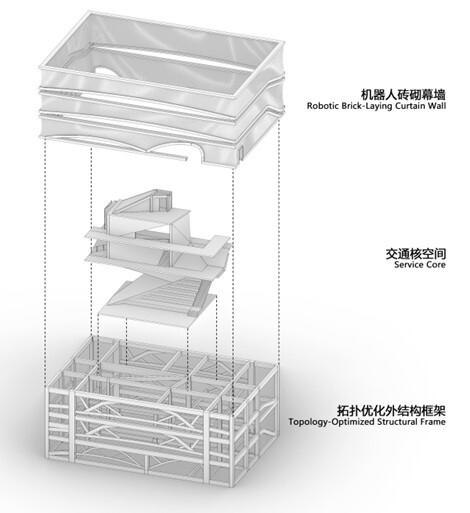
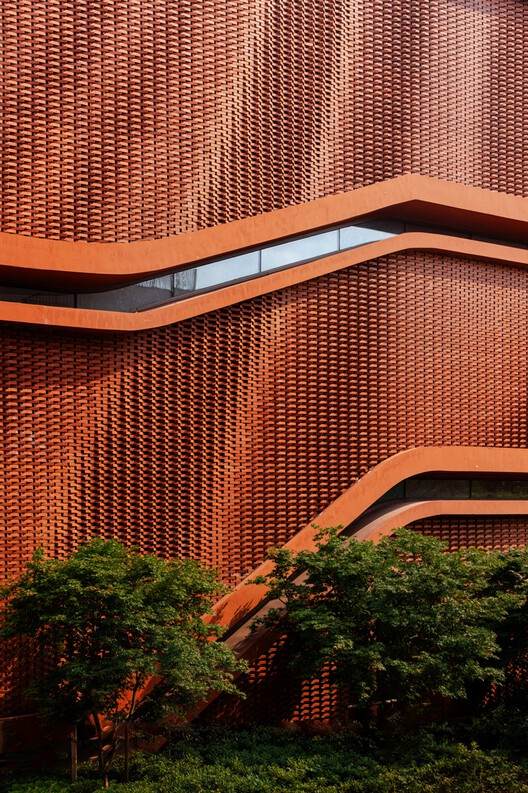
The most recognizable element of the ICH Pavilion is the "brick weaving screen" on its main facade, which functions as both a shading envelope and a cultural representation. Its design logic originates from the natural imagery of "wind sweeping across the water surface," translated into structural logic via parametric algorithms: using uniform bricks as units, the mechanism of rotation angle and cantilever distance is generated through function superposition, creating a ripple-like woven surface. The brick screen acts as the building's outer envelope and a self-stabilizing secondary structural system, supported by a steel龙骨 (dragon bone/keel) frame behind it. Through the controlled arrangement of voids and window bands, it achieves the dual requirements of balanced daylighting and shading energy saving in the exhibition hall. This design allows traditional red bricks, under algorithmic control, to exhibit the visual perception of "flexible fabric," achieving a dual translation of "re-materialization" and "re-construction."
非遗馆最具标识性的元素为其主立面上的“砖织幕”,该构件既是遮阳表皮,也是文化表征。其设计逻辑由“风掠水面”的自然意象出发,经由参数算法转译为结构逻辑:以均匀砖块为单元,通过函数叠加生成旋转角度与出挑距离为形成机制,形成类似“涟漪状”的织纹表皮,砖幕作为建筑外表皮的同时也作为次结构自稳定系统,其背后为钢龙骨支撑体系。通过可控的孔洞与窗带排布,实现展厅内部均衡采光与遮阳节能双重需求。该设计使传统红砖在算法控制下展现“柔性织物”的视觉感知,实现“再材料化”与“再构造化”的双重转译。
Analysis Diagram
04 Construction System of Robotic Masonry
The realization of the facade brick screen relies on a robotic construction system. The design team collaborated with a digital fabrication platform to use robotic arms for precise prefabrication of bricks in the factory, which were assembled on-site via segmented splicing. The entire process realizes a closed loop from design to manufacturing: brick position information is first exported from the parametric model to automatically generate serial numbers and coordinates. Based on the position information, the operation path of the robotic arm is precisely controlled. Through prefabricated assembly construction and segmented installation with dry connections, scaffolding work is eliminated, significantly reducing on-site wet work. The bricks use replaceable hanging node connections, supporting local maintenance and replacement, extending the service life. It is calculated that the overall construction period was shortened by about 30%, and material waste was reduced by 40%, demonstrating the adaptability of digital fabrication technology in cultural projects.
立面砖幕的实现依托于机器人建造体系。设计团队与数字建造平台合作,采用机械臂在工厂进行逐砖精准预制,现场通过分段拼接方式装配完成。整个流程体现为:该项目实现设计到制造闭环,先从参数模型导出砖位信息,自动生成编号与坐标。通过位置信息,精准控制机械臂作业路径,通过预制装配施工,分段拼装,干式连接,无需脚手架作业,大幅降低现场湿作业。砖块采用可替换式挂件节点,支持局部维修与更换,延长生命周期。据测算,整体工期缩短约 30%,材料浪费降低 40%,展现出数字建造在文化项目中的技术适配能力。
05 Interior Space: Triple Coupling of Structure-Circulation-Environment
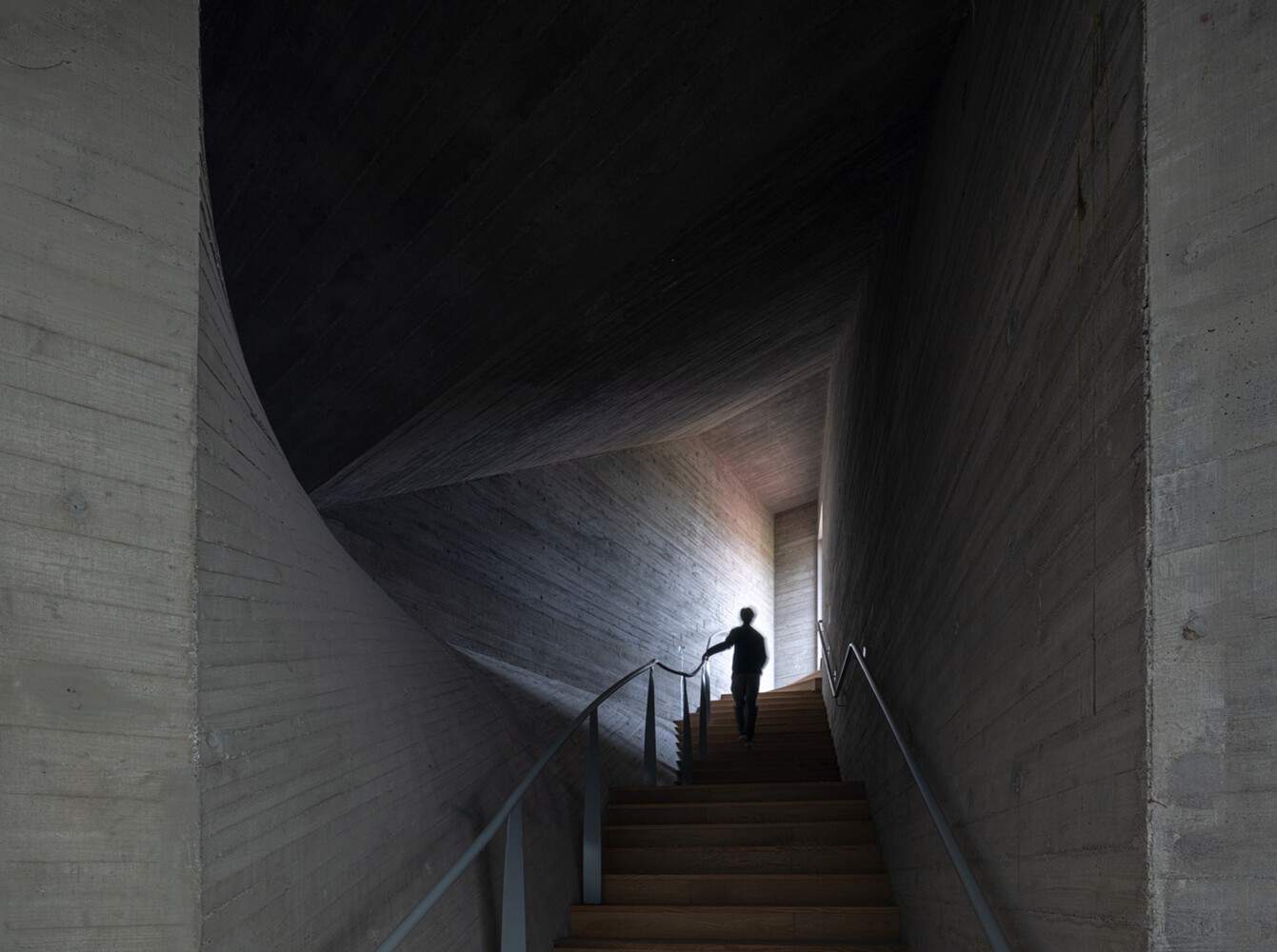
The interior does not resort to decorative displays but creates a walk-through, perceptible mechanical-narrative carrier through the multiple couplings of "structure—circulation—environmental performance." After entering the gray space of the entrance hall, the line of sight is actively drawn toward the central fair-faced concrete core space spanning three floors: this core, based on Bi-directional Evolutionary Structural Optimization (BESO) for geometric reference, bears vertical loads while coordinating spatial organization and microclimate control.
-Structure-Circulation Integration
The slab-shear wall core directs vertical force flow to the bases on both sides; the stair treads cantilever over the tension edges, superimposing the "walking path" with the "force path," thus translating the circulation experience into a readable structural section.
-Light-Material Interaction
The narrow skylight at the top and the point-like openings on the sides together form a three-dimensional light well; natural light slides down the slabs, casting shadows on the walls resembling cloud maps of structural performance, allowing visitors to directly perceive the dynamic correspondence between the force field and the light field while moving.
-Environment-Airflow Synergy
The core cavity utilizes the stack effect for vertical ventilation; the quasi-self-supporting shading provided by the outer brick screen complements the exhaust air ducts of the core, forming a passive cooling strategy for non-air-conditioned seasons.
-Function-Scene Translation
The periphery of the core is a 24m × 12m column-free rectangular exhibition hall; movable partitions and floor slot systems allow for rapid switching between "exhibition" and "workshop" modes. The M&E dry-line conduits reserved in the BIM model are concealed within the floor slab cavities, ensuring ceiling height and acoustic integrity.
In this context, the interior is shaped into a walk-in "Structure-Environment Instrument": the rational tension of fair-faced concrete and the flexible halo filtered by the brick screen are superimposed, allowing the digital fabrication logic and local material semantics to achieve deep intertextuality at the pedestrian scale.
室内并未诉诸装饰性陈列,而是通过 “结构—动线—环境性能” 的多重耦合,打造可步入、可感知的力学-叙事载体。进入前厅灰空间后,视线被主动引向中心的清水混凝土通贯核空间:这座贯穿三层的结构/交通核心体以双向渐进结构优化(BESO)为几何依据,既承担竖向荷载,又统筹空间组织与微气候调控。
-结构-动线整合
折板-剪刀墙式核心将竖向力流导向两侧基座;楼梯踏步在受拉边缘悬挑,使“行走路径”与“受力路径”叠合,从而把交通体验转译为可读的结构剖面。
-光-材质交互
顶部狭缝天窗与侧向点状开口共同构成立体光井;自然光沿折板滑落,在墙面投射出类似结构性能云图的光影,令观者在行进中直接感知力学场与光场的动态对应。
-环境-气流协同
核体空腔利用烟囱效应形成垂直通风;外层砖织幕提供的准自承遮阳与核心排风道互补,构成非空调季节的被动降温策略。
-功能-场景转译
核体外围为 24 m × 12 m 的无柱矩形展厅;可移动隔墙与地面插槽系统允许空间在“展陈”与“手工坊”之间快速切换。BIM 预留的机电干线槽隐藏于楼板腔体,确保室内净高与声学完整性。
在这一语境中,室内被塑造成一座可步入的“结构-环境仪器”:清水混凝土的理性张力与砖幕过滤的柔性光晕相互叠合,使数字化建造逻辑与地方材料语义在步行尺度上完成深度互文。
Analysis Diagram
06 Structural Design and Topology Optimization Strategy
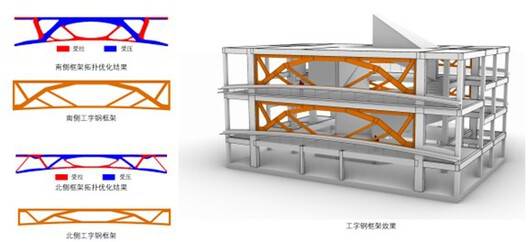
Beyond architectural expression, the ICH Pavilion also serves as an experimental exploration in structural optimization design. The main frame structures on the north and south sides adopt Bi-directional Evolutionary Structural Optimization (BESO) for lightweight design. The strategy involves: inputting load cases and constraint conditions, allowing the BESO algorithm to automatically identify the main tensile and compressive paths to achieve topology generation. The optimized structural map is post-processed into an I-beam component system, reducing the number of components and controlling node complexity. The undulating form of the brick screen is coordinated with the internal structural framework, achieving a continuous transition from formal aesthetics to load-bearing logic. This strategy effectively reduces structural redundancy, making the building form and structural behavior consistent, reflecting a rational expression path guided by construction.
在建筑表达之外,非遗馆亦是一次结构优化设计的实验性探索。南北两侧主要框架结构采用双向渐进结构优化法(BESO)进行轻量化设计。其策略为:输入荷载工况与约束条件,通过 BESO 算法自动识别主要受拉受压路径,实现拓扑生成。优化结构图谱经后处理转化为工字钢构件体系,精简构件数量,控制节点复杂度。砖幕之起伏形态与内部结构骨架协同设计,实现从形式美学到受力逻辑的连续过渡。该策略有效减少结构冗余,使建筑形体与结构行为趋于一致,体现出由构造引导空间的理性表达路径。
© Su Shengliang
07 Reorganization Mechanism of Cultural Space
Within the "Nanqiao Yuan" renewal system, the Shenjia Garden ICH Pavilion plays three core roles: Firstly, it is a container for regional cultural memory, carrying functions such as the inheritance of intangible heritage skills, craftsmanship education, and local cultural exhibition. Secondly, it serves as a demonstration sample for intelligent construction technology, vividly showcasing how local materials can be digitally translated and innovatively applied through robotic masonry and structural optimization. Simultaneously, it is a key node for activating urban space, effectively connecting the main building with the canal walkway to collectively shape an accessible and vibrant public cultural arcade. Through micro-scale intervention, it reorganizes site memory, handicraft skills, and community publicness, responding to the trend of urban renewal shifting from "physical improvement" to "cultural cultivation."
在“南桥源”更新体系中,沈家花园非遗馆扮演着三重核心角色:首先,它是区域文化记忆的容器,承载着非遗技艺传承、手工艺教育和地方文化展陈的功能;其次,它成为智能建造技术的示范样本,通过机器人砌筑和结构优化,生动展示了如何将本地材料进行数字化转译与创新应用;同时,它更是激活城市空间的关键节点,有效串联起主楼与运河步道,共同塑造出一个日常可达、充满活力的公共文化敞廊。其以微尺度的介入方式,重新组织场地记忆、手工技艺与社区公共性,回应城市更新从“物理改善”走向“文化营造”的转向趋势。
© Su Shengliang
08 Conclusion: Cultural Narrative from Brick Material to Digital Context
The Shenjia Garden ICH Pavilion uses the most local material, brick, as a medium, and the most futuristic construction technology as a tool, to build a bridge between culture and intelligence, tradition and modernity. Its design logic unfolds from the brick envelope, completing a re-grammarization of architectural language through structural optimization, parametric texture, and digital fabrication. This is not only a spatial practice concerning the exhibition of "intangible heritage" but also an attempt at contemporary expression of architecture as a cultural mechanism. In the context of urban renewal, architecture is no longer merely a physical container but an organizer of cultural relations and an intermediary for semantic conversion. The Shenjia Garden ICH Pavilion, as one example, offers us a new perspective: new construction does not mean rewriting history, but rather re-decoding and regenerating the cultural context.
沈家花园非遗馆以最具地方性的砖材为媒介,借助最具未来性的建造技术,搭建起文化与智能、传统与当代的桥梁。其设计逻辑由砖构表皮展开,通过结构优化、参数织理与数字建造完成一次建筑语言的再语法化。这不仅是一次关于“非遗”的展览空间实践,更是一次关于建筑作为文化机制的当代表达尝试。在城市更新语境下,建筑不再只是物理容器,而是文化关系的组织者、语义转换的介体。沈家花园非遗馆作为其中一例,为我们提供了新的视角:新建不意味着重写历史,而是对文脉的再解码与再生成。
© Su Shengliang