伊斯玛仪中心:当代诠释与文化传承的典范:休斯敦伊斯玛仪中心成功地将伊斯兰建筑的传统理念——如结构清晰、装饰人文、重复统一、光线物质化——通过现代工艺进行了创新性表达。建筑从波斯民居汲取灵感,运用伊万式门廊和穿孔石屏等元素,不仅创造了清晰、宁静且永恒的空间感受,更巧妙地适应了休斯敦的湿热气候,通过一系列有遮蔽的过渡空间(伊万和中庭)模糊了室内外的界限,极大地增强了公共性和日常使用的灵活性。
精湛的材料运用与细致的结构处理:在材料选择上,设计强调美观、清晰与持久性。外立面采用多样的石质瓷砖,实现了远观的整体量感与近观的精细装饰的统一。室内则以简约的色调、丝质夹层玻璃和高性能混凝土等现代材料,突出了几何形态的纯粹性。尤其值得称赞的是,从屏风的三角形孔洞到扇贝形过渡,再到中央圆形天窗与祈祷厅入口的轴线呼应,都体现了建筑师对细节的极致把控和对精神核心的尊重。
景观与场所精神的有机融合:纳尔逊·伯德·沃尔茨事务所的景观设计是该项目的另一大亮点,它将伊斯兰园林的空间哲学与休斯敦的本土生态韧性深度结合。通过对波斯园林“逐级延伸至河流”布局的研究,设计创造了一个适应五百年一遇洪水的弹性系统,包括阶梯式草坪和适应性花园。植物配置模拟“德州生态剖面”,象征着社群的适应力,使得建筑不仅是文化机构,更是一个与环境对话、体现社群责任与归属感的鲜活生态系统。
Ismaili Centers around the world serve as ambassadorial buildings, welcoming people from all walks of life to explore the intersection of faith, culture, and civic life. Each center embodies the Ismaili community’s commitment to pluralism, the exchange of knowledge, and shared humanity, providing a space for spiritual reflection, cultural exchange, and public dialogue. The Ismaili Center in Houston continues this tradition, conceived as a vibrant home for nurturing the mind and spirit—a place where programs in education, arts, music, performance, and dialogue converge to foster mutual understanding among people of different backgrounds.
全球各地的伊斯玛仪中心(Ismaili Centers)宛如大使级建筑,欢迎各界人士前来探索信仰、文化与公民生活的交汇点。每一座中心都体现了伊斯玛仪社群对和平多元主义、知识交流与人类共性的承诺,为人们提供了一个进行精神反思、文化交流与公众对话的场所。休斯敦伊斯玛仪中心延续了这一传统,它被构想为一个滋养心灵与精神的鲜活家园 —— 在这里,教育、艺术、音乐、表演与对话等各类项目汇聚一堂,促进不同背景人士之间的相互理解。
© Iwan Baan
© Iwan Baan
Inside the Center, visitors will find permanent and rotating art exhibitions, a black-box theater, a multi-purpose hall, a café, administrative offices, classrooms, and the Jamatkhana—the prayer hall which serves as the spiritual heart of the complex and the center for community activities. In keeping with the Ismaili community’s spirit of service, the Center is largely staffed by volunteers. The Ismaili Center Houston welcomes organizations dedicated to advancing the public good across education, arts, public health, environmental awareness, and social equity, positioning itself as a venue for exchange, learning, and openness that nurtures intellectual discourse and strengthens the bonds of civic life.
在这座中心的建筑内,访客将能看到常设艺术展览与轮换艺术展览、一间黑匣子剧场、多功能厅、一家咖啡馆、行政办公室、教室,以及一座作为整个建筑群精神核心与社群活动中心的贾玛特卡纳(Jamatkhana,即伊斯玛仪穆斯林的祈祷厅)。秉持伊斯玛仪社群的服务精神,该中心的工作人员大多由志愿者担任。休斯敦伊斯玛仪中心欢迎各类致力于推动公共利益的机构入驻,这些机构涵盖教育、艺术、公共卫生、环保意识以及社会公平等多个领域,该中心将成为一处促进交流、学习与开放的场所,滋养思想交流,进而强化公民生活的纽带。
© Iwan Baan
“Houston is honored to welcome the Ismaili Center, a place that brings people together to engage in dialogue, increase understanding, and learn from one another. During its construction, I visited the site and already envisioned its significance for our city. Now complete, it stands as a new landmark along the Allen Parkway corridor and a shining beacon surrounded by our most cherished neighborhood and cultural institutions. The Ismaili Center truly embodies the essence of the Houston spirit: our diversity, our generosity of heart, and our commitment to community. It is a place that invites all Houstonians to gather, to celebrate our interconnectedness,” said Mayor Whitmire.
“休斯敦市很荣幸能迎来伊斯玛仪中心的落成,这是一个能让各界人士齐聚一堂,开展对话、增进理解、相互学习的地方。在项目建设期间,我曾到访工地,当时就已预见它对我们城市的意义。如今,它已竣工,成为艾伦公园大道走廊沿线的一座新地标,也是一座熠熠生辉的灯塔,周边环绕着我们最为珍视的社区和文化机构。伊斯玛仪中心真正体现了休斯敦精神的精华所在:我们的多元性、我们的仁爱之心,以及我们对社区的承诺。这是一个邀请所有休斯敦人齐聚一堂、共同庆祝我们之间紧密联系的地方,”市长惠特迈尔(Whitmire)说道。
© Iwan Baan
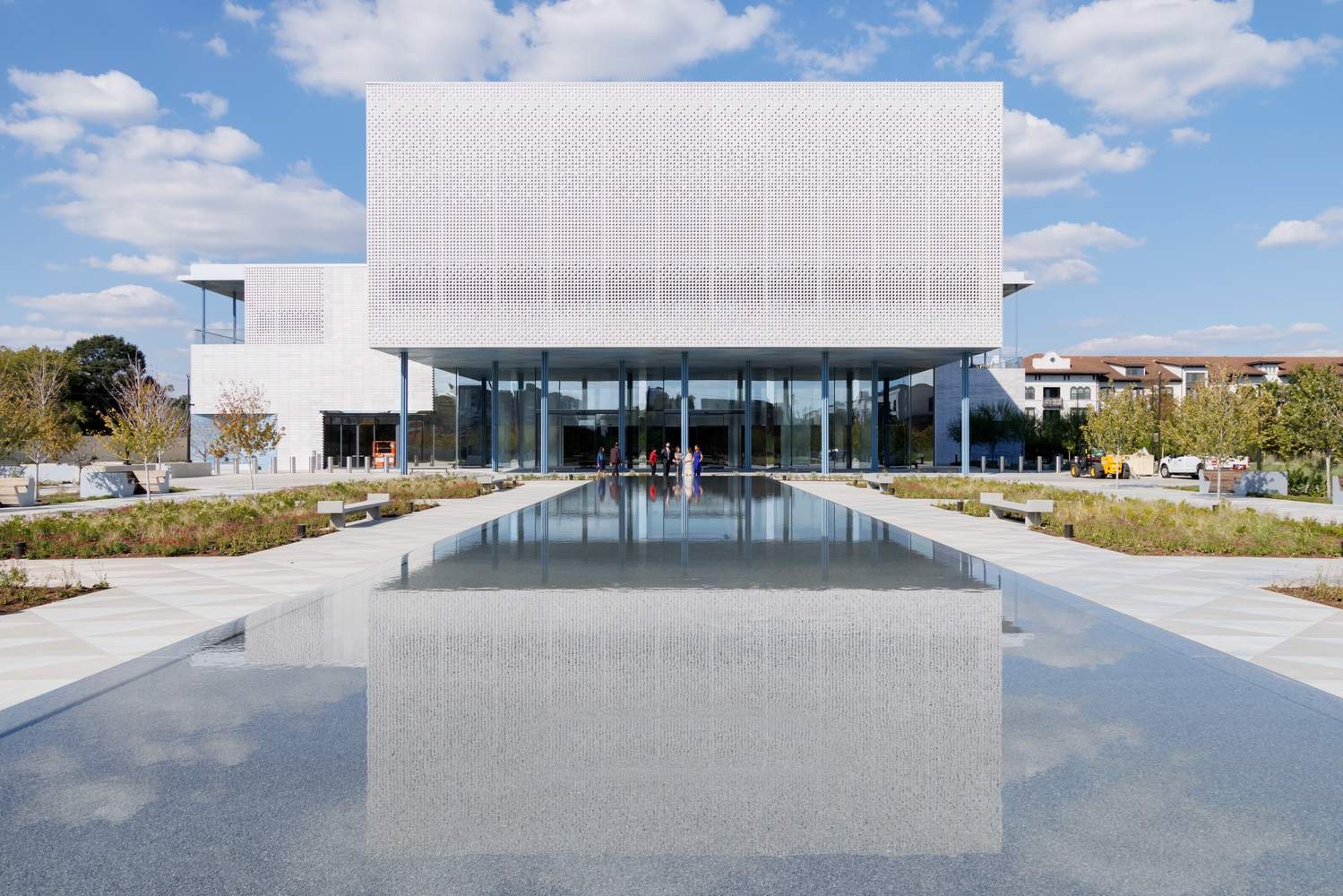
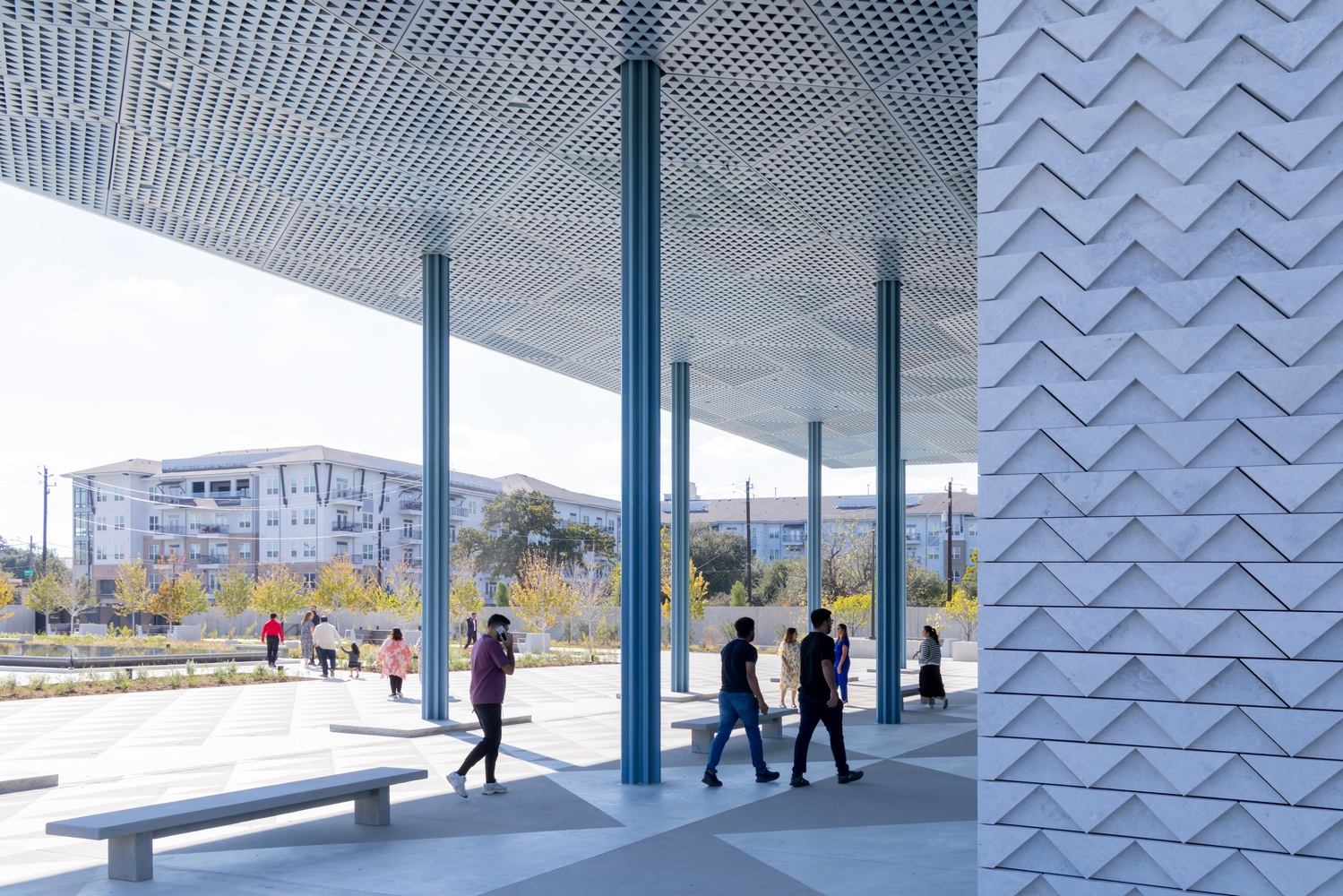
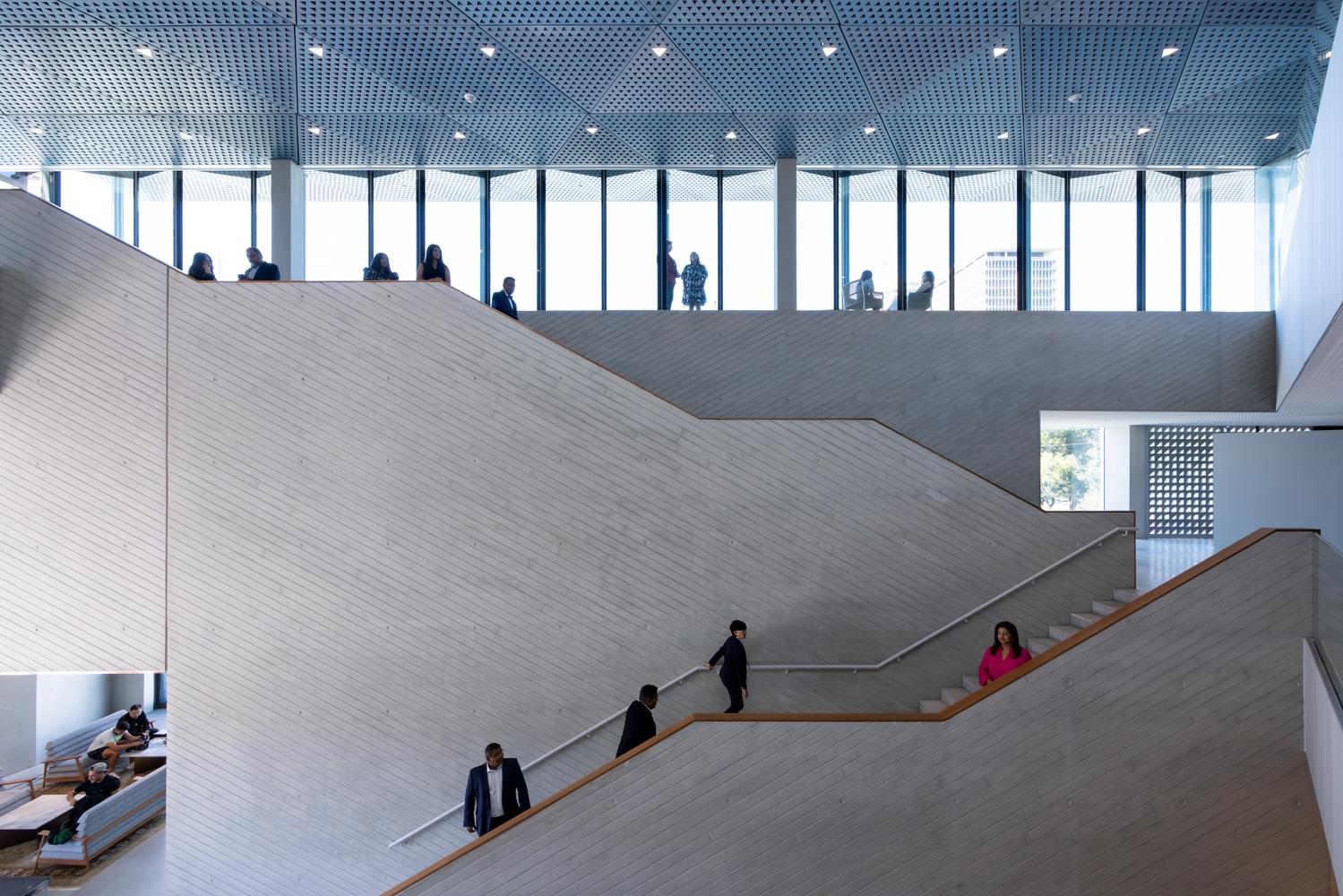
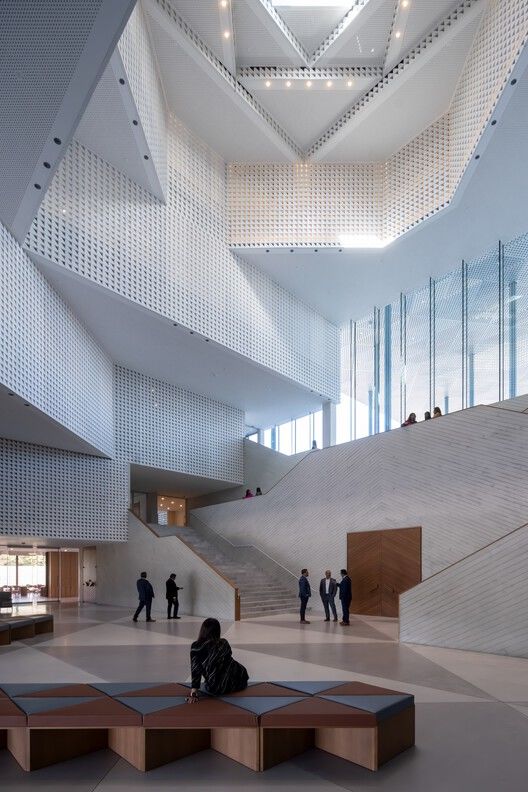
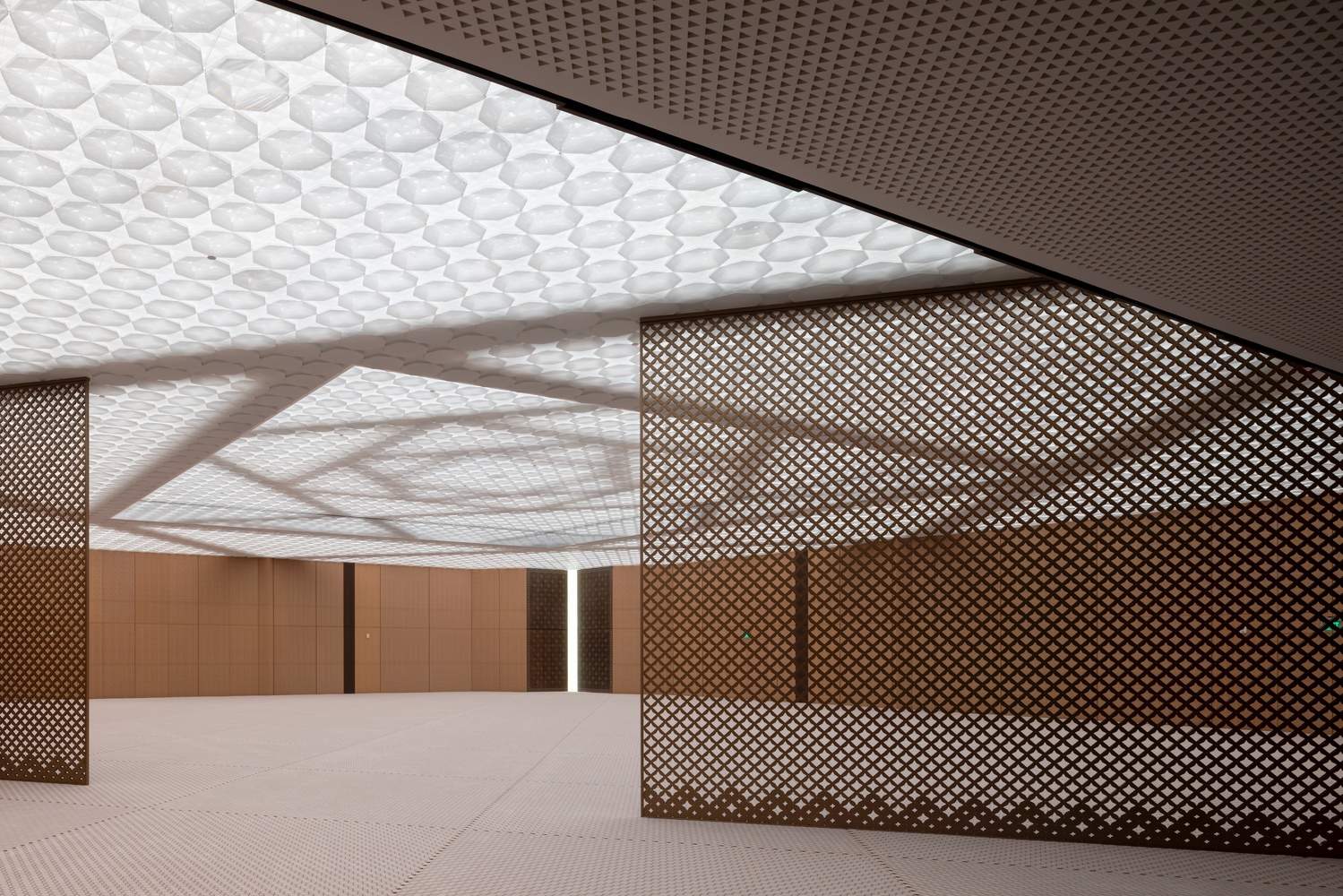
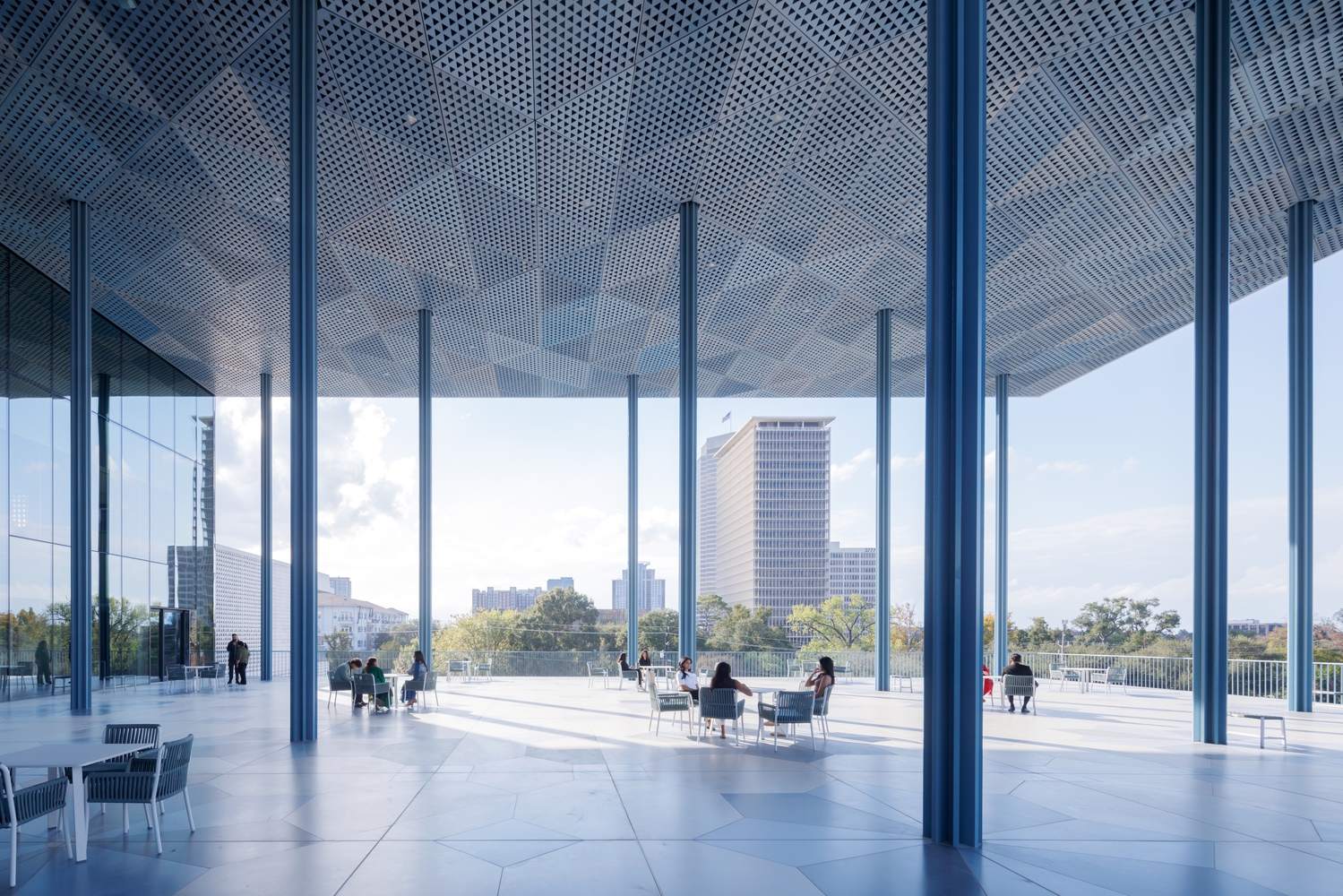
The architecture of the Ismaili Center Houston does not simply replicate historical styles but instead reinterprets enduring concepts from the Muslim world—such as clear, ordered layout, human-scaled ornamentation, unity through repetition, and light as a physical material—through modern craft. Its design draws distinct inspiration from Persian residential and palatial traditions, evident in the use of eivans (arched loggias) and perforated stone screens that modulate light and afford privacy. Large geometric structures are refined into delicate details, creating spaces that are clear, serene, and timeless rather than dictated by fleeting trends. The design thoughtfully responds to Houston’s climate and site conditions, carefully arranging translucent eivans and courtyards to seamlessly integrate shaded outdoor spaces with bright interior areas. These covered transitional zones allow for free passage between inside and out at any time of year, and remain available for casual use even when formal programming is not scheduled, further reinforcing the Center’s public mission as a daily place for gathering, reflection, and exchange.
休斯敦伊斯玛仪中心的建筑并未简单复刻历史风格,而是通过现代工艺,将穆斯林世界中历久弥新的理念 —— 如结构呈现为清晰有序的布局、装饰体现人文尺度、重复带来统一感、光线作为实体材质 —— 进行了全新诠释。其设计灵感明显汲取自波斯民居与宫殿传统,体现在伊万式门廊(eivans,即带拱顶的凉廊)和穿孔石屏上,这些元素既能调节光线,又能保护隐私。大型几何结构最终细化为精致细节,营造出清晰、宁静且永恒的空间,而非受潮流驱使的短暂设计。该中心的设计充分考虑了休斯敦的气候特点和场地地理条件,精心布局了一系列通透的伊万式门廊和中庭,将遮荫的户外空间与明亮的室内区域巧妙结合。这些有顶的过渡空间,让人们在一年中的任何时候都能自由穿梭于室内外,即便在非预定活动时间,也可供人们随意使用,进一步强化了该中心作为日常聚会、反思与交流场所的公共使命。
© Iwan Baan
© Iwan Baan
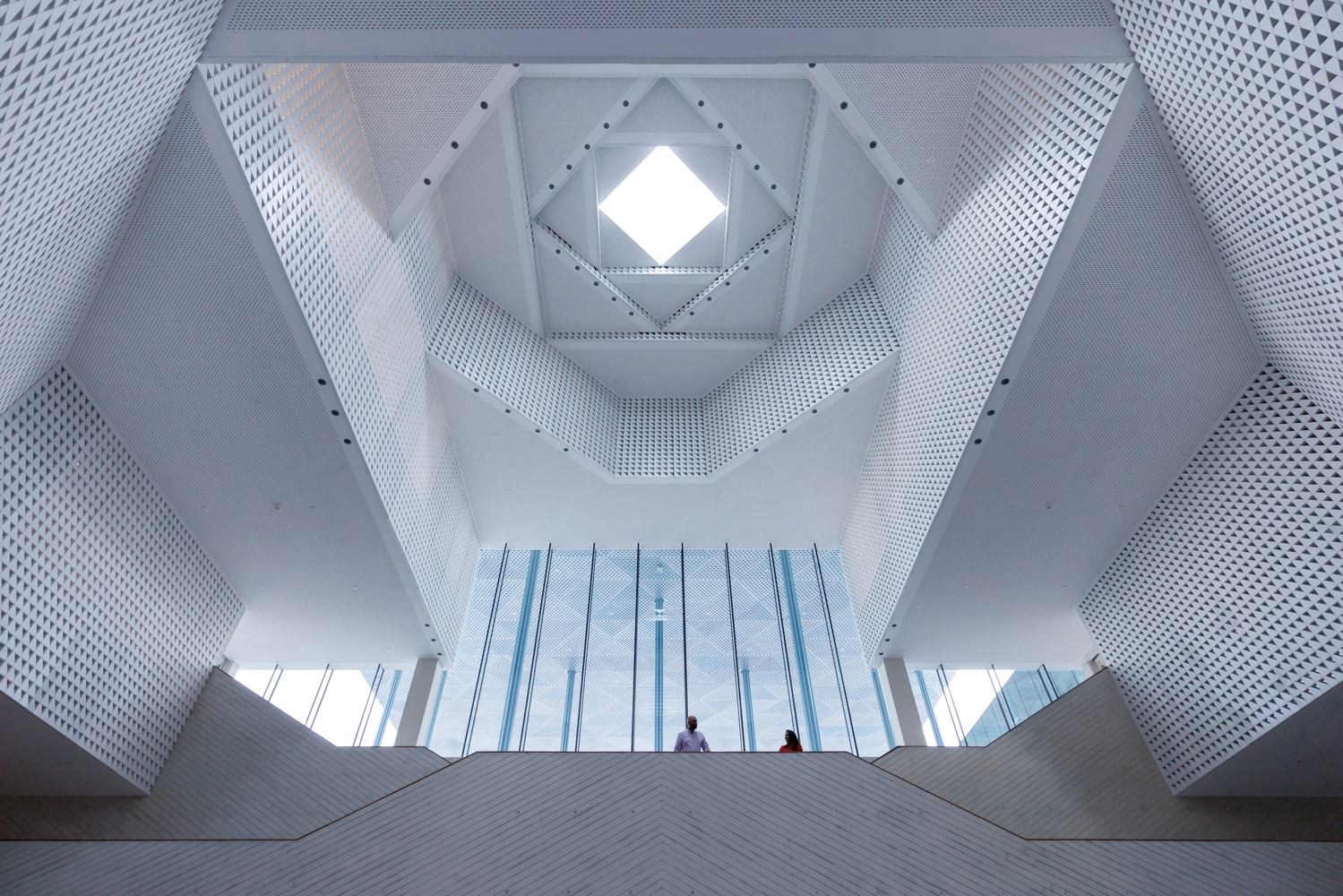
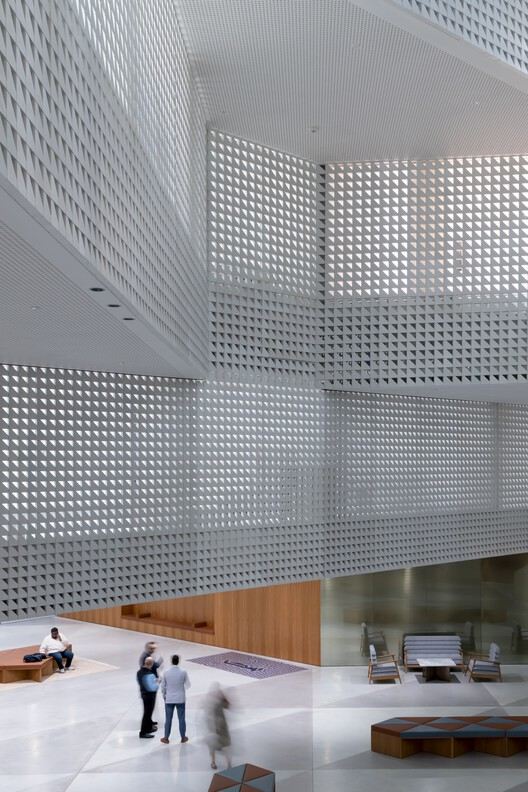
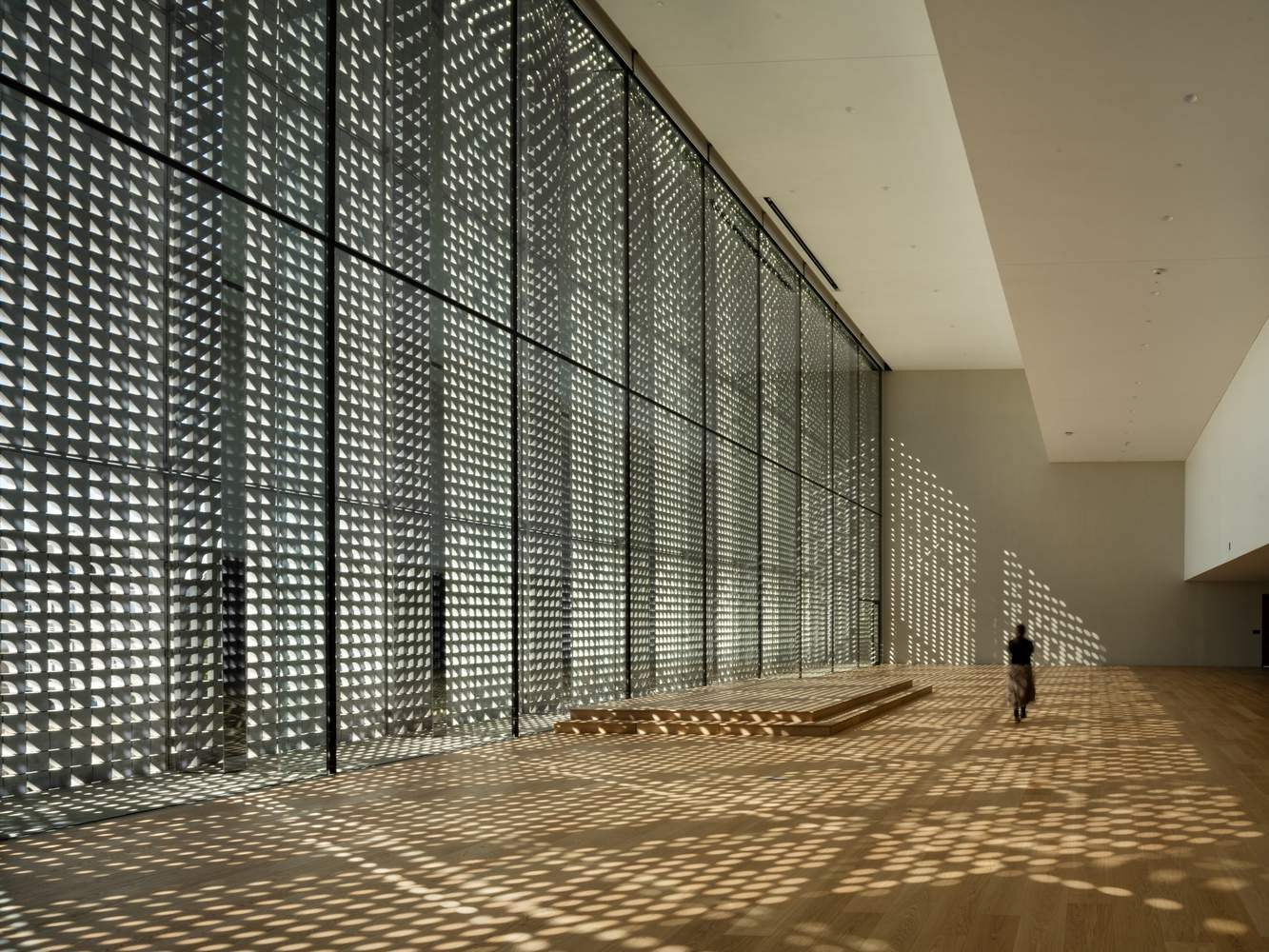
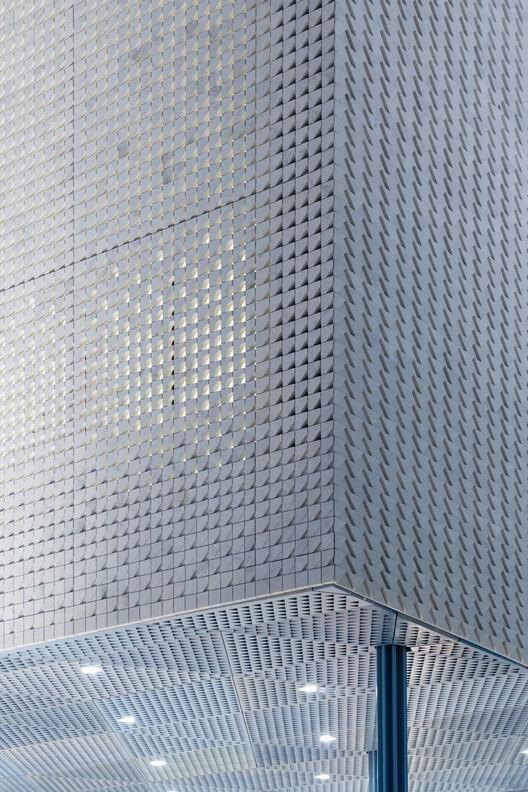
The materials selected are beautiful, clear, and built to last a century. The exterior façade features small, varied stone tiles that read as a solid volume from a distance but reveal intricate decorative detail up close. Inside, the palette is restrained, emphasizing geometric form over surface adornment, utilizing materials like silk-laminated glass, steel, wood paneling, and ultra-high-performance concrete. The screens transition from triangular perforations to subtle scalloped patterns, widening views for occupants while maintaining structural integrity. At the top of the building, a circular skylight crowns the central courtyard, aligning with the entrance to the Jamatkhana, connecting sky to sacred space. Situated at the highest point of the site, safely elevated above the 500-year floodplain, the building’s underground parking garage is designed to accommodate pooling water if necessary.
所选材料兼具美观、清晰与百年耐用的特性。建筑外立面采用小块、多样的石质瓷砖,远观呈现出沉稳的体量感,近看则尽显精致装饰细节。室内采用简约的色调搭配,包括丝质夹层玻璃、钢材、木质饰面板以及超高性能混凝土,着重凸显几何造型而非表面装饰。屏风设计巧妙,从三角形孔洞过渡到微妙的扇贝形图案,既拓宽了坐者的视野,又保持了结构的稳固性。建筑顶部,一个圆形天窗(skylight)矗立于中央中庭上方,与贾玛特卡纳(Jamatkhana,即祈祷厅)的入口门遥相呼应,将天空与神圣空间相连。该建筑坐落于场地最高点,高出 500 年一遇的洪泛平原,受到充分保护,其地下停车库设计为必要时可容纳积水。
© Nic Lehoux
For Woltz, the Ismaili Center Houston represents the culmination of more than a decade of his research into how the landscape of the Muslim world can be renewed in the 21st century. The Center is the fourth project the landscape architecture firm Nelson Byrd Woltz has completed for the Aga Khan Development Network. In 2011, His Late Highness Prince Karim Aga Khan IV commissioned the firm, tasking Woltz and his team with a year-long study to visit historic sites across Spain, Egypt, and India, exploring the spatial, sensory, and cultural qualities of Islamic gardens—such as the sound of water, the scale of enclosure walls, the rhythm of geometry, and the symbolism of enclosed space. The insights from this research have guided the firm’s approach to subsequent projects, including the Ismaili Center Houston. Drawing on these lessons, Woltz views the Ismaili Center Houston as a masterpiece of environmental engineering and a living embodiment of cultural continuity.
对沃尔茨(Woltz)而言,休斯敦伊斯玛仪中心是他十多年来对穆斯林世界景观如何在 21 世纪焕发新生的研究成果的集大成之作。该中心是纳尔逊·伯德·沃尔茨(Nelson Byrd Woltz)景观设计事务所为阿迦汗发展网络(Aga Khan Development Network)完成的第四个项目。2011 年,已故的阿迦汗四世殿下(His Late Highness Prince Karim Aga Khan IV)委托该事务所,要求沃尔茨及其团队开展为期一年的研究,遍访西班牙、埃及和印度的历史遗迹,探索伊斯兰园林在空间、感官与文化层面的特质,例如水流之声、围墙之尺度、几何之韵律以及围合空间之象征意义。这项研究的洞见为该事务所后续项目(包括休斯敦伊斯玛仪中心)的设计方法提供了指引。沃尔茨汲取这些经验,将休斯敦伊斯玛仪中心视为一项环境工程杰作,同时也是文化传承的鲜活体现。
© Iwan Baan
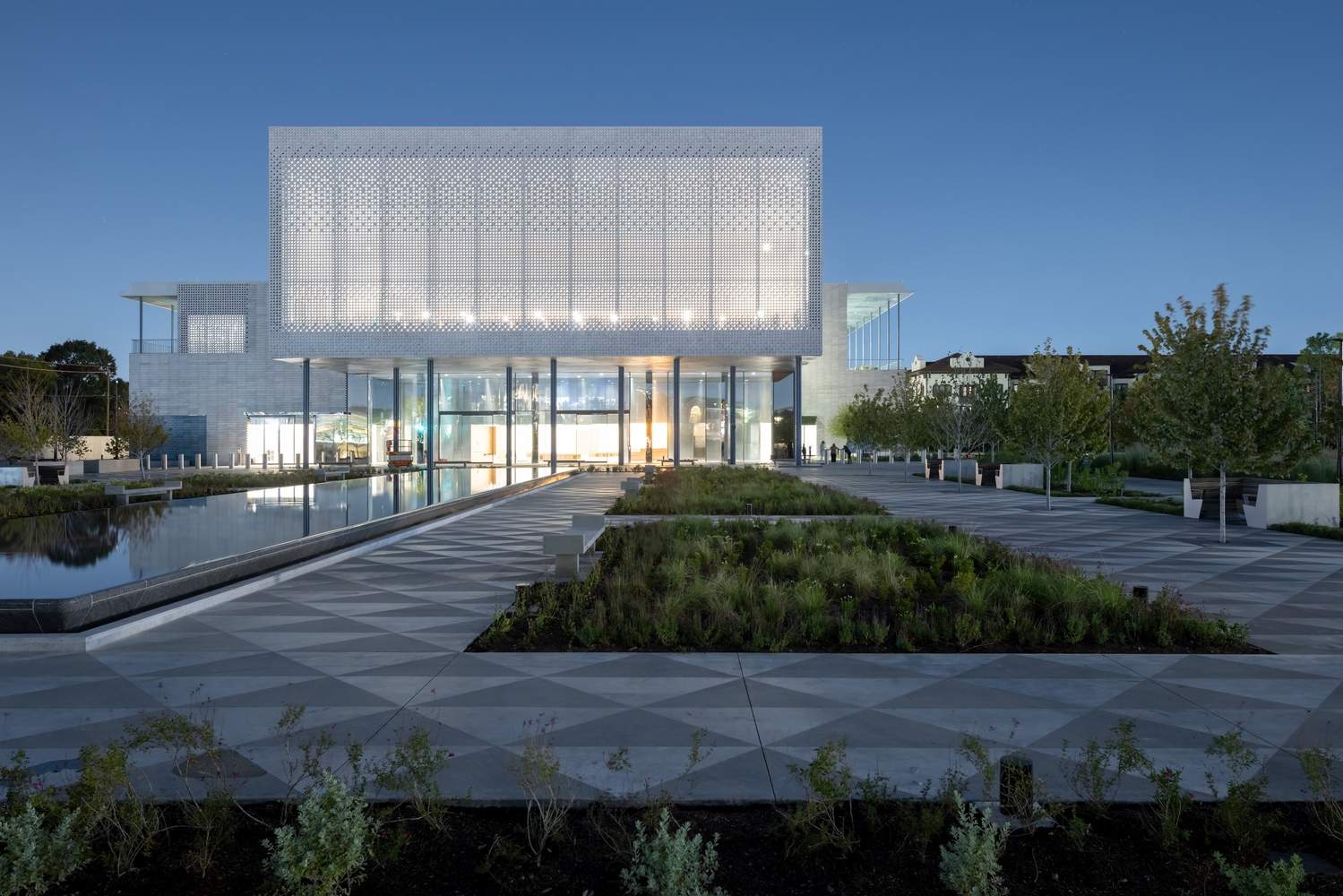
The site was chosen for its gentle slope toward Buffalo Bayou, echoing the layout of ancient Persian gardens that descend toward a river. Woltz translated this topography into a resilient system of terraced lawns, reflecting pools, and flood-adaptive gardens capable of withstanding Houston’s 500-year storm events. Collaborating with Professor Hanif Kara of the London-based structural engineering firm AKT II, the design team subtly integrated a hidden geometric grid throughout the architecture and landscape, ensuring that every path, fountain, and tree is arranged in quiet visual harmony—a tradition respected in Eastern cultures for centuries. The Center is enveloped by acoustic garden walls, soon to be covered in climbing vines, creating a serene enclave that is both buffered from the city’s noise and deeply connected to its ecology.
该场地因地势缓缓向布法罗河湾(Buffalo Bayou)倾斜而被选中,这一地形与古代波斯园林逐级延伸至河边的布局相呼应。沃尔茨的设计将这片地形转化为一个富有韧性的系统,包括阶梯式草坪、反射水池以及适应洪水的花园,能够抵御休斯敦 500 年一遇的暴雨侵袭。设计团队与伦敦结构工程公司 AKT II 的哈尼夫·卡拉(Hanif Kara)教授合作,在建筑与景观中巧妙融入了一个隐秘的几何网格,确保每一条小径、每一座喷泉和每一棵树木都以静谧的视觉和谐排列,遵循东方文化自古以来的传统。中心四周环绕着即将被爬墙虎覆盖的消音花园围墙,形成一片宁静的飞地 —— 既与城市喧嚣隔绝,又与其生态环境紧密相连。
© Iwan Baan
More than an aesthetic or ecological vision, the landscape embodies the Ismaili community’s values of cohesion, responsibility, and belonging. Woltz conceived the planting as a “Texas Ecological Cross-Section,” beginning with desert species like cacti and agaves, transitioning through prairie, and culminating in Gulf Coast flora—mirroring the resilience demonstrated by Ismailis in their new home. The site is designed not as a static garden but as a living, evolving ecosystem that will mature over time. “It’s not just about beauty,” Woltz notes, “it’s about creating a place where people can pause and gather—a landscape of connection, resilience, and care.”
这片景观不仅承载着美学与生态愿景,更体现了伊斯玛仪社群重视社群凝聚力、责任担当与归属感的价值观。沃尔茨将植物配置构思为“德克萨斯生态剖面”,从仙人掌、龙舌兰等沙漠物种起始,经由草原过渡至墨西哥湾沿岸植物,映射出伊斯玛仪人在新家园中展现出的强大适应力。该场地并非设计为静态花园,而是一个鲜活、不断演变的生态系统,将随时间推移而愈发成熟。“这不仅仅关乎美丽,”沃尔茨指出,“更在于打造一个能让人们静心沉思、相聚一堂的地方 —— 一个充满联结、韧性与关怀的景观。”
© Iwan Baan
The Ismaili Center Houston adds a significant new element to the cultural landscape of this Southern metropolis, joining esteemed neighbors such as The Menil Collection, Rothko Chapel, Asia Society Texas, the Cistern, and the Museum of Fine Arts, Houston. More than a venue for worship or exhibition, the Center stands as a symbol of an open spirit—a place for a community to convene, learn from one another, celebrate shared values, and imagine a more connected world.
休斯敦伊斯玛仪中心为这座美国南部文化之都的声誉增添了崭新的标志性元素,与邻近的梅尼尔收藏博物馆(The Menil Collection)、罗斯科礼拜堂(Rothko Chapel)、德州亚洲协会(Asia Society Texas)、蓄水池(Cistern)以及休斯敦美术馆(Museum of Fine Arts, Houston)等文化地标交相辉映。该中心不仅仅是一个宗教礼拜或艺术展示的场所,更是一座开放精神的象征 —— 一个社群汇聚一堂、相互学习、共庆共享价值观、畅想更加紧密相连的世界的空间。
© Iwan Baan