城市共生与社区驱动的体育综合体:该项目成功地将体育场馆从传统的封闭孤立模式中解放出来,转变为一个以体育为核心驱动力的共享开放社区。设计理念强调体育建筑应具备公共服务属性,通过将棒球场、集训中心、体能训练馆与特色商业街有机结合,构建了一个运动社区式的文化综合体。这种前瞻性的城市融入策略,打破了体育设施的“边界感”,使其成为激活周边未来社区活力的引力内核,充分体现了共享、共融和可持续发展的设计精髓。
地域文化与技术诗意的融合:在建筑语言上,设计巧妙地从绍兴水乡意境和纺织文化中汲取灵感,实现了地域文化与现代建筑技术的完美结合。丝带状的二层公共平台编织起各个场馆,连接城市街道网络;而弧形穿孔铝板立面则以细腻的曲线和穿孔纹样,既呼应了江南水波与书卷意象,又延续了传统纺织的工匠精神。这种对地域文化符号的抽象提炼和技术化转译,赋予了建筑独特的文化深度和审美韵律。
“云翼”结构下的轻盈与多功能性:标志性的漂浮“云翼”罩棚是结构工程与美学表达的杰作。采用双向桁架和PTFE膜结构,实现了大跨度悬挑,同时,顶部膜材和底部穿孔铝板的结合,营造出朦胧、轻盈的视觉效果,消解了庞大体量的压迫感,并巧妙地隐喻了水乡特色。此外,设计高度关注赛时与赛后的双重需求,通过整合酒店、商业和全民健身中心,确保了场馆在非赛事期间仍能高效运营,成为服务于社区生活的重要配套中心,展现了高度的可变性和前瞻性的后评估意识。
The inherent attributes of sports architecture compel us to re-examine how to organize its intrinsic connection with the city. We aim to construct a sports community driven by the stadium, which fully considers the multiple possibilities within the urban context and integrates it into urban life from a forward-looking perspective. Simultaneously, the design is permeated with the concept of shared openness throughout the building's lifecycle, allowing it to serve as a link connecting culture and life, thereby endowing sports architecture with its unique public service value. — Qian Xidong
体育建筑的内在属性促使我们重新思考如何组织其与城市之间的内在关联。我们想构建一个以体育场馆作为驱动力的体育社区,它能充分考虑城市语境中的多重可能,以前瞻性的视角将其融入城市生活之中。同时,设计以共享开放的理念贯穿整个建筑的生命周期,使其作为联系文化与生活的纽带,赋予体育建筑特有的公共服务价值。——钱锡栋
© 赵强
© 赵强
© 赵强
© 赵强
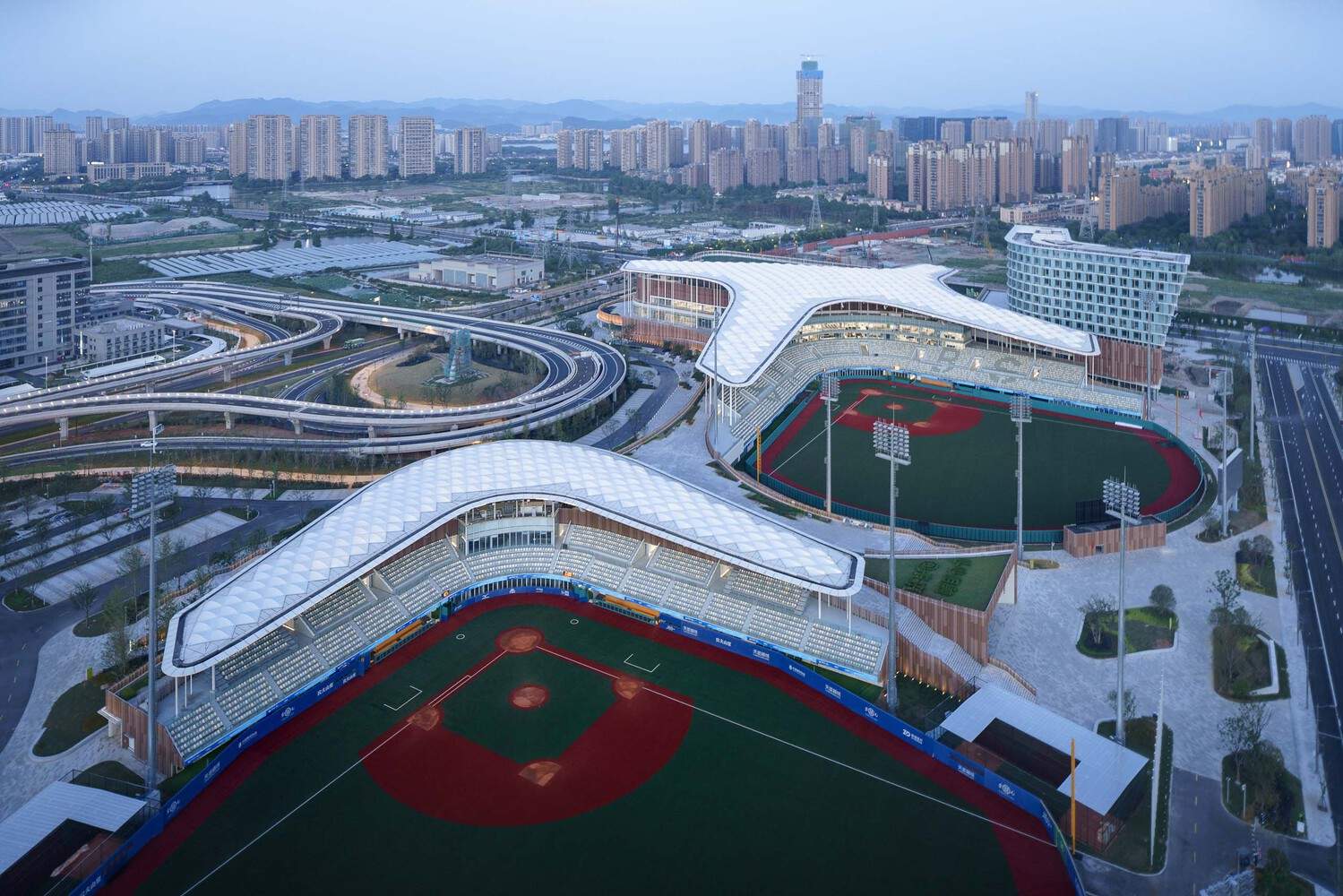
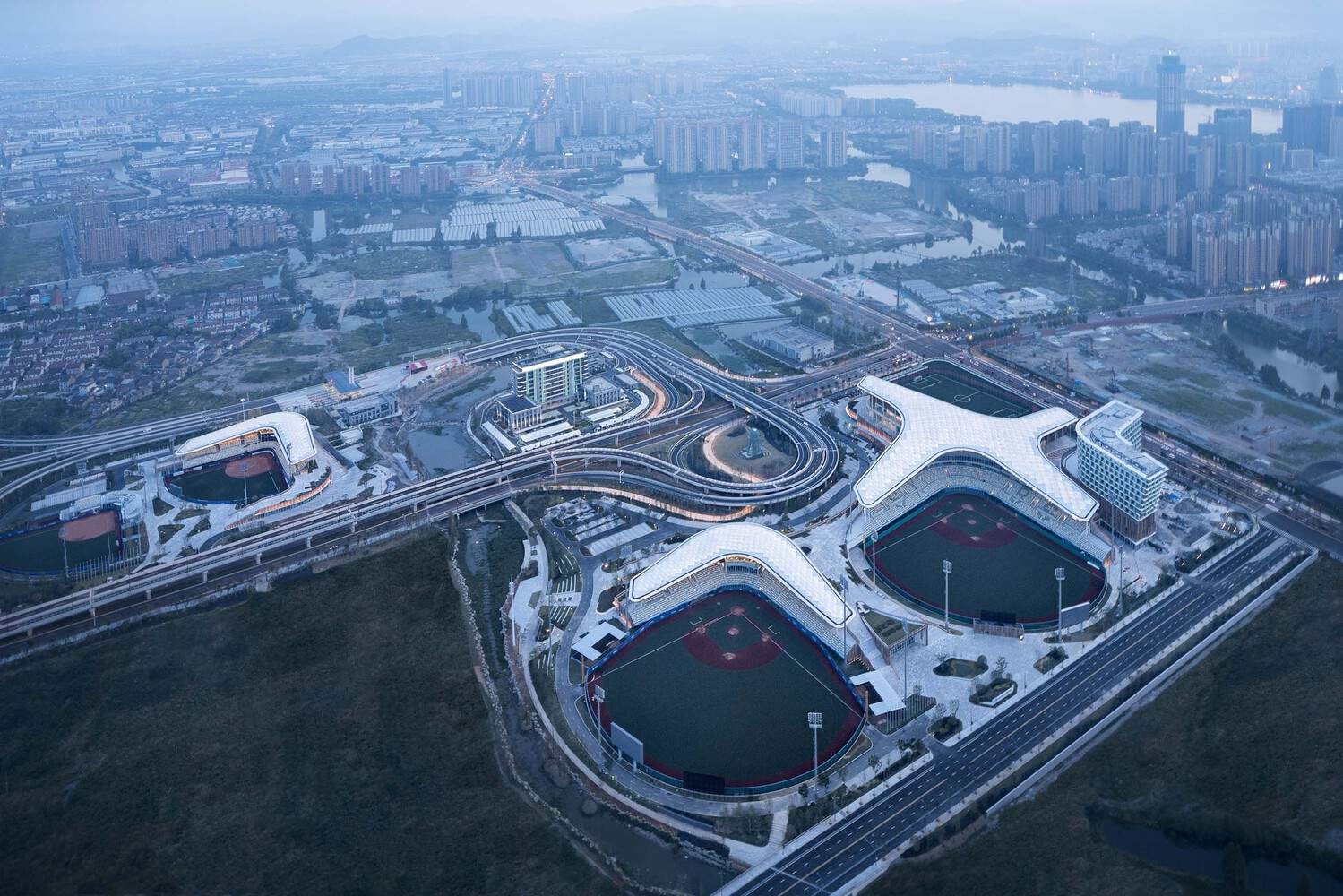
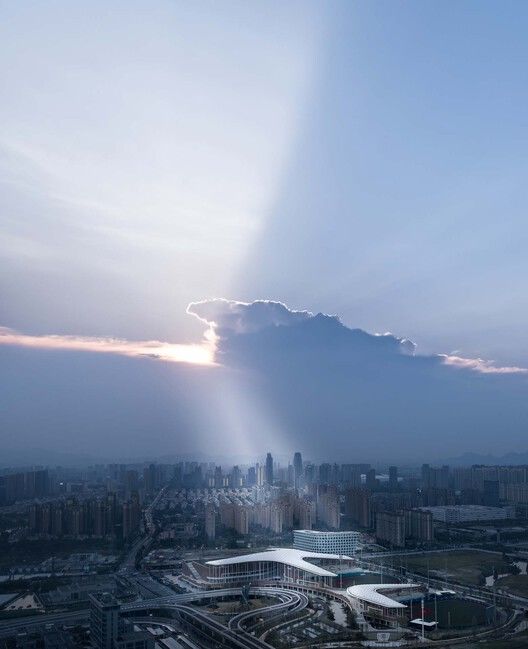
The 19th Asian Games will be held in Hangzhou, China, in 2023. As the largest newly built venue for this Asian Games and currently the largest, highest standard, and most advanced baseball and softball sports center in China, the Hangzhou Asian Games Baseball and Softball Sports and Cultural Center will inject new vitality into the surrounding future community, making sports culture the local cultural undertone. We believe that sports architecture should emphasize flexible public service rather than being confined to athletic competition functions, to adapt to the trend of open sharing in society. Building a sports-cultural complex in the style of a sports community, making it the gravitational core of the surrounding environment and region, is a significant feature distinguishing the Baseball and Softball Sports and Cultural Center from traditional paradigms. Not limited by traditional enclosed, independent venues, the design seeks to break the stereotypical impression of sports architecture being relatively closed off. It fully considers the multiple possibilities within the urban context, integrating the sports cultural complex—composed of a baseball field, a training center, and a fitness hall—with a distinctive commercial street covered by a "Cloud Wing" roof, immersing citizens in the atmosphere of a shared and integrated future sports community.第19届亚洲运动会将于2023年在中国杭州市举行。杭州亚运会棒垒球体育文化中心作为本届亚运会规模最大的新建场馆,同时也是目前中国规模最大、标准最高、设施最先进的棒垒球体育中心,它将为周边未来社区注入全新的活力,使体育运动成为周边的文化底色。我们认为,体育建筑并不止于体育竞技功能,而更应强调灵活性的公共服务,以适应开放共享的社会趋向。构建运动社区式的体育文化综合体,使其成为周边环境、区域的的引力内核,是棒垒球体育文化中心不同于传统范式的重要特征。不囿于传统的封闭式独立场馆,设计希望能够打破体育建筑相对封闭的刻板印象,充分考虑城市语境中的多重可能,由棒球场、集训中心、体能训练馆组成的体育文化综合体和一条云翼盖顶的特色商业街紧密结合,引领市民沉浸在共享共融的未来运动社区氛围之中。
© 赵强
© 赵强
A Sports Park in the Future Community
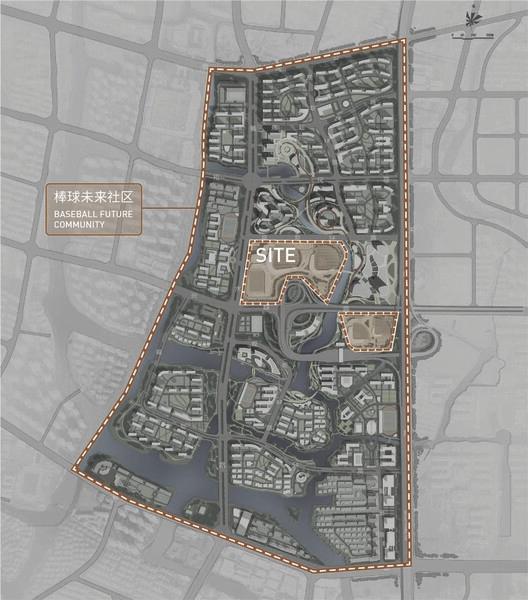
The project is located at the junction of Keqiao District and Jinghu New Area in Shaoxing, serving as a crucial node and supporting facility for the planned Baseball Future Community. To cultivate a vibrant sports community, the design superimposes diverse urban cultures with composite functions, focusing on shaping cultural identity, scientific planning, and integrated utilization to fully leverage the public service nature of the sports facility within the sports community. The project covers a total construction area of approximately 136,000 square meters, divided into two plots, A and E. Plot A primarily houses the main and auxiliary baseball fields, a fitness training center, and an accompanying hotel; Plot E mainly contains the main and auxiliary softball fields. As a sports and cultural park open to the public, the site has no perimeter walls. Citizens can enter anytime and experience it at zero distance, whether on the sports and cultural commercial street or the second-floor platform connecting the various venues. The project ingeniously links the publicly accessible internal spaces with the surrounding future community, considering the operational management feasibility for both the Asian Games competition period and the post-Games phase, thus responding to the spirit of the Hangzhou Asian Games theme: "Heart to Heart, @Future."
未来社区中的体育公园
项目位于绍兴柯桥区和镜湖新区交界处,是规划建设的棒球未来社区中的重要节点及配套。为营建一个充满生机的运动社区,设计以多样城市文化叠加复合功能,从塑造文化性、科学规划、综合利用入手,充分发挥体育建筑在运动社区中的公共服务性质。本项目总建筑面积约136000平方米,分为A、E两个地块。A地块主要建设棒球主副场,体能训练馆与配套酒店;E地块主要建设垒球主副场。作为一个对公众开放的体育文化公园,场地整体不设围墙,无论是体育文化商业街或是串联各个场馆的二层平台,市民都可以随时进入,零距离体验。项目综合考虑了亚运赛时和赛后双阶段的运行管理可行性,巧妙地将场地内部公共空间开放,与周边未来社区有机关联,响应了杭州亚运会“心心相融,@未来”的主题精神。
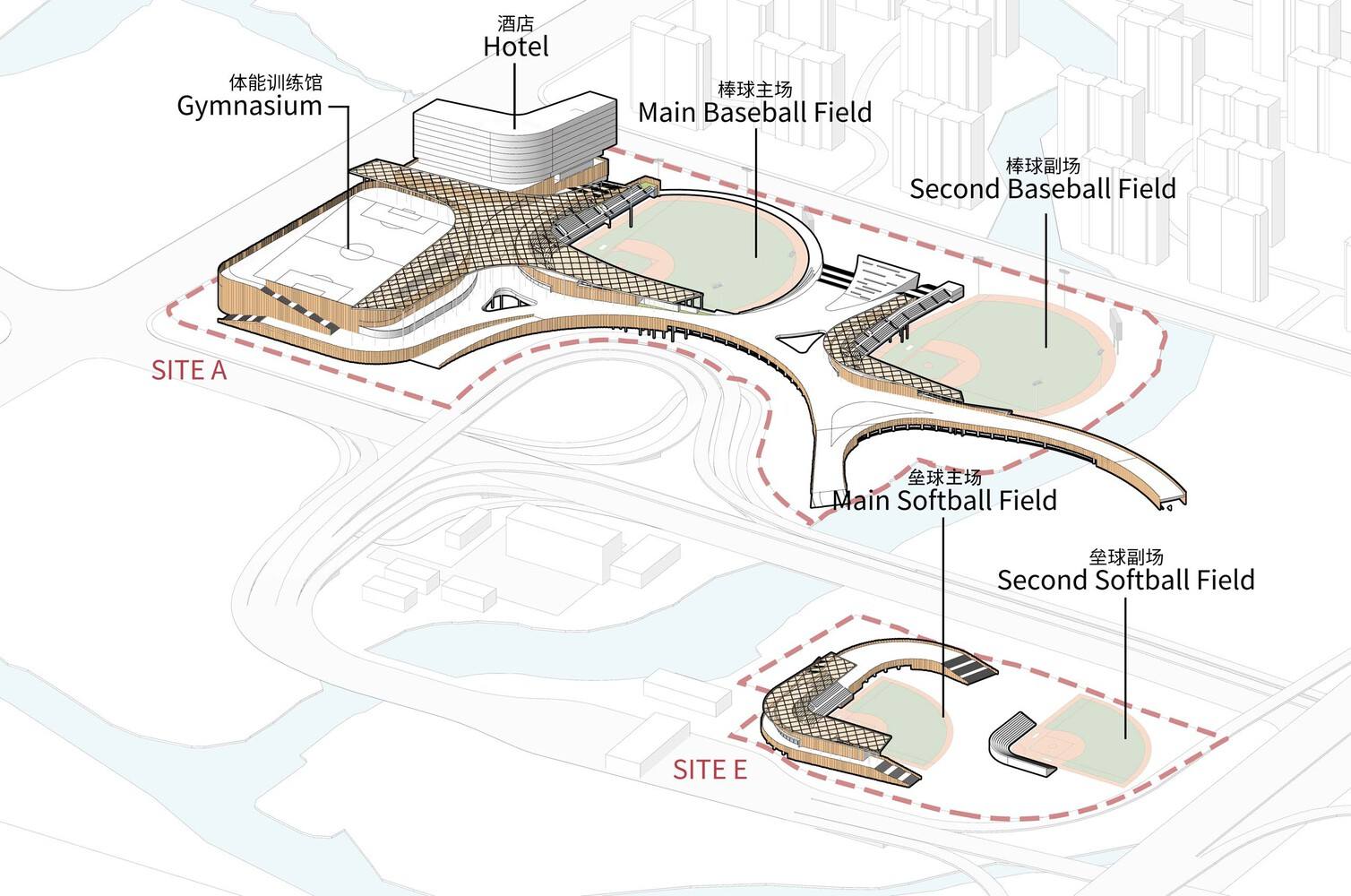
功能分区
© 赵强
© 赵强
Presentation of Regional Culture
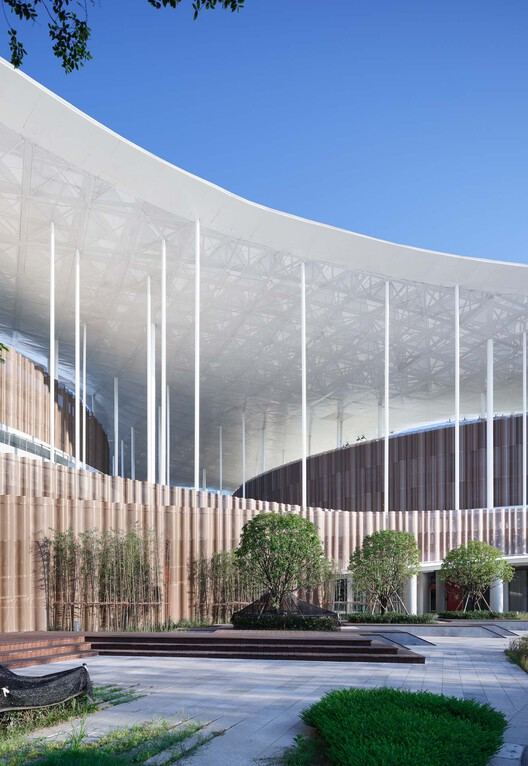
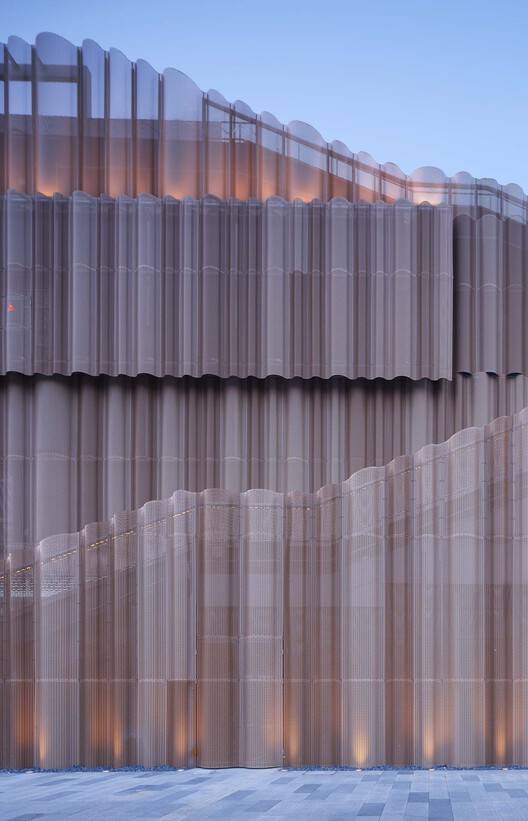
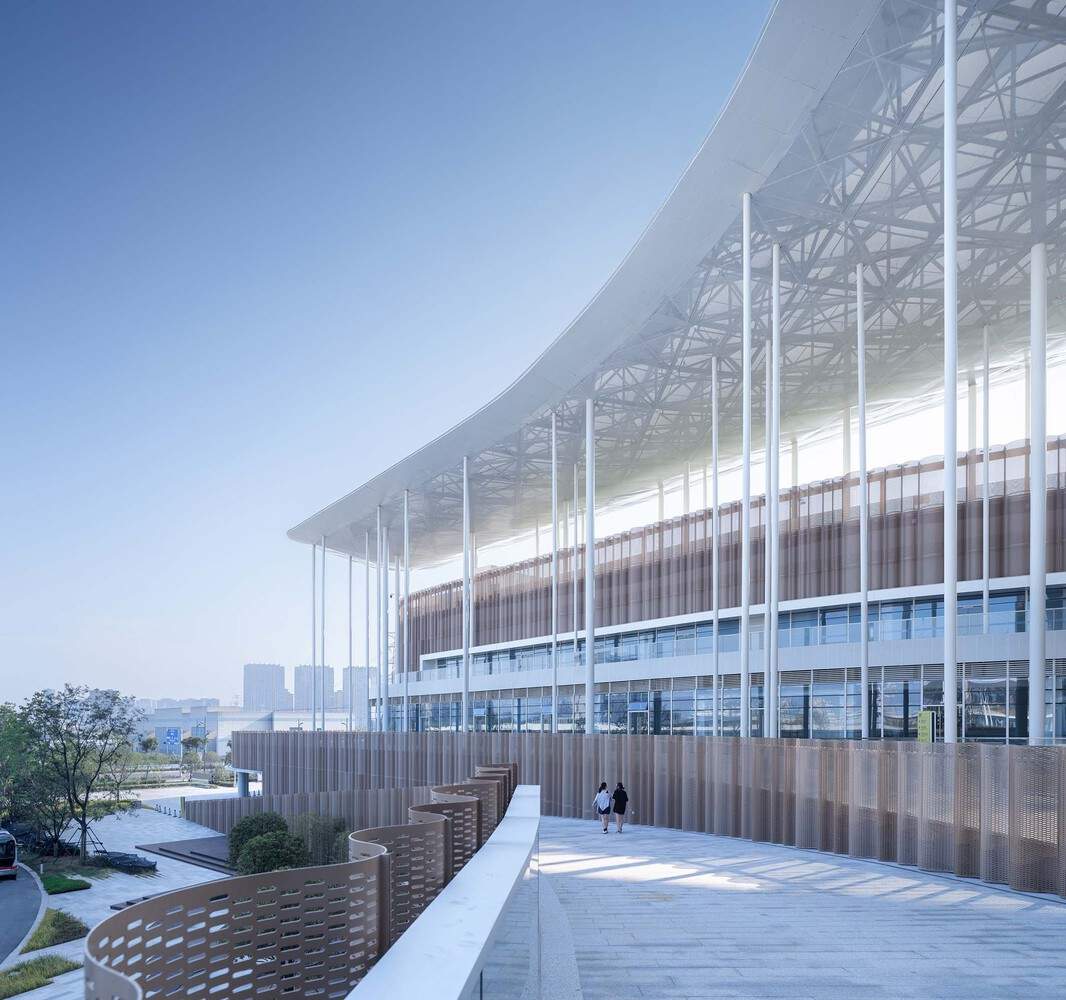
"Inheriting history and reflecting regional cultural characteristics" is the design's significant response to the city's culture. The design draws inspiration from the artistic conception of Shaoxing's water towns and its textile culture, presenting a unique vision tailored to the locality. Various venues are woven together by a ribbon-like second-floor public platform, connecting with the city streets and becoming part of the street network. The building facade extracts curved elements from traditional cultural symbols such as silk ribbons, scrolls, and tile roofs, using curved perforated aluminum panels to create a continuous Jiangnan water wave imagery. The varying proportions and forms of perforations on the aluminum panels imbue the facade with a unique technical rhythm, continuing the poetic craftsmanship of traditional textiles and evoking public memory of regional culture.
地域文化的呈现
“传承历史,体现地域文化特色”是本设计对城市文化的重要回应。设计从绍兴水乡意境和纺织文化中汲取灵感,展示出契合地域的独特构想。各场馆通过丝带状的二层公共平台编织在一起,并与城市街道相连接,成为街道网络的一部分。建筑立面从绸带、书卷、瓦顶等传统文化符号中提取曲线元素,以弧形穿孔铝板材料营造水波连绵的江南意象。穿孔铝板不同比例与形式的穿孔纹样赋予立面特有的技术韵律,延续传统纺织的匠人诗意,唤起民众对地域文化的记忆。
© 赵强
© 赵强
Starting from Post-Games Utilization
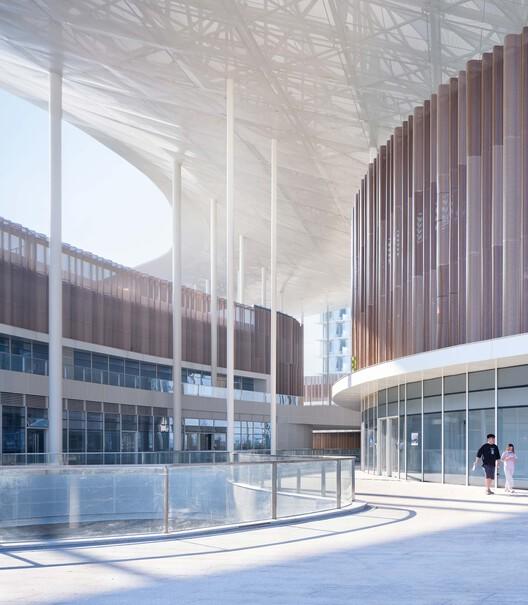
The project comprehensively considers the operational management feasibility for both the Asian Games competition period and the post-Games dual stages, cleverly linking the internal public spaces of the venue with the surrounding community. Meanwhile, the design emphasizes the integration of the architecture with the natural environment and boasts high spatial functional variability. It is designed in accordance with local conditions to provide convenience for the sports and cultural community. Besides the baseball and softball fields, the Baseball and Softball Sports and Cultural Center is also equipped with a hotel, a public fitness center, and substantial commercial service spaces, capable of meeting diverse operational demands after the Asian Games and becoming an important supporting service center within the future community. Using sports services as a pivot point, it drives the development of the entire area and enhances community vitality.
从赛后利用出发
项目综合考虑了亚运赛时和赛后双阶段的运维管理可行性,巧妙地将场地内部公共空间与周边社区进行有机关联。同时,设计注重建筑与自然环境的融合,空间功能可变性强,因地制宜,为体育文化社区提供便利。棒垒球体育文化中心除棒球场和垒球场之外,还配建有酒店、全民健身中心与大量的商业服务空间,能够满足亚运赛后多样化的运营需求,成为未来社区内重要的配套服务中心。以体育服务为支点,带动整个片区的发展,提升社区的人气。
区位图
© 赵强
The Floating "Cloud Wing"
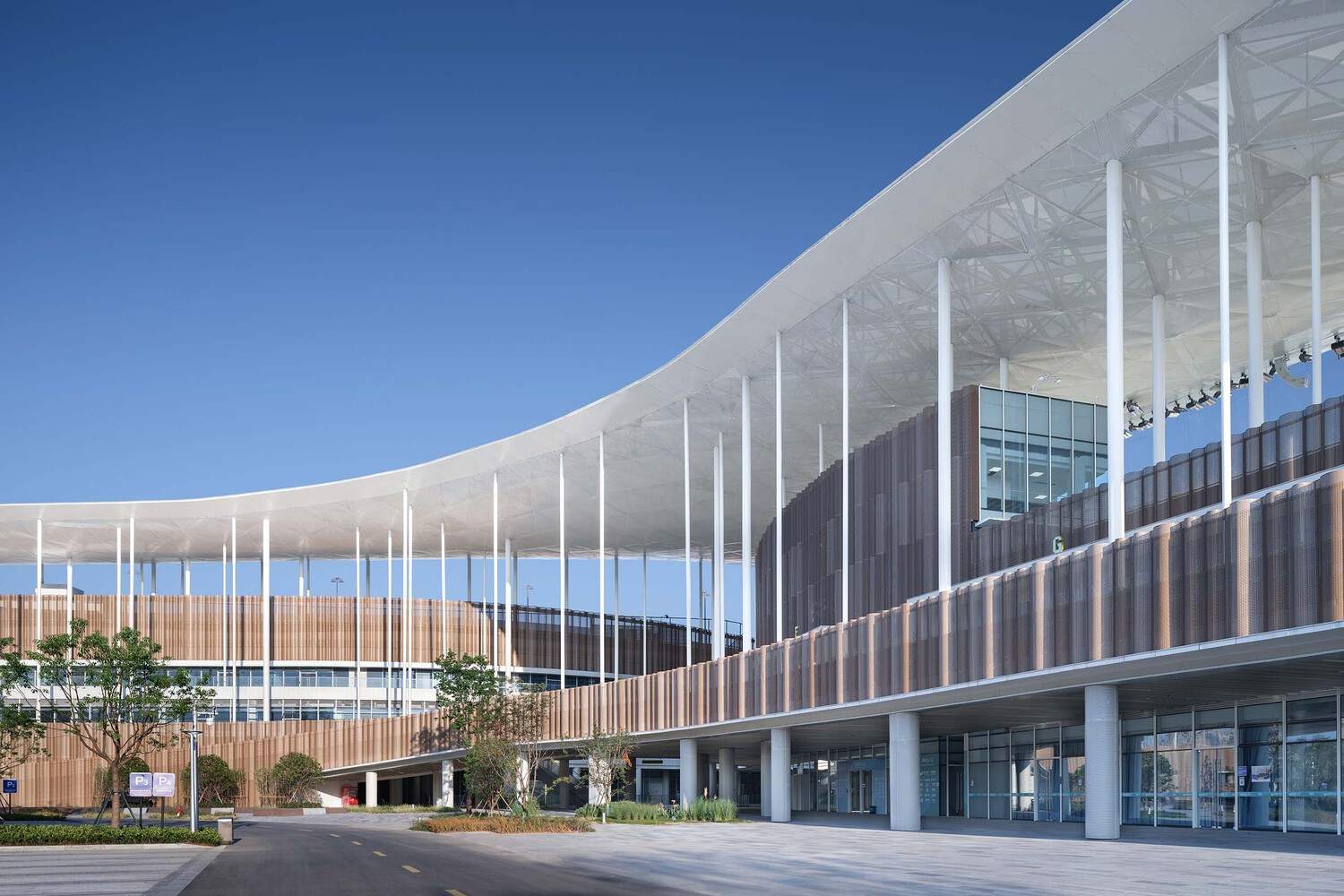
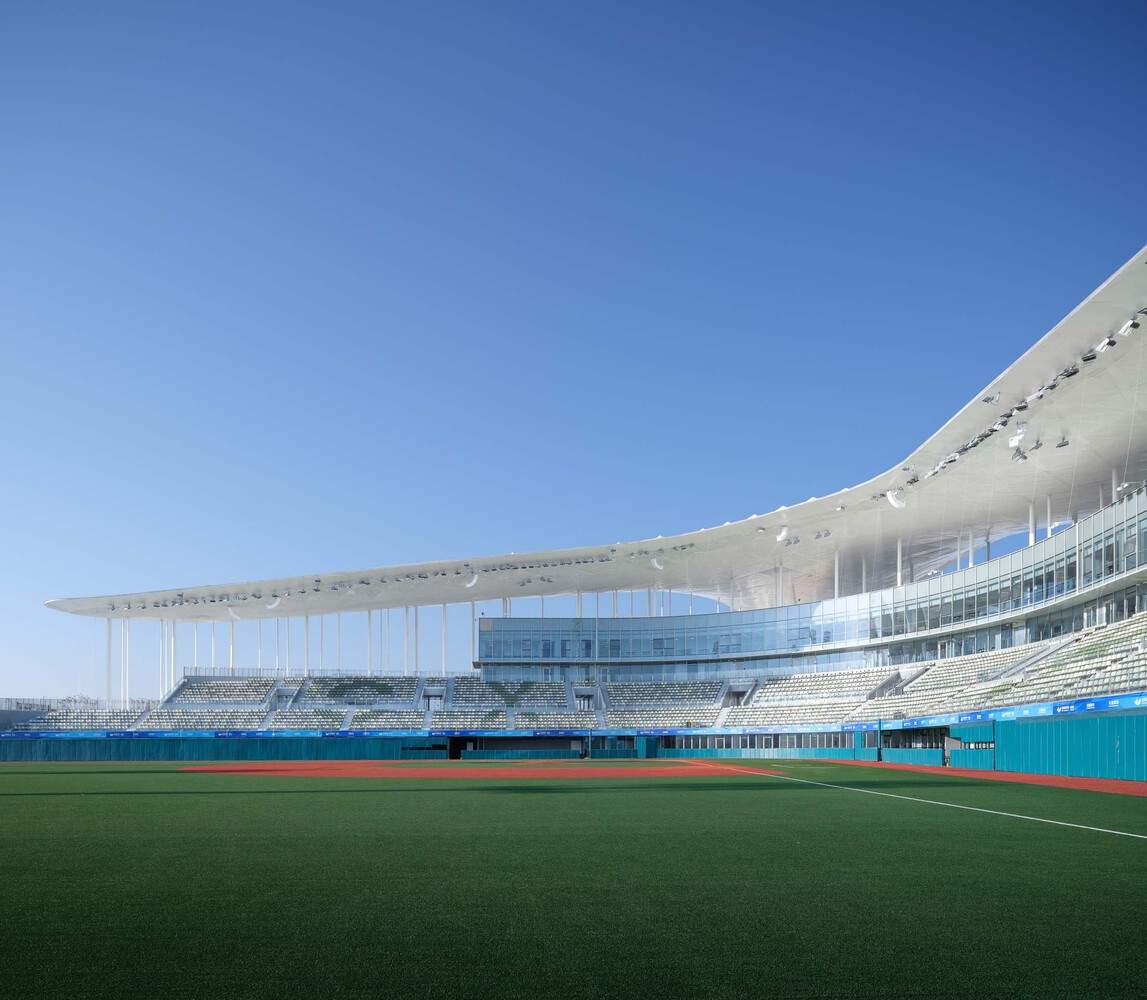
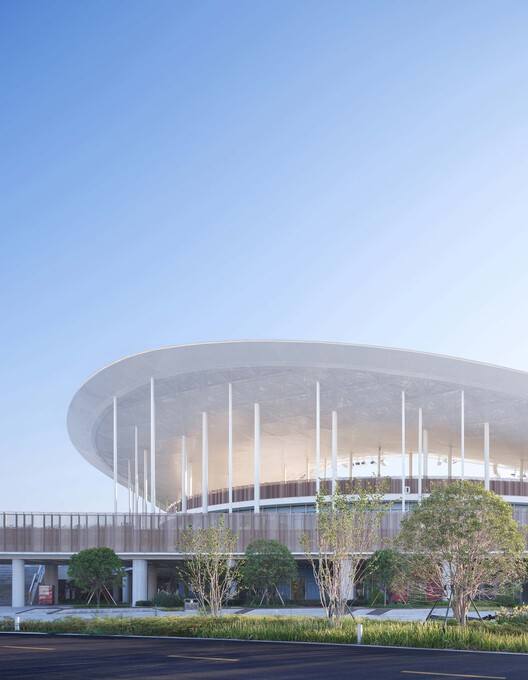
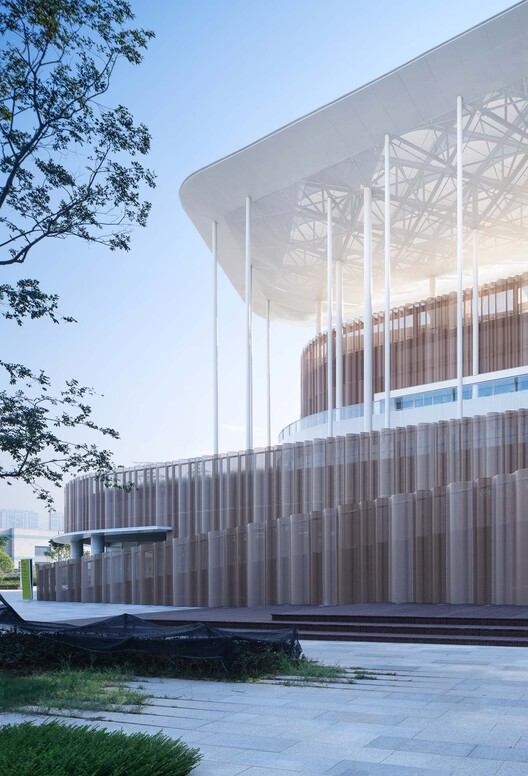
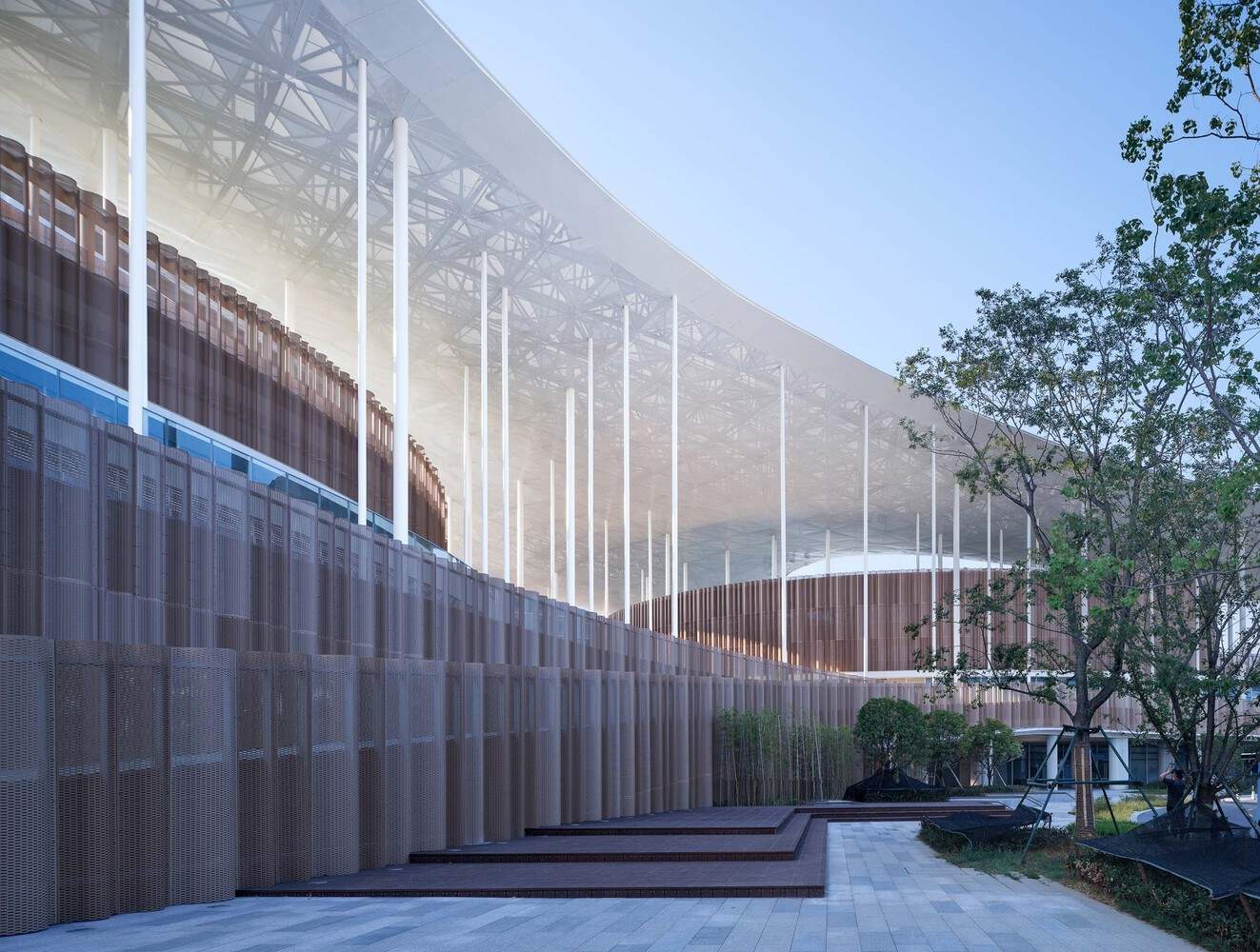
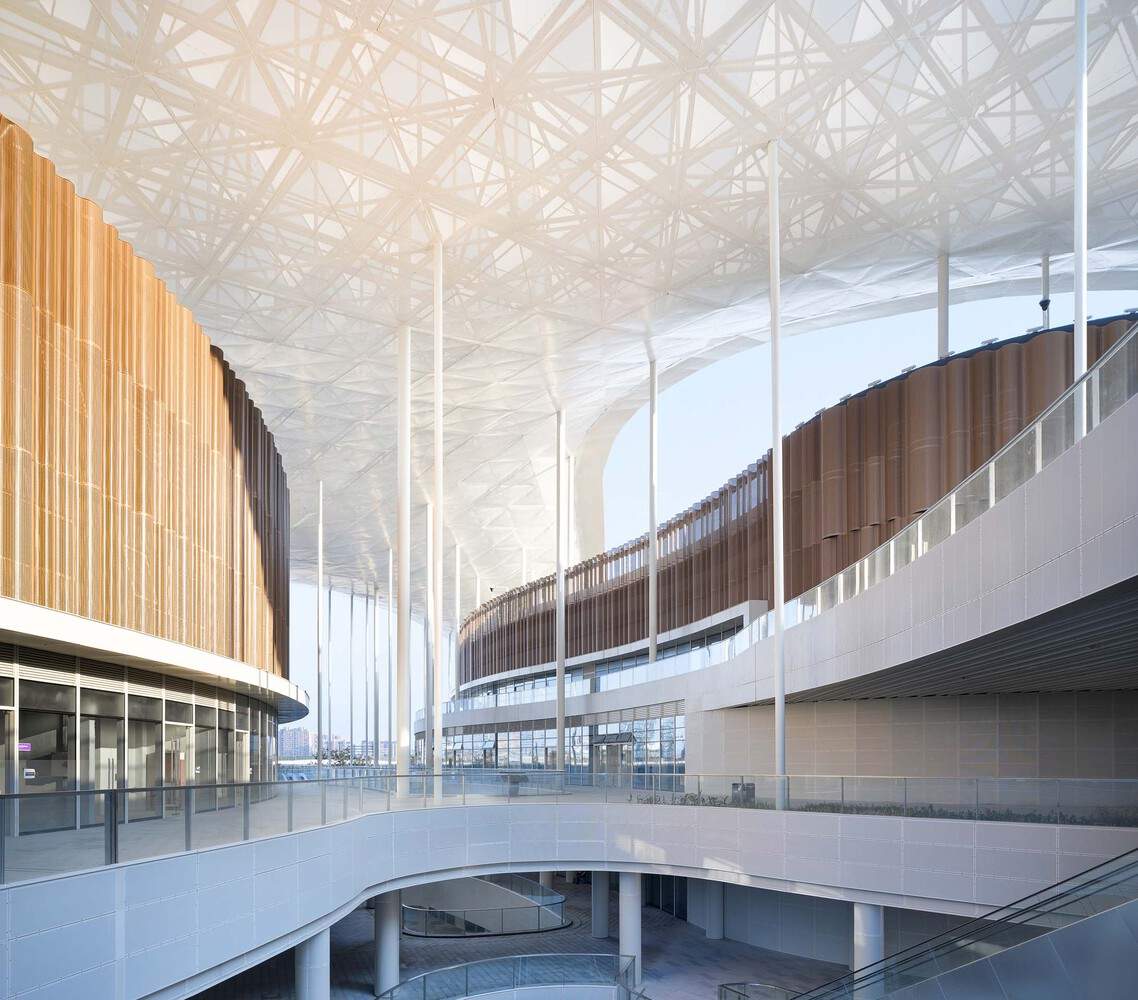
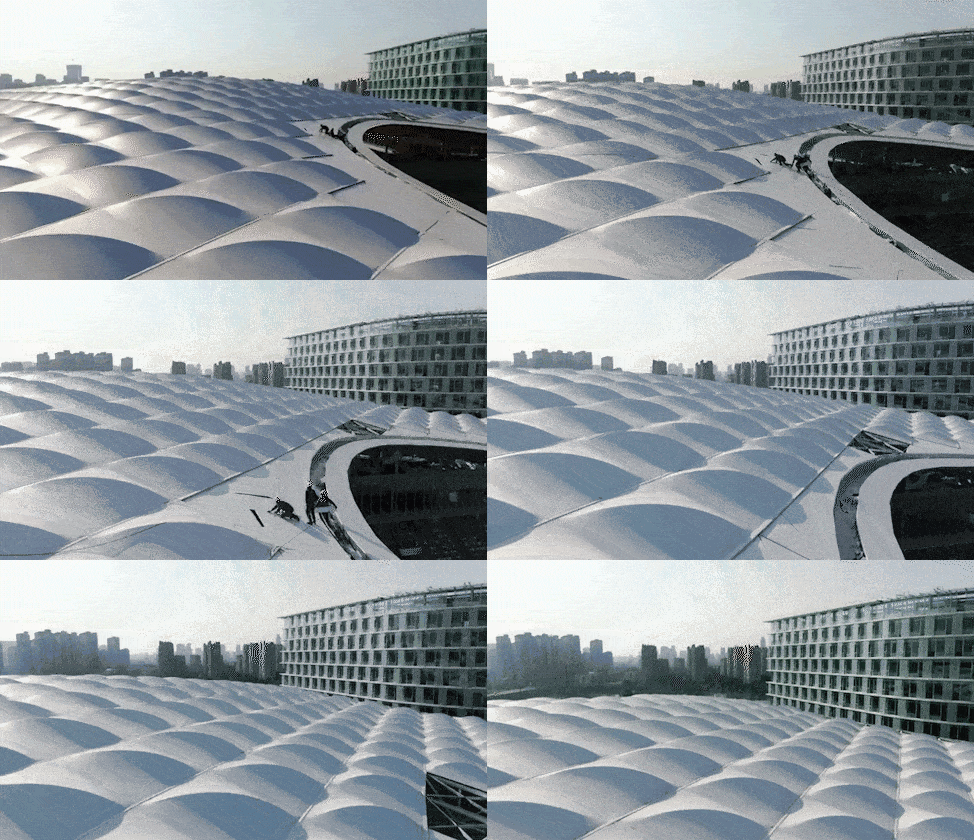
The huge canopy above the venue was the focus and difficulty of this design. We adopted a two-way truss structure system, with a maximum cantilever of 16 meters, supported by slender steel columns. The roof is covered with a PTFE membrane coated with titanium dioxide, totaling 21,000 square meters. Each unit is slightly raised in the center, resembling ripples formed by a breeze across water when viewed from a distance, metaphorically representing the regional characteristics of Shaoxing's water town. The underside of the canopy is covered with curved white perforated aluminum panels, through which daylight is diffused into the venue, creating rich layers of light and shadow. The semi-transparent visual effect eliminates the oppressive feeling brought by the massive volume, making the boundary blurred with the sky, appearing hazy and light. The slender white structural columns resemble shafts of daylight piercing through the clouds, creating a sense of lightness and breathability. At night, under the rich LED lighting, the canopy is bright and transparent, providing a unique viewing experience for spectators during the competition. The surface curvature of the canopy was determined by simulations of rainwater and solar radiation, leading to the formal prototype of a high center and a low perimeter, achieving optimal drainage and shading effects. The slender steel columns vary in diameter, with the thickest being structural columns, while the rest serve as concealed drainage pipes, electrical conduits, and decorative columns, with different diameters representing their respective functions. The spatial atmosphere is clean and pure, orderly in distribution, like moving through a bamboo forest. Viewed from afar, the entire canopy appears to float above the venue, resembling a white cloud wing sheltering the entire stadium beneath it.
漂浮的“云翼”
场馆上方巨大的罩棚是本次设计的重难点。我们采用双向桁架结构系统,最大处悬挑16米,由纤细的钢柱支撑。顶面覆盖带二氧化钛涂层的PTFE膜,总面积达到2.1万平方米。每块单元在中间微微隆起,远远望去就像微风吹过水面泛起的波纹,隐喻着绍兴水乡的地域特色。罩棚底面则覆盖曲面白色穿孔铝板,天光透过罩棚漫射于场馆,营造丰富的光影层次。半透明的视觉效果能够消除巨大体量所带来的压抑感,与天际间模糊的边界更显朦胧而轻盈。细长的白色结构柱好似透过云层的天光,形成一种轻盈感和呼吸感。入夜,在丰富的LED灯光中,罩棚明亮并通透,为赛时的观众提供独特的观赛体验。罩棚的表面曲率经由雨水与日照模拟计算,决定了中部高,周圈低的形式原型,达到最佳的排水和遮阳效果。纤细的钢柱中最粗的是结构柱,其余为排水暗管、电缆暗管和装饰柱,不同的管径代表其所承担的不同功能。空间氛围整洁纯净,疏密有致,犹如穿梭于竹林之中。由远而观,整个罩棚犹如漂浮于场馆之上,又似洁白的云翼,将整个场馆荫蔽其下。
© 赵强
Conclusion
Whether for Asian Games athletes or ordinary residents, the Hangzhou Asian Games Baseball and Softball Sports and Cultural Center allows one to perceive a new model of sports architectural philosophy: composite service functions, a benign circulatory system with the external city, and the spatial phenomena converged within it. The project integrates itself into the city from the perspective of a sports community, building upon the warp and weft of urban, community, and cultural factors. The "Cloud Wing" quietly awaits rest above the water town, anchoring the natural connection between the place and the city, eliminating the gaps between them, and thus fostering a dynamic sports community.
结语
无论对于亚运会体育竞技者,还是普通居民,都能从杭州亚运会棒垒球体育文化中心中体察到新式体育建筑理念:复合式的服务功能,与外界城市的良性循环体系,以及荟萃于其中的空间现象。项目以运动社区的视角,将其融入城市之中,将建造建立在城市、社区、文化因素的经纬之上。“云之翼”静候栖伏于水乡之上,锚定着场所与城市间的自然关联,消弭着两者间的空隙,活力的运动社区由此生发。
© 赵强