Claremont McKenna College Robert Day Science Center/BIG Architecture Firm
克莱蒙特·麦肯纳学院罗伯特·戴伊科学中心 / BIG建筑事务所
项目亮点:这座科学中心最引人瞩目的特点在于其打破常规的设计理念,旨在促进跨学科交流与协作。通过旋转的楼层布局,建筑师创造了开放的、非线性的空间,鼓励来自不同学科的学生和教职员工进行互动。这种设计不仅体现在物理空间上的连接,更体现在视觉上的贯通,人们可以在中庭和各个楼层之间自由穿梭,从而激发思想的碰撞和交流。此外,建筑采用了模块化设计和灵活的布局,以适应未来科学研究和教学的需求,这体现了设计师对可持续性和前瞻性的关注。项目也注重与环境的融合,屋顶露台和周边景观设计为师生提供了舒适的户外空间。
建筑精髓:该项目在建筑材料的选择和运用上展现出独特的匠心。外立面采用玻璃纤维增强混凝土,模仿木材的质感,兼顾了美观与实用。室内设计则大量运用温暖的木质饰面,与混凝土的地面形成对比,营造出舒适、宜人的学习和研究环境。建筑内部的结构元素,如三角钢桁架,不仅承载了建筑的重量,也成为了重要的设计元素,其纹理和几何形状延伸至建筑外部,实现了室内外的无缝连接。此外,项目还巧妙地融入了艺术元素,例如悬挂在中庭的艺术雕塑,为建筑增添了文化气息,提升了整体品质,打造了视觉焦点。
设计理念:罗伯特·戴伊科学中心的设计理念深刻地体现了对未来教育模式的思考。项目不仅仅是一个科学研究和教学的场所,更是一个促进跨学科交流、激发创新思维的“熔炉”。设计师通过开放的空间、灵活的布局和视觉上的连接,打破了学科之间的壁垒,鼓励学生和教职员工跨学科地进行合作和交流。此外,项目还注重与周边环境的融合,建筑的选址、朝向和屋顶露台的设计,都旨在创造一个舒适、宜人的学习和生活环境,这体现了设计师对人本主义和可持续发展的关注,也预示着未来科学中心的设计趋势。
© Laurian Ghinitoiu
© Laurian Ghinitoiu
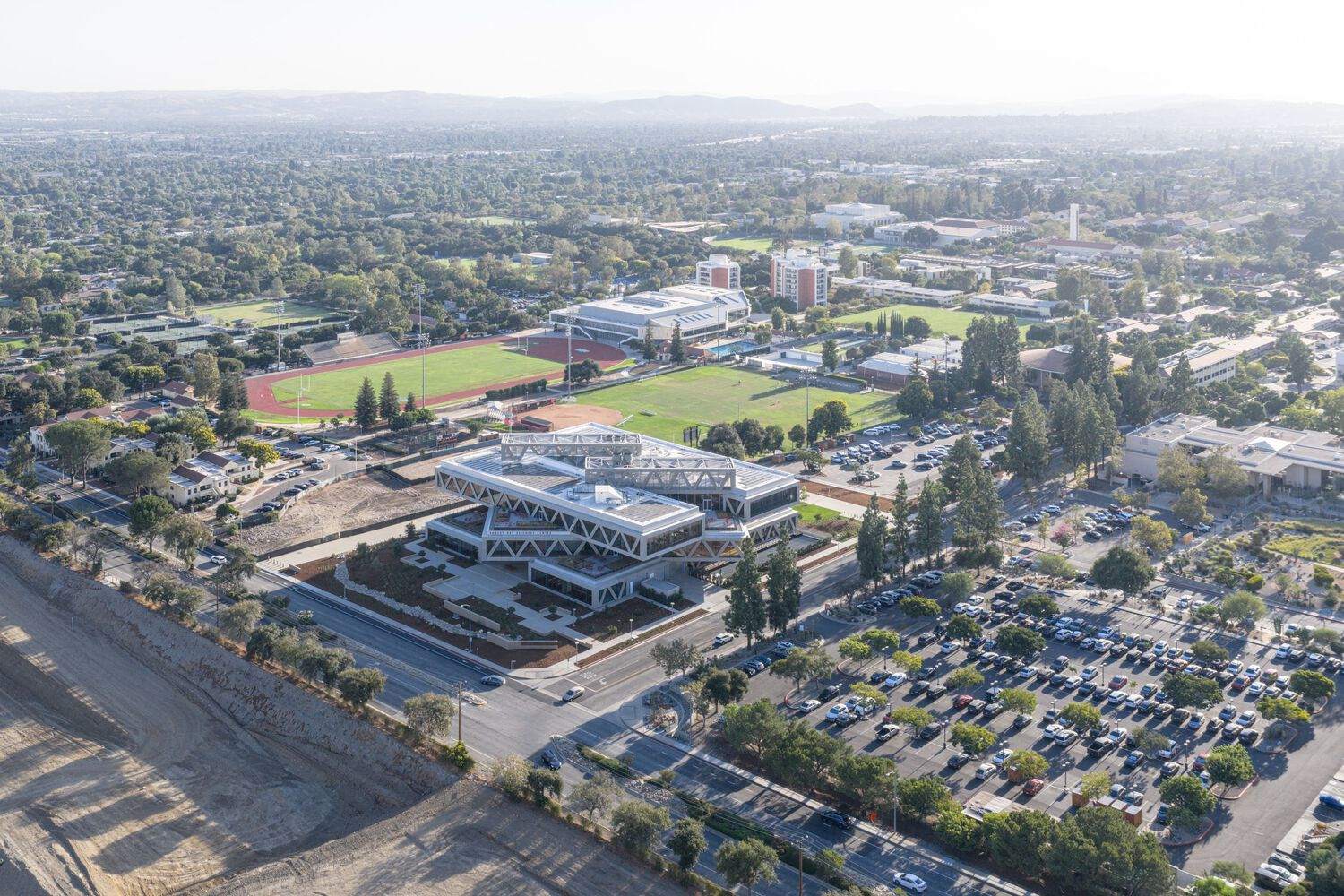
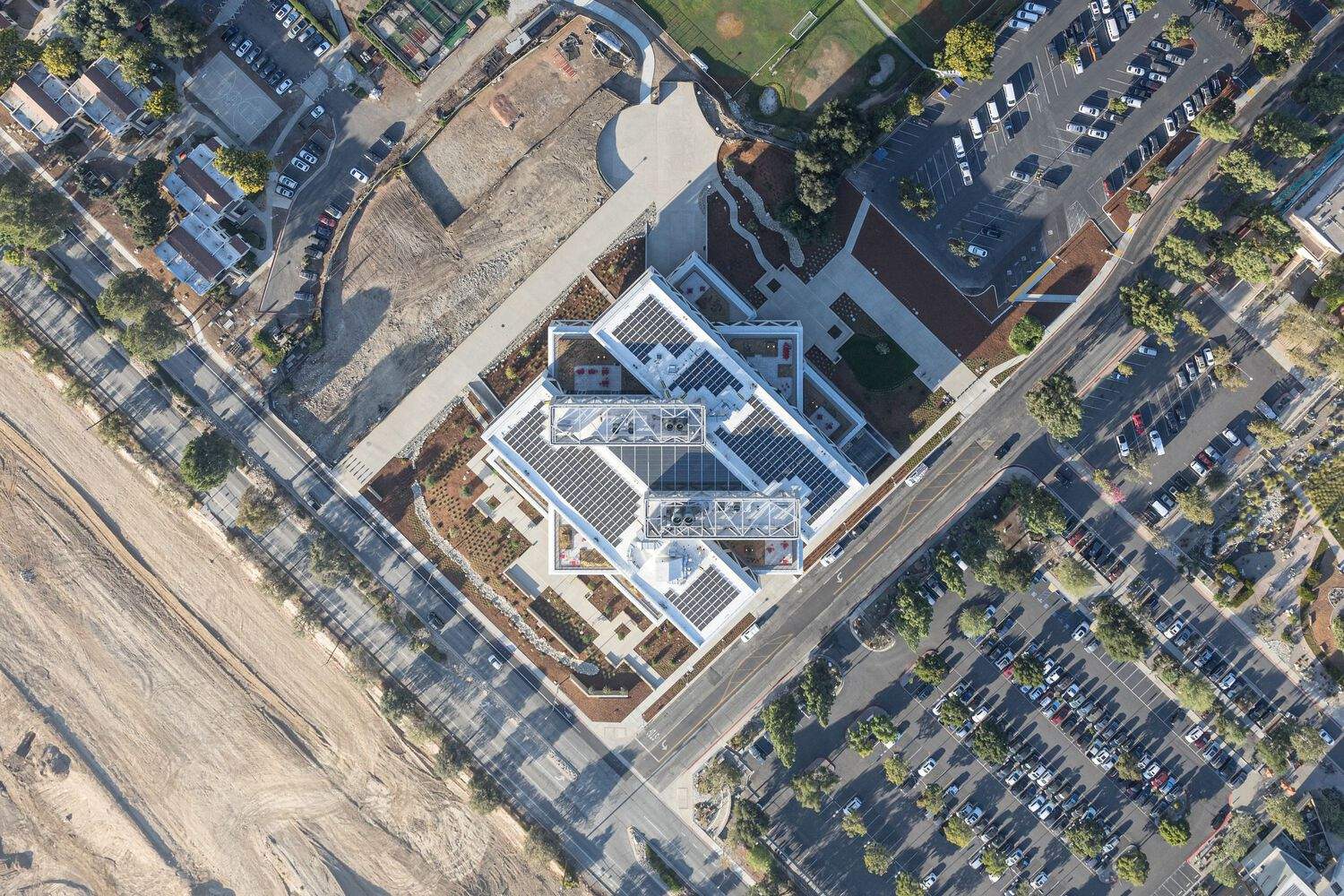
The newly built Robert Day Sciences Center at Claremont McKenna College maximizes interdisciplinary integration and interaction: this 135000 square foot building, with each floor facing in different directions, guides people and ideas to flow between laboratories, classrooms, and surrounding campuses. The Robert Day Science Center was put into use in 2020, serving a community of 1400 students. This center is BIG Architects' first completed project in Los Angeles and the first building to be completed in their master plan for the Roberts Campus of Claremont McKenna College (CMC). The overall plan aims to create a more unified campus, consisting of a series of buildings that will extend the existing central square and adjacent sports venue areas currently under construction. The collaborative team of the Science Center includes structural engineer Saiful Bouquet, general contractor KPRS Construction, and construction management company IDS Real Estate Group.
克莱蒙特·麦肯纳学院(Claremont McKenna College)新建的罗伯特·戴伊科学中心(Robert Day Sciences Center)最大程度地促进了多学科融合与互动:这座占地 13.5 万平方英尺的建筑,每一层都朝向不同方向,引导人员与思想在实验室、教室及周边校园之间流动。罗伯特·戴伊科学中心于 2020 年投入使用,服务于 1400 名学生组成的社区。该中心是BIG建筑事务所在洛杉矶的首个建成项目,也是其为克莱蒙特·麦肯纳学院(CMC)罗伯茨校区(Roberts Campus)设计的总体规划中首个竣工的建筑。该总体规划旨在打造一个更为统一的校园,由一系列建筑构成,这些建筑将延伸现有的中央广场及毗邻、目前正在建设中的体育场馆区。科学中心的合作团队包括结构工程师赛弗尔·布凯特公司(Saiful Bouquet)、总承包商KPRS建筑公司(KPRS Construction)以及施工管理方IDS房地产集团(IDS Real Estate Group)。
© Laurian Ghinitoiu
© Laurian Ghinitoiu
At this critical moment that concerns human well-being, brain health, and the future of the planet, this magnificent building showcases and elevates the revolutionary vision of higher education. Nowadays, we can no longer rely solely on isolated divisions within the scientific field or between science, social sciences, and humanities to address the challenges and opportunities of our era. The Robert Day Science Center and the Kravis Department of Integrated Sciences integrate facilities and projects to bring together multidisciplinary expertise, conduct problem-based learning, integrate applied ethics, and enhance human intelligence in the era of artificial intelligence. The rotating floor layout designed by BIG creates opportunities for interdisciplinary learning. The wood element inspires our social warmth. Glass material has broken through numerous barriers. Exquisite decorations and spectacular public art works inspire our humanistic feelings. This is a precious gem meticulously crafted by Claremont McKenna College, an eternal gem. ——Hiram E. Chodosh, President of Claremont McKenna College
在这关乎人类福祉、大脑健康与地球未来的关键时刻,这座美轮美奂的建筑彰显并升华了高等教育领域的革命性愿景。如今,我们已无法仅依靠科学领域内部或科学、社会科学与人文学科之间的孤立划分,来应对我们这个时代的挑战与机遇。罗伯特·戴伊科学中心与克拉维斯综合科学系(Kravis Department of Integrated Sciences)将设施与项目融为一体,在人工智能时代,汇聚多学科专业知识,开展基于问题的学习,融入应用伦理学,并提升人类智能。BIG 设计的旋转楼层布局,为跨学科学习创造了契机。木材元素激发了我们的社交温情。玻璃材质打破了重重壁垒。精美的装饰与壮观的公共艺术作品,激发了我们的人文情怀。这是克莱蒙特·麦肯纳学院精心雕琢的瑰宝,一颗永垂不朽的明珠。——克莱蒙特·麦肯纳学院校长希拉姆·E·乔多什(Hiram E. Chodosh)
© Laurian Ghinitoiu
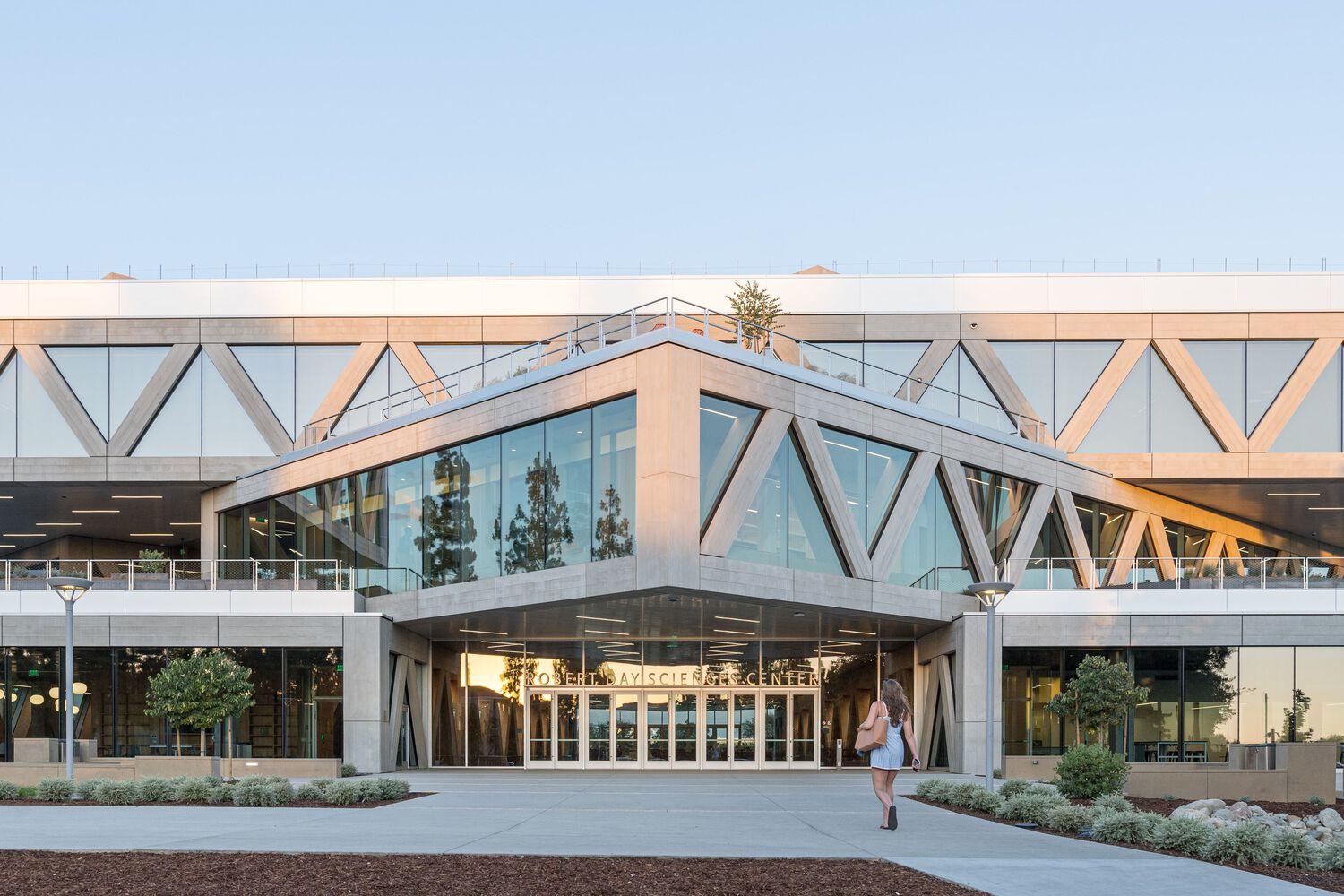
The Robert Day Science Center boasts magnificent views of Mount Baldy, located on the east side of the campus at the intersection of Ninth Street and Claremont Boulevard - becoming a new gateway to the school and strategically promoting close connections with other academic departments. A striking 15 foot cantilevered canopy warmly welcomes students, professors, faculty, staff, and visitors, leading them into a vibrant and lively multi-level atrium with ample natural light and bustling crowds.
罗伯特·戴伊科学中心坐拥博尔德山(Mount Baldy)的壮丽景致,位于校园东侧,地处第九街(Ninth Street)与克莱蒙特大道(Claremont Boulevard)的交汇处——此处成为通往学校的新门户,并从战略层面促进了与其他学术院系的紧密联系。一座引人注目的 15 英尺悬挑式遮篷,热情迎接着学生、教授、教职员工及访客的到来,引领他们步入一个充满生机与活力的多层次中庭,这里采光充足,人来人往,热闹非凡。
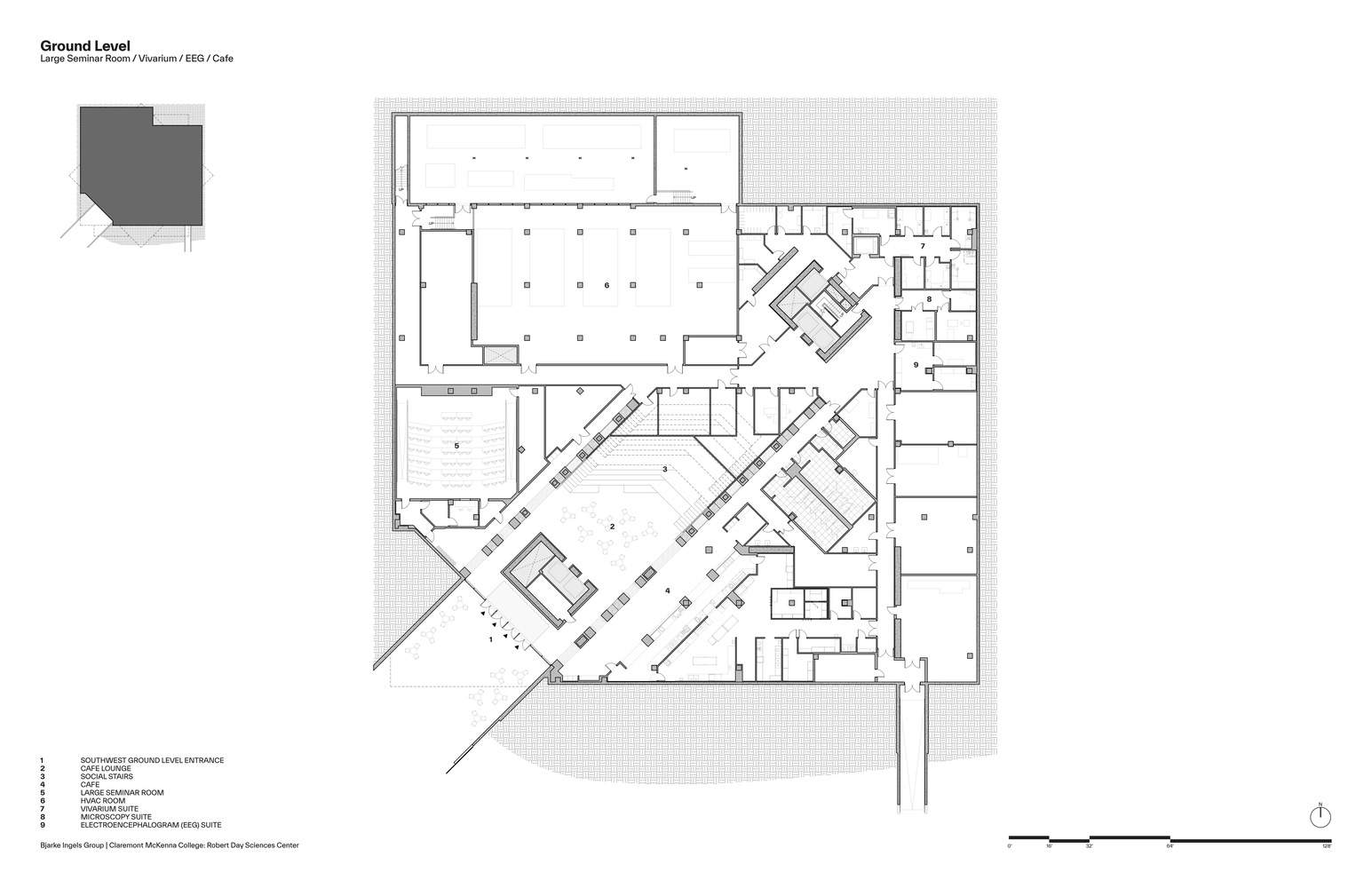
一层平面图
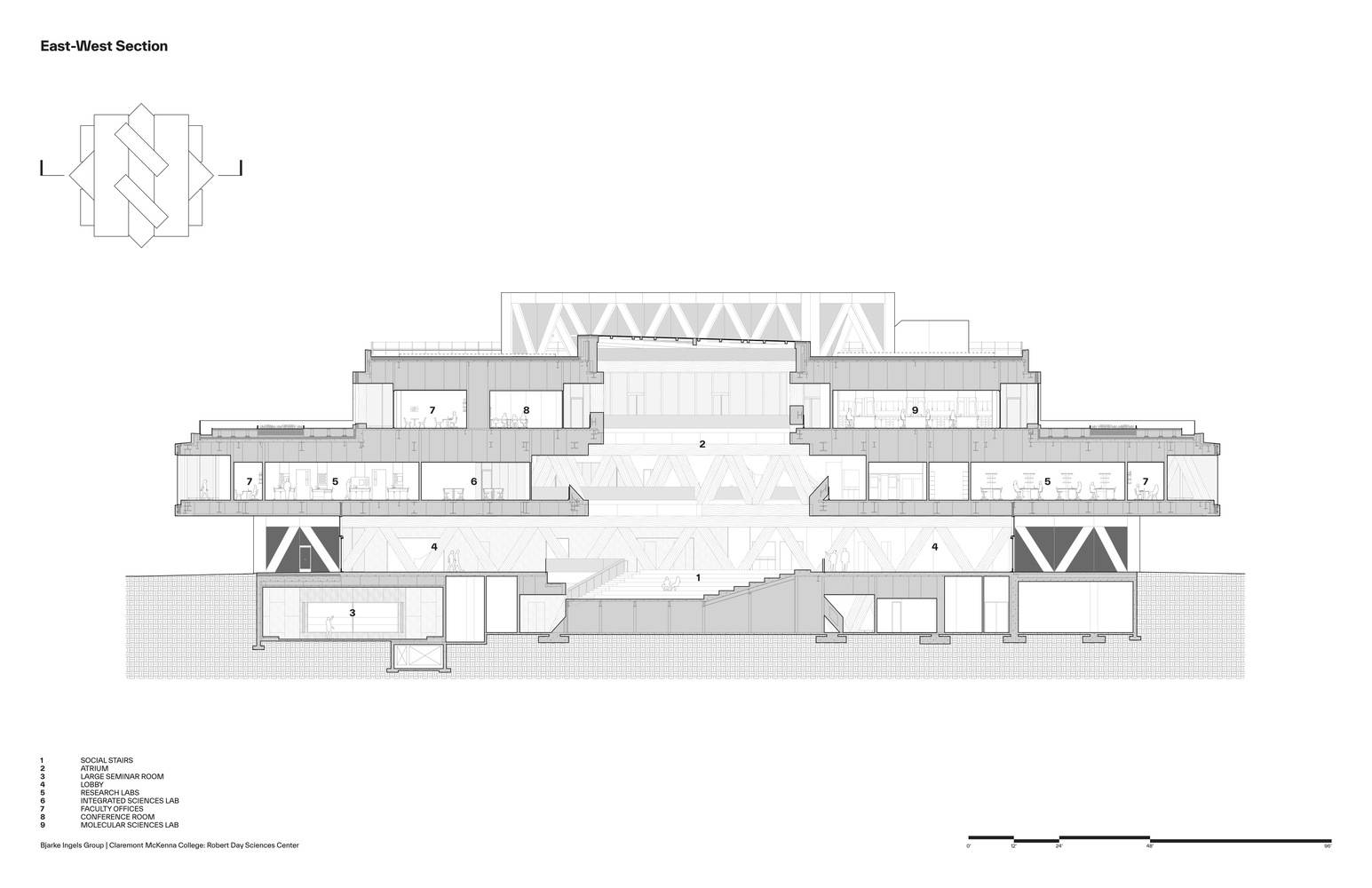
东西向剖面
The Robert Day Science Center brings together computer science, data science, and life sciences in a comprehensive environment. As the first completed building in the overall plan of Claremont McKenna College, it extends the north square into a winding and connected group of squares, becoming the hub of pedestrian flow for the entire campus. We envision the Science Center as a series of parallel building volumes arranged side by side, with a public space in the middle, and all building volumes maintaining the same orientation as the square. Although each independent building is designed with reasonable and flexible volumes, serving as both a computer laboratory and a wet laboratory, the open atrium between them has become a Piranesian social space where you can see classmates, faculty, colleagues, and professors from various floors. Therefore, even if you spend most of your time in a wet laboratory, computer lab, or classroom, there will still be many opportunities for you to collide with your classmates' ideas and stimulate the exchange of ideas across traditional knowledge barriers. In this sense, the Robert Day Science Center has become a melting pot, bringing together various types of knowledge and diverse students and teachers in a complex, three-dimensional learning environment. ——Bjarke Ingels, Founder and Creative Director of BIG Architecture Firm
罗伯特·戴伊科学中心将计算机科学、数据科学与生命科学汇聚于一个综合环境中。作为克莱蒙特·麦肯纳学院总体规划中的首座竣工建筑,它将北侧广场延伸成曲折相连的广场群,成为整个校园的人流集散枢纽。我们构想科学中心为一系列并排的平行建筑体量,中间设有公共空间,且所有建筑体量均与广场保持相同朝向。尽管每一座独立的建筑体量都设计得合理、灵活,既可用作计算机实验室,也可作为湿实验室,但它们之间的开放中庭却变成了一个皮拉内西式(Piranesian)的社交空间,在这里,你可以从各个楼层看到同学、教职员工、同事和教授。因此,即使你大部分时间都待在湿实验室、计算机实验室或教室里,仍然会有很多机会与同学们产生思想碰撞,激发跨传统知识壁垒的思想交流。从这个意义上说,罗伯特·戴伊科学中心成为了一个熔炉,让各种不同类型的知识以及各种不同的学生和教师汇聚在一个复杂、三维的学习环境中。——Bjarke Ingels,BIG 建筑事务所创始人兼创意总监
© Laurian Ghinitoiu
© Laurian Ghinitoiu
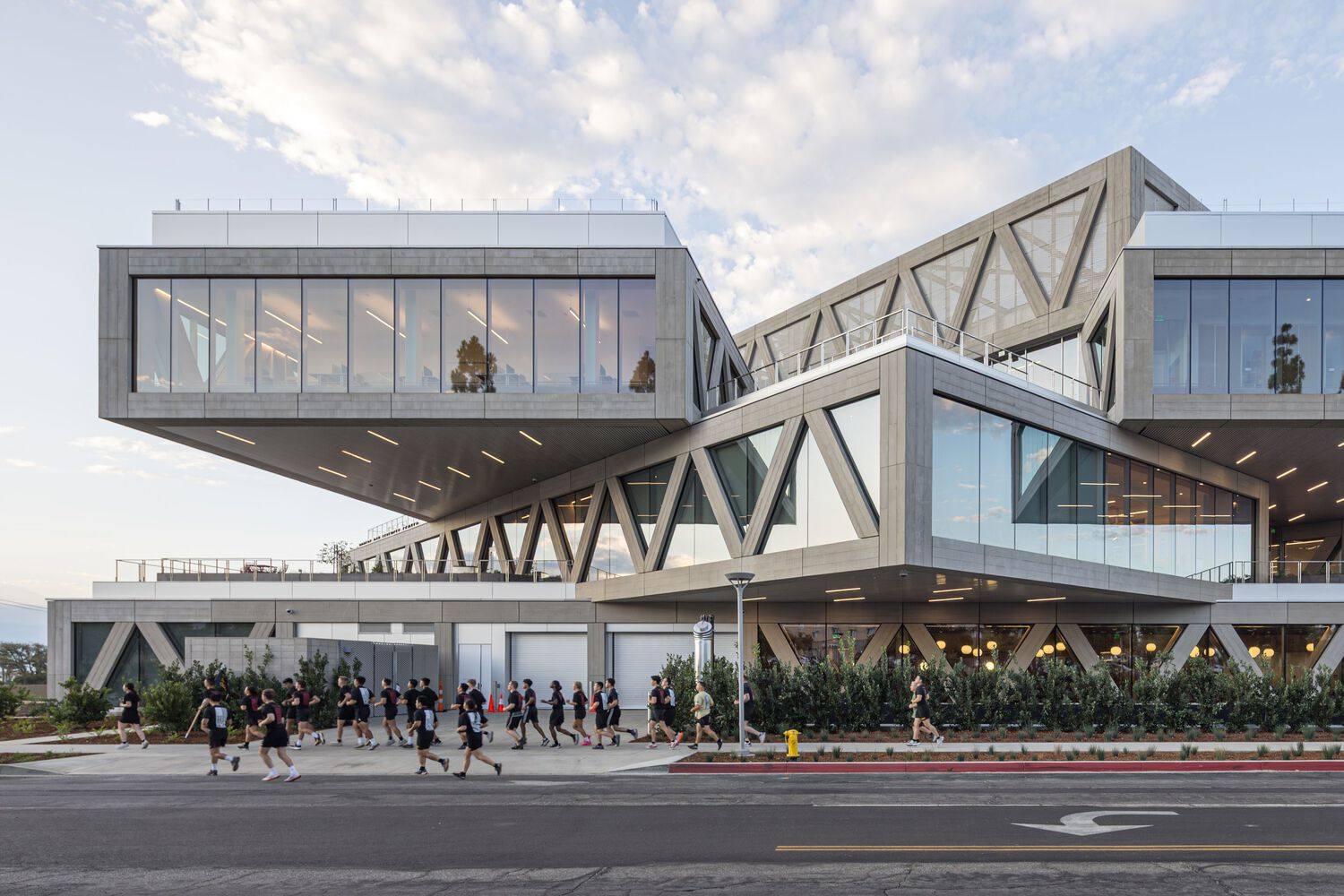
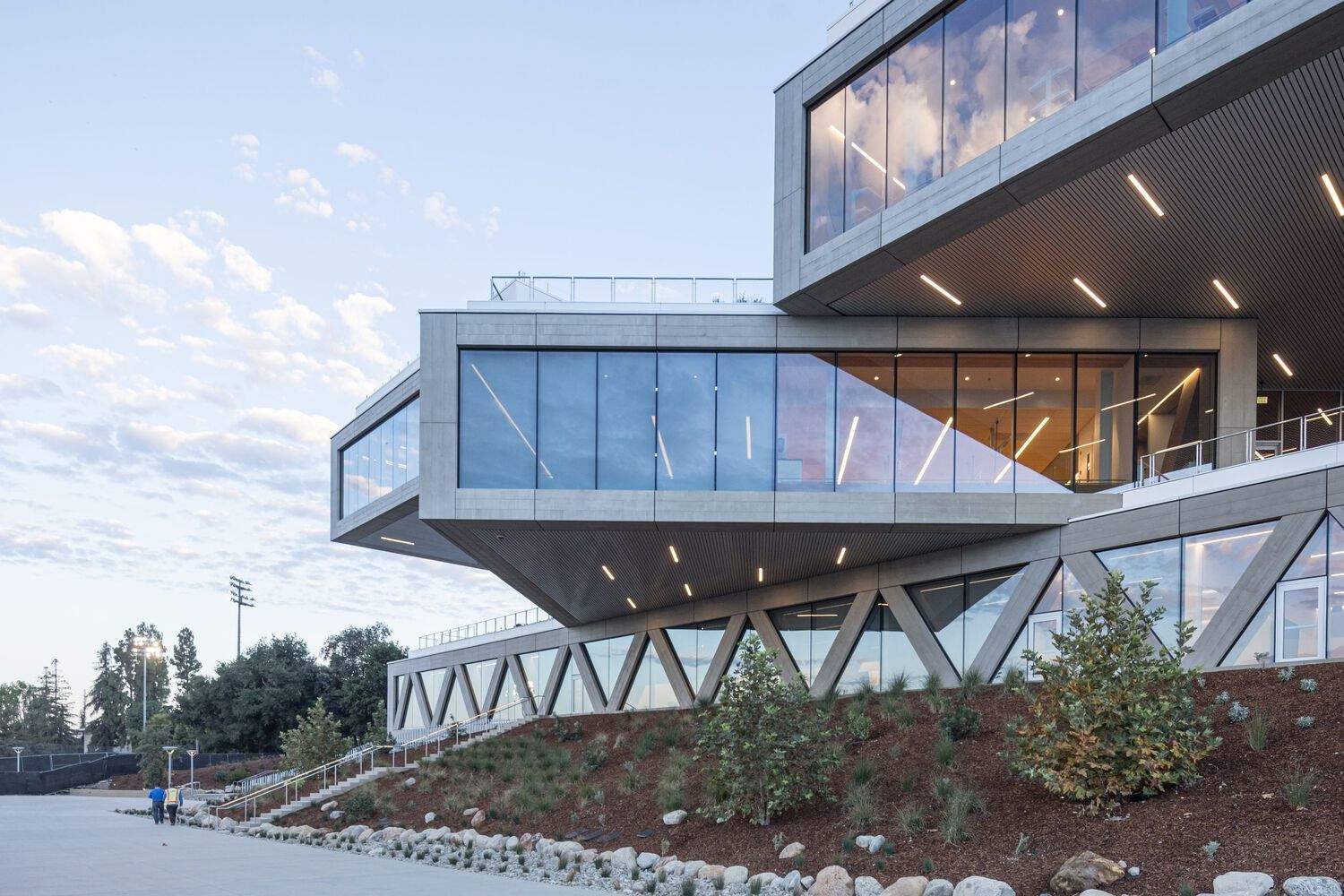
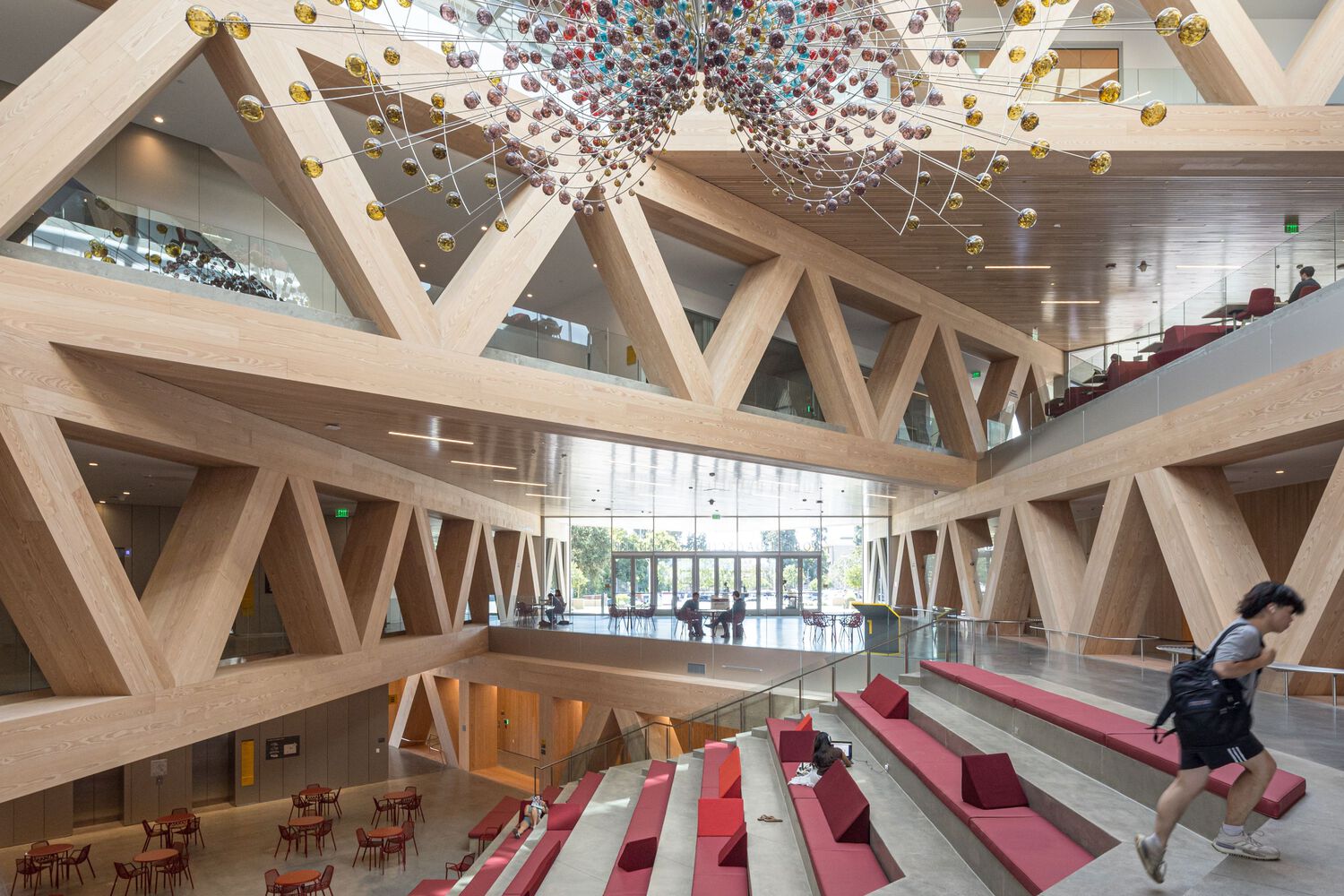
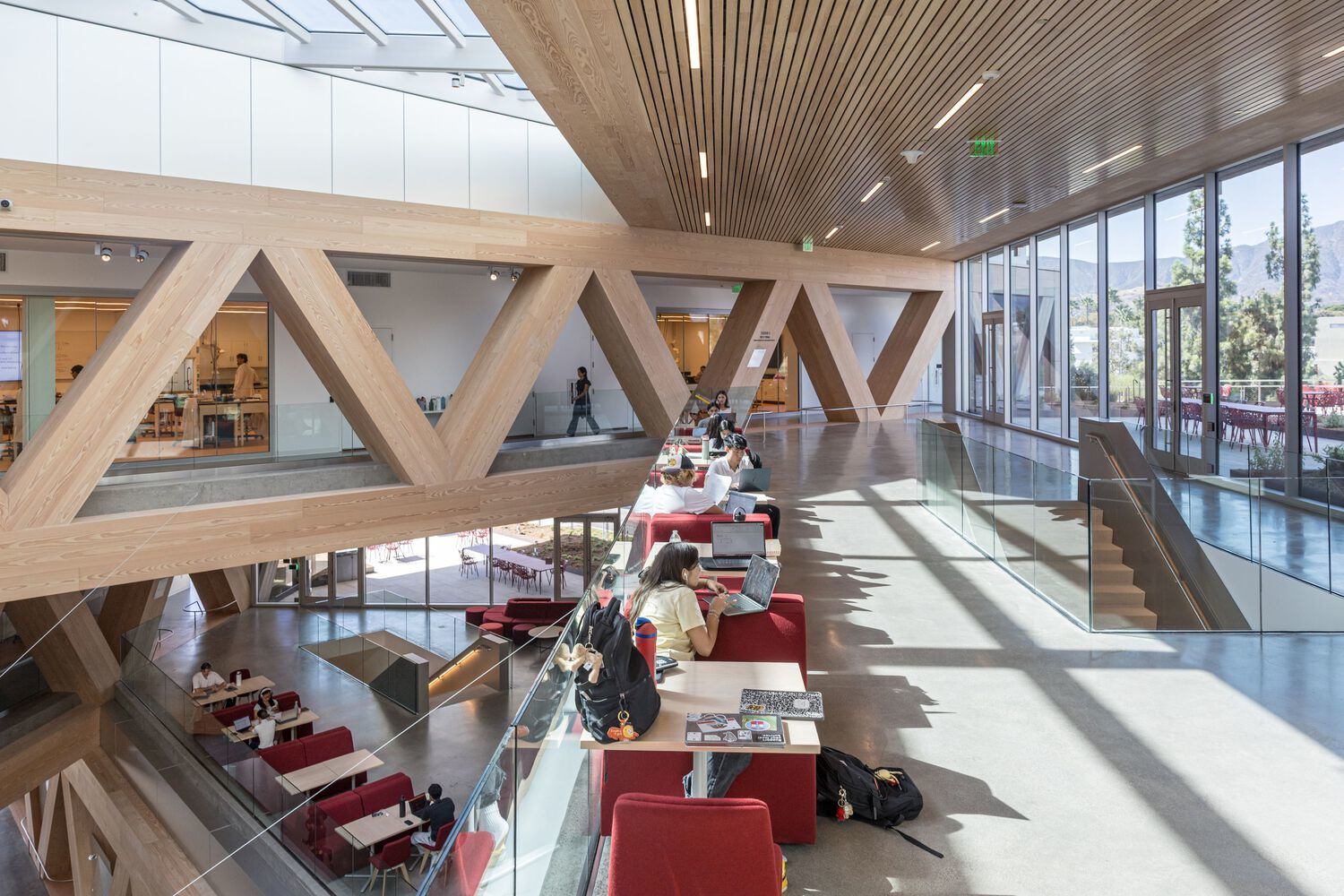
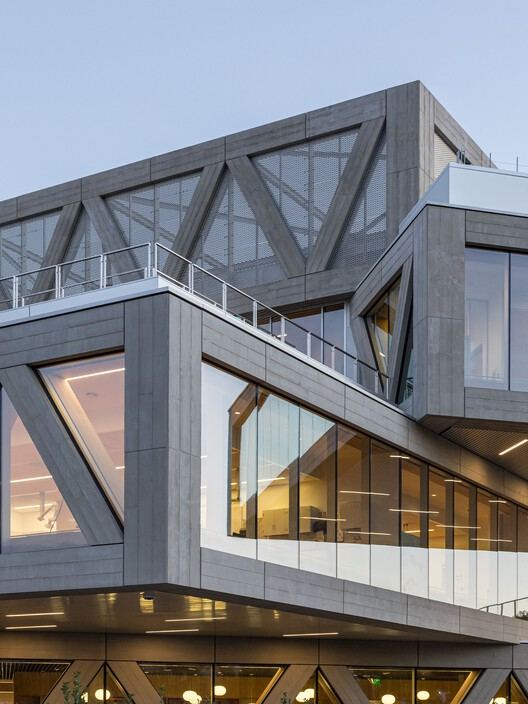
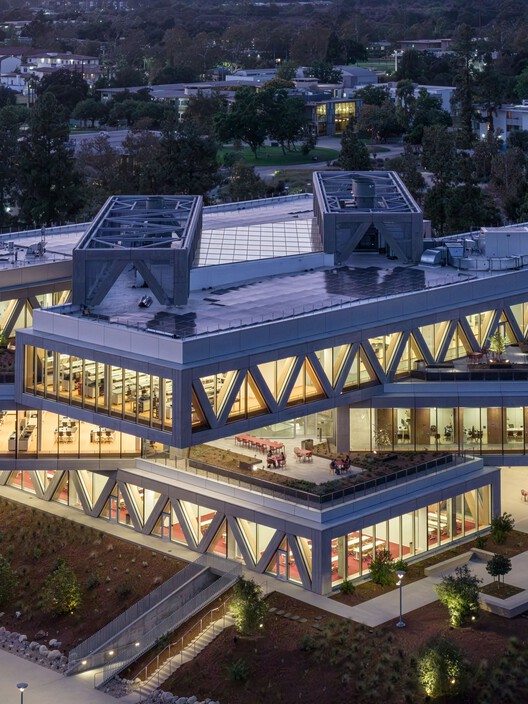
The building structure is designed as a stack of two levels, with each pair of volumes rotated 45 degrees relative to the lower level. The gaps between the rotated building blocks form a full height atrium at the core of the building, where classrooms and research spaces can be directly seen from each floor. The open space in the atrium encourages collaboration, reflecting the center's architectural and educational philosophy. The exterior facade of the building is made of glass fiber reinforced concrete formwork panels, which not only create a texture similar to wood, but also meet the durability and fire resistance requirements of modern laboratories. The 11000 square meters of solar panels on the roof can generate approximately 342 megawatt hours of electricity annually. Inside the building, each floor is connected to the next floor through triangular steel trusses, and the trusses are wrapped with Douglas fir veneer. The texture, rhythm, and geometric shape of the truss extend to the exterior of the building, achieving a seamless transition from indoors to outdoors. There is a large staircase in the atrium for socializing and leisure, connecting the first and second floors, and a caf é, making the center of the building a vibrant hub. Hanging at an altitude of 30 feet is Damien Ortega's "Magnetic Field" - a complex sculpture depicting the Earth's magnetosphere, consisting of 18 metal rings and 1476 brightly colored glass spheres, as if floating and spinning in the air.
该建筑结构设计为两层体量的堆叠,每一对体量均相对于下层旋转45度。旋转后的建筑体块间的空隙形成了建筑核心处的全高中庭,从各个楼层均可直接看到教室和研究空间。中庭内的开放空间鼓励协作,体现了该中心在建筑与教育方面的理念。建筑外立面采用了玻璃纤维增强混凝土制成的模板成型板,既营造出类似木材的纹理质感,又满足了现代实验室所需的耐久性和防火性能。屋顶上 1.1 万平方米的太阳能板每年可产生约 342 兆瓦时的电能。建筑内部,每一层都通过三角钢桁架与下一层相连,桁架外包有花旗松饰面。桁架的纹理、节奏和几何形状延伸至建筑外部,实现了从室内到室外的无缝过渡。中庭内设有一座大型楼梯,用于社交和休闲,连接着首层和二层,并设有一家咖啡馆,使建筑中心成为一个充满活力的枢纽。悬挂在 30 英尺高空的,是达米安·奥尔特加(Damien Ortega)创作的《磁场》(Magnetic Field)——这是一件描绘地球磁层的复杂雕塑,由 18 个金属环和 1476 个色彩鲜艳的玻璃球组成,仿佛在空中漂浮旋转。
© Laurian Ghinitoiu
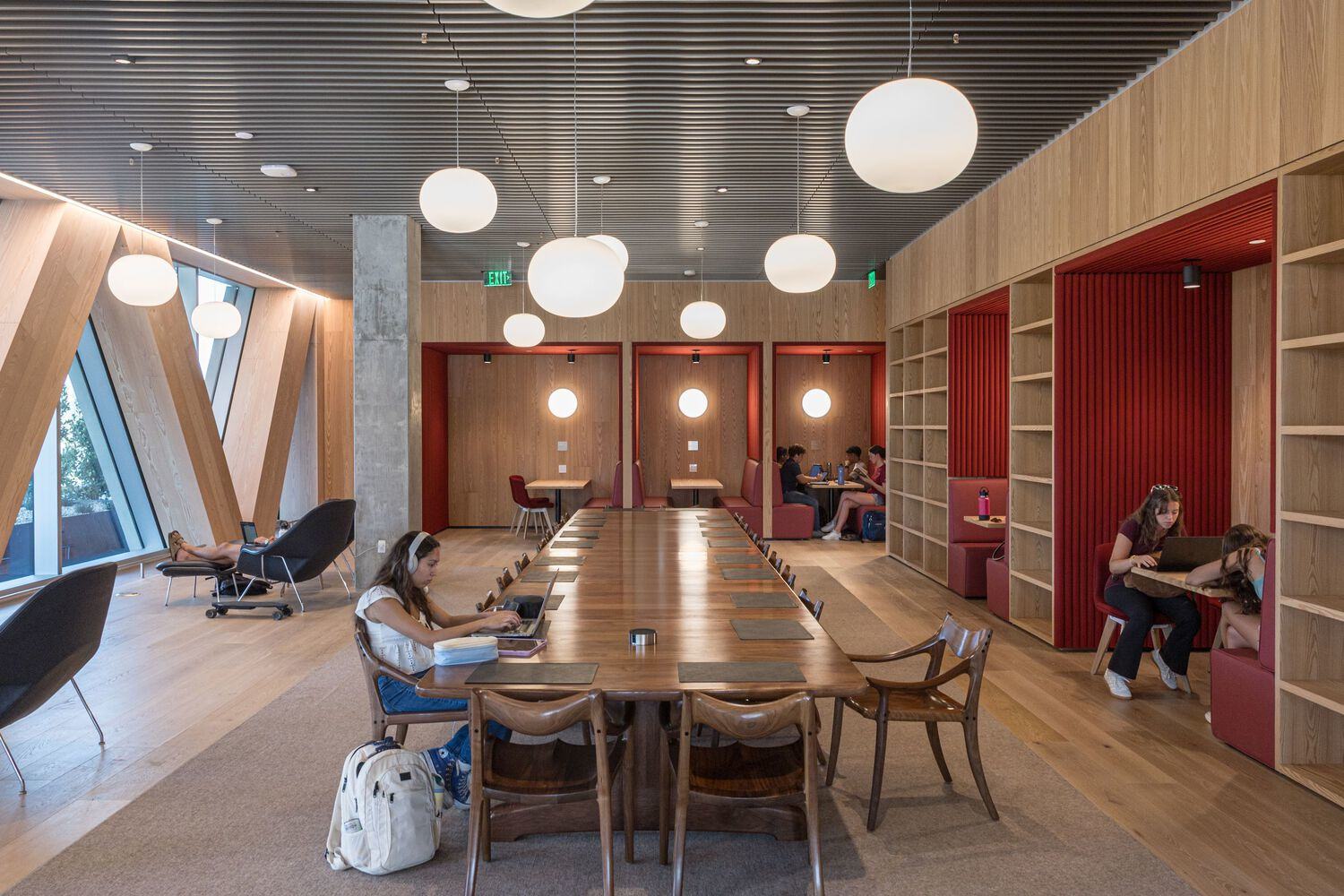
The first floor features the McElwee Forum (a large seminar space) and imaging studios, while classrooms, research areas, dry and wet laboratories, quantum libraries, and maker spaces are distributed on the upper floor. The classroom is arranged along the perimeter of the building, providing a picturesque landscape while also separating it from the atrium and social area below. Throughout the entire building, warm wooden finishes complement the concrete flooring and are embellished with the school's iconic red and gold tones. The interior space designed by BIG Architects aims to meet the needs of future scientific innovation, incorporating elements such as reconfigurable classrooms and modular seating. Eight outdoor rooftop terraces located around the corners of each "bar" building offer a 360 degree panoramic view of the mountains to the north, the campus to the west, and the sports venue area to the east. These multifunctional spaces are planted with native plants, which can be used as outdoor classrooms, as well as learning areas or social spaces. The Robert Day Science Center is committed to obtaining LEED Gold certification.
首层设有麦克尔维论坛(McElwee Forum,一个大型研讨空间)以及影像工作室,而教室、研究区域、干湿实验室、量子图书馆和创客空间则分布在上层。教室沿建筑周边布置,在提供如画景观的同时,又使其与下方中庭及社交区域分隔开来。整栋建筑内,温暖的木质饰面与混凝土地板相得益彰,并点缀着学校标志性的红金色调。BIG 建筑事务所设计的内部空间旨在适应未来科学创新需求,融入了可重新配置的教室和模块化座椅等元素。位于每座“条形”建筑转角周边的八处户外屋顶露台,可 360 度全景俯瞰北面的山脉、西面的校园以及东面的体育场馆区。这些多功能空间种植着本土植物,既可用作户外教室,也可作为学习区域或社交场所。罗伯特·戴伊科学中心正致力于获得 LEED 金级认证。
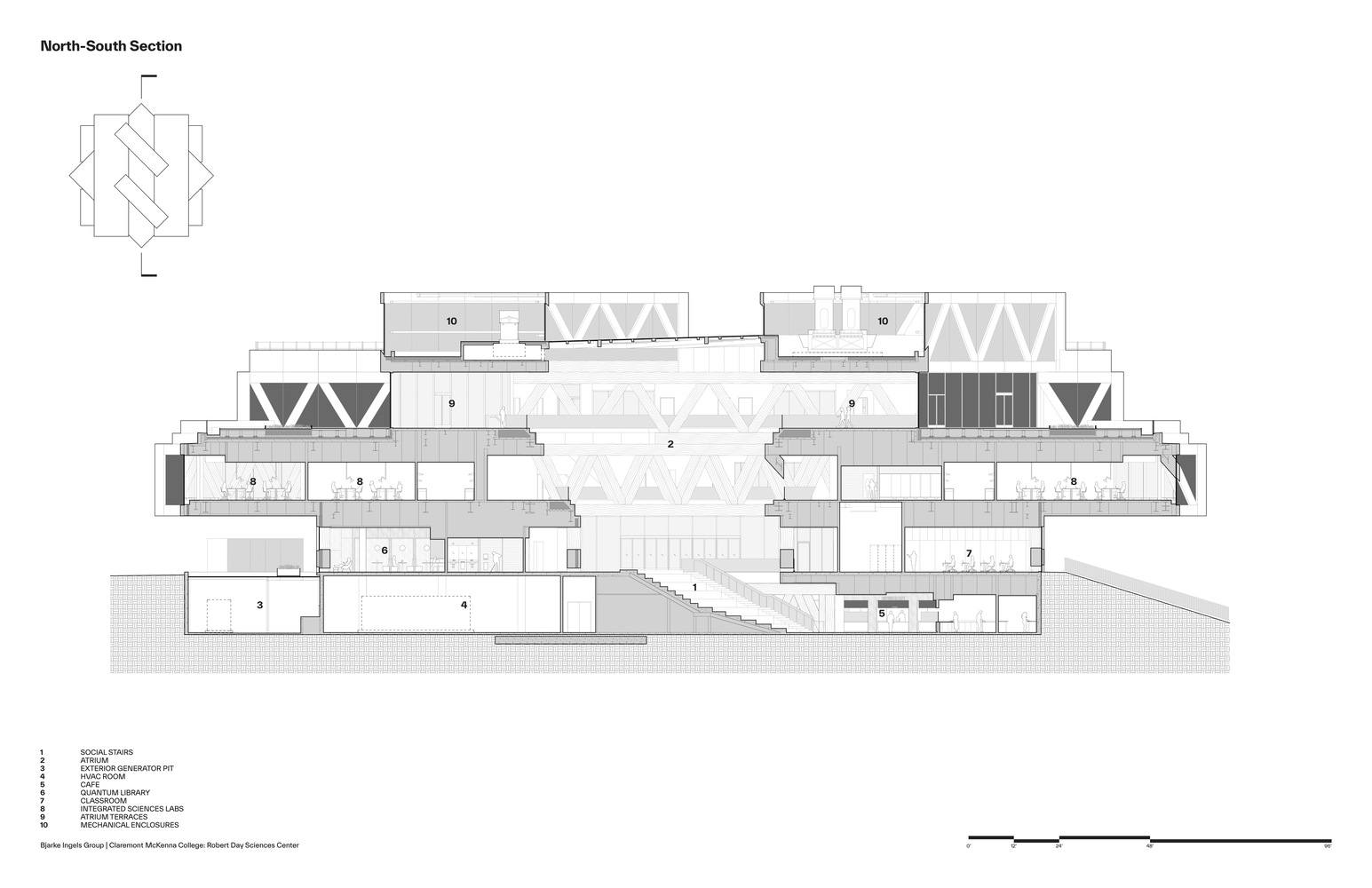
南北向剖面
The Robert Day Science Building is like a cleverly placed queen chess board, opening up a new path for campus development - it extends the north square, opens up a diagonal square, and opens up a passage to the Eastern Sports Campus. This building has grown in sync with our Los Angeles office and has become a common milestone for us - it is both the cornerstone of the campus architecture and a witness to the growth and transformation of our team as California architects. ——Leon Rost, Partner of BIG Architecture Firm
罗伯特·戴伊科学楼宛如棋盘上一枚落点精妙的女王棋,为校园发展开辟了新路径——它延伸了北侧广场,开启了斜向广场,并打通了通往东部体育校区的通道。该建筑与我们在洛杉矶的事务所同步成长,已成为我们共同的里程碑——它既是校园的建筑基石,也见证了我们团队作为加州建筑师的成长与蜕变。——BIG建筑事务所合伙人 Leon Rost
© Laurian Ghinitoiu
© Laurian Ghinitoiu
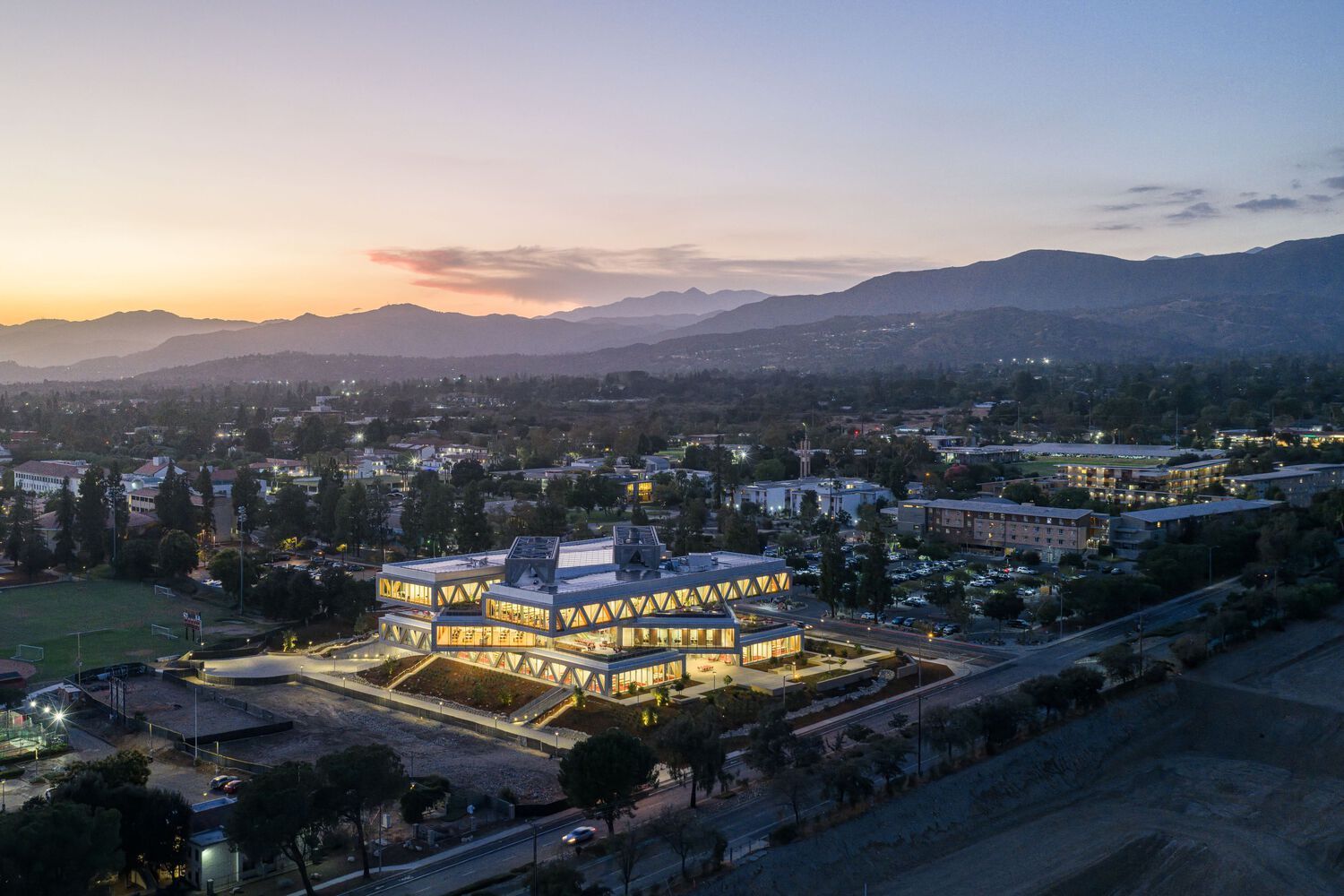
As day gradually turns into night, the Robert Day Science Center still shines like a lighthouse, gathering a torrent of scientific ideas, research, and innovation. Against the backdrop of the San Gabriel Mountains, this brightly lit building not only stands firmly at the eastern gateway of Claremont McKenna College (CMC), but also transforms the surrounding campus into a vibrant and inspiring place of exploration.
随着白昼渐入黑夜,罗伯特·戴伊科学中心依旧如灯塔般闪耀,汇聚着科学思想、研究与创新的洪流。在圣盖博山脉的映衬下,这座灯火通明的建筑不仅稳稳矗立于克莱蒙特·麦肯纳学院(CMC)的东部门户,更将周边校园转变为一个充满活力、启迪灵感的探索之地。
© Laurian Ghinitoiu